The return of The Thing: Artbook

thing-artbook.jpg

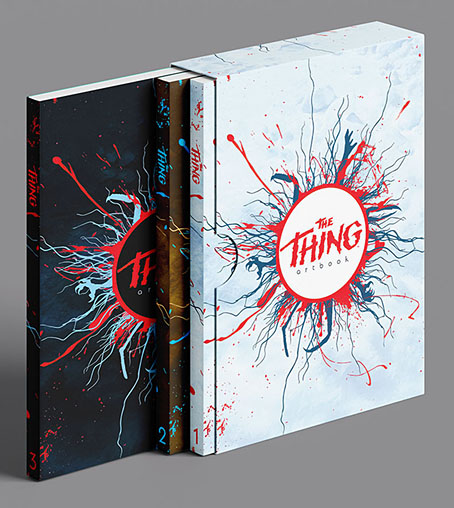
The most notable feature of the alien organism in John W. Campbell’s “Who Goes There?” is its physical mutability, a quality memorably expressed in John Carpenter’s film adaptation of the story, The Thing. Fitting, then, that The Thing: Artbook is due to be republished later this year in a new edition which adds fresh material to the original volume. I was one of over 350 artists asked to create personal responses to Carpenter’s film in 2016, the results of which were published by Printed In Blood as a heavyweight, large-format hardback. The new book will divide the original into a more manageable two-volume paperback set to which a third volume of fresh material will be added, with all three volumes being contained in a slipcase. The third volume will also be available as a standalone book. Pre-orders may be placed here.

For the reprint there’s the possibility of original contributors doing a new piece, a tempting idea but not something I have the time for at the moment. Last month I started work on a new series of book illustrations which I need to concentrate on even though I wouldn’t mind doing something new based on the film. Before the book was published I guessed that many of the artists would be working variations on favourite scenes or characters, an accurate prediction as it turned out. My own contribution was an attempt to depict some of the moments we don’t see, when transformations are taking place offscreen, but I also had a more complicated, poster-style design in mind which I never managed to work out to my own satisfaction. For now the idea will have to remain frozen in the conceptual ice.
thing-bantam.jpg

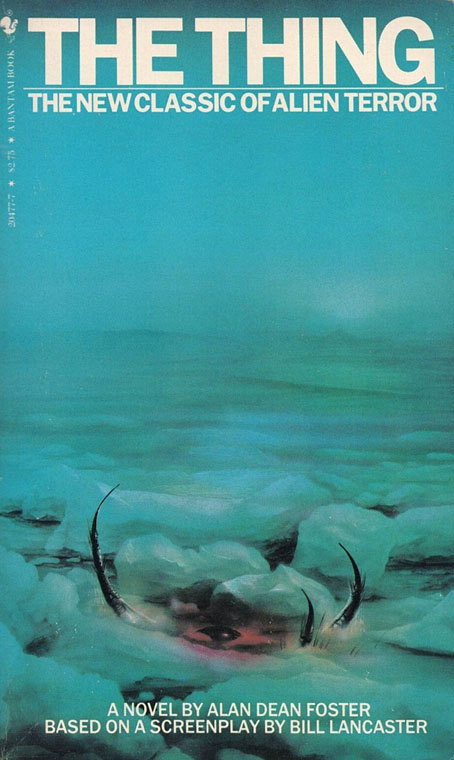
Before starting work on my own drawing I also read John W. Campbell’s story and looked for earlier depictions of his alien. One of the book covers that turned up was the Bantam paperback of Alan Dean Foster’s novelisation (above), a book with a better cover than the UK editions which recycled elements from the film posters. I couldn’t find an artist credit at the time but the cover art is by Jim Burns, a British illustrator best known for his depictions of spacecraft and futuristic technology. Looking for confirmation of his credit turned up a picture of the original painting which has a husky looking at the frozen alien. I can see why the art director wanted the dog removed—the cover is better with all the viewer’s attention drawn to those insectile legs—but Burns’ colour scheme is spoiled by the greenish tinge of the printed version. Ice is a difficult substance to paint well. If I was Burns I would have been a little annoyed that all those icy details had been lost.

Previously on { feuilleton }
The Thing: Artbook
The Thing Group Art Show
Things

Engulfed Cathedrals

debussy.jpg

La cathédrale engloutie by Claude Debussy. From Préludes pour Piano (1910).

La cathédrale engloutie performed by Daniel Barenboim.


escher.jpg

The Submerged Cathedral (1929) by MC Escher.


colquhoun.jpg

La cathédrale engloutie (1950) by Ithell Colquhoun.


richards.jpg

La cathédrale engloutie III (1960) by Ceri Giraldus Richards.


simon.jpg

La cathédrale engloutie (1968) by Luc Simon.


tomita.jpg

Snowflakes Are Dancing (aka Clair De Lune) (1974) by Tomita.

• Track 6: The Engulfed Cathedral (Preludes, Book 1, No. 10).


escape.jpg

Escape From New York (Original Motion Picture Soundtrack) (1981) by John Carpenter In Association With Alan Howarth.

• Track 4: Engulfed Cathedral.


sora.jpg

Re:Sort (2003) by Sora.

• Track 4: La Cathédrale Engloutie.


Previously on { feuilleton }
L’après-midi d’un faune
Hokusai record covers
Tomita album covers

Weekend links 745

kronberg.jpg

Eros (1905) by Julius Kronberg.

• At the Internet Archive (for a change): All 15 episodes (with English subs) of Návštevníci (The Visitors, 1983/84), a Czech comedy TV serial about time travellers visiting the present day. Directed by Jindrich Polák, better known for the serious science fiction of Ikarie XB-1 and another time-travelling comedy, Tomorrow I’ll Wake Up and Scald Myself with Tea. The main interest for this viewer is the involvement of Jan Švankmajer who creates collage animation for the first episode while animating food and other objects in later episodes. This was the period when Švankmajer was mainly working as an effects man at the Barrandov Studios after the Communist authorities had put a stop to his film-making. Even with Švankmajer’s involvement I’m not sure I can endure 450 minutes of Czech wackiness but it’s good to keep finding these things.

• “…for the melomaniac who wasn’t in and around Bristol in the 1980s or 90s, the term [trip hop] simply opens the door to a whole universe of music that blurs the lines between so many styles in a way that is still compelling three decades on.” Vanessa Okoth-Obbo on the 30th anniversary of Protection by Massive Attack.

• Coming soon from Strange Attractor: Moon’s Milk: Images By Jhonn Balance, compiled by Peter Christopherson & Andrew Lahman.

For some in Ireland, [The Outcasts] is a dim but impressive memory, glimpsed on late-night television during its only broadcast in 1984. The Outcasts over the decades became a piece of Irish cinema legend, less seen and more peppered into conversations revolving around obscure celluloid. The Irish Film Institute describes this film as “folk horror”, a phrase I find too liberally applied these days to just about anything featuring sticks, rocks, and goats or set in the countryside. The Outcasts does not necessarily strive for the ultimate unified effect of horror. Instead, this film is of a rarer breed, more akin to Penda’s Fen (1974) in its otherworldly ruminations. I’ve come to prefer the phrase “folk revelation” as perhaps a more accommodating description for these sorts of stories. Whatever the case, I hope you get to see this remarkable film.

Brian Showers discussing the contents of The Green Book 24, newly published by Swan River Press. The Outcasts has just been released on blu-ray by the BFI

Still casting a spell: Broadcast’s 20 best songs – ranked!

• New music: Earthly Pleasures by Jill Fraser.

• At Dennis Cooper’s: John Carpenter‘s Day.

• RIP Maggie Smith.

The Visitors (1981) by ABBA | Two Different Visitors (2003) by World Standard & Wechsel Garland | We Have Visitors (2010) by Pye Corner Audio

Weekend links 730

beardsley.jpg

Cover Design for ‘The Yellow Book’ Vol.I (1894) by Aubrey Beardsley.

• “[Dorian Gray’s] version of Decadence filled the popular imagination when Decadence became an ostentatiously stylish zeitgeist—stylish being the operative word. For Decadent style encapsulated the attitude of being hellbent on thrilling experiences.” The danger of Decadence is also its value. We need more of it, says Kate Hext.

• At Swan River Press: Of Wraiths, Spooks and Spectres. Robert Lloyd Parry, in an interview with John Kenny, talks about the researches that led to the compiling of his latest ghost-story collection, Friends and Spectres.

• The latest pictorial accumulation from DJ Food is a collection of late-60s concert posters by Jim Michaelson, an artist whose designs look like Mad magazine going fully psychedelic.

• Old music: Future Travel by David Rosenboom; new music: Taking Shasta Mountain (By Strategy) by John Von Seggern & Dean DeBenedictis.

• At Public Domain Review: Hunter Dukes on Rückenfiguren, views of the human back as a subject in the history of art.

• In a week when Adobe has been in the news for pissing off its users, a list of alternatives for Adobe software.

• At Spoon & Tamago: Hokusai-inspired erasers reveal Mt. Fuji the more they get used.

• At Unquiet Things: A celebration of Annie Stegg Gerard’s enchanting worlds.

• Mix of the week: DreamScenes – June 2024 by Ambientblog.

• At The Quietus: The Strange World of…Diamanda Galás.

Wraith (2002) by Redshift | El Wraith (2002) by Amon Tobin | Wraith (2015) by John Carpenter

Weekend links 686

bickus.jpg

The Great Lab (2020); speculative architecture by Gytis Bickus. “This room is where the majority of the hallucinogenic substances are archived, within the walls & floors. It seems as though the architecture itself is being affected by the hallucinogenic substances stored within its fabric.”

• “They ran the recording through a vocoder, so it sounded staticky, like a voice infused with white noise, and put it at the end of the song. Then they went home.” Mark Dent on Change The Beat by Beside (aka Bee-side or Beeside), a song produced by Bill Laswell & Michael Beinhorn that includes one of the most sampled vocal lines in hip-hop. A great piece of audio-archaeology: I knew the sample but had no idea this song was its source. I only got to hear the Change The Beat very recently when I found a copy of Materialism, a collection of early Laswell productions, in a charity shop.

• At Unquiet Things: Artist, Chemist, Goofball: Catching Up With Tyler Thrasher.

• DJ Food looks at psychedelic posters created for London’s Middle Earth club.

His last commissioned work for Radio Berlin was a fantastical play he had composed himself. The transcript, titled “Lichtenberg: A Cross-Section,” ranks among the strangest things that he ever wrote. Beings who live on the moon are charged with the task of investigating the career of Georg Christoph Lichtenberg, a prominent physicist of the German Enlightenment. The moon beings have uncanny names—Labu, Quikko, Sofanti, and Peka—and they convene as the Moon Committee for Earth Research, which deploys odd contraptions for its work, each of them “easier to use than a coffee grinder.” There is a “Spectrophone,” which permits them to hear and see everything that happens on Earth; a “Parlamonium” that translates human speech into music; and an “Oneiroscope” that allows the researchers to observe human dreams. With the aid of these devices, the moon beings seek to understand why humans are so afflicted with misery. Their investigations finally reach the tentative conclusion that even if humans are unhappy, “perhaps it is their unhappiness that allows them to advance.” To honour the scientific achievements of Herr Lichtenberg, they conclude by naming a crater in his honour, a crater from which shines a “magical light that illumines the millennium.”

Peter E. Gordon on Walter Benjamin’s radio years

• At Dennis Cooper’s: Spotlight on…Brigid Brophy In Transit (1968).

15 lighthouses from the Smithsonian Magazine Photo Contest.

Sathnam Sanghera’s favourite songs.

• RIP William Friedkin and Jamie Reid.

• New music: The Long Song by Drøne.

Lighthouse (1978) by Tim Blake | Walk To The Lighthouse (1980) by John Carpenter | The Lighthouse (1994) by Hector Zazou ft. Siouxsie