Sphinxes

sphinx09.jpg

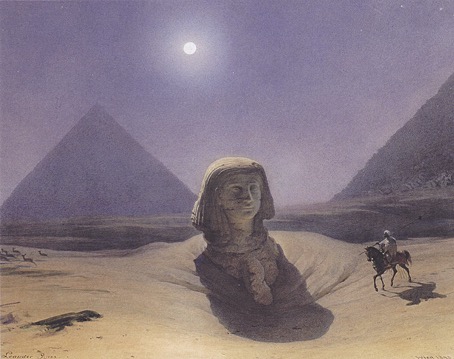
Bei den Pyramiden (1842) by Leander Russ.

A horde of sphinxes from NYPL Digital Collections and Wikimedia Commons, a pair of sites I was searching through last week. I was looking for a very particular kind of sphinx, not the Great Sphinx that sits near the Pyramids at Giza. What I wanted was something smaller and less ruined, like the sentinels that proliferated during the fads for Egyptian art and design in the early 1800s and the 1920s. My search was satisfied eventually, the results of which will be revealed in the next post.
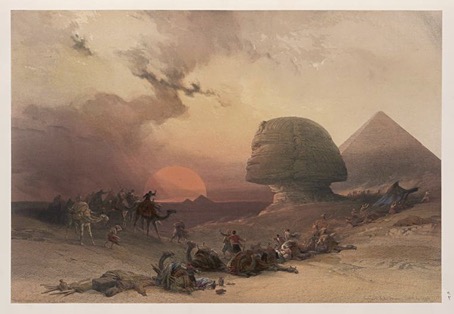
sphinx06.jpg

Approach of the Simoom. Desert of Gizeh (c. 1846–49) by David Roberts. 

As for the Great Sphinx, I enjoy seeing artistic representations of the monument, especially those which place the creature in a dramatic setting. Older depictions tend to look bizarre or even comical, especially the ones made during the centuries when the figure was little more than a head protruding from the drifting sands. The photographs I prefer are those that show the Sphinx in the 19th century before all the restorations began, when the creature was another half-buried fragment of antiquity, not something that seems to have just been removed from a box in a museum.
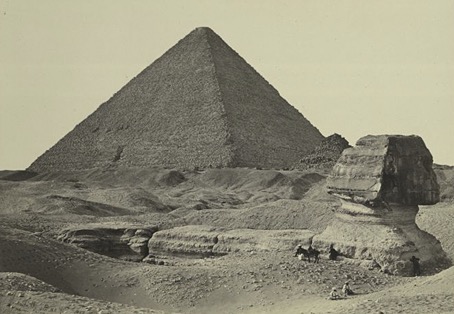
sphinx08.jpg

The Sphinx and Great Pyramid, Geezeh (1858–1859).
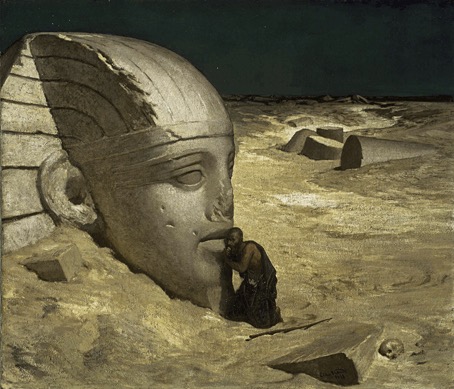
sphinx10.jpg

The Questioner of the Sphinx (1863) by Elihu Vedder.
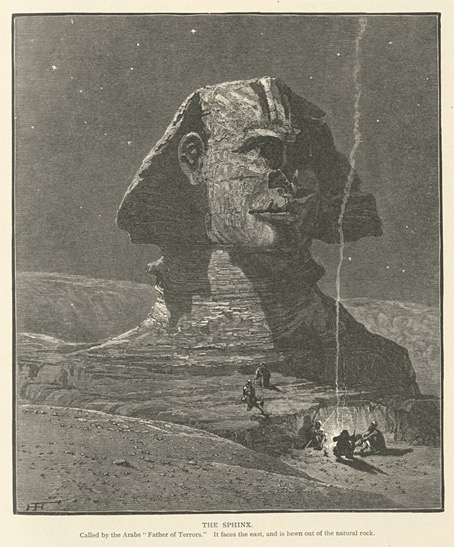
sphinx07.jpg

The Sphinx by Harry Fenn (1881–1884). “Called by the Arabs “Father of terrors.” It faces the east, and is hewn out of the natural rock.”

Continue reading “Sphinxes”

Eric Pape’s Arabian Nights

pape01.jpg

Eric Pape (1870–1938) was an American artist and illustrator who shouldn’t be confused with his contemporary Frank C. Papé, a Briton who was also a popular illustrator. Pape was more of a fine artist—he studied in Paris under Jean-Léon Gérôme—whose magazine illustrations are of that type that favoured realistic scenes using posed models. The illustrations in The Arabian Nights Tales of Wonder and Magnificence (1923) differ enough from his paintings to be taken for the work of another artist, the book being a substantial volume which Pape fills with many full-page ink drawings replete with stippling and detail.

pape02.jpg

The stories are a retelling by Padraic Colum with an eye to maintaining the flavour of the original (or older) texts. Books like this were aimed at a young readership but Colum begins with an introduction that describes the origin of the tales, and also weighs the pros and cons of the translations by Lane and Burton. In the stories he avoids simplifying the names of the more popular characters, so we have the six voyages of “El-Sindibad of the Sea”, and the tale of “Ala-ed-din” and his wonderful lamp. These gestures of fidelity are matched by Pape’s vignettes, many of are borrowed from Arabian or Persian sources. Pape had spent two years living and working in Egypt—his painting of the Sphinx by moonlight was a product of this period—a factor which may explain why he was offered the commission.

pape03.jpg

The pictures I’ve selected are mostly the full-page pieces which I’ve adjusted slightly to remove the grey tone of the paper. This copy of the book is a reprint from 1945, a period when print standards suffered from wartime restrictions. Older printings may be better.

pape04.jpg

pape05.jpg

Continue reading “Eric Pape’s Arabian Nights”

Inferni

inferno06.jpg

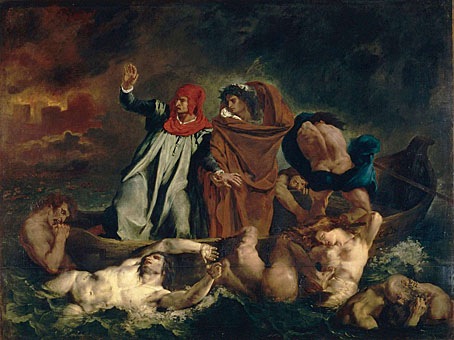
The Barque of Dante (1822) by Eugène Delacroix.

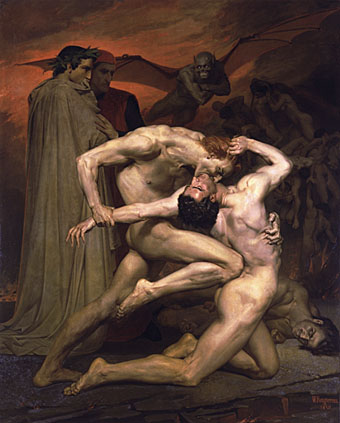
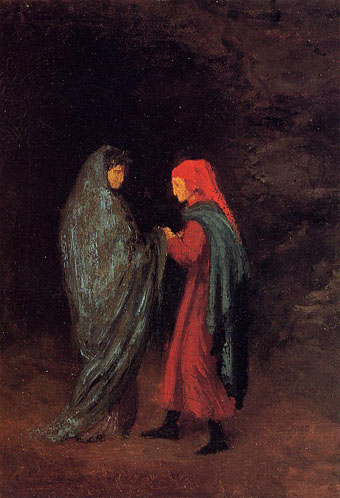
More infernal visions. Depictions of Hell aren’t exactly recent but the 19th century saw an increase in Dantean themes, helped, no doubt, by the Romantic taste for violent drama. There are many more such paintings, especially of the doomed lovers Paolo and Francesca whose plight is almost an artistic sub-genre. I’ve avoided the popular depictions by William Blake and Gustave Doré although the latter is represented below by a painting you don’t often see.

inferno03.jpg

Dante and Virgil in Hell (1850) by William-Adolphe Bouguereau.

inferno04.jpg

Dante and Virgil at the Entrance to Hell (1857) by Edgar Degas.

Continue reading “Inferni”

The Divine Sarah

bernhardt11.jpg

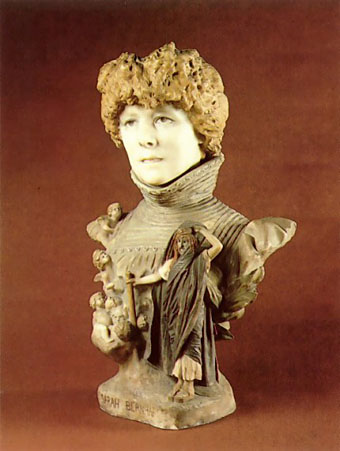
Sarah Bernhardt by Jean-Léon Gérôme (1895).

You can’t be a fin de siècle fetishist and not develop a fascination with actress Sarah Bernhardt, a woman who was muse to many of the era’s finest artists, most notably Alphonse Mucha, who she employed as her official designer. Mucha’s marvellous posters are endlessly popular, of course; less well-known is the sculpture by academic painter and Orientalist Jean-Léon Gérôme, a rare three-dimensional work inspired by the actress.

bernhardt2.jpg

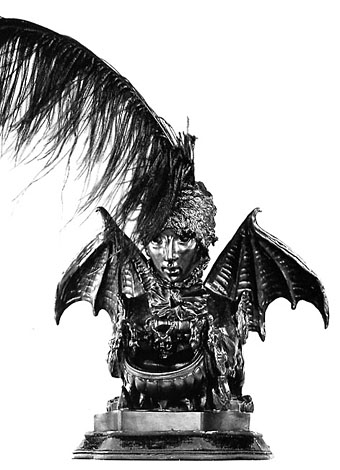
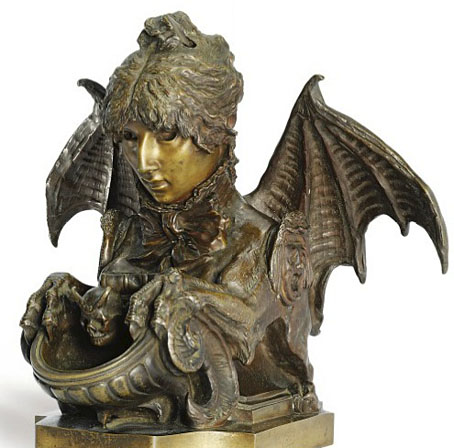
Inkwell by Sarah Bernhardt (1880).

Even less well-known is Ms Bernhardt’s own design for a curious bat-winged inkwell. I’ve read of her having created other sculptural works but so far this is the only one I’ve seen a picture of. With something as decadent as this you’d really have to use peacock quills for pens, wouldn’t you?

bernhardt4.jpg

bernhardt3.jpg

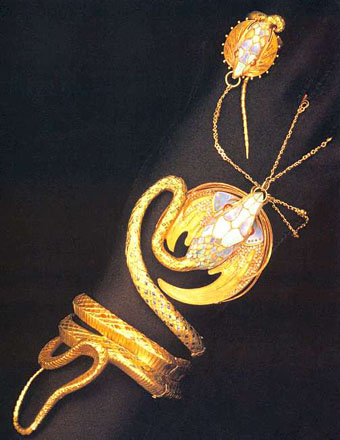
Bracelet by Alphonse Mucha & Georges Fouquet (1899).

And in a similar sinister vein to the inkwell there’s this serpentine bracelet and ring, a superb one-off, designed by Mucha and crafted by the jeweller Fouquet. After seeing works such as this and the Lalique dragonfly (which Ms Bernhardt once wore), most other jewellery seems timid and unadventurous in comparison.

Update: Added another photo of the inkwell.

Previously on { feuilleton }
The art of Philippe Wolfers, 1858–1929
Lalique’s dragonflies
Lucien Gaillard
Smoke
The Masks of Medusa