Elie Grekoff’s Tirésias

grekoff1.jpg

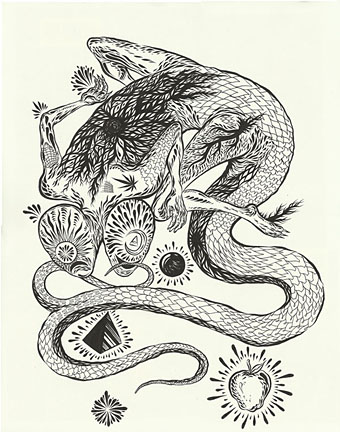
Elie Grekoff (1914–1985) is the illustrator, a Russian-born French artist. Tirésias (1954) is a short work of homoerotica originally published anonymously in an edition of 150. The Grekoff website describes the volume (via Babel Fish) thusly:

One of the most beautiful text of the homosexual literature, a work which circulated under the coat, and which was condemned by the courts in 1964 and which make also this work an extremely rare publication. Publication of 92 pages.

The author, Marcel Jouhandeau (1888–1979), apparently spent much of his life oscillating between licentiousness and guilt thanks to his Catholicism but nevertheless managed to produce an acclaimed piece of gay fiction. Us Anglophones have to take the acclaim on faith, however, since the story doesn’t yet appear to have been translated into English. Given the increasing interest in gay fiction past and present this is a surprising oversight but we can still appreciate Grekoff’s illustrations, a rather fine series of fifteen wood engravings. There was also an additional run of fifteen copies of the book containing five “refusées” prints.

grekoff2.jpg

Grekoff illustrated a variety of novels and poetry in different styles. His work for Tirésias is reminiscent of Jean Cocteau’s in its outline figures and especially the stars for nipples, the star being a recurrent Cocteau motif. Jouhandeau’s wife, Élisabeth Toulemont, was a friend of Cocteau’s so this may have been deliberate although it’s hard to tell either way given the scarcity of information.

The excellent Bibliothèque Gay should be commended for making these rare illustrations public. See the complete set here. At the same site recently was a substantial post about Jean Cocteau’s Le livre blanc (1930).
Continue reading “Elie Grekoff’s Tirésias”

Vaslav Nijinsky by Paul Iribe

iribe1.jpg

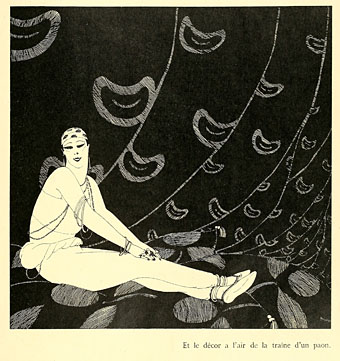
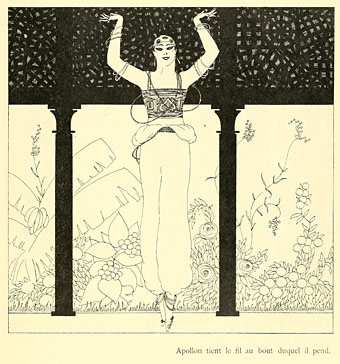
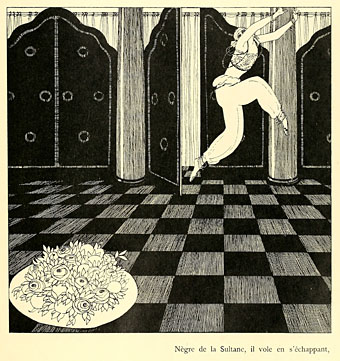
Another small and obscure volume hiding in the Internet Archive, Vaslav Nijinsky is a portfolio of six ink drawings by Paul Iribe (1883–1935) with a few lines of appended verse by Jean Cocteau. Iribe was a French designer and fashion illustrator who for a while was a member of the Ballets Russes circle, hence these depictions of the troupe’s most celebrated dancer. As post-Beardsley black-and-whites go these are pretty good although Iribe’s figures lack the requisite grace for their subject. If they were the only drawings of their kind that wouldn’t be so bad but one of Iribe’s contemporaries, George Barbier, produced his own superb series of Nijinsky drawings most of which can be seen here.

Note: the date given for this book at the Internet Archive is 1900 which seems quite wrong given that Nijinsky was still a young dancer in Russia at that time. Iribe’s drawings must date at least from 1910, maybe later.

iribe2.jpg

iribe3.jpg

Continue reading “Vaslav Nijinsky by Paul Iribe”

Weekend links 88

zarnowerowna.jpg

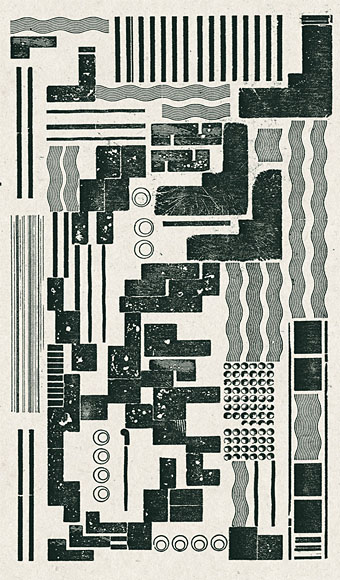
Typographic Composition (1924) by Teresa Zarnowerówna from a post about Polish graphic design at 50 Watts.

• “Direct action is a matter of acting as if you were already free… […] …the link between military and money systems remains the dirty secret of capitalism.” A lengthy and essential interview with “anarchist anthropologist” David Graeber, author of Debt: The First 5000 Years.

• “…it was after being told by an art director that he preferred her images of women to men that Toyin [Ibidapo] began to shoot boys in an attempt to prove him wrong. Something that Cult of Boys does perfectly.”

The pornographic imagination is deeply intertwined with the pain and horror of life. Some of that comes from our basic biological reality, which is unpleasant enough, and much of it comes from our social structures. Biological life has been completely degraded and continues to become more and more degraded in novel and more horrific ways, so it is inevitable that our horrible social structures – our schools, prisons, families, slaughterhouses and farms – become sites for the pornographic imagination.

Stephen Beachy discusses his novel, boneyard.

• “To my right is a wall bracket that, on closer inspection, turns out to be a human face made of porcelain fruits. The anteater rests on top of the television.” Jonathan Jones meets Jan Švankmajer.

Anselm Kiefer‘s new exhibtion at White Cube, London, takes its name and some inspiration from Fulcanelli’s alchemical exegesis, Le Mystère des Cathédrales (1926).

• Today (Sunday, 11th December) on Resonance FM at 8.00pm GMT, Alex Fitch talks to Alan Moore about HP Lovecraft and related matters.

Nick Hydra is putting all 112 issues of occult encyclopaedia Man, Myth & Magic online.

• Ira Cohen ‘s 1968 film The Invasion of Thunderbolt Pagoda is available again on DVD.

• Colleen Corradi Brannigan’s paintings of Italo Calvino’s Invisible Cities.

• “Margate’s a bloody toilet!” Can you handle The Reprisalizer?

• Bibliothèque Gay on Cocteau’s Le livre blanc (in French).

• Josie & the Pussycats in A Clockwork Orange.

Lovely Book Covers

Words With The Shaman (1985) by David Sylvian w/ Jon Hassell, Steve Jansen & Holger Czukay – I: Ancient Evening | II: Incantation | III: Awakening (Songs From The Treetops).

The recurrent pose 44

flandrin.jpg

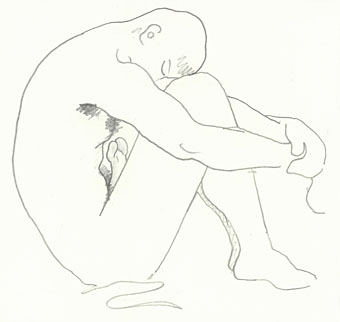
An item found in a collection of erotic drawings of dubious provenance, this piece is credited to Jean Cocteau. While I can’t be 100% certain it is Cocteau’s work it does closely resemble his other erotic drawings, and the rendering of the ear and hands is typical. Cocteau (or whoever) here does the obvious jokey thing with the Flandrin pose, something I’m surprised I haven’t seen already.

Elsewhere, Nathalie spotted a feature about the photography of Yannis Bournias which features another close variation as well as being gorgeous pictures in their own right.

Elsewhere on { feuilleton }
The recurrent pose archive

Previously on { feuilleton }
The writhing on the wall
Le livre blanc by Jean Cocteau
Cocteau’s sword
Cristalophonics: searching for the Cocteau sound
Cocteau at the Louvre des Antiquaires
La Villa Santo Sospir by Jean Cocteau

Weekend links 72

lesyeux.jpg

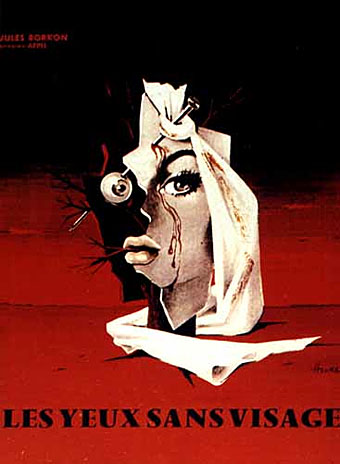
If Jean Cocteau had made a horror film it might have resembled George Franju’s dreamy and disturbing body-horror masterwork Les Yeux Sans Visage (1960). I’ve not been able to trace the artist for this poster but it’s a good example of the diluted Surrealism which was still prevalent in poster graphics at this time.

If I were asked what’s needed today, I’d say innovation, and greater timbral variety. If you truly want the audience to experience the clammy thrill of the grotesque, the uncanny and the fearful, you have to reach for the unfamilar, the perplexing, even the ugly; there’s an infinite Lovecraftian sound-world out there waiting to be explored. We need new combinations, new textures in film scoring. Horror has a licence to be weird – it’s supposed to mess with our heads. (more)

Stephen Thrower.

Stephen Thrower is an ex-member of Coil, a current member of Cyclobe, was the editor of a great magazine, Eyeball, devoted to horror cinema and what Kim Newman (casting about for a wider, non-generic label) calls “nightmare movies”, and is the author of Nightmare USA and Beyond Terror: The Films of Lucio Fulci. In other words, he’s more than qualified to write about horror film soundtracks. The reason is an event at the South Bank Centre, London, two weeks from now, Sound of Fear: The Musical Universe of Horror, one of the highlights of which will be a performance by John Carpenter’s soundtrack collaborator Alan Howarth. Related: my post about Italian horror soundtracks from 2008.

lovato.jpg

Art by Justin Lovato.

Mind Over Matter: Alan Fletcher’s The Art of Looking Sideways. “The Art of Looking Sideways captures the sensory overload of contemporary visual culture, while also acting as a primer in visual intelligence.” Related: Alan Fletcher profiled at the Design Museum.

• More music and more psychedelia: Past Present Future Space-Time “Wysing Arts Centre explores the legacy of psychedelia in this year’s annual music event”.

The Coilhouse International Silent Auction is GO and ends Sunday night if you want to bid for some rare and special things.

The Garden of Kama and Other Love Lyrics from India (1901), illustrated by John Byam Shaw.

• Chris Marker’s take on the recent London riots: Overnight.

• Bristol’s graffiti artists are redecorating the city’s streets.

• Women and knives: a Dario Argento poster gallery.

Inferno (1993) by Miranda Sex Garden, from their album Suspiria.