Magic Lantern: A Film about Prague

prague1.jpg

There are many documentary films about the city of Prague but Magic Lantern is the only one written and presented by playwright Michael Frayn. Very good it is too, a personal view of the city’s political and cultural history which takes in the usual names and subjects: Rabbi Loew and his Golem, Emperor Rudolf II, Rudolf’s alchemists, artists and scholars, photographer Josef Sudek, the ubiquitous Franz Kafka, puppets, automata, and so on. While Frayn discusses the Communist and post-Communist periods there’s a brief clip of Jan Švankmajer’s The Death of Stalinism in Bohemia.

prague2.jpg

Frayn’s film was directed by Dennis Marks, and broadcast in 1993 as part of the BBC’s long-running Omnibus strand. (There’s a further Švankmajer connection in the person of executive producer Keith Griffiths whose Koninck company produced this film at a time when they were also helping Svankmajer make his features.) Magic Lantern wasn’t the only film that Marks and Frayn made together, and not their first metropolitan essay either. Imagine a City Called Berlin (1974) is a portrait of the former capital of Germany during its Cold War isolation; there’s also The Mask of Gold: A Film about Vienna (1977), and Jerusalem: A Personal History (1984), all of which may be seen at The Dennis Marks Archive. My complaints about YouTube are copious enough to paper the walls of the Hradčany, but the site is at its best when it provides this kind of haven for television history that would be impossible to find elsewhere.

Previously on { feuilleton }
Le Golem, 1967
Gustav Meyink’s Prague
Stone Glory, a film by Jirí Lehovec
The Face of Prague
Josef Sudek
Liska’s Golem
Das Haus zur letzten Latern
Hugo Steiner-Prag’s Golem
Karel Plicka’s views of Prague
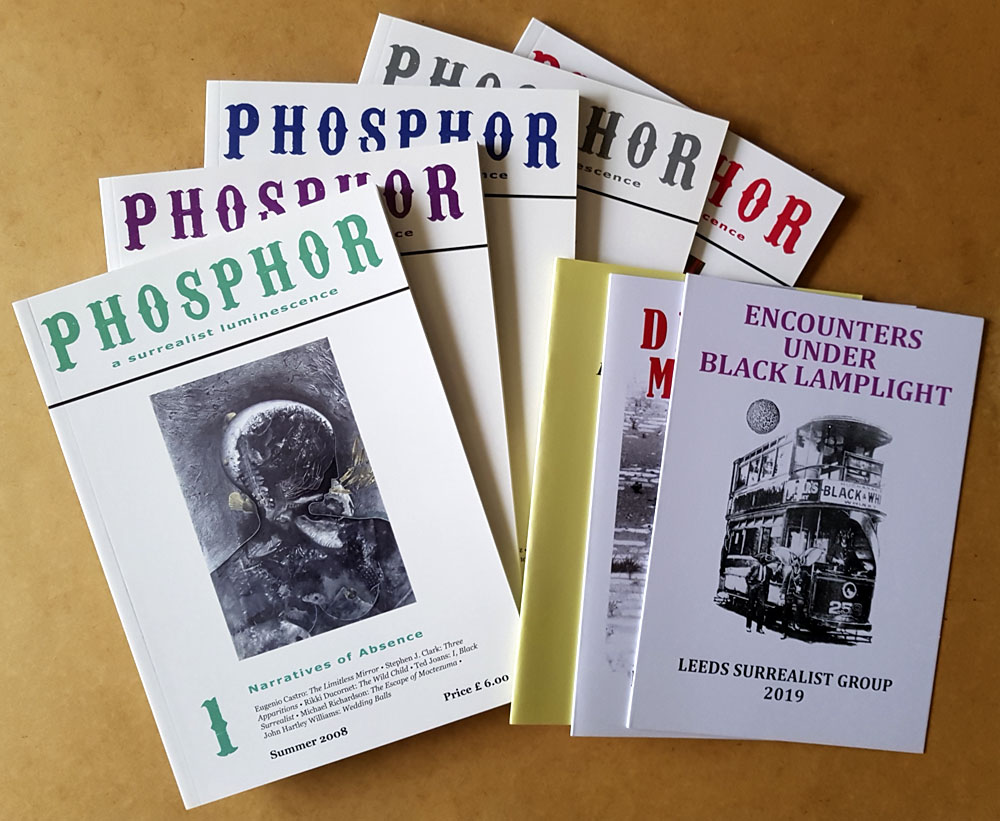
Phosphor: A Surrealist Luminescence

phosphor.jpg

In the mail this week, a living Surrealist journal from the Leeds Surrealist Group. I ordered the entire run of Phosphor and received a couple of bonus extras (thanks!). Among the contents, issue 3 has an interview with (and article by) the great Jan Švankmajer, there are various pieces about other Czech Surrealists, also an obituary for Franklin Rosemont in issue 2 with a photo that shows him meeting Bugs Bunny. If the last detail is perplexing, see the previous post.

Elsewhere on { feuilleton }
The Surrealism archive

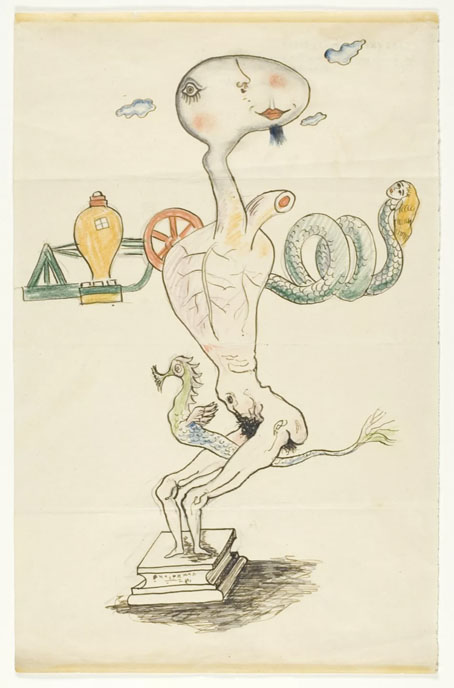
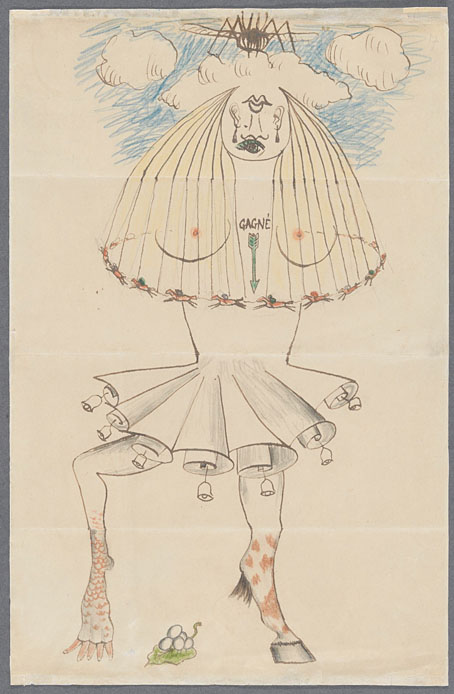
The exquisite corpse will drink the new wine

ec01.jpg

From One Dough (1996) by Martin Stejskal, Jan Švankmajer, Eva Švankmajerová.

From A Dictionary of Surrealism by José Pierre (Eyre Methuen, 1974):

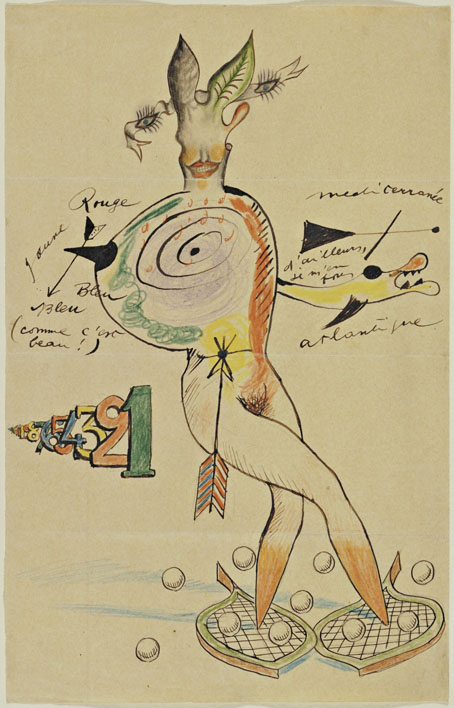
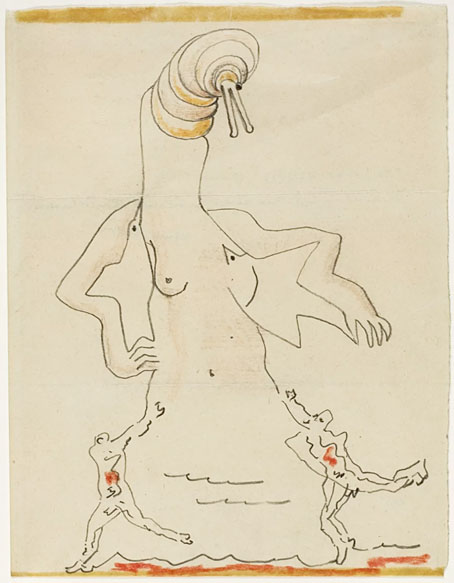
Exquisite corpse. The most famous of the surrealist games takes its name from the opening sentence that materialized: “Le cadavre—exquis—boira—le vin—nouveau” (1925) (The exquisite corpse—will drink—the new wine). It was produced by five players writing in turn subject, adjective, verb, object, complement, each folding over the paper so that the next player could not see what had been already written. The violent whiff of strangeness and the droll effects obtained by these verbal collages reappeared in the drawn “exquisite corpses” in which Surrealist poets and painters often combined. Despite the fact that each contribution—especially in the case of painters—is relatively identifiable, the total effect (mostly in the form of a “personage”) results from the combined elements. In this, the “exquisite corpse” can claim to have scored a victory for collective invention over individual invention and over the “signature”.

ec09.jpg

Nude (1926–27) by Yves Tanguy, Joan Miró, Max Morise, Man Ray.

ec04.jpg

Exquisite Corpse (1927) by André Masson, Max Ernst, Max Morise.

ec06.jpg

Exquisite Corpse (1928) by Man Ray, André Breton, Yves Tanguy, and Max Morise.

ec07.jpg

Exquisite Corpse (1928) by Man Ray, Max Morise, André Breton, Yves Tanguy.

Continue reading “The exquisite corpse will drink the new wine”

Forbidden reproductions

magritte2.jpg

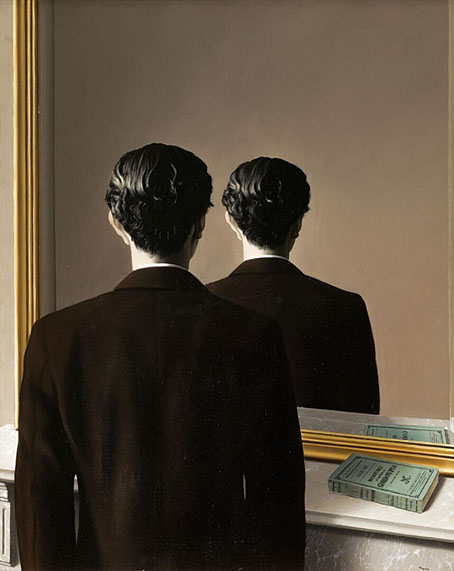
La Reproduction Interdite (1937) by René Magritte.

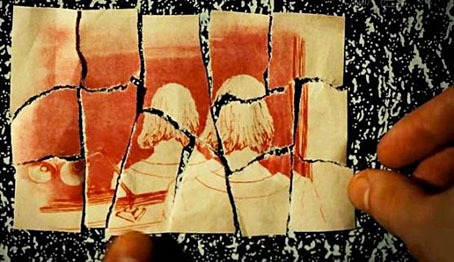
English translations of the title of Magritte’s painting vary, with Not to be Reproduced and Reproduction Prohibited being two of the most popular. I prefer Reproduction Forbidden, a title that sounds more serious, and with a use reinforced by Forbidden Games, the English title of a René Clement feature film, Jeux Interdits. Whatever the translation, this is one of Magritte’s most popular inventions, one that people like recreating.


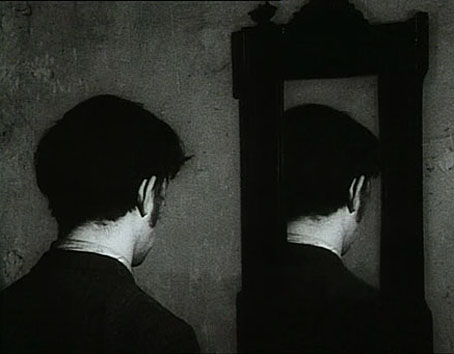
The Flat (1968).

flat.jpg

Jan Švankmajer’s short has more justification for copying the painting than some of the examples which follow. Švankmajer and Eva Švankmajerová were members of the long-running Prague Surrealist group, and The Flat is very much a Surrealist piece, with a man trapped inside a room where none of the mundane objects behave as he expects. In addition to the overt Magritte quote there’s an appearance by Švankmajer’s film-directing friend, Juraj Herz, as a bowler-hatted man carrying a chicken.


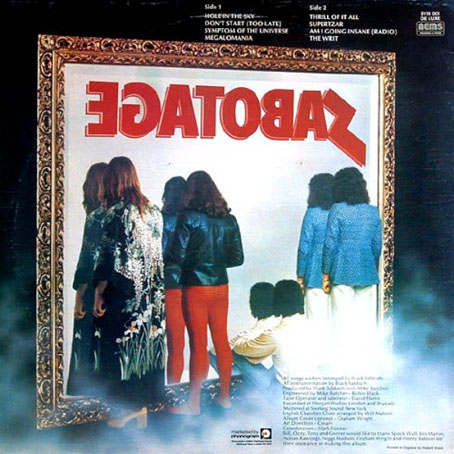
Sabotage (1975) by Black Sabbath.

sabotage.jpg

The front cover is the Magritte idea but with them all facing away from the mirror.


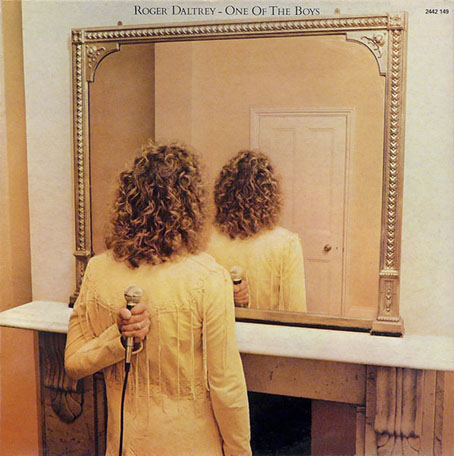
One Of The Boys (1977) by Roger Daltrey.

daltrey.jpg

One of the things that makes Magritte’s original work so well is the blank space in the mirror which directs attention to the impossible reflection. I suspect that if design group Hipgnosis had been asked to imitate the painting they would have done something similar, avoiding the lacklustre effect achieved here by photographer Graham Hughes. Hipgnosis acknowledged their own debt to Magritte in the title of their first book, Walk Away René in 1978, and often constructed whole sets for photo shoots. Hughes tried another Magritte-like effect for the back cover of the Daltrey album but with diminished success.


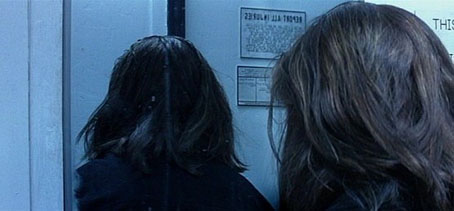
Dolores Claiborne (1995).

dolores.jpg

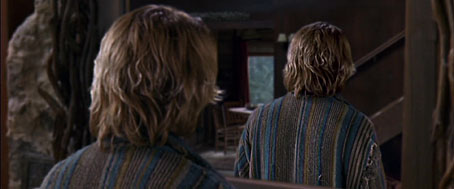
The following images are from films (and a TV series), two of which are coincidentally based on Stephen King stories. To date I’ve only seen Secret Window which isn’t one I’d recommend. Are there any more forbidden reproductions out there?


Secret Window (2004).

secret.jpg


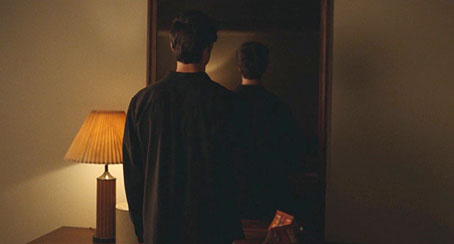
The Double (2013).

double.jpg


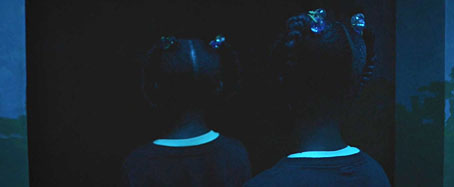
Us (2019).

us.jpg


Euphoria (2019).

euphoria.jpg


Update: Added Sabotage and Euphoria.

Elsewhere on { feuilleton }
The Surrealism archive

Previously on { feuilleton }
René Magritte, Cinéaste
Magritte: The False Mirror
Magritte, ou la lecon de chose
René Magritte album covers
Monsieur René Magritte, a film by Adrian Maben
George Melly’s Memoirs of a Self-Confessed Surrealist
The Secret Life of Edward James
René Magritte by David Wheatley

The Secret Adventures of Tom Thumb

tom1.jpg

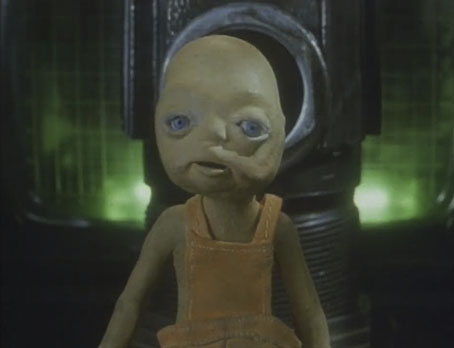
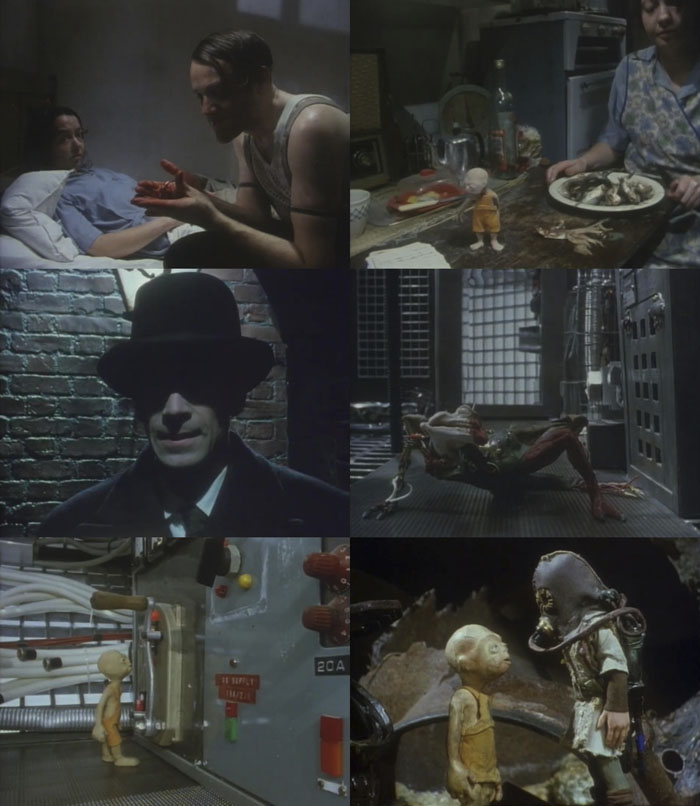
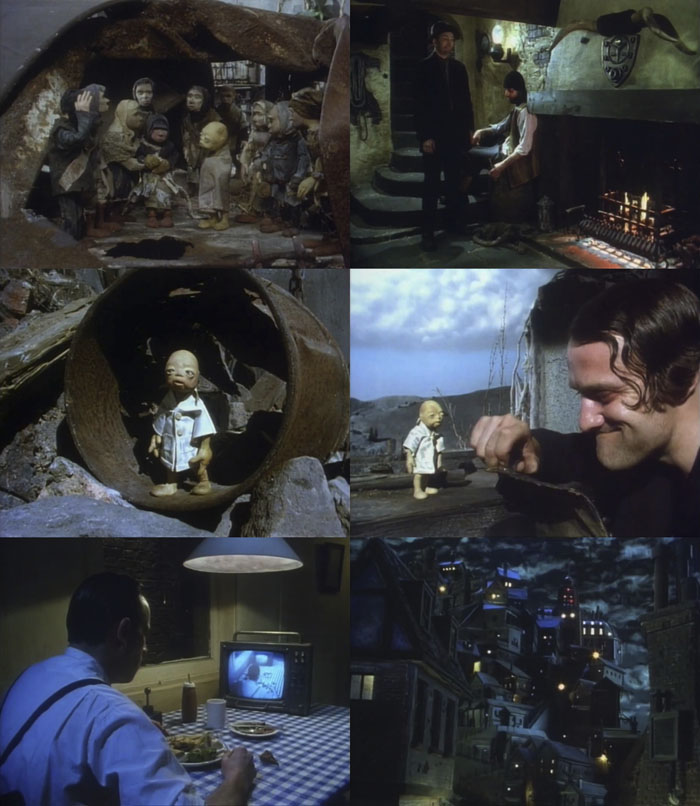
The dark fairy tale turns up often enough in animated film to be a genre of its own, a kind of mutant sibling to the more traditional fare which has been a staple of the medium as far back as Lotte Reiniger. The darkness is especially pronounced in The Secret Adventures of Tom Thumb, an hour-long film in which the tale of the tiny boy is combined with that of Jack the Giant-killer. In this version Tom is the product of an accident in an insemination plant, to which he’s returned after being kidnapped by sinister adults, and from which he escapes to join a community of miniature scavengers.

tom2.jpg

Dave Borthwick’s film owes nothing to the Tim Burton school of Goth fantasy. This is a queasily British take on the Tom Thumb story: kitchen-sink grotesquerie strained through Terry Gilliam’s Brazil and Jan Švankmajer’s savagery; biological experiments, toxic waste, sweating faces, spiders and insects everywhere. There must be more animated houseflies in this film than in any other before or since. The human characters are pixilated throughout, a technique which adds to their lumbering clumsiness while allowing them to blend with the animated figures and other details.

tom3.jpg

In the previous post I talked about Channel 4’s years of support for underground and experimental cinema. The channel was also a great supporter of animation in its first decade, helping fund films by Jan Svankmajer, the Quay Brothers and many others, as well as regularly screening the kind of child-unfriendly animation which is seldom shown on TV. Having not seen Dave Borthwick’s film since the 1990s I thought this might be another Channel 4 production but it was actually co-funded by the BBC, together with La Sept in France. The BBC’s involvement is surprising considering how weird and unpleasant the film is. The corporation had apparently commissioned a short for their Christmas schedule but turned down the results as unsuitable for the season. (The Christmas connection may explain the detail of a crucified Santa hanging on a wall.) They did, however, agree to help Borthwick and co. make this longer version of the story, a commendable decision that I doubt would pass today. Dave Borthwick died in October last year. His fellow animators regard The Secret Adventures of Tom Thumb as his best film. Watch it here.

Previously on { feuilleton }
The Magic Art of Jan Švankmajer
Jiří Barta’s Labyrinth of Darkness
The Web by Joan Ashworth
Jiří Barta’s Pied Piper