Cocteau’s sword

cocteau1.jpg

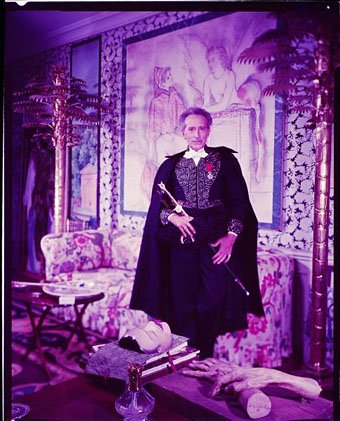
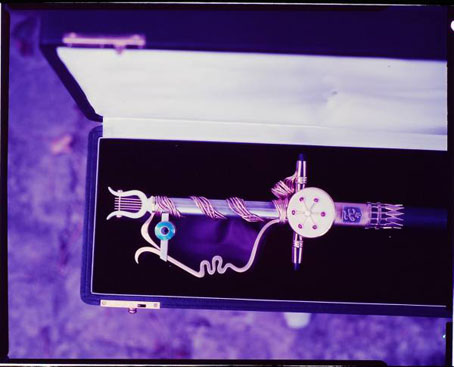
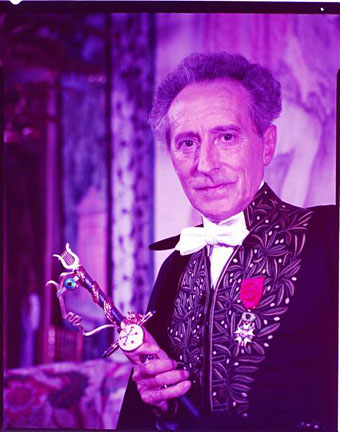
Jean Cocteau looking nothing less than fabulous in what I guess is 1955 since the writer is sporting his Académie française medal, an award bestowed upon him that year. The ceremonial sword is his own design, needless to say, and the curiously-tinted photographs are by Frank Scherschel for LIFE. The colours and lavish decor—those metallic palm trees—aren’t so far removed from the photographs of James Bidgood although the milieu certainly is. I doubt Cocteau would mind who the photographer was if Bidgood’s favourite model, Bobby Kendall, was in the picture with him.
cocteau2.jpg

cocteau3.jpg

Elsewhere on { feuilleton }
The men with swords archive

Previously on { feuilleton }
Cristalophonics: searching for the Cocteau sound
Cocteau at the Louvre des Antiquaires
James Bidgood
La Villa Santo Sospir by Jean Cocteau
Les Demi Dieux revisited

demidieux1.jpg

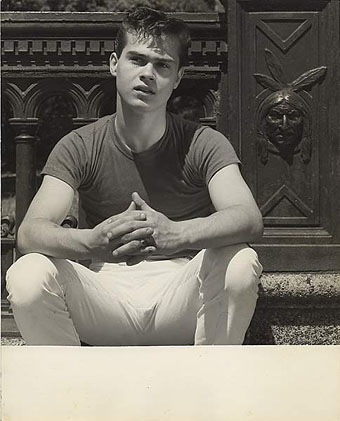
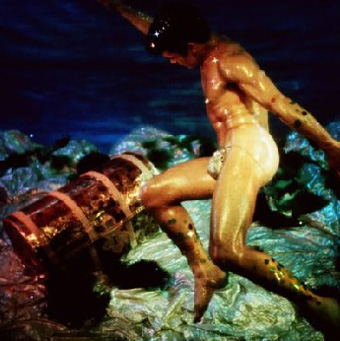
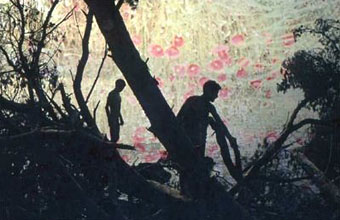
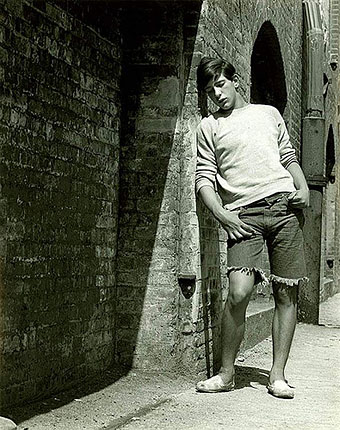
Watching the Kenneth Anger DVDs last week (which really are superb, by the way, and should be on the Christmas shopping lists of anyone interested in underground cinema) had me hunting around for more of the kind of period imagery one sees in his Scorpio Rising (1964) and Kustom Kar Kommandos (1965), imagery that’s erotic if seen with the correct eye (a gay one, naturally). The photos produced by Les Demi Dieux, a New York photographer of the Fifties and Sixties, correspond very much to the atmosphere in Anger’s films, not least because of the location, Scorpio Rising being filmed among the biker groups of Coney Island. I linked to a Flickr page showing some of these photos in March and since then this page has surfaced which sheds a bit more light on the still elusive history of these pictures.

demidieux2.jpg

Les Demi Dieux at Big Kugels

Previously on { feuilleton }
Relighting the Magick Lantern
Les Demi Dieux
James Bidgood
Kenneth Anger on DVD…finally

Exterface

exterface1.jpg

Situla—Fassbinder Homage.

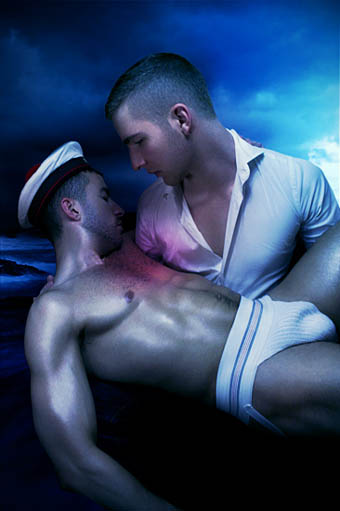
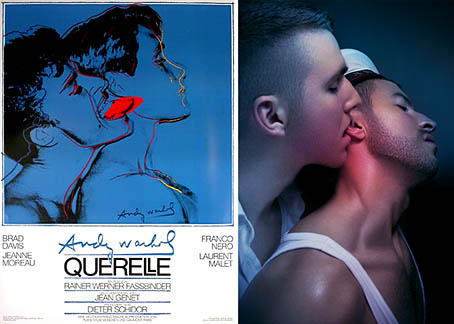
Two samples from a Querelle-themed series based on Fassbinder’s film of Genet’s erotic fantasy. Exterface is Julien and Stéphane in Paris whose luscious, saturated tableaux make them seem a contemporary equivalent of James Bidgood, while the picture below may have been referring to the poster Andy Warhol produced for Querelle.

Via MiamiGlen.

exterface2.jpg

Previously on { feuilleton }
Penguin Labyrinths and the Thief’s Journal
James Bidgood
Un Chant d’Amour by Jean Genet

Relighting the Magick Lantern

anger2.jpg

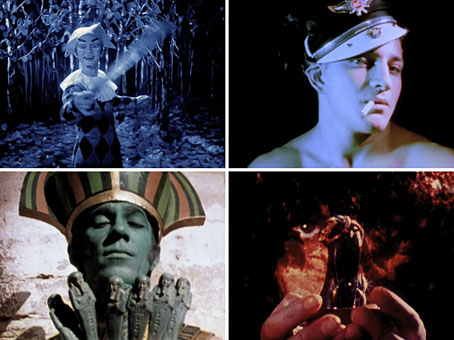
The first part of Kenneth Anger’s Magick Lantern Cycle appeared on DVD in a splendid edition from Fantoma earlier this year. The second and final part is due for release on October 2nd and you can see the mouthwatering trailer here.

This new set includes the Cocteau-esque Harlequinade, Rabbit’s Moon (1950); homoerotica, bikers and rock’n’roll in Scorpio Rising (1964); a hot rod, a blond boy in tight pants and the Paris Sisters crooning Dream Lover in Kustom Kar Kommandos (1965); magick ceremonies and Mick Jagger playing with a Moog synth in Invocation of My Demon Brother (1969); and Donald Cammell, Marianne Faithfull, Egypt, volcanoes, Aleister Crowley, an orange UFO and a great score from Bobby Beausoleil in the miniature epic, Lucifer Rising (1982).

The Magick Lantern Cycle is a great work of cinema that’s suffered from shoddy presentation on previous video releases; Fantoma have given these films the care and attention they deserve. If you haven’t seen them yet, you’re in for a treat.

Previously on { feuilleton }
James Bidgood
Kenneth Anger on DVD…finally
Un Chant d’Amour by Jean Genet

The Male Gaze

male_gaze1.jpg

Trunk (Jay Garvin) by James Bidgood (early 1960s).

The Male Gaze is an exhibition at the powerHouse Arena,
Brooklyn, NYC, from April 20th–May 27th, 2007.

male_gaze2.jpg

Untitled by Raymond Carrance (aka Czanara) (1960–70).

Sullen burger boys meet the effete cognoscenti in The Male Gaze: a group show including over 20 artists whose cultural explosions have rocked foundations across the world. With work spanning over 100 years of bloodless revolution, The Male Gaze features contemporary artists and their classic antecedents reinventing themselves, their world, and their media in savvy, bawdy, dreamy, and terrifyingly new ways. Artists include Stephen Andrews, Gio Black Peter, James Bidgood, AA Bronson, Raymond Carrance, Robert Filippini, Andrew Harwood, Christian Holstad, Scott Hug and Michael Magnan, Brian Kenny, Bruce LaBruce, Qing Liu, Ryan McGinley, Futoshi Miyagi, Slava Mogutin, J. Morrison, Will Munro, Joe Ovelman, Paul P., Jack Pierson, Ezra Rubin, Paul Mpagi Sepuya, Lionel Smartly, and Wilhelm Von Gloeden.

male_gaze3.jpg

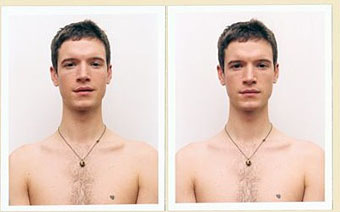
Two revisited portraits of John by Paul Mpagi Sepuya (2004).

The NYT interviews some of the artists

powerHouse Arena
37 Main Street
Brooklyn
NY 11201

Elsewhere on { feuilleton }
The gay artists archive