Welles at 100

welles.jpg

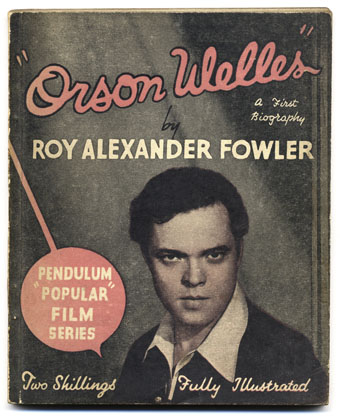
Orson Welles: A First Biography (1946) by Roy Alexander Fowler.

Happy birthday, Orson. The premature celebrity biography is nothing new, as this small volume from the Coulthart library demonstrates. Welles was only 31 in 1946 but was already the director of three feature films. If I’m less of a Welles obsessive today it’s because many of the films and radio plays that were once inaccessible can now be easily seen and heard, although a handful of unfinished projects still wait in the wings. The following is a selection of some favourite Wellesiana, old and new.

• The Mercury Theatre On The Air: Recordings of Welles’ theatre troupe at the Internet Archive and at the dedicated website. The Mercury production of The War of the Worlds is the essential one, of course, but I’m also partial to their production of Dracula which featured Agnes Moorehead playing Mina Harker, Welles as the Count, and a suitably spooky score by Bernard Herrmann. The production of Around the World in 80 Days was later expanded by Welles into an ambitious (and expensive) stage musical in collaboration with Cole Porter.

The Night America Trembled (1957) is a TV dramatisation of the alarmed reaction of some Americans to the War of the Worlds broadcast. Presented live by Ed Murrow, the drama features Warren Beatty, James Coburn, Warren Oates, and Ed Asner (who later presented the BBC’s RKO Story). Closer to Welles is The Night That Panicked America (1975) a TV movie recreation of the original broadcast with Paul Shenar as the director.

Newsreel footage of the final scenes of the so-called Voodoo Macbeth from 1936. As part of the WPA program to return Americans to work, Welles directed an all-black cast with the action of the play moved to Haiti. As usual, Welles wasn’t afraid of rearranging the Bard’s words, and this staging ends with the same lines as his 1948 film version: “Peace! The charm’s wound up.”

• My favourite Welles book is still This is Orson Welles (1992), a collection of Peter Bogdanovich’s interviews edited by Jonathan Rosenbaum. Bogdanovich’s interview tapes can be heard at the Internet Archive.

Orson Welles’ Horrorshow: Colin Fleming on Welles’ Macbeth, “the horror film no one likes to call a horror film”.

Peter Bradshaw on Citizen Kane and the meaning of “Rosebud”.

Six actors who have played Orson Welles onscreen

Previously on { feuilleton }
The Fountain of Youth
The Complete Citizen Kane
Return to Glennascaul, a film by Hilton Edwards
Screening Kafka
The Panic Broadcast

More Alberto Solsona

solsona01.jpg

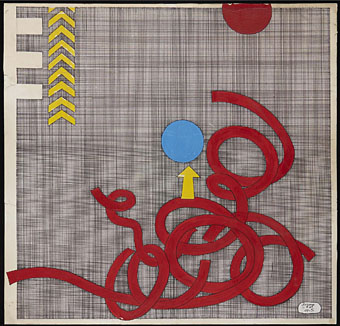
Opus 5 (1968).

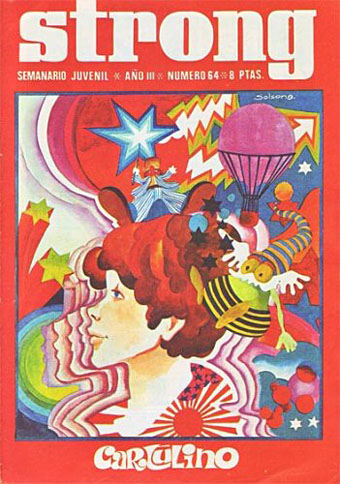
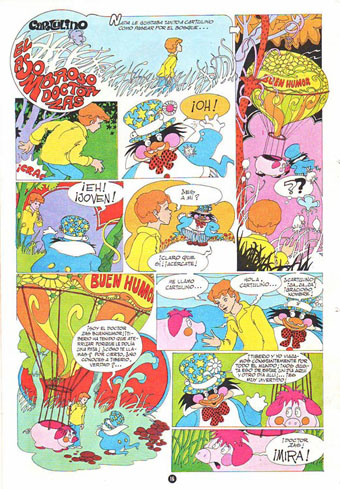
It’s dismaying to learn that Alberto Solsona, the creator of the wonderful Agar-Agar, was only 41 when he died in 1988. It’s also a little disappointing to discover that his work for comics is the least part of an artistic career begun in the late 1960s; I’d been hoping there might be other work in the same style. Solsona’s early paintings are very much in the Pop Art sphere which makes them more attractive to me than his later shift into a form of Abstract Expressionism. Between painting he was working as a book illustrator and a comic artist in magazines for children. Among the examples of the latter the page from Strong (1971) is the closest to Agar-Agar, unsurprisingly when they both date from the same period. This museum page has examples of many more paintings and prints.

solsona02.jpg

Strong (1971).

solsona03.jpg

El asombroso doctor Zas (1971).

Solsona also had a humorous strip about King Arthur in Strong but I prefer the drawing style in this one, yet another example of the diluted psychedelic graphics that filtered into children’s stories in the early 70s. (See this post.)

solsona04.jpg

Símbolos (1971).

Not very surprising seeing American symbols mixed with swastikas—the war in Vietnam provoked many such responses—but I wonder how much of a risk it was to do the same with the Spanish flag when the Franco regime was still in power. This painting also refers to Superman, a character that Agar-Agar takes a dig at.

Continue reading “More Alberto Solsona”

More Esteban Maroto

maroto05.jpg

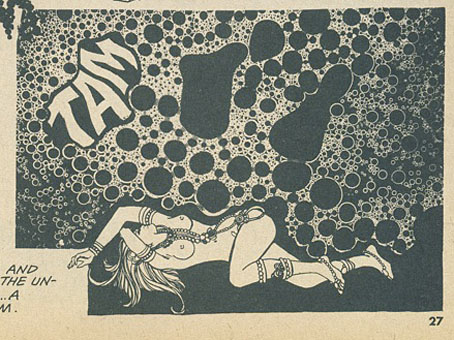
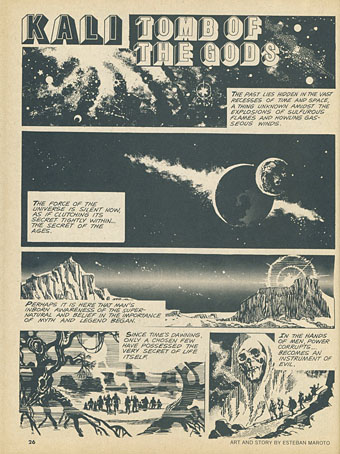
Psychedelic Kali from Vampirella 18.

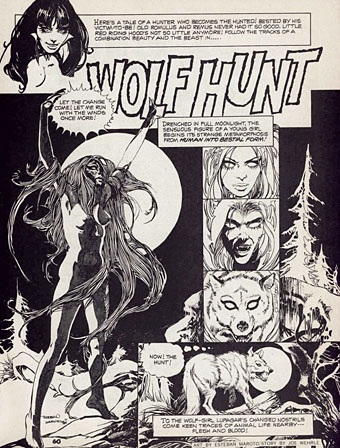
Copies of the Dracula comics may be scarce these days but two of the artists who appeared in the title—Esteban Maroto and José Beá—were also appearing regularly in Vampirella around the same time. The Internet Archive has a large collection of Warren titles including an almost complete run of Vampirella. Esteban Maroto’s work stands out for me for his draughtsmanship, his page layouts, the atmosphere of heady eroticism, and the frequent touches of psychedelia of which the panel above is one of the more striking examples. The best strips are the ones he wrote himself; when he works with American writers the results tend to be more restrained. It’s a shame Vampirella was mostly a black-and-white title, so many of these pages would benefit from the same colour treatment as Wolff.

maroto01.jpg

Wolf Hunt from Vampirella 14.

And speaking of wolves, there’s a similar collection of witches and lycanthropes in these stories.

maroto02.jpg

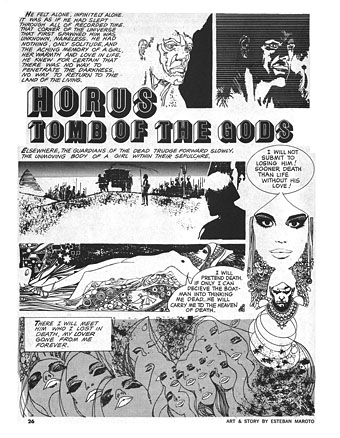
Tomb of the Gods: Horus from Vampirella 17.

Tomb of the Gods is a short series in which mythological stories are explored Maroto-style. The exception is Gender Bender, a piece of science fiction with masculine and feminine psyches pitted against each other in a virtual arena. The story title is a surprise for anyone thinks that phrase originated in the 1980s.

maroto03.jpg

Tomb of the Gods: Kali from Vampirella 18.

Continue reading “More Esteban Maroto”

The Dracula Annual

wolff1.jpg

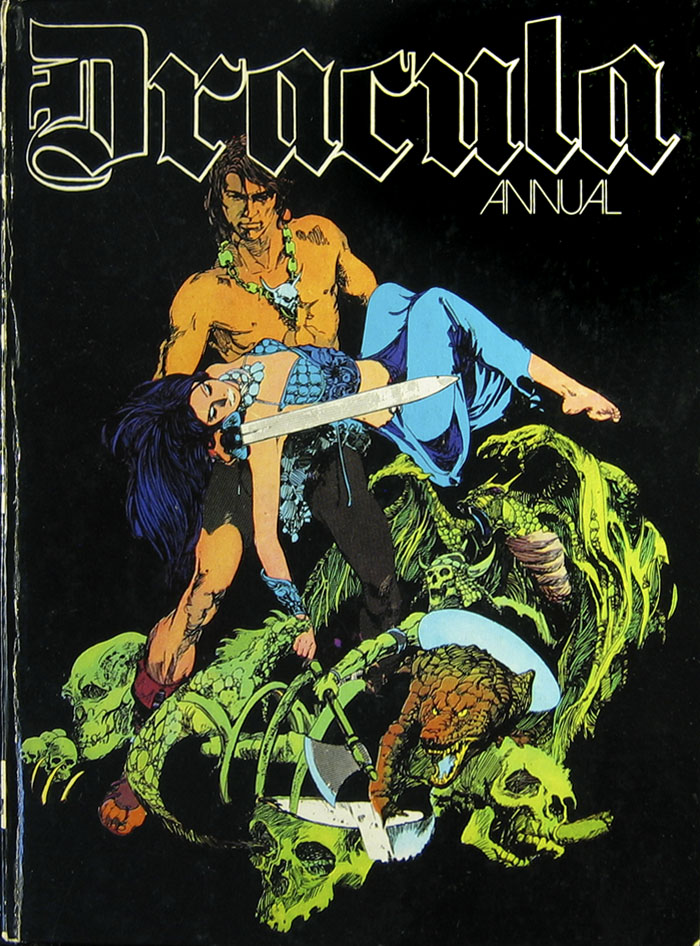
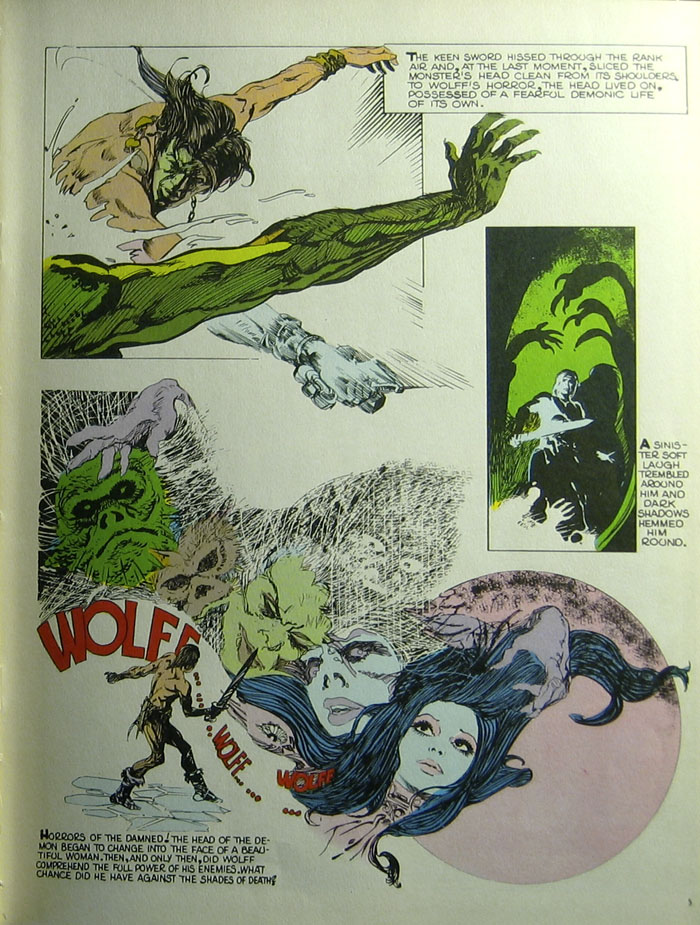
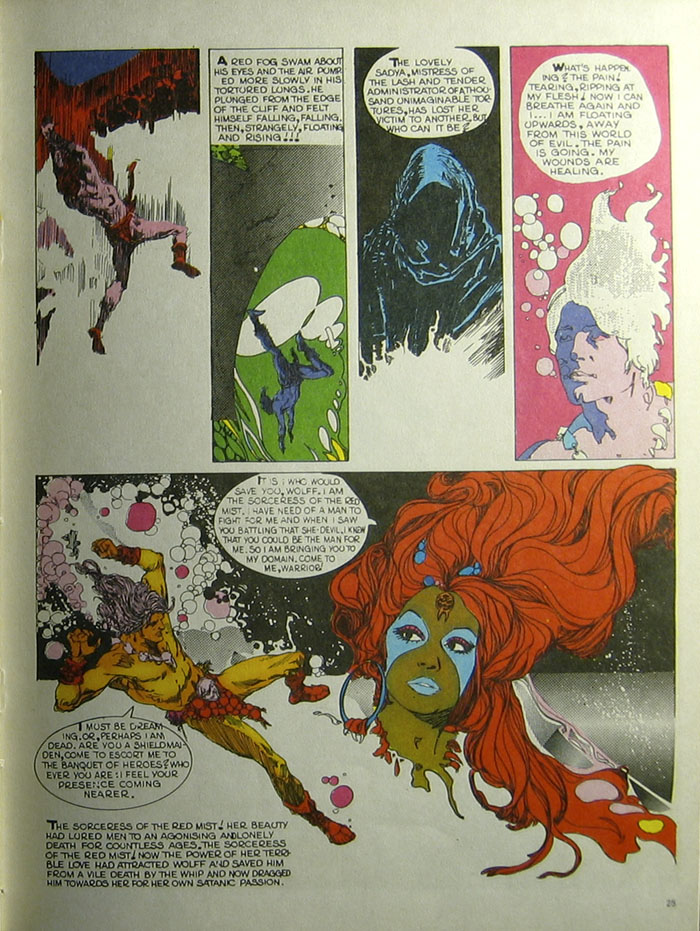
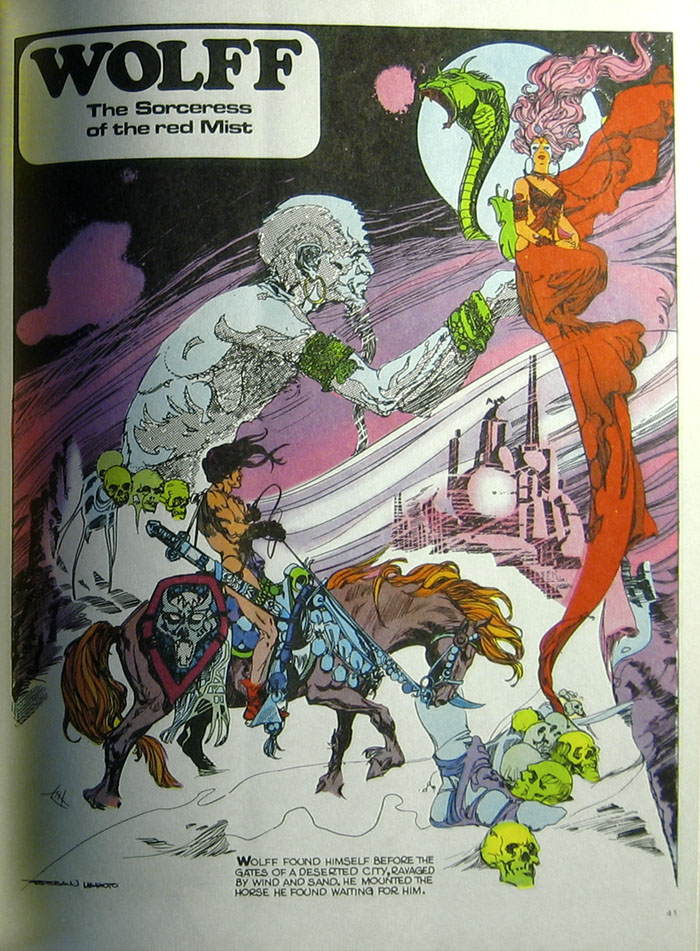
A comment by Modzilla in last month’s post about psychedelic comic book Saga de Xam is responsible for this recent book purchase. Dracula was a full-colour large-format comic book from notorious pulp imprint New English Library (later to be distributors for my colleagues at Savoy Books) that repackaged Spanish horror strips for a British audience. The comic ran for 12 issues in the early 1970s; the pages shown here are from the hardback annual that gathered all the issues into a single volume. I remember this being around in secondhand shops for years but I never paid it any attention at all so the artwork has been a revelation.

NEL’s Dracula isn’t much of a horror comic, despite its title; Dracula himself only appears in one story, and that’s a jokey throwaway piece. The two main episodic strips are Wolff, a Conan clone searching for his lost wife in a world ravaged by witches, werewolves and other supernatural threats; and Agar-Agar, a deliriously psychedelic picaresque concerning a hyper-sexual “sprite” (or a hippyish young woman with blue hair and magic powers) from the planet Xanadu. Everything in the book is redolent of the early 1970s when strains of psychedelia were still percolating through pop culture. Watered-down psychedelia used to bore me because I wanted the authentic stuff but forty years on this kind of work is much more attractive.

wolff2.jpg

Wolff is the work of Esteban Maroto whose splash pages and inventive layouts give Barry Windsor-Smith’s Conan the Barbarian (which was running at this time) some serious competition. Wolff is very much in the Conan mould—he even shouts “Crom!” at crucial moments—a pawn of supernatural forces he often fails to comprehend. The artwork in Smith’s Conan was often praised for its details and decor but the Art Nouveau influence in Maroto’s work is much more overt. Maroto’s flame-haired witches are like Alphonse Mucha sirens—one panel even borrows from Mucha’s Salammbô—and he’s no slouch with the Frazetta-like demons either. The scripting is perfunctory but I don’t mind that when it turns up pages like these. There’s also a brief nod to Lovecraft when “R’Lyeh” is mentioned.

wolff3.jpg

wolff4.jpg

Continue reading “The Dracula Annual”

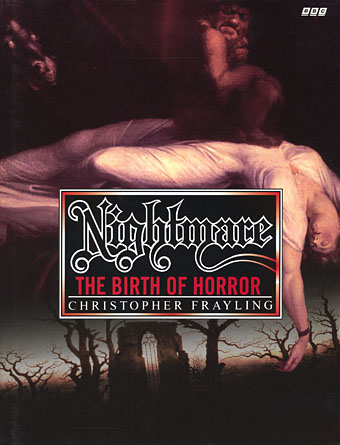
Nightmare: The Birth of Horror

frayling.jpg

Nightmare: The Birth of Horror (1996): Dracula (and Louis Jourdan again).

Christopher Frayling, like Marina Warner, is that rare thing: a British academic with an enthusiasm for popular culture, and a talent for communicating that enthusiasm to a general audience. Both writers also have more than a passing interest in the darker areas of fiction, whether that means Gothic romance or contemporary horror films. One of Frayling’s first books was The Vampyre: Lord Ruthven To Count Dracula (1978); the same year he contributed an excellent Lovecraft essay, Dreams of Dead Names, to George Hay’s The Necronomicon: The Book of Dead Names, one of the two Necronomica published in the 1970s (three if you count Giger’s art book). Frayling’s essay, and another by Angela Carter are among the highlights in Hay’s curious volume.

frayling2.jpg

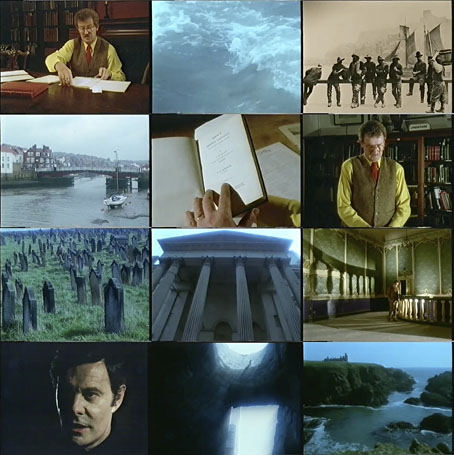
Nightmare: The Birth of Horror was both a book and a television series produced by the BBC in 1996. The year before, Frayling had written and presented Strange Landscape, an examination of the culture and philosophy of the Middle Ages. Nightmare looks at the creation of four British horror novels: Frankenstein, Dracula, The Strange Case of Dr Jekyll and Mr Hyde, and The Hound of the Baskervilles. Two of these stories—Frankenstein and Jekyll and Hyde—were famously the product of nightmares so Frayling stretches this coincidence to include the others; I’m still not sure the case is properly made for Bram Stoker but it hardly matters.

Another aspect of Frayling’s thesis is the extraordinary power of these works, all of which have had a lasting global influence. The book is naturally more detailed than the TV series, delving into the fiction for the subtexts that contribute to the power of the stories. The Dracula section is a tour-de-force of condensed information, sketching a history of fictional vampires then looking at Stoker’s career as assistant to actor Henry Irving, a man whose outsize personality was an inspiration for that of the vampiric count. There’s also some interesting speculation about Stoker’s sexuality; a letter he wrote to Walt Whitman is (to borrow a phrase from Sherlock Holmes)…suggestive. The rest of the chapter looks in detail at the slow creation of the novel. In the TV series what you lose in the literary specifics you gain in visits to some of the locations mentioned in the story, so for Dracula that means windswept Whitby on the Yorkshire coast. The same applies to the other novels: for Frankenstein there’s a visit to the Villa Diodati on the shore of Lake Geneva, a journey to Dartmoor for Hound of the Baskervilles, and so on.

I was hoping the whole series might be on YouTube but for the moment the Frankenstein episode seems to be missing. The Dracula one is the best quality, the other two look a little rough. In the meantime copies of the book may still be found at reasonable prices.

Nightmare: The Birth of HorrorDracula | Dr Jekyll & Mr Hyde | The Hound of the Baskervilles