
Weekend links 818

paunzen.jpg

The Bookworm (no date) by Arthur Paunzen.

• New Cabaret Voltaire: Nag Nag Nag (Live 2025 Single Edit). Good to hear they’ve reinstated the Patrick Moore dialogue sample, something that’s on the studio version but usually missing from live recordings. The single is a trailer for a forthcoming album based on the group’s recent anniversary tour.

The Mysterious Castle in the Carpathians (1981), a wacky Czech comedy, one of many directed by Oldřich Lipský. With a story by Jules Verne, music by Luboš Fišer, and steampunk props by Jan Švankmajer.

• More new music: Butch’s Guns by Sunn O))); Sidings by Craven Faults; Frequencies In The Fog by Rod Modell.

What strikes me most is the difference between people who’ve learned to construct what I call “containers for attention”—bounded spaces and practices where different modes of engagement become possible—and those who haven’t. The distinction isn’t about intelligence or discipline. It’s about environmental architecture. Some people have learned to watch documentaries with a notebook, listen to podcasts during walks when their minds can wander productively, read physical books in deliberately quiet spaces with phones left behind. They’re not rejecting technology. They’re choreographing it.

What we think is a decline in literacy is a design problem, says librarian Carlo Iacono

• At Colossal: “Striking photos by Peter Li capture the soaring majesty of sacred spaces.”

• At Public Domain Review: The Eight Horses of King Mu, Son of Heaven (ca. 1300).

• At the BFI: Brogan Morris selects 10 great political thrillers.

• At Dennis Cooper’s: Roland Topor’s Brain.

• RIP Robert Duvall and Tom Noonan.

The Book Lovers (1997) by Broadcast | Tiny Golden Books (2000) by Coil | Library Of Solomon Book 2 (2011) by Demdike Stare
Weekend links 809

hubacher.jpg

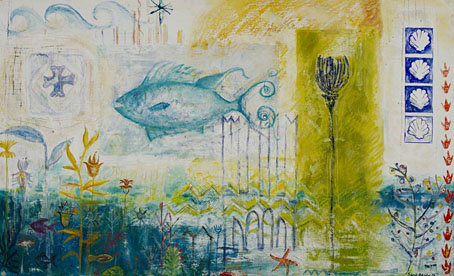
Atlantis by Sarah Hubacher.

• Regular readers will know Leigh Wright from his Wyrd Daze creations which I’ve linked here many times in the past. (The same goes for his frequent Mixcloud compilations.) Leigh’s wife died recently which means he now has to return to the UK from Canada where he doesn’t have permanent resident status. His request for help is here.

Melinda Gebbie’s Greatest Fits: “Ranging from painting, illustration, Comix, portraiture, eroticism and so much more, this fully illustrated and beautifully presented book is a glimpse into the unique mind of a woman forged in the fire of counterculture.”

• At The Daily Heller: Adrian Wilson’s collection of elaborate vintage fabric stamps is explored in a two-part feature here and here.

• Mixes of the week: DreamScenes – December 2025 at Ambientblog, and ASIP – Reflection on 2025 at A Strangely Isolated Place.

Dennis Cooper’s favourite fiction, poetry, non-fiction, film, art, and internet of 2025. Thanks again for the link here!

• At Colossal: “Field Kallop meditates on universal patterns through bold chromatic compositions.”

• “Scientists discover massive underwater ruins that may be a lost city of legend.”

• New music: The King In Yellow by Blarke Bayer.

• RIP Rob Reiner.

Atlantis (1955) by Les Baxter | The Atlantis Healing Harp (1982) by Upper Astral | A Man For Atlantis (2000) by Broadcast

Weekend links 803

USA-ad.jpg

Ad for The United States Of America from Helix magazine, 1968.

• American composer Joseph Byrd died this week but I’ve yet to see a proper obituary anywhere. He may not have been a popular artist but he was significant for the one-off album produced in 1968 by his short-lived psychedelic group, The United States Of America. Their self-titled album has been a favourite of mine since it was reissued in the 1980s, one of the few American albums of the period that tried to learn from, and even go beyond, the studio experimentation of Sgt Pepper. The United States Of America didn’t have the resources of the Beatles and Abbey Road but they did have Byrd’s arrangements, together with an energetic rhythm section, an electric violin, a ring modulator, some crude synthesizer components, the voice of Dorothy Moskowitz, and a collection of songs with lyrics that ranged from druggy poetry to barbed portrayals of the nation’s sexual neuroses. The album became an important one for British groups in the 1990s who were looking for inspiration in the wilder margins of psychedelia, especially Stereolab, Portishead (Half Day Closing is a deliberate pastiche), and Broadcast. Byrd did much more than this, of course, and his follow-up release, The American Metaphysical Circus by Joe Byrd And The Field Hippies, has its moments even though it doesn’t reach the heights of its predecessor. Byrd spoke about this period of his career with It’s Psychedelic Baby Magazine in 2013.

• At BBC Future: “The most desolate place in the world”: The sea of ice that inspired Frankenstein. Richard Fisher examines the history of the Mer de Glace in fact and fiction with a piece that includes one of my Frankenstein illustrations. The latter are still in print via the deluxe edition from Union Square.

• A Year In The Country looks at a rare book in which Alan Garner’s children describe the making of The Owl Service TV serial.

• The final installment of Smoky Man’s exploration of The Bumper Book of Magic has been posted (in Italian) at (quasi).

• At Public Domain Review: Perverse, Grotesque, Sensuous, Inimitable: A Selection of Works by Aubrey Beardsley.

• At Colossal: Ceramics mimic cardboard in Jacques Monneraud’s trompe-l’œil ode to Giorgio Morandi.

• At the Daily Heller: The “narrative abstraction” of Roy Kuhlman‘s cover designs for Grove Press.

• New music: Elemental Studies by Various Artists; and Gleann Ciùin by Claire M. Singer.

• Steven Heller’s font of the month is Archive Matrix.

Sensual Hallucinations (1970) by Les Baxter | The Garden Of Earthly Delights (United States Of America cover) (1982) by Snakefinger | Perversion (1992) by Stereolab

Weekend links 767

east-totem-west.jpg

East Totem West head shop poster, from DJ Food‘s latest delve into the psychedelic poster auctions.

• The week in science-fiction illustration: Joachim Boaz on Rodger B. MacGowan’s “approachable New Wave art”; and Andrew Liptak talks to Adam Rowe about Rowe’s Worlds Beyond Time: Sci-Fi Art of the 1970s.

• At The Wire: Philip Brophy sets out his intentions for the return of his long running column on film music.

• At Public Domain Review: Gustatory Wisdom: Bruegel the Elder’s Twelve Proverbs (1558).

Though the project’s genesis predated Roeg’s involvement, Cammell said that his codirector “needled” him: “He provoked me, made me focus more and more clearly on what I was trying to say.” It was Roeg’s visual sensibility, Cammell graciously admitted, that “mobilized” and “improved” his own concepts. It’s appropriate that the movie concerns two men who become fully realized only in meeting and merging with each other. Turner, said Cammell, “believes himself to be at the end of his creative life. He’s a man in despair. And then destiny brings him his mirror image, Chas, the man in whom he sees what he was and what he could be again.”

Roeg and Cammell were hardly in despair in 1968; both were novices in the foothills of their own artistry. It is not fanciful, though, to see in their collaboration something like the same lightning connection that forms between Turner and Chas. Cammell said that he set out “to make a transcendental movie.” In achieving that goal, he stretched and challenged not just himself but cinema too. Even as Performance closed the lid definitively on the sixties, it opened the door to a radical new way of making films.

Ryan Gilbey on Donald Cammell and Nicolas Roeg’s Performance

• At A Year In The Country: Broadcast and Pathways Through Otherworldly Villages.

• “Pilot is an elegant and expressive display serif,” says Kim Tidwell.

Winners of the 2025 World Nature Photography Awards.

• New music: Forgotten Worlds by Rodrigo Passannanti.

• Janus Rose presents her Digital Packrat Manifesto.

• RIP Jamie Muir and Gene Hackman.

Pilots Of Purple Twilight (1981) by Tangerine Dream | Pilots (2000) by Goldfrapp | I’m With The Pilots (2001) by Ladytron

Weekend links 746

mondrian.jpg

Composition B (No.II) with Red (1935) by Piet Mondrian.

• “Red is practically faultless, save, perhaps, for one hard-to-get-excited-about foray into atmospheric free jazz (Providence), though the sprawling, epic roller coaster of emotion and dexterity that follows (Starless) surely makes up for any shortfall.” Patrick Clarke on 50 years of my favourite King Crimson album. I like Providence, the piece is part of a live performance in Rhode Island so the Lovecraft connection adds to the aura of doom that pervades the album; and the structure of the album’s second side—jazz improv followed by a multi-part, Mellotron-heavy epic—harks back to the group’s debut.

• “It’s important to challenge the common idea of an almost evolutionary procession, where modernist abstract art is somehow the climax, a new and perfectly original approach to the visual world, absolutely different from all that preceded it.” Hunter Dukes on the yellow rectangle that denotes silence in the Silos Apocalypse.

The Art of Sidney H. Sime, Master of Fantasy, an exhibition at the Heath Robinson Museum, Pinner, London. Meanwhile, at the USC Fisher Museum of Art in Los Angeles, there’s Sci-fi, Magick, Queer L.A.: Sexual Science and the Imagi-Nation.

• “I did not realize how much I had done. I am a serial polluter.” Ralph Steadman and his daughter, Sadie Williams, talking to Steven Heller about Steadman’s latest exhibition which is touring the USA.

• New music: Come Back To Me [Demo] by Broadcast; The Last Sunset Of The Year by Marcus Fjellström; Hexa by Cleared.

• At Spoon & Tamago: Artists summon mythical creatures of the Echigo region for the 2024 Wara Art Festival.

• The Italian Art of Violence: Samm Deighan on the giallo cinema boom of the 1960s and 1970s.

Gavin Friday’s favourite albums.

Red (1991) by Jarboe | Red Earth (As Summertime Ends) (1991) by Rain Tree Crow | Red Sun (2012) by Anna von Hausswolff