Weekend links 73

sun2.jpg

Johnny Trunk of Trunk Records reissued the soundtrack to The Wicker Man in 1997. Mr Trunk’s latest delve into the cultural past is Own Label: Sainsbury’s Design Studio, a book from Fuel examining the supermarket chain’s packaging design of the 1960s and 1970s. Creative Review shows some examples while I have to note the uncanny similarity between one of the posters for The Wicker Man and an old Sainsbury’s corn flakes box. Now we see that the Old Weird Britain wasn’t only hiding in the fields and the folk songs but was also lurking on the supermarket shelves.

Related: a new DVD set from the BFI, Here’s a Health to the Barley Mow: A Century of Folk Customs and Ancient Rural Games. And let’s not forget the ley lines of Milton Keynes, and a new edition of Ritual by David Pinner, said to be the novel which inspired The Wicker Man.

• “He wrote me…” Sans Soleil (1983), Chris Marker’s beguiling accumulation of memories, dreams and reflections, is recalled in a Quietus piece entitled Things that Quicken the Heart. Not the first time on DVD as it says there (Nouveaux Pictures released it with La Jetée in 2003) but it’s good to know it’s being reissued.

• Marker’s film references Tarkovsky’s Stalker a couple of times, most notably in the comment, “On that day there will be emus in the Zone.” Geoff Dyer has what he describes as “a very detailed study” of Stalker out next year.

I don’t like those commentators who keep on saying that London will never be the same again. London is always the same again. I remember those comments were made very loudly after the [July 2005] terrorist attacks – “London will never be the same again, London has lost its innocence” – it was all nonsense. London was exactly the same again the following day. Rioting has always been a London tradition. It has been since the early Middle Ages. There’s hardly a spate of years that goes by without violent rioting of one kind or another. They happen so frequently that they are almost part of London’s texture. The difference is that in the past the violence was more ferocious, and the penalties were more ferocious – in most cases, death.

Peter Ackroyd, reminding us that the Four Horsemen of the Apocalypse don’t wear hoodies and ride bikes.

Wolf Fifth: “rare vinyl records from the golden era of avant garde and experimental music”. And in FLAC as well, not crappy mp3; I want to hear all those scratches uncompressed, dammit!

Another great mix at FACT, this time compiled by snd who throw together Morton Feldman, Siberian shamen, Einstürzende Neubauten, Dome, Oval and many others.

• Colin Marshall asks “how weird is Australia?” in an appraisal of Nicolas Roeg’s Walkabout.

A Comprehensive Solution to the Tokyo Umbrella Problem.

• More poster art from Hapshash and the Coloured Coat.

Morbid Excess, a series of drawings by May Lim.

Conrad Schnitzler (1937–2011) by Geeta Dayal.

Neopolitan cephalopods.

Willow’s Song (1973) by Paul Giovanni & Magnet | The Willow Song (1989) by The Mock Turtles | Wicker Man Song (1994) by Nature and Organisation.
Chernobyl’s zone of alienation

prypiat.jpg

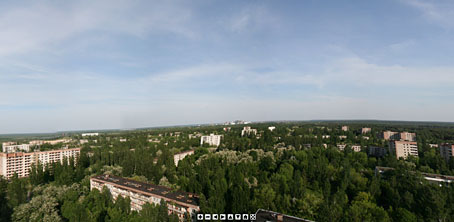
Chernobyl/Pripyat (2011) by Paul Curry.

Everyone’s favourite irradiated town, Pripyat in Ukraine, has been in the news again now that twenty-five years have passed since the the Chernobyl nuclear disaster. This photo of the area by Paul Curry is part of a panorama (with the nuclear plant in the distance) taken from a rootop on a clear day. Most photos of the site show the now-familiar abandoned buildings, empty playgrounds and so on; Curry’s view taken on 29th May this year is remarkable for showing how overgrown the place has become.

Chernobyl has become indelibly twinned with Andrei Tarkovsky’s masterwork of grimy science fiction, Stalker (1979), and the novel upon which the film was based, Arkady and Boris Strugatsky’s Roadside Picnic, a mesh of connections I explored in an earlier post. Darren Nisbett’s series of photos currently showing at the Rhubarb and Custard gallery, Berkshire, are good examples of how Stalker-like the place is now looking. Nisbett calls his series, many of which are infra-red views, Chernobyl’s Zone of Alienation although there’s no indication of whether he’s alluding to the hazardous Strugatsky/Tarkovsky “Zone”. The photos are on display until the end of this month, and the prints are for sale. The Independent has a gallery feature about the exhibition here.

Update: Simon Sellars from Ballardian alerts me to this blog which is currently running reports from a visit to the Chernobyl exclusion zone.

Previously on { feuilleton }
Rerberg and Tarkovsky: The Reverse Side Of “Stalker”
The slow death of modernism
The Stalker meme

Weekend links 63

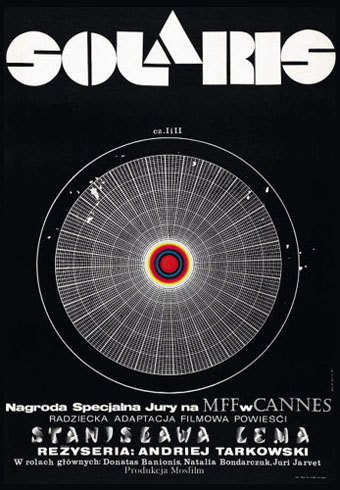
solaris.jpg

Polish poster by Andrzej Bertrandt for Andrei Tarkovsky’s 1972 film of Solaris.

• Stanisław Lem’s Solaris receives its first ever direct English translation by Bill Johnston (only on Audible for the moment), all previous editions having been sourced from a poor French translation. An all-too-common state of affairs for non-English fiction where bad or bowdlerised translations persist for years.

• Now that Minnesota politician Michelle Bachmann is running for US president it’s a good time to examine her views when (theoretically) her actions could one day impact on us all. The Daily Beast gathered together some of her worst pronouncements, including the following about gay people: “It’s a very sad life. It’s part of Satan, I think, to say that this is gay.” Her husband describes his attempts to counsel (ie: cure) gay teenagers with the words “Barbarians need to be educated.” It’s no surprise that both these people find confirmation of their views in the usual narrow interpretation of Christian doctrine. Not all American Christians are this ignorant or offensive, of course. The Heartland Proclamation calls for “an end to all religious and civil discrimination against any person based on sexual orientation and gender identity and expression”.

Journalist Andrew Sullivan in 2003 proposed a label for people like Bachmann: “I have a new term for those on the fringes of the religious right who have used the Gospels to perpetuate their own aspirations for power, control and oppression: Christianists. They are as anathema to true Christians as the Islamists are to true Islam.” It’s a term that ought to have more widespread use.

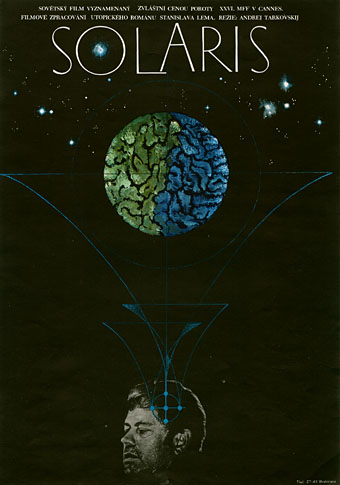
solaris-czech.jpg

Czech poster for Solaris. No designer credited.

• Probing the secrets of psilocybin: “Scientists at the Johns Hopkins University School of Medicine have zeroed in on the dose levels of the ‘sacred mushroom’ chemical capable of yielding positive, life-changing experiences, while minimizing the chance of transient negative reactions in screened volunteers under supportive, carefully monitored conditions.”

• Rick Poynor relates a visit to the Frederic Marès Museum, Barcelona, home to the 50,000 objects Marès collected over his lifetime. Further details of the collection can be found at the museum website.

In her 1969 essay “The Pornographic Imagination,” [Susan] Sontag insisted that Story of O could be correctly defined as “authentic” literature. She compared the ratio of first-rate pornography to trashy books within the genre to “another somewhat shady subgenre with a few first-rate books to its credit, science fiction.” She also maintained that like science fiction, pornography was aimed at “disorientation, at psychic dislocation.”

If so, that aim is far more interesting than what most generic “mainstream” novels set out to do. No one could describe O as predictable or sentimental. Its vision was dark and unrelenting; everything about it was extreme. Sontag also compared sexual obsession (as expressed by Réage) with religious obsession: two sides of the same coin.

Carmela Ciuraru on the story of The Story of O by Pauline Réage.

• “No hay banda! There is no band. It is all an illusion.” David Lynch will be opening a Club Silencio in Paris (Montmartre, of course). Facebook pages here and here.

• Sad to say that Chateau Thombeau is now closed but Thom has begun a more personal journal here.

• Picture galleries of the Vorticists at the Tate here and here. Related: Into the Vortex.

• Illuminated Persian pages from 1604 at BibliOdyssey.

• Tape drawings by Chris Hosmer.

• Miles Davis and co. at the Isle of Wight Festival, 1970: part 1 | part 2 | part 3 | part 4

Weekend links 15

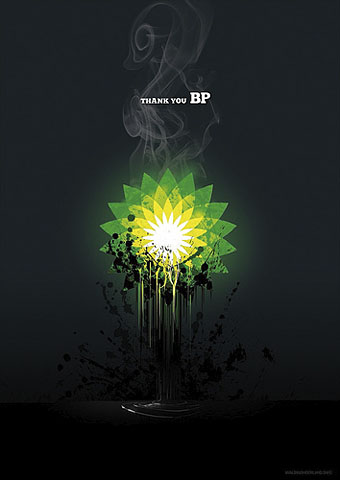
bp.jpg

One of the entries from the Greenpeace competition to rebrand BP.

What Kenneth Anger was doing inside the Pentagon, October 1967.

Ghosts Of The Future: Borrowing Architecture From The Zone Of Alienation. Jim Rossignol on Stalker: the film, the game and the reality.

Electric Eden: Unearthing Britain’s visionary music. A blog and a forthcoming book by Rob Young.

• Lesbian filmmaker Kiana Firouz isn’t wanted in the UK thanks to the iniquitous asylum laws of the previous administration; the Home Office intends to return her to Iran where gay people are flogged and executed. Coilhouse has details including recommendations of how people can help. Related: Britain’s immigration system is guilty of “institutional homophobia”, according to a new report.

Cameron Carpenter, a prodigiously talented (and sequinned) concert organist.

No Barcode: Javier Garcia’s graphic design blog.

Shapeways: 3D printing from your own designs.

Spintriae: brothel coins from Ancient Rome.

Winq magazine: “global queer culture”.

A steam-powered synthesiser.

Seven days with Brian Eno.

Among The Trees, Michael Chapman on the Whistle Test in 1975.

Rerberg and Tarkovsky: The Reverse Side Of “Stalker”

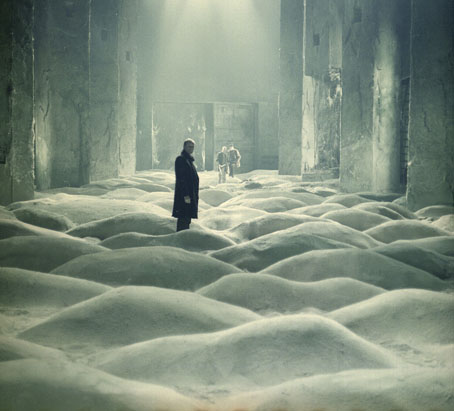
stalker.jpg

Stalker (1979).

Among the new documentary films being shown at the Sheffield (UK) Doc/Fest is Igor Mayboroda’s Rerberg and Tarkovsky: The Reverse Side Of “Stalker”.  Behind the unwieldy title there lies an exploration of the troubled genesis of one of my cult artefacts, Andrei Tarkovsky‘s 1979 science fiction film, Stalker, a personal adaptation by the director of a Russian sf novel, Roadside Picnic, by Arkadi & Boris Strugatsky. Tarkovsky’s production suffered from technical calamities, illness, artistic disagreements and, worst of all, location work in a polluted area which (allegedly) caused the early deaths of a number of the people involved, including the director and leading actor, Anatoli Solonitsyn. All of which makes the completed film seem both miraculous and chilling for reasons beyond its uniquely sinister atmosphere.

When the British Film Institute launched a survey on “the film you would like to share with future generations”, behind Blade Runner in first place was a surprise second place entry: Andrei Tarkovsky’s science fiction film Stalker, in which a guide leads two clients to a site known as “the Zone”, which has the supposed potential to fulfill a person’s innermost desires. This creative documentary tells the remarkable story behind the making of Stalker, including the series of conflicts which led to crew members, most notably celebrated director of photography Georgi Rerberg, being left off the credits, leaving careers in tatters. Far from your standard making of doc, Director Igor Mayboroda has woven an engrossing “documentary cinema novel” which not only stands as a tribute to Rerberg’s career but also as a delight for cinephiles interested in how the creative process can flourish even under the most difficult and ultimately devastating of circumstances.

Stalker as it currently exists on DVD has a couple of interviews about the making of the film but nothing as substantial as Mayboroda’s documentary which sounds like essential viewing. Those in the Sheffield area can see a repeat showing on November 8.

Also at the Doc/Fest is a new film for the BBC’s long-running arts series, Arena, which will no doubt be screened on TV in due course. Eno is directed by Nicola Roberts and—needless to say—its subject is musician, producer, artist, etc, Brian Eno. Arena has always used Eno’s short piece, Another Green World, for its theme music but I believe this is the first time he’s been profiled in the series. Roberts also directed the excellent 1994 Arena doc, Philip K Dick: A Day in the Afterlife, so I’ll be looking forward to seeing this one as well.

Danger! High-radiation arthouse! | Geoff Dyer on his own Stalker obsession.

Previously on { feuilleton }
Brian Eno: Imaginary Landscapes
The slow death of modernism
Thursday Afternoon by Brian Eno
The Stalker meme