
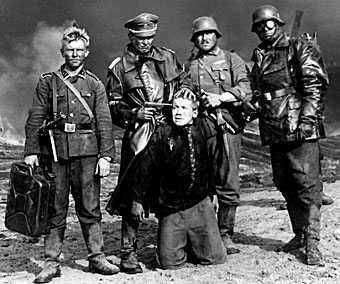
The Disasters of War

Idi_i_smotri.jpg

7 ¶ And when he had opened the fourth seal, I heard the voice of the fourth beast say, Come and see.
8 And I looked, and behold a pale horse: and his name that sat on him was Death, and Hell followed with him. And power was given unto them over the fourth part of the earth, to kill with sword, and with hunger, and with death, and with the beasts of the earth.
Revelations 6

There are horror films, there are films about the horror of war, and then there is Elem Klimov’s Come and See (Idi i Smotri). Klimov made the film in 1985 from a screenplay by Ales Adamovich based on that writer’s experiences as a young Russian partisan fighting the Nazis during the Second World War. This biographical quality may be what gives the film its incredible immediacy and authority (Klimov also suffered as a child during the war) even though its power is obviously a product of Klimov’s skills as a director.
Continue reading “The Disasters of War”

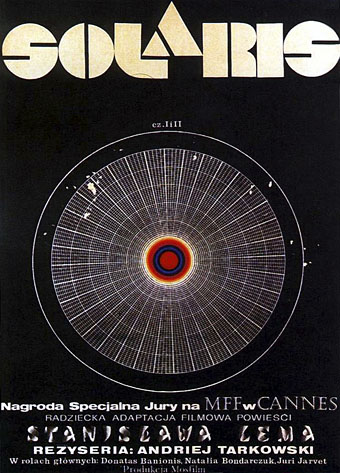
Solaris

solaris.jpg

This wonderful poster was designed by Andrzej Bertrandt for the Polish release of Andrei Tarkovsky’s 1972 film of the novel by Stanisław Lem. Lem didn’t like the film, referring to it as “Crime and Punishment in space”, but then he disliked most of the filmed adaptations of his novels.

There are more posters and pictures at the great Tarkovsky site Nostalghia.com. Also lengthy quotes and interviews about all his films:

I don’t like science fiction, or rather the genre SF is based on. All those games with technology, various futurological tricks and inventions which are always somehow artificial. But I’m interested in problems I can extract from fantasy. Man and his problems, his world, his anxieties. Ordinary life is also full of the fantastic. Life itself is a fantastic phenomenon. Fyodor Dostoievsky knew it well. That’s why I want to focus on life itself—everyday, ordinary. Because within it anything can happen. My Solaris is not after all true science fiction. Neither is its literary predecessor. What counts here is man, his personality, his very persistent bonds with planet Earth, responsibility for the times he lives in. I don’t like your typical science fiction, I don’t understand it, I don’t believe in it. The fact is when I was working on Solaris I was concerned with the same subject as in (Andrei) Rublev. Human being. These two films are only separated by the time the action is taking place.