Carceri, thermae and candelabra

piranesi_tivoli.jpg

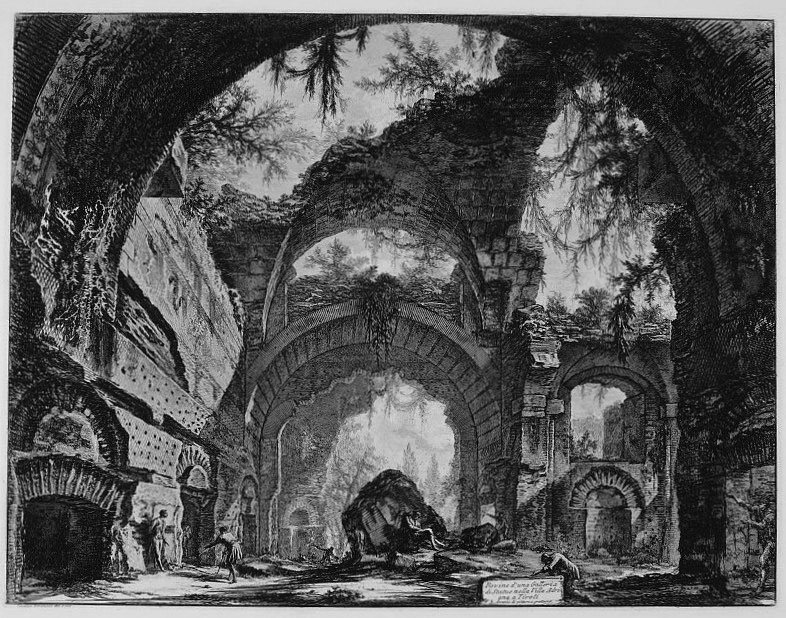
Piranesi’s etching which purports to show a statue gallery at Hadrian’s Villa was published in 1770 as part of the artist’s Vedute di Roma series, and conveniently provides a themed link for a pair of new exhibitions. The artist’s attribution of statue gallery was a mistaken one, the structure is actually the remains of Hadrian’s thermae, or baths, but archaeology was still in its infancy in the 18th century so mistakes were inevitable. If you’re fortunate enough to be in Venice during the next two months the Fondazione Cini has a major exhibition of Piranesi’s work, The Art of Piranesi: architect, engraver, antiquarian, vedutista, designer. On display are over three hundred prints which no doubt include many of the Vedute di Roma.
piranesi.jpg

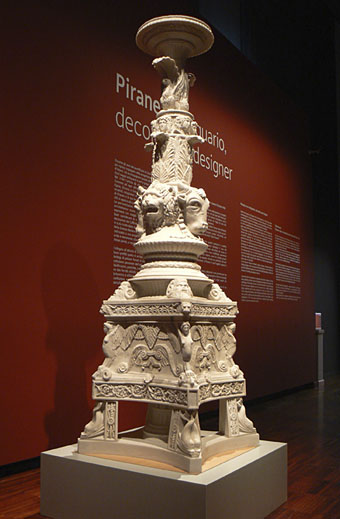
Ornamental candelabrum created by Factum Arte from a design by Piranesi.

Good as that sounds, what’s especially notable about this exhibition is a presentation of three-dimensional works specially created from Piranesi’s designs for candelabra, fireplaces, and other objects based on his studies of artefacts from the ancient world. These pieces have been produced by Factum Arte who have a great website showing the finished pieces and also a page detailing the production of the objects. Also on that page is one of the exhibition’s other features, a 10-minute video by Gregoire Dupond which cleverly joins together and animates a journey through several of Piranesi’s Carceri d’invenzione (Imaginary Prisons). The music accompaniment is Bach’s Cello Suite 2 which happens to be the piece played by Yo-Yo Ma in an earlier animation of the Carceri, so it’s a reasonable guess that the earlier film was an inspiration for this new work. The exhibition runs to November 21, 2010.
jauregui.jpg

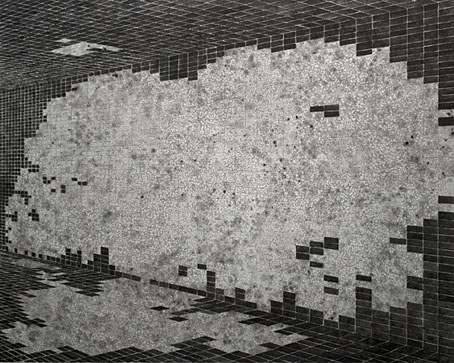
Jack’s Bath (2010) by Danny Jauregui. Gouache on canvas.

Hadrian’s obsession with his doomed lover Antinous makes the Emperor a gay icon which explains the connection between Piranesi’s view of the ruined baths and an exhibition of work by American artist Danny Jauregui. There Goes the Neighborhood is at the Leslie Tonkonow Gallery, New York, and features a selection of Jauregui’s paintings of tiles from the bathhouses which were a feature of gay life in the days before AIDS.

I make paintings of bathhouses in ruin. Moldy, disheveled and abandoned, the paintings are memorials to the absence of memorials – indexes of the traumatic erasure inflicted on the radical gay sexuality of the past. They are paintings of what I imagine those spaces to look like, had they not been disguised and hidden from sight. (More.)

The exhibition runs until October 30, 2010. By coincidence gay news blog Towleroad had a post yesterday about New York’s first anti-gay police raid on the Ariston Baths in 1903.
time-bandits.jpg

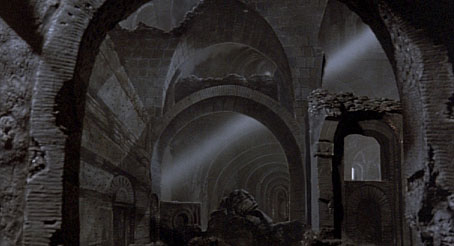
Time Bandits.

Seeing as I posted the picture of Hadrian’s baths I have to also post this shot from Terry Gilliam’s Time Bandits (1981) showing the interior of the Fortress of Ultimate Darkness. Here we see the Piranesi’s ruined baths incorporated into a vast and gloomy space which must surely be inspired by the Carceri, the views of Rome being absorbed by the artist’s darker imaginings. And for a final piece of trivia, writer Marguerite Yourcenar is not only the author of Memoirs of Hadrian (1951), a novel about the Emperor’s passion for Antinous, but also penned an essay about the Carceri. I haven’t read either of those works so I think it’s time to add them to the shopping list.

Update: For those in the UK, there’s also Piranesi’s Prisons, an exhibition at the Mead Gallery, Warwick, from now until December.

Elsewhere on { feuilleton }
The etching and engraving archive

Previously on { feuilleton }
La Tour by Schuiten & Peeters
Set in Stone
Hadrian and Greek love
Piranesi as designer
Vedute di Roma
Aldous Huxley on Piranesi’s Prisons
The Cult of Antinous

La Tour by Schuiten & Peeters

tour1.jpg

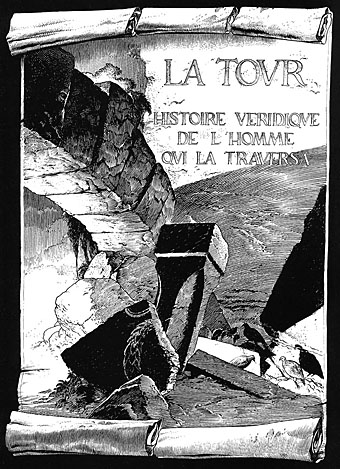
La Tour (1987) by François Schuiten and Benoît Peeters is the third story in the Cités Obscures series, although it’s the fourth volume if you want to be strictly canon about things, L’archivist, a guide to places in the Obscure World, having preceded it.

piranesi1.jpg

Carcere Oscura by Piranesi (1750).

This is another book where Schuiten and Peeters’ interests tick a list of my own obsessions, being a tale which seems to originate in the question “What would it be like if you crossed Piranesi‘s Prisons etchings with Bruegel’s Tower of Babel?” The protagonist of La Tour, Giovanni Battista, has his name borrowed from Piranesi’s forenames and his appearance taken from Orson Welles’ Falstaff in Chimes at Midnight. The story owes something to Kafka, although it lacks Kafka’s drift towards paradox, concerning a colossal building referred to throughout as The Tower, a structure we only ever see in close-up—and then mostly from the inside—but whose height must reach several thousand feet.

tour2.jpg

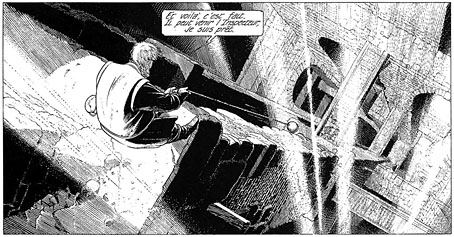
Battista (above) is one of the Keepers, a group of men charged with maintaining small sections of the Tower whose structure suffers continual decay and collapse. Tired of years spent in complete isolation, and concerned that other Keepers aren’t doing their job, Battista goes in search of the Tower’s feared Inspectors, only to discover that the lack of maintenance is endemic and few of the Tower’s scattered residents have any idea of the origin or purpose of the vast building where they’ve spent their lives, never mind a concern for its upkeep. There are no Inspectors, and while Battista is worried at the beginning about vines in the stonework, we later see small forests growing among the ruins. Kafka resonances come with the mention of the mysterious Base, and the equally mysterious Pioneers, those builders and engineers who went ahead years or even centuries before, climbing skyward.

Continue reading “La Tour by Schuiten & Peeters”

Psychedelic vehicles

further.jpg

Further: the second version of Ken Kesey’s Merry Prankster bus.

The word psychedelic, like surreal before it, slipped from its original meaning through appropriation. Humphrey Osmond’s neologism was first coined in drug-related correspondence with Aldous Huxley in 1957 and was specifically intended to describe the “mind-manifesting” quality of the hallucinogenic drug experience. The drug-inspired art and music which came after the experiments of the Fifties quickly assumed a gaudy and chaotic aspect derived from the intense visual abstractions of LSD trips. Huxley in The Doors of Perception (1954) rejected these fractal visions as trivial and distracting—he was more concerned with the deeper spiritual revelations—but a new way of seeing in a new era required a new label. Art and design which is vivid, florid, multi-hued and quite often incoherent is where the term psychedelic is most commonly applied today.

Of the three vehicles here, only Ken Kesey’s bus can be regarded as psychedelic in Osmond’s sense, this being the renovated school bus which travelled the United States in the mid-Sixties dispensing free LSD to those it met along the way. These events were recounted in Tom Wolfe’s The Electric Kool-Aid Acid Test (1968) and the creators of last year’s Milk, Gus Van Sant and Dustin Lance Black, have a film in preparation based on Wolfe’s book. Milk was a film about gay rights campaigner Harvey Milk, and Ang Lee (director of Brokeback Mountain) has a new film of his own due shortly, Taking Woodstock, which concerns Elliot Tiber, the gay organizer of the Woodstock Festival of 1969. Both stories bracket the psychedelic era. Is this coincidence or do I detect something in the air? But I digress….

porsche.jpg

For the chaotic and decorative nature of the psychedelic style, look no further (so to speak) than Janis Joplin’s 1965 Porsche. I saw this in 2005 at Tate Liverpool when it was touring with the Summer of Love exhibition of psychedelic art. One of  Joplin’s very last recordings before her death in 1970 was a birthday song for John Lennon so it’s perhaps fitting that the third vehicle here is Lennon’s lavish Rolls-Royce. His 1965 limousine came originally in black livery but two years later he decided he wanted it painted like a gypsy caravan. There’s a great page about the car here including details of its decoration, created in consultation with Marijke Koger of Dutch design group The Fool.

rolls.jpg

In a small way these three vehicles encapsulate the psychedelic period, from optimistic, proselytising origins following the revelations of hallucinogenic drugs to decline into a mannered, highly-commercialised graphic style. Ken Kesey died in 2001 but his second bus is still active while the cars are now museum pieces. Perhaps the real psychedelic spirit prevails after all.

See also: George Harrison’s Mini Cooper

Previously on { feuilleton }
Dutch psychedelia
The art of LSD

Set in Stone

allchurch.jpg

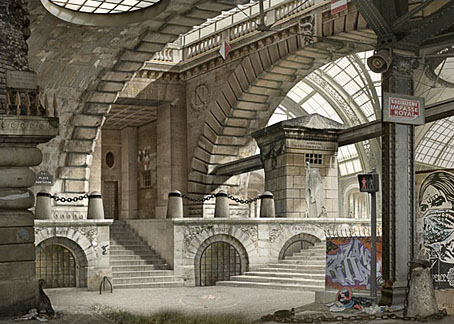
Urban Chiaroscuro 6: Paris (after Piranesi) (2007) by Emily Allchurch.

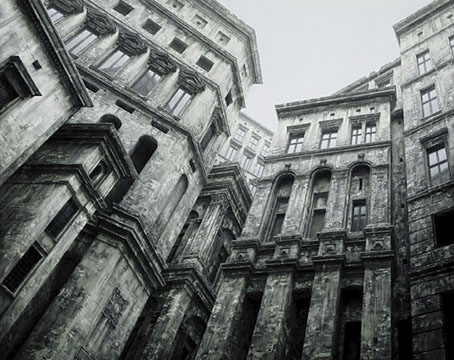
Pitzhanger Manor-House in Ealing, London, hosts an exhibition with architecture as its theme, a suitable subject given that the house was designed by notable 18th century architect (and friend of Piranesi) Sir John Soane. Artist Emily Allchurch has some meticulous and clever photo-collage reworkings of Piranesi on display while painter Stefan Hoenerloh—whose work I hadn’t seen before—is worthy of a dedicated post here seeing as he produces exactly the kind of imaginary architectural renderings I love. Some of his paintings could be colour views of similar scenes by Gérard Trignac.

hoenerloh.jpg

Via Subalterna (1990) by Stefan Hoenerloh.

Set in Stone runs from 28 March–26 April 2008.

Artists: Emily Allchurch, Stephen Carter, Michael Durning, Stefan Hoenerloh and Ben Johnson.

PM Gallery present the work of five artists who share a fascination in the power and importance of architecture, as an inspiration for works in paint and photography.

Emily Allchurch makes collages from many photographs to create a seamless new ‘view’, creating imaginary buildings or recreating buildings that no longer exist. A series of works, inspired by the 16th Century (sic) artist Giovanni Battista Piranesi’s ‘Carceri d’Invenzione’ (Imaginary Prisons), seamlessly constructs Piranesi’s original work but shows buildings constructed in a mass of architectural styles, complete with warning signs, CCTV cameras, razor wire and security mirrors to give a sense of foreboding and claustrophobia. In ‘Crystal Palace, (recomposed)’, she took what remains of the platform as a basis to recreate the palace, using architectural details of the period, such as at the Palm House at Kew Gardens and Paddington Station.

The detail of London’s Westway has been examined by Stephen Carter, with a series of paintings taken from photographs shot beneath the huge concrete flyover. Carter sees the Westway as representing both an escape for city dwellers to the beauty of the countryside and for country dwellers to get to the exciting heart of the city. But this optimism is tempered by the fact that the perspective is often viewed from below the Westway in a forgotten, uncelebrated and polluted part of the city.

Michael Durning’s beautiful paintings of neglected and broken monuments and buildings, question attitudes to Scottish heritage and culture. Often buildings are shown in relation to Scotland’s grand landscapes and unforgiving weather, reducing their prowess in the face of the natural environment.

German painter Stefan Hoenerloh creates monumental buildings with accurate, detailed architectural features, in oil and acrylic. The works appear photographic, but in fact are all invented by Hoenerloh. The buildings loom, often so large that the viewer is only able to see part of them within the frame of the picture. There is little sign of life in these structures, which appear old and weather-beaten, but solid in the face of everything they have withstood over the years since they were built.

Ben Johnson paints calm, often majestic interiors and large city panoramas. Although painted in meticulous detail, Johnson ‘ investigates’ the built space, to create far more than simple photo-realism, allowing the viewer to gain an intense experience of the presented space. Here we show work dating from 1973 to 2007.

Elsewhere on { feuilleton }
The etching and engraving archive
The fantastic art archive

Previously on { feuilleton }
The art of Gérard Trignac
Aldous Huxley on Piranesi’s Prisons

Happy birthday { feuilleton }

one.jpg

It was a year ago today that I sat down and wrote some words of Charles Fort’s, “One measures a circle beginning anywhere…”, as a headline for the first entry on this page. Some posts over the ensuing year have been more popular than others (and it should be pointed out that the “most popular” list in the sidebar has only registered hits since a new plugin was activated). Referral links and Del.icio.us adds are a good guide to popularity so here’s the top five:

Watchmen (June 24th). An old Fantasy Advertiser interview with Alan Moore and Dave Gibbons about their graphic novel masterwork. I knew this would be popular, not least because it’s one of the best interviews I’ve read about Watchmen, and one conducted quite soon after the story had been completed. Good to be reminded that the book’s creation owed as much to the artist as it did to the writer. As Alan Moore’s popularity has grown there’s been a tendency on the part of critics to see him as the sole author of his comics, all of which are collaborations with different artists who invariably contribute to the work themselves. From Hell artist Eddie Campbell has recently been showing examples of these working methods on his excellent weblog, The Fate of the Artist.

Atomix by Nike Savvas (August 5th). A big surprise this. I spotted pictures of this installation in passing on a Yahoo! news page, thought it looked interesting so made a little entry about it. Many hits later people are still searching for pictures. Ms Savvas would be advised to tour this artwork, people love it.

Aldous Huxley on Piranesi’s Prisons (August 25th). Another scanned article and another surprise. I remember thinking ?no one will want to read a long-dead writer talking about a long-dead engraver.? The moral, then, is never underestimate your audience.

The boys (various dates). Despite the groaning tubes of the interweb being stuffed with every shade and variety of porn, some pictures of unclothed young men remain more popular than others. So people arrive here searching for Eugen Bauder (very popular indeed), Felipe Von Borstel, Brian Joubert and others. I often feel as though I should apologise for not having any exclusive material but surfers of the one-handed variety are probably only stopping by for a moment before flitting elsewhere.

Barney Bubbles: artist and designer (January 20th). Very gratifying that this has been received with enthusiasm as this is the kind of post I like best, something that makes up for gaps in the pool of web data. These entries take time to prepare so it’s good to know that people appreciate the effort; I’m hoping there’ll be more to come (work allowing) in 2007.

Thanks for reading!

John x