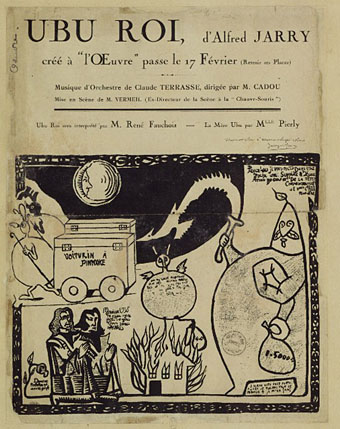
Ubu Roi by Alfred Jarry.
Now here’s a marriage made in heaven (or hell, depending on your point of view): Pere Ubu plus the Brothers Quay presenting Alfred Jarry’s 1896 classic of proto-surrealist theatre, Ubu Roi. I hope someone’s filming this given that there’s no guarantee I’ll be able to get down there to see it. Pere Ubu’s David Thomas has this to say about collaborations:
Well, it’s pretty simple. If someone wants to work with me then they have the right stuff. Working with me is guaranteed career endangerment, not to be undertaken lightly. I had no idea of who the Quays were. Everybody else seems to know but I don’t watch films, tv or video unless a space ship or baseball is involved. The Quays don’t involve themselves with either. So how am I supposed to know? I don’t make the Rules. I obey. We met. We talked. We immediately understood each other and the project and how it all would fit together. I don’t trust visual information of any kind. The Quays were clearly men who were capable of taming the Eye Beast. I told them I’d be delighted to stay out of their way and let them get on with doing what they feel most. They sent me pictures. They were, as I knew they must be, perfect. No space ships. Or baseball. But perfect nevertheless. Only people who don’t understand need to talk. We have no need of talking. Talking is for the weak, the uncertain… and girls. Ha-ha! (I mean it.) We are men who stand in the moment and can deliver the goods. So down to the process: Only work with people who are Masters, and who Understand. If you choose to work with such people then don’t get in their way unless they appear to be set on a course that will break The Rules. Don’t make up the Rules. Don’t work with people who feel the need to talk to you. Don’t work with children or animals. Don’t run into the furniture.
Details from the press release follow and I feel the need to make a point of order: the famous first word of the play, “Merdre!”, doesn’t mean “shitter” as mentioned below. Rather, it’s an untranslatable combination of the French words for “shit” and “murder” which Cyril Connolly rendered unsatisfactorily as “Pschitt!” in his 1968 translation with Simon Watson Taylor.
Pere Ubu and the Brothers Quay present the WORLD PREMIERE of Bring Me The Head Of Ubu Roi
In two specially created performances for Southbank Centre’s ETHER 08 festival, expressionist avant-garage band Pere Ubu presents the world premiere of Bring Me The Head of Ubu Roi, an adaptation of Ubu Roi (King Ubu), Alfred Jarry’s landmark 1896 play that inspired the band’s name and is widely seen as the precursor to the Absurdist, Dada and Surrealist art movements.
At the heart of Jarry’s original production was the use of various performance media, and Pere Ubu’s show reflects this with a unique visual staging by the enigmatic Brothers Quay, featuring intriguing stop-motion animation, projections and imaginative stage designs. Singer David Thomas will feature as Père Ubu, partnering Sarah-Jane Morris (ex-Communards) in the role of Mère Ubu, and the production includes an original music score by the band Pere Ubu and 10 new songs. Gagarin, aka London-based former Ludus, Nico and John Cale drummer Graham Dowdall, will contribute minimal electronic soundscapes.
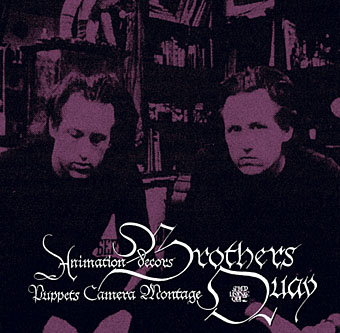
The Brothers Quay.
With this part music, part spoken word, part animated production on the stage of the Queen Elizabeth Hall, David Thomas of Pere Ubu realises a dream he has had since being turned on to Alfred Jarry as a 16-year-old high school student in Cleveland, Ohio.
David Thomas said: “Jarry’s ideas resonated with feelings I had about the use of abstract, concrete and synthesised sound in the narrative architecture of rock music, all tools to engage the imagination of the listener when detailing the picture told by the music and lyrics.”
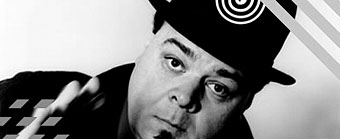
David Thomas.
Ubu Roi is a play for the mind and imagination. It is a drama of ideas and grotesqueries, and a fusion of several disparate and incongruous elements. It shocked early audiences with its blend of grotesque absurdity, wild humour and coarse language. At the premiere in 1896, the very first word of Ubu Roi (‘merdre’, translated as ‘shitter’) provoked a riot amongst the audience and fist fights broke out in the orchestra. Alfred Jarry’s plays in general were widely and wildly hated for their vulgarity, brutality, low comedy and complete lack of literary finish, and his work revealed a lack of respect for royalty, religion and society that prompted some to see his output as the theatrical equivalent of an anarchist bomb attack and an act of political subversion.
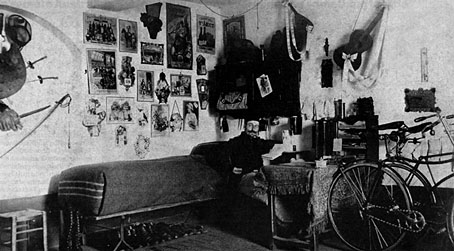
Alfred Jarry with his weapons and bicycles, somewhere in the 1890s. (No it ain’t; see the comments.)
Prior to the Friday performance, there’s a free event in the Front Room at Queen Elizabeth Hall, entitled ‘Pataphysics in Sound. This specially curated musical journey through the history of ’pataphysics, the science of imaginary solutions, celebrates the genius of Alfred Jarry, creator of Ubu Roi and literary madman, time-travelling, absinthe-drinking, pistol-toting, and cycling maniac.
Bring Me The Head of Ubu Roi is presented at the Southbank Centre, Queen Elizabeth Hall, Thursday 24 and Friday 25 April 2008.
Previously on { feuilleton }
• Crossed destinies revisted
• Crossed destinies: when the Quays met Calvino
• The Brothers Quay on DVD
• Surrealist cartomancy