Koho Shoda’s nocturnes

shoda01.jpg

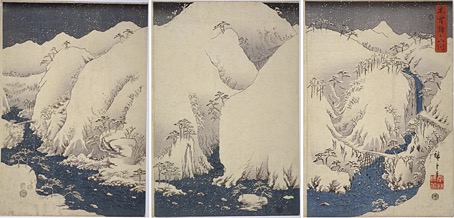
Futamigaura.

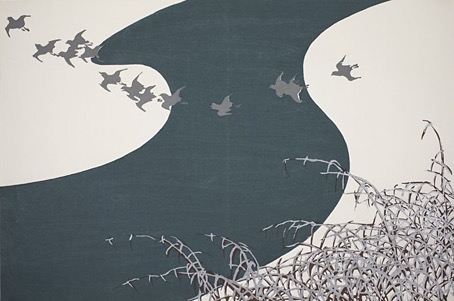
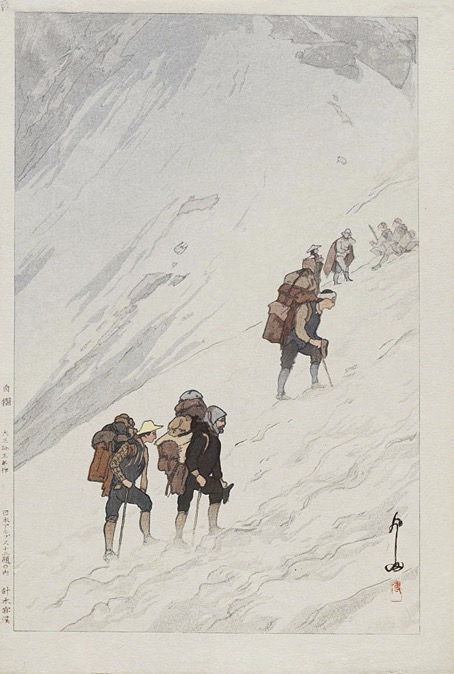
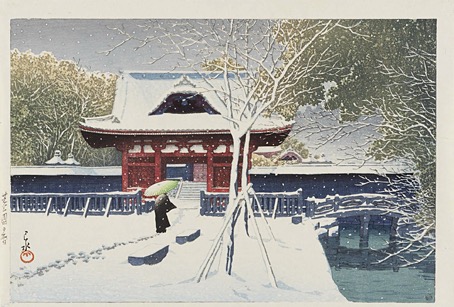
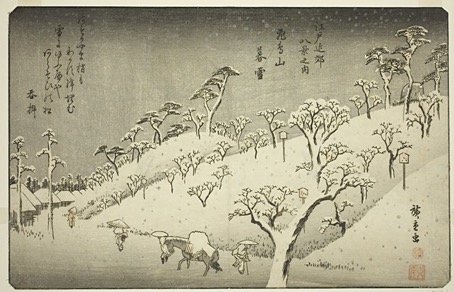
The biographical dates (1871–1946) are apparently uncertain for this Japanese artist about whom little documentation exists. What we do have is the prints he created, a couple of which have appeared here before. Nocturnes were Shoda’s speciality, together with other atmospheric scenes created with carefully graded colouring. As always with prints such as these, I’m in awe of the artist’s ability to create a sense of verisimilitude in the difficult medium of woodblock printing.

shoda09.jpg

Shrine Gate of Miyajima.

shoda05.jpg

Lake Biwa.

shoda08.jpg

Shinagawa Shore.

shoda10.jpg

Uyeno Park.

Continue reading “Koho Shoda’s nocturnes”

Eric Pape’s Arabian Nights

pape01.jpg

Eric Pape (1870–1938) was an American artist and illustrator who shouldn’t be confused with his contemporary Frank C. Papé, a Briton who was also a popular illustrator. Pape was more of a fine artist—he studied in Paris under Jean-Léon Gérôme—whose magazine illustrations are of that type that favoured realistic scenes using posed models. The illustrations in The Arabian Nights Tales of Wonder and Magnificence (1923) differ enough from his paintings to be taken for the work of another artist, the book being a substantial volume which Pape fills with many full-page ink drawings replete with stippling and detail.

pape02.jpg

The stories are a retelling by Padraic Colum with an eye to maintaining the flavour of the original (or older) texts. Books like this were aimed at a young readership but Colum begins with an introduction that describes the origin of the tales, and also weighs the pros and cons of the translations by Lane and Burton. In the stories he avoids simplifying the names of the more popular characters, so we have the six voyages of “El-Sindibad of the Sea”, and the tale of “Ala-ed-din” and his wonderful lamp. These gestures of fidelity are matched by Pape’s vignettes, many of are borrowed from Arabian or Persian sources. Pape had spent two years living and working in Egypt—his painting of the Sphinx by moonlight was a product of this period—a factor which may explain why he was offered the commission.

pape03.jpg

The pictures I’ve selected are mostly the full-page pieces which I’ve adjusted slightly to remove the grey tone of the paper. This copy of the book is a reprint from 1945, a period when print standards suffered from wartime restrictions. Older printings may be better.

pape04.jpg

pape05.jpg

Continue reading “Eric Pape’s Arabian Nights”

Weekend links 803

USA-ad.jpg

Ad for The United States Of America from Helix magazine, 1968.

• American composer Joseph Byrd died this week but I’ve yet to see a proper obituary anywhere. He may not have been a popular artist but he was significant for the one-off album produced in 1968 by his short-lived psychedelic group, The United States Of America. Their self-titled album has been a favourite of mine since it was reissued in the 1980s, one of the few American albums of the period that tried to learn from, and even go beyond, the studio experimentation of Sgt Pepper. The United States Of America didn’t have the resources of the Beatles and Abbey Road but they did have Byrd’s arrangements, together with an energetic rhythm section, an electric violin, a ring modulator, some crude synthesizer components, the voice of Dorothy Moskowitz, and a collection of songs with lyrics that ranged from druggy poetry to barbed portrayals of the nation’s sexual neuroses. The album became an important one for British groups in the 1990s who were looking for inspiration in the wilder margins of psychedelia, especially Stereolab, Portishead (Half Day Closing is a deliberate pastiche), and Broadcast. Byrd did much more than this, of course, and his follow-up release, The American Metaphysical Circus by Joe Byrd And The Field Hippies, has its moments even though it doesn’t reach the heights of its predecessor. Byrd spoke about this period of his career with It’s Psychedelic Baby Magazine in 2013.

• At BBC Future: “The most desolate place in the world”: The sea of ice that inspired Frankenstein. Richard Fisher examines the history of the Mer de Glace in fact and fiction with a piece that includes one of my Frankenstein illustrations. The latter are still in print via the deluxe edition from Union Square.

• A Year In The Country looks at a rare book in which Alan Garner’s children describe the making of The Owl Service TV serial.

• The final installment of Smoky Man’s exploration of The Bumper Book of Magic has been posted (in Italian) at (quasi).

• At Public Domain Review: Perverse, Grotesque, Sensuous, Inimitable: A Selection of Works by Aubrey Beardsley.

• At Colossal: Ceramics mimic cardboard in Jacques Monneraud’s trompe-l’œil ode to Giorgio Morandi.

• At the Daily Heller: The “narrative abstraction” of Roy Kuhlman‘s cover designs for Grove Press.

• New music: Elemental Studies by Various Artists; and Gleann Ciùin by Claire M. Singer.

• Steven Heller’s font of the month is Archive Matrix.

Sensual Hallucinations (1970) by Les Baxter | The Garden Of Earthly Delights (United States Of America cover) (1982) by Snakefinger | Perversion (1992) by Stereolab

Lynd Ward’s Beowulf

ward01.jpg

A tale of fire and blood for Bonfire Night. I posted a link to Lynd Ward’s marvellous Beowulf illustrations many years ago but, as is often the case, the site that hosted them is now defunct. These copies are from a recent addition to the indispensable Internet Archive, and unlike the earlier site you get to see the entire book, complete with Ward’s many vignettes. Ward is as good a match for this dark story as he was with Frankenstein, and there’s some similarity between his rendering of Victor Frankenstein’s creation and the even more murderous Grendel. I generally prefer Ward’s black-and-white work to his colour illustrations, and I suspect Ward preferred working in a single tone when given the choice, as with his celebrated woodcut “novels”, God’s Man and Madman’s Drum. But the hot/cold palette works well here, reflecting a world of firelit halls and the icy dark beyond the fire where nightmares wait for sleeping men.

ward08.jpg

It’s also possible to read the poem itself, although I wouldn’t advise it with this translation by William Ellery Leonard, not when it begins so risibly with the words “What ho!” Beowulf famously opens with a declaration in Old English—”Hwæt!”—that bards would have shouted to gain the attention of their audience. The word doesn’t translate easily to contemporary English but it’s usually given as “Hear!” or “Listen!” Leonard’s “What ho!” is a phrase that belongs with Bertie Wooster. There are plenty of other translations available, Seamus Heaney’s, for example. I favour the David Wright translation that we read at school, a version which includes a five-page note concerning the difficulties of faithfully translating the poem.

ward02.jpg

ward03.jpg

ward04.jpg

Continue reading “Lynd Ward’s Beowulf”

Raffles, the gentleman thief

raffles1.jpg

The Raffles that concerns us here is the television incarnation as seen in a series of adventures made by Yorkshire TV in 1977. I recently bought a cheap DVD set of the series, not for reasons of nostalgia (a wretched condition) but out of curiosity and whim. I had a vague recollection of enjoying the few episodes I’d seen, and was hoping for another decent Victorian adventure series along the lines of The Rivals of Sherlock Holmes (1971/1973). Raffles proved to be better than I expected; not quite up to the standards of Granada TV’s peerless adaptations of the Sherlock Holmes stories but thoroughly enjoyable. The production values are better than those in The Rivals of Sherlock Holmes, a well-written series with an impressive cast that was nevertheless compromised by a restricted budget. I’m not really reviewing the Raffles series here, this piece is intended to note a couple of points of interest which, for me, added to its pleasures.

raffles2.jpg

Raffles and Bunny as they were originally. An illustration by FC Yohn from Raffles: Further Adventures of the Amateur Cracksman (1901).

Arthur J. Raffles was invented by EW Hornung, a writer who was, among other things, Arthur Conan Doyle’s brother-in-law. Raffles, like Sherlock Holmes, is a resolute bachelor with a devoted friend and accomplice, but the two men share few other characteristics beyond a talent for outwitting the dogged inhabitants of Scotland Yard. Raffles’ indulgent lifestyle in the bachelor enclave of (the) Albany, Piccadilly, is financed by his burglaries which invariably target aristocrats and the homes of the wealthy. To the general public he’s known as one of the nation’s leading cricket players, a position which gives him access to upper-class social circles from which he would otherwise by excluded. His former school-friend, “Bunny” Manders, is also his partner-in-crime, a position that Bunny is happy to fill after Raffles saves him from bankruptcy and suicide. Conan Doyle disapproved of the immoral nature of the Raffles stories but they were very popular in their day, and they’ve been revived in a number of adaptations for film, TV and radio. George Orwell admired the stories, and writes about them with his usual perceptiveness here, noting the importance of cricket to Raffles’ gentlemanly philosophy of criminal behaviour. I’ve not read any of the stories myself, and I’m not sure that I want now, not when the television adaptations succeed so well on their own terms.

raffles3.jpg

Anthony Valentine and Christopher Strauli.

The TV series was preceded by a pilot episode made in 1975 which saw the first appearances of Anthony Valentine as the dashing Raffles and Christopher Strauli as the fresh-faced Bunny. Valentine and Strauli fit their roles so well it’s difficult to imagine anyone else improving on them, Valentine especially. In the series the pair are supported by many familiar faces from British drama: Graham Crowden, Charles Dance, Brian Glover, Robert Hardy, Alfred Marks, and, in a rare piece of TV acting, Bruce Robinson. Pilot and series were all written by Philip Mackie, and here we have the first noteworthy element since Mackie had earlier adapted six stories for The Rivals of Sherlock Holmes, including the one that features Donald Pleasence as William Hope Hodgson’s occult detective, Thomas Carnacki. Raffles is another rival of Sherlock Holmes, of course, albeit a criminal one, and much more of a mirror image of Holmes than the thoroughly villainous Professor Moriarty. Raffles only breaks the law to improve his bank balance, or as an occasional, daring challenge; he regards theft and evasion from the police as a form of sport, and generally deplores other types of crime. Some of his thefts are intended to punish the victim following an infraction, as with the belligerent South African diamond miner who causes a scene at Raffles’ club, and the Home Secretary who makes a speech in Parliament demanding stiffer penalties for burglary. In one conversation about the morality of their activities Bunny suggests to Raffles that his friend is a kind of Robin Hood figure; Raffles agrees before admitting that he never gives his spoils to the poor.

Continue reading “Raffles, the gentleman thief”