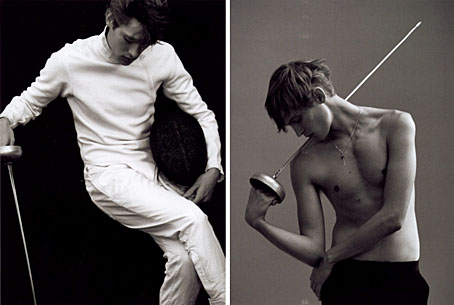
Foiled again… Model Mathias Lauridsen photographed by Kacper Kasprzyk. Thanks to Thom for the tip!
Elsewhere on { feuilleton }
• The men with swords archive
A journal by artist and designer John Coulthart.
Foiled again… Model Mathias Lauridsen photographed by Kacper Kasprzyk. Thanks to Thom for the tip!
Elsewhere on { feuilleton }
• The men with swords archive

Las Meninas (1656) by Diego Velázquez.
The sight of one of Picasso’s many versions of Las Meninas (The Maids of Honour) by Velázquez earlier this week prompts this post. An endlessly fascinating painting whose influence runs through three hundred years of art history. That influence isn’t so surprising if you consider this as a painter’s painting; it certainly never seems to figure in the canon of favourite works among the wider public. But artists are beguiled by the games it plays with our ways of seeing: a self-portrait of the artist painting a subject (the royal couple) standing where the viewer would be, with the couple seen in reflection in the mirror on the back wall. We are the watchers and the watched. Wikimedia Commons has a decently large copy of the painting.
I’ve long been fascinated by the detail of the queen’s chamberlain, Don José Nieto Velázquez, standing on the steps at the back of the picture. Lines of perspective draw our attention to his figure, not only the perspective of the room but also the line which can be drawn across the heads of the three figures in the foreground right. I always look to see how Don José is treated in subsequent variations, some of which appear below.

Las Meninas, after Velázquez (c. 1778) by Francisco de Goya y Lucientes.
One of the commonplaces of contemporary art is artworks about other artworks. Goya’s etching shows that this idea is by no means a new one. Goya was apparently dissatisfied with his attempt, and its main interest is the degree to which he distorts various parts of the picture.
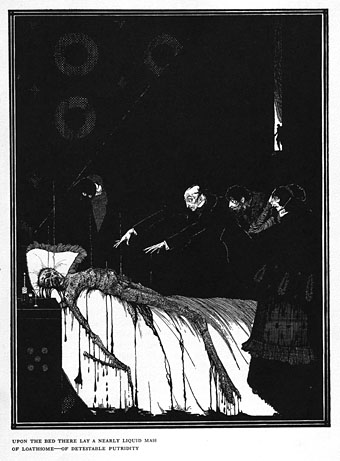
The Facts in the Case of M Valdemar (1919) by Harry Clarke.
Harry Clarke scholar Nicola Gordon Bowe proposed in The Life and Work of Harry Clarke (1989) that the figure in the background of this Poe illustration was a version of Don José. Clarke’s picture also has a similar grouping of foreground figures which adds to the speculation. The division of space in the Velázquez painting would have held considerable appeal for an artist used to dealing with similar divisions in his stained glass window designs. Will at A Journey Round My Skull recently uploaded a set of high-resolution scans of Clarke’s Poe drawings and paintings.

Las Meninas (after Velazquez) (1957) by Pablo Picasso.
In the 1950s Picasso took to producing a series of variations on favourite paintings. There are 44 versions of Las Meninas, some more abstract than others. This one reminds me of Guernica and I like the humour of presenting Velázquez’s dog—one of the great dogs of art history—as though it’s been drawn by Nicolas Pertusato, the child who attempts to rouse the animal with his foot. Velázquez here has a head surmounting a spindly body comprised of the Order of Santiago cross.
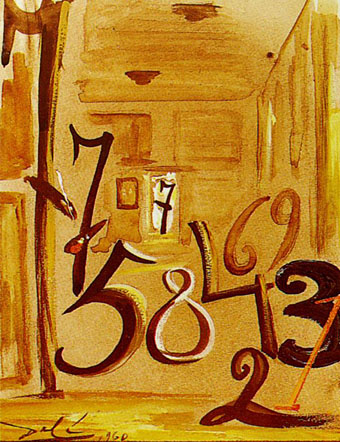
Las Meninas (1960) by Salvador Dalí.
Salvador Dalí venerated Velázquez and he happily quoted other artists throughout his career so it’s no surprise to find variations of Las Meninas. This wins the award for the most eccentric, with the figures reduced to numerals. Closer examination shows it to be quite clever the way each number corresponds to a different figure. The use of the number 7 for the artist and for Don José makes sense when you consider that they share the same surname. Don José turns up alone is another painting the same year, a work entitled Maelstrom: Portrait of Juan de Pareja fixing a string of his mandolin.
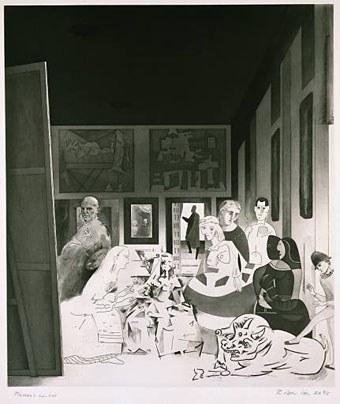
Picasso’s Meninas (1973) by Richard Hamilton.
Richard Hamilton’s aquatint is equally playful, substituting Velázquez with Picasso and his works.
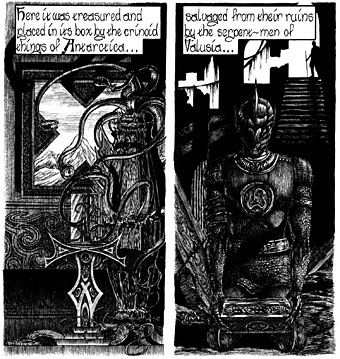
The Haunter of the Dark (1986).
I seem to have referred to my own work quite a lot recently, and here’s some more of it. The panel on the right quotes from Harry Clarke’s Poe illustration and so can be considered as continuing a trace element of the shadowy Don.

Las Meninas (Self Portrait) (1987) by Joel-Peter Witkin.
Joel-Peter Witkin has quoted Picasso’s works frequently in his photo-tableaux so the Picasso-esque figure on the right is perhaps inevitable. Witkin also has a considerable fondness for dead things so it’s quite likely that the dog in this photograph isn’t sleeping.
I’ll be surprised if there haven’t been a lot more variations during the past twenty years. If anyone knows of any which are better than this item by Antonio Guijarro Morales, please leave a comment.
Previously on { feuilleton }
• Picasso-esque
• Reflections of Narcissus
• My pastiches
• Guernica, seventy years on
• The art of Harry Clarke, 1889–1931
Along the shore the cloud waves break,
The twin suns sink beneath the lake,
The shadows lengthen
In Carcosa.Strange is the night where black stars rise,
And strange moons circle through the skies
But stranger still is
Lost Carcosa.The King in Yellow, Act i, Scene 2.
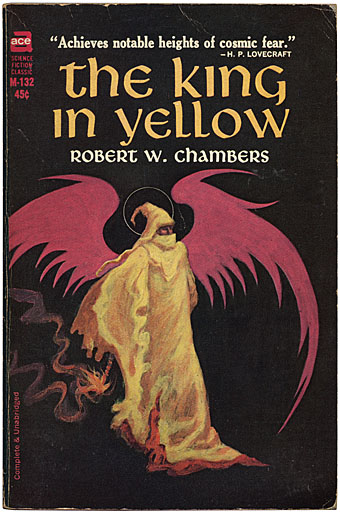
Rearranging the bookshelves this week had me looking again at this old Ace paperback of Robert Chambers’ weird classic, one of that select handful of books which can bear a blurb from HP Lovecraft. Any Lovecraft aficionados yet to read the first four stories in Chambers’ collection (the others pieces are of lesser interest) are missing out. These are as good as anything that Weird Tales published and together they achieve that unique blend of science fiction, fantasy and horror which Lovecraft and others also managed in the days when writers, and readers for that matter, were far less concerned with the definition and boundaries of genre.

My Ace edition was the first paperback printing from 1965 and the cover painting is by Jack Gaughan, credited inside as being based on Chambers’ own first edition design. I’d often wondered what the original cover looked like and now, of course, it’s easy to find. Whether Chambers himself drew this is unclear but whoever the artist was, the design is rather more finessed than Gaughan’s sketchy painting.
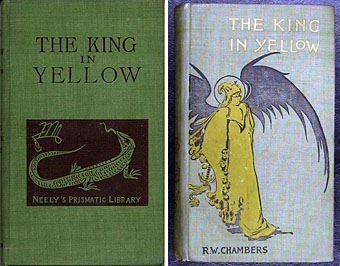
Searching around reveals two further variations, one of which—the green cover—is described on a bookselling site as the actual first edition of the book from 1895. Yours for a mere $1,750. The other cover is probably a later reprint which gives a clearer view of the mysterious King. What’s notable here is the curious sigil on both the Neely editions. I was hoping this might be the dreaded Yellow Sign which is the subject of Chambers’ fourth (and Lovecraft’s favourite) story; it’s certainly more suitable than the squiggle which seems so unaccountably popular among certain quarters of Lovecraft fandom. It isn’t the Yellow Sign, however, it turns out to be the monogram for publisher F. Tennyson Neely. Perhaps this is just as well. “The solution to the mystery is always inferior to the mystery itself,” as Borges said, and some things, like the malevolent play which gives its name to this collection, are best kept out of reach.
• The King in Yellow at the Internet Archive
Elsewhere on { feuilleton }
• The book covers archive
• The Lovecraft archive
Previously on { feuilleton }
• Arthur Machen book covers
• Clark Ashton Smith book covers
TS Eliot: Guru-in-chief | The poet as editor and businessman.
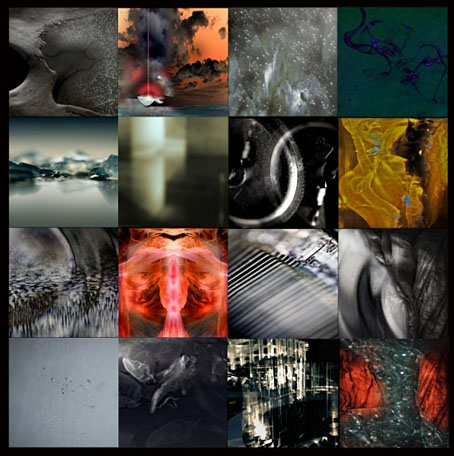
One of the drawbacks with recommending Paul Schütze‘s music lately has been a lack of availability, with most of his CDs being out of print. That changes this month with his back catalogue returning via iTunes sporting a range of impressive new artwork (above) created by Mr Schütze himself.
Schütze’s electronic music stood out for me in the mid-Nineties for a number of reasons: firstly, and most obviously, it wasn’t always tied to the rigid metronomic pulse which governed the rest of the dance world. There were 4/4 beats at times—and he even had an album on Belgian dance label Apollo under the anagrammatical pseudonym Uzect Plausch—but his music was equally subject to unusual time-signatures with chiming timbres borrowed from gamelan orchestras.
Those timbres and their attendant tropical atmospheres were a second point of distinction. Like Jon Hassell, to whom he pays homage on Stateless (1997), there’s an acknowledgement of non-Western music without any falling into pastiche. This realises one aspect of Hassell’s Fourth World concept, whereby a meeting of the First World and the Third World creates an exclusive temporary zone that nonetheless can’t exist without the contribution of either party.
A third distinction would require a detailing of Schütze’s notable collaborators—Bill Laswell and Raoul Björkenheim among them—and his inventive track titles, many of which sound like Surrealist paintings. But describing music is always a poor thing compared to experiencing it. If you want a place to start, I’d recommend New Maps of Hell II: The Rapture of Metals (1993; reissued 1996) or Abysmal Evenings (1996), two constant favourites.
Previously on { feuilleton }
• The art of Josiah McElheny
• The Garden of Instruments