Sounds off the Beaten Track

womad1.jpg

In 1987 the Glastonbury Festival opened its WOMAD stage for the first time to provide a showcase for the kind of acts you might expect to see at the separate World Of Music And Dance festival. Sounds off the Beaten Track is a 52-minute TV documentary about the acts who appeared on the WOMAD stage at Worthy Farm that year, and also about the WOMAD ethos itself, a project inaugurated in 1980 by Peter Gabriel and others to give greater prominence to musicians from all over the world. One of the WOMAD initiators, Mark Kidel, also directed the film, while co-founders Peter Gabriel and Thomas Brooman talk on camera. The film captures the Glastonbury Festival at a time when it was still a relatively small and rather ramshackle affair, closer to its hippy roots, and very different from the sprawling tent city of later years.

womad2.jpg

The main interest, however, is the music, especially the amount of time given to the Burkina Faso group, Farafina, and to Jon Hassell, whose Flash Of The Spirit collaboration with Farafina was released the following year. This was the first I saw of Hassell on TV, and also the last until he turned up much later as a guest on MTV’s Seal Unplugged session. I remembered the Farafina performance but I’d forgotten that Hassell also talks a little about his Fourth World idea. Among the other featured artists are The Bhundu Boys, Toumani Diabaté, Amadu Bansang Jobarteh, The Inspirational Choir, and Najma Akhtar who subsequently appeared on another unplugged (or partly plugged) session with Jimmy Page and Robert Plant. Jon Hassell had been under the WOMAD umbrella since 1982 via the excellent Music And Rhythm compilation album which included an exclusive live recording of Ba-Benzélé. He was often critical of the “world music” marketing label, seeing it as a convenient way for record companies and music sellers to appear to be supporting musical diversity while placing all the non-Anglophone recordings in a ghetto area away from everything else. He preferred to talk of “worldly music”, an idiom that was of the world, uncloistered, freed from the ghetto; music where the beaten and unbeaten tracks might combine to form a new highway.

Previously on { feuilleton }
Jon Hassell, 1937–2021
Jon Hassell, live 1989
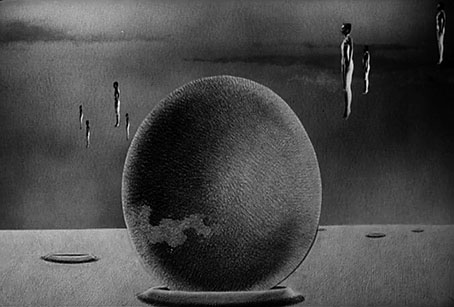
Power Spot by Michael Scroggins

Hands with a mind of their own

orlac1.jpg

My weekend viewing included two films based on The Hands of Orlac (1920), a novel by Maurice Renard. This is one of those books that remains little read and seldom discussed even though its central idea—a concert pianist injured in a train wreck is given the hands of an executed murderer in a transplant operation—has prompted many film adaptations, almost enough to make the novel the origin of a sub-genre of hand-transplant horror. Robert Wiene’s The Hands of Orlac was the first screen adaptation made in 1924, and is another in the long list of silent films I’ve known about for decades but had to wait until now to see. The film is notable for reuniting the director of The Cabinet of Dr Caligari with Conrad Veidt, the actor who portrayed Caligari’s murderous somnambulist, Cesare, in a mute role that mostly required stalking around acutely-angled sets in a black body stocking.

orlac3.jpg

The Hands of Orlac: Paul Orlac (Conrad Veidt) is besieged by nightmares in his colossal hospital room.

Veidt has much more to do as the lead in The Hands of Orlac, giving a suitably tormented performance as the pianist convinced that his new hands retain the violent impulses of their former owner. The acting from Veidt and Alexandra Sorina as Orlac’s wife, Yvonne, is often wildly emotive, surprisingly so for a film made near the end of the silent era when the mannerisms of early silent pictures were being replaced by greater naturalism. Lotte Eisner in The Haunted Screen explains this in terms of the Expressionist influence which was still prevalent in German cinema, and which extends beyond lighting and set design. A scene in which Orlac is overwhelmed by his predicament is described by Eisner as “an Expressionist ballet”; when Orlac holds a dagger aloft this becomes an unmistakable mirroring of a climactic moment in Caligari.

orlac5.jpg

Continue reading “Hands with a mind of their own”

Weekend links 574

vyletal09.jpg

Poster for Beauty and the Beast (1978) by Josef Vyletal.

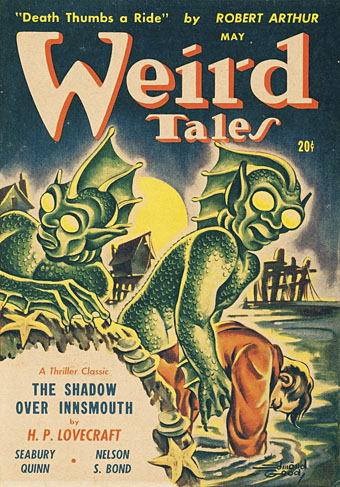
• Next month, Second Run release Juraj Herz’s 1978 adaptation of Beauty and the Beast on region-free blu-ray. I watched this last year on a Czech DVD so it’s good to hear it’s being given an upgrade. Herz’s film is a distinctly sinister take on the familiar tale, with a bird-headed Beast that’s closer to Max Ernst than anything you’ll find in illustrations for Perrault’s stories.

• “In a coincidence so unlikely it almost seems, well, magical, the girls traced illustrations from a book of folklore that also contained a short story by Sir Arthur Conan Doyle himself, a reflection of a reflection of a reflection.” Audrey Wollen on the Cottingley fairy photographs. Related: The Coming of the Fairies by Arthur Conan Doyle.

• “[Mark E. Smith], with his love of Stockhausen, HP Lovecraft, and (bizarrely) the sitcom Keeping Up Appearances, becomes a reverse coder, an apostle of avant pulp, a ‘paperback shaman’.” Sukhdev Sandhu reviews Excavate! The Wonderful and Frightening World of the Fall, edited by Tessa Norton and Bob Stanley.

• “Found photos of men in love from 1850–1950“. Maybe. As before, I’m always cautious about imposing a narrative on old photographs.

• Mixes of the week: A mix for The Wire by Pamela Z, and a dose of post-punk esoterica by Moin for XLR8R.

DJ Food takes another dive into back issues of International Times in search of ads for London’s Middle Earth club.

• At The Smart Set: Colin Fleming watches John Bowen’s drama of pastoral horror, Robin Redbreast.

• At Dennis Cooper’s: Heavily plotted non-linear structures whose velocity lacks narrative drive.

Ryan Gilbey attempts to rank Robert Altman’s features into a list of 20 best.

• Still Farther South: Poe and Pym’s Suggestive Symmetries by John Tresch.

• New music: At One Point by Scorn.

Visionist‘s favourite albums.

The Beast (1956) by Milt Buckner | Leggo Beast (1978) by Gregory Isaac’s All Stars | This Beast (1983) by Tuxedomoon

Paul Delvaux ou les Femmes Défendues

delvaux1.jpg

Henri Storck’s short film from 1971 is mostly an overview of Paul Delvaux’s irreducibly mysterious paintings but the first 7 minutes are invaluable for the views they give of the artist at work. I’m always interested in the technical details of painting but these are seldom mentioned in art books which tend to be more concerned with discussions of meaning and artistic intent. So here we see Delvaux sketching, then leafing through a collection of preliminary studies before finally dabbing at a figure on a large canvas in his skull-filled studio.

delvaux2.jpg

The rest of the film is taken up with shots that roam over many of the artist’s earlier paintings. I don’t have any books about Delvaux so there are more of his pictures here than I’ve seen in one place, all of them displaying the familiar nocturnal enigmas: somnambulist nudes, trains, moonlight, Classical architecture and so on. The voiceovers, including that of the artist, are in unsubtitled French but the film is available with subtitles as part of a DVD collection of films about Belgian artists and cultural figures directed by Storck and others. One for the shopping list.

Previously on { feuilleton }
Raoul Servais: Courts-Métrages
The mystery of trams
Temptations
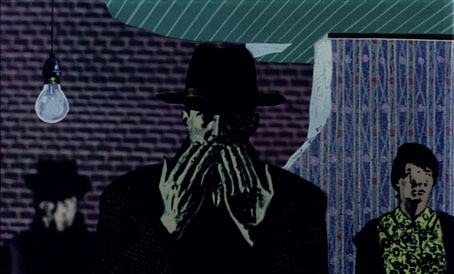
Papillons de Nuit, a film by Raoul Servais
Paul Delvaux: The Sleepwalker of Saint-Idesbald
Ballard and the painters
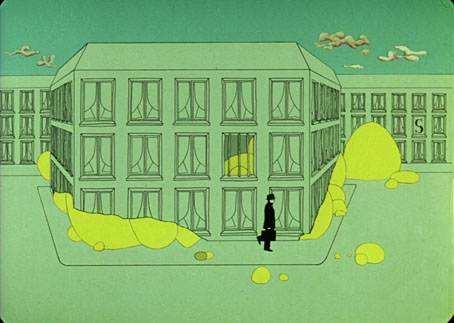
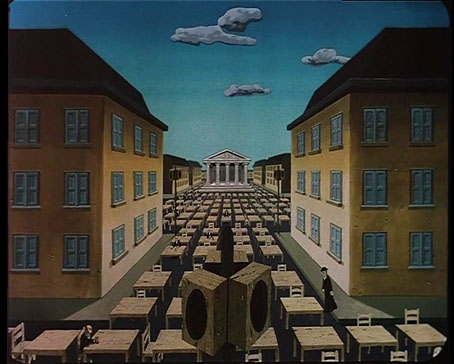
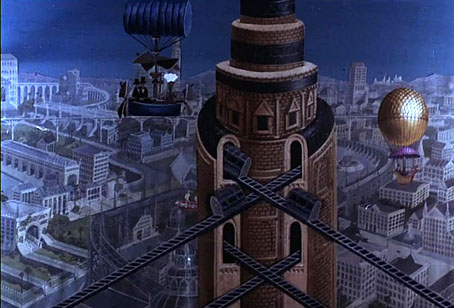
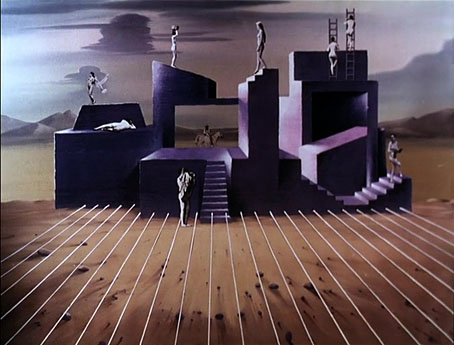
Taxandria, or Raoul Servais meets Paul Delvaux

Weekend links 571

valck.jpg

Habit d’Astrologue (c. 1700) by Gerard Valck.

• “The Appointed Cloud begins with the high-pitched, keening sound of many bagpipes noisily playing at once—and then the music slowly coalesces, approaching a peaceful, tranquil hum. This gives way to fast-paced repetitive pulses, reminiscent of the minimalist works of composers such as Terry Riley and Philip Glass. Then the bagpipes join in once more, in a ferocious swarm of energy.” Geeta Dayal on the music of Yoshi Wada.

• “How can we conceive of the time of climate change, the time of planetary death? The House on the Borderland tried to conceive of exactly this a century ago. Yes, the narrator’s acts are fruitless. He gets haplessly carted about the universe to witness the end of time, which never really ends, is always at the edge, nearing an asymptote, on the borderland.” Namwali Serpell journeys through space and time with William Hope Hodgson.

• The Bureau of Lost Culture: DJ Food hosts a podcast discussion with Tony Bennett, founder and publisher of Knockabout Comics.

• Mixes of the week: Isolated Mix 111 (plus interview) by Ian Boddy, and a Wire mix (plus interview) by Teresa Winter.

• Fantastic visions and unknown worlds: Edwin Pouncey on Van Der Graaf Generator’s sleeve art.

• At Spoon & Tamago: Sculptor Kenichi Nakaya reconfigures ubiquitous Japanese rural crafts.

• My Bloody Valentine’s Kevin Shields: “We wanted to sound like a band killing their songs.”

• At Wormwoodiana: More earth mysteries are explored in Northern Earth magazine.

• New music: Black Horses Of The Sun by Dave Bessell.

The Exotica Project: One Hundred Dreamland 45s

• At Dennis Cooper’s: Hans Richter Day.

Mdou Moctar‘s favourite music.

Earth Floor (1985) by Michael Brook | Earth Tribe (1993) by Transglobal Underground | Earth Lights (2012) by Belbury Poly