Strange Attractor Salon

tarot.jpg

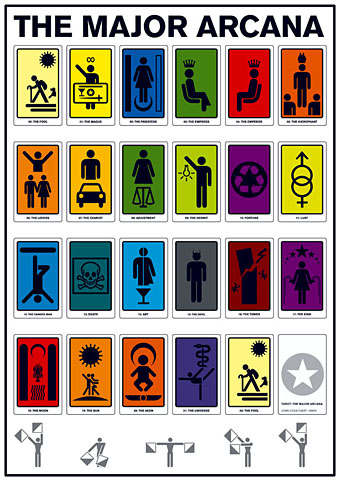
Some of my work makes a rare appearance in the gallery world next month as part of the Strange Attractor Salon at Viktor Wynd Fine Art, London. The Major Arcana (2006) will be one of the designs on display as a large print with its occult theme complementing the esoteric tenor of the exhibition. Not sure how busy I’ll be in the New Year but I may be down there for the opening on the January 7th.

The first Strange Attractor Salon will be held at Viktor Wynd Fine Art (incorporating The Little Shoppe of Horrors), 11 Mare Street, London, UK, E8 4RP, between 7 and 31 January 2010. The exhibition will gather together, for the first time, a selection of art and illustration from Strange Attractor’s contributors, friends, allies and inspirations.

Like our books and events the Salon will incorporate a wide range of media (painting, drawing, photography, sculpture, sound and video) from both trained and untrained artists. The assembled exhibitors all share Strange Attractor’s fascinations with inner space, craft, science (natural and unnatural) and the fantastic.

Confirmed contributing artists are:
Joel Biroco * Richard Brown * Ossian Brown * John Coulthart * Rod Dickinson * Disinformation * Tessa Farmer *Blue Firth * Alison Gill * Doug Harvey * Josephine Harvatt * Stewart Home * Julian House * Ali Hutchinson * Alyssa Joye * Maud Larsson John Lundberg * Eleanor Morgan * Drew Mulholland * Katie Owens * Edwin Pouncey * Arik Roper * Gavin Semple * Martin Sexton * Catharyne Ward  * Eric Wright *

Previously on { feuilleton }
SAJ again
Strange Attractor Journal Three
The Major Arcana

Winter light

friedrich1.jpg

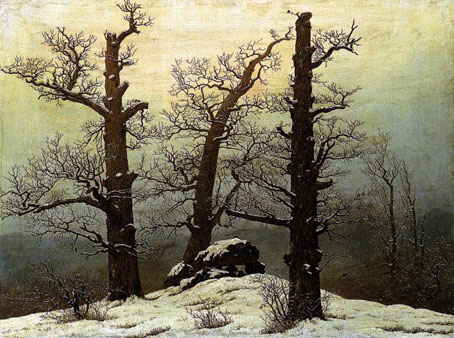
Dolmen in the Snow (1807).

Some paintings for the Winter Solstice by one of my favourite Romantic artists, Caspar David Friedrich (1774–1840). Snow scenes tend to inspire picturesque cliché but in Friedrich’s paintings winter is merely another season in which to evoke his Christian mysticism through the depiction of landscape. The pagan dolmen above is an unusual subject, far more common are churchyard ruins and mountainside crosses although he was also happy enough painting luminous landscapes, especially of mountains and the sea. His treatment of natural light is quite extraordinary and his photo-realist style makes an interesting contrast with the similar effects captured by JMW Turner‘s palette of blurs and smears.

friedrich2.jpg

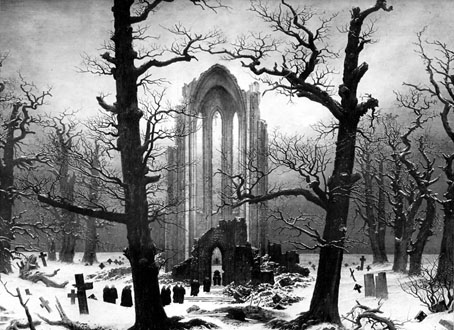
Monastery Graveyard in the Snow (1819).

I hadn’t noticed before until I looked through some online galleries that Friedrich was painting the same trees over and over. The gnarled trunks in the dolmen painting are almost identical (but reversed) to the foreground trees in the graveyard picture and similarly-shaped trees occur in other paintings. If you’re wondering why the graveyard picture is in black and white, the original was destroyed during the Second World War. Colour copies can be found but I think these may have been tinted from a monochrome photo print.

friedrich3.jpg

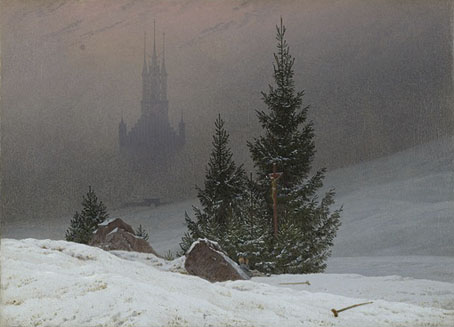
Winter Landscape (1811).

Previously on { feuilleton }
Winter Solstice
The art of John Atkinson Grimshaw, 1836–1893
The art of Karl Friedrich Schinkel, 1781–1841

The tights have it

slimane.jpg

In which the marvellous Hedi Slimane captures dancer Oscar Nilsson resting during a performance involving a percussive score tapped out by someone wearing a bear’s head. (Video here and here.) There’s probably a joke to be made there about bears and twinks but you won’t find me attempting it.

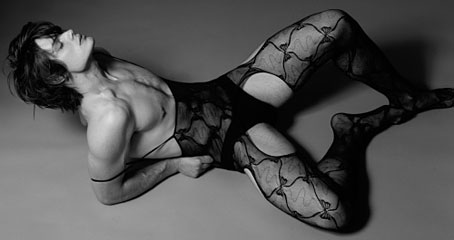
The picture below is from a fishnets session photographed by Bell Soto. Both links are from Homotography which continues to be an essential curator of male pulchritude.

soto.jpg

Previously on { feuilleton }
Torero
Eonism and Eonnagata
Tiger Lily
Chris Nash
Peter Reed and Salomé After Dark
Felix D’Eon
Dancers by John Andresen
Youssef Nabil
Images of Nijinsky

Dan O’Bannon, 1946–2009

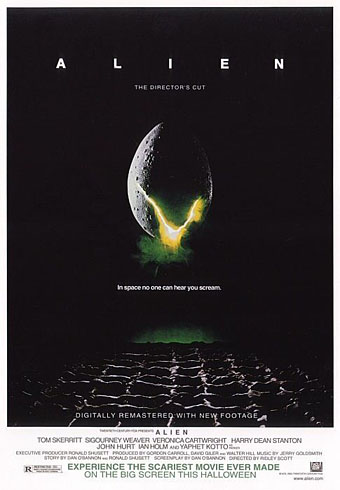
alien.jpg

Re-release poster by Bemis Balkind.

Alien was a big deal for me when it appeared in late 1979, one of those films that seems to arrive at exactly the right moment. I’d just left school, I was eagerly reading reprints of French and Belgian comic strips in Heavy Metal magazine, and also paperback reprints of science fiction stories from New Worlds; I was listening to Hawkwind and becoming increasingly obsessed with HP Lovecraft. I was, in short, the target audience for a serious SF-themed horror film with contributions from major artists like HR Giger and Jean “Moebius” Giraud, and I went to see it three times in a row.

Watching Star Wars two years earlier (for which Dan O’Bannon created the computer displays), I’d enjoyed the special effects but been disappointed by its space-opera tone and dumb heroics. HR Giger’s large-format Necronomicon art book was published in the UK the same year and the sight of his work was a revelation for the way it pushed Dalí-esque Surrealism to a pitch of unprecedented mutation and malevolence. A year later his paintings were appearing in Omni magazine but it was Alien which exploded his popularity. Throughout 1979 you could hardly open a magazine or newspaper without finding a Giger interview or examples of his work. Alien benefited from the SF boom that Star Wars generated but Dan O’Bannon didn’t need George Lucas’s feeble mythology to point him towards science fiction, he’d already made one low-budget sf film, Dark Star, with John Carpenter, and was planning the effects for Jodorowsky’s ill-fated Dune project years before the world had heard of Luke Skywalker. Dune introduced him to Moebius, and the pair collaborated on an SF-noir strip, The Long Tomorrow, which was published in Heavy Metal in 1977. But it was Giger’s connection with the Dune project which proved crucial for Alien:

“(Dune) collapsed so badly,” O’Bannon says, “that I ended up in L.A. without any money, without an apartment, without a car, with half my belongings back in Paris and the other half in storage.”

He retreated to the sofa of a friend, screenwriter Ron Shusett, and didn’t leave it for a week. But depressed or not, O’Bannon knew he had to get back to work. He got his files and typewriter out of storage, and he and Shusett went to work on stacks and stacks of partially completed ideas.

“We pulled out one that I liked very much,” he says, “an old script called Memory that was half-finished and was basically what the first half of Alien is now. I told Ron I’d never been able to figure out the rest of the story. So he read it and said, ‘Well, you told me another idea you had once for a movie. It was the one where gremlins get onto a B-17 bomber during World War II and give the pilots a lot of trouble. So why don’t you make that the second half and put it on a spaceship?’

“That was a great idea, but then we had to figure out the monster. Well, I hadn’t been able to get Hans Rudi Giger off my mind since I left France. His paintings had a profound effect on me. I had never seen anything that was quite as horrible and at the same time as beautiful as his work. And so I ended up writing a script about a Giger monster.”

The working title was Star Beast. O’Bannon had a fortunate brainstorm late one night as he continued to write while Shusett slept. “I was writing dialogue and one of the characters said, ‘What are we going to do about the alien?’ The word came out of the page at me and I said, ‘Alien. It’s a noun and an adjective.’ So I went in the other room and shook Ron awake and told him and he said, ‘Yeah, OK,’ and went back to sleep. But I knew I had found a really hot title.”

The Book of Alien (1979) by Paul Scanlon and Michael Gross

Lest we forget, it was O’Bannon who insisted that Ridley Scott look at Giger’s work during the production of the film after artist Ron Cobb failed to produce a sufficiently nightmarish creature. O’Bannon’s script was mauled by Walter Hill who removed sub-plots, and further scenes were trimmed to speed the pace, but Alien‘s unique atmosphere remains as potent today as it was in 1979. It’s ironic that O’Bannon died in the week that James Cameron’s Avatar (which happens to star Sigourney Weaver) is released. To watch all four Alien films in sequence is to witness progressively diminishing returns, and it was Cameron’s sequel which set the pattern for the later films by dropping the adjective part of the O’Bannon’s title in favour of the noun. There had been plenty of movie monsters before but it was the inhuman quality which we label “alien” that O’Bannon and Giger brought to SF cinema. It’s a quality that few have been able to deliver since, not least in Avatar which (from what I’ve seen) looks less alien than something Frank R Paul might have painted in the 1930s. O’Bannon did a lot more after Alien, of course, but it’s his first big success which will always mean the most to me. I recommend Ridley Scott’s director’s cut from 2003 which restored scenes and shots removed from the original release.

Remembering the late, great Dan O’Bannon
The first action heroine: Ellen Ripley and Alien, 30 years on

Previously on { feuilleton }
Alejandro Jodorowsky’s Dune
The monstrous tome

More Steampunk and the Crawling Chaos

steampunk1.jpg

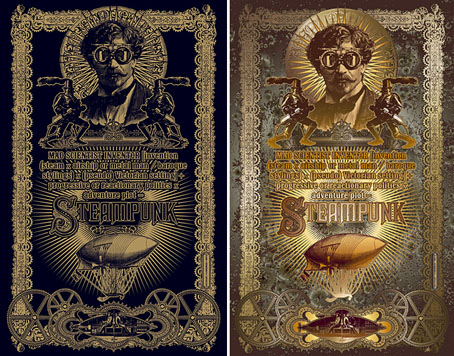
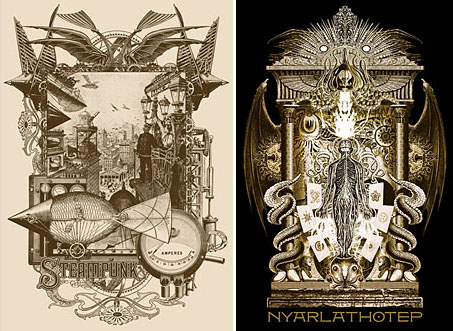
Yes, it’s these again, and no, I’m not posting them because it Christmas (although you probably don’t believe that). This is the first opportunity I’ve had to add the designs to CafePress after letting them sit for a while seeing as they’re all still available on Modofly’s book range. I’ve had queries recently for the Steampunk designs as poster prints so these are now available in the usual CafePress sizes of large, small and mini. There’s also a range of CafePress t-shirts, and if you’d like one of those they have a bewilderingly extensive choice. The four pieces are:

Steampunk | CafePress shop
Steampunk Redux | CafePress shop
Steampunk: Life in Our New Century! | CafePress shop
Nyarlathotep: the Crawling Chaos | CafePress shop

steampunk2.jpg

While we’re on the subject of Coulthart merchandise, I haven’t mentioned that I’ve discontinued selling signed prints for the time being so CafePress is now the sole place to get a print of anything. I’ve been so busy recently that keeping up with print orders was becoming a serious problem, in addition to never having been very lucrative in the first place. CafePress has excellent printing and can produce things at a large size a lot more cheaply than I’d be able to manage. This doesn’t rule out signed prints altogether but in future they’ll probably be strictly limited editions, signed and numbered. Any developments along those lines will be announced here.

Previously on { feuilleton }
New Modofly books
Nyarlathotep: the Crawling Chaos
Steampunk Redux
Steampunk framed
Steampunk Horror Shortcuts