The art of Johfra Bosschart, 1919–1998

johfra1.jpg

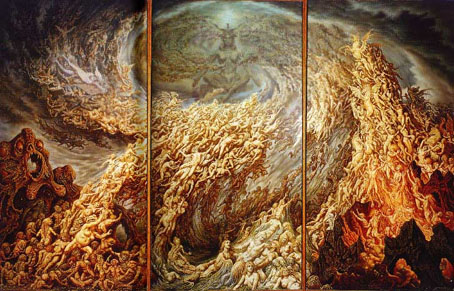
The Adoration of Pan triptych (1979).

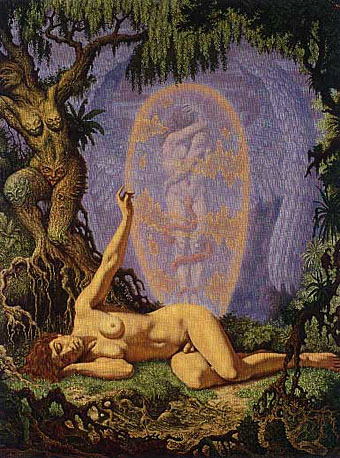
The hyper-detailed paintings of this Dutch artist, who often seems to be referred to by his forename alone, were self-described as “Surrealism based on studies of psychology, religion, the Bible, astrology, antiquity, magic, witchcraft, mythology and occultism”. All bases are covered, in other words, and the work is certainly furious and intense at its best even if it’s not always to my taste. Some of Johfra’s Monsters from the Id are closer to Basil Wolverton than HR Giger which makes for unintentional comedy. As usual with detailed artwork, it’s a shame the reproductions on offer aren’t a larger size.

johfra2.jpg

Moldoror series: The Hermaphrodite (1976).

The pictures here are from one of the online numbers of Visionary Review which a biography and several galleries of work from different periods of Johfra’s career. Thanks to Thom for the reminder about this artist.

Elsewhere on { feuilleton }
The fantastic art archive

John Dee’s Monas Hieroglyphica

monas1.jpg

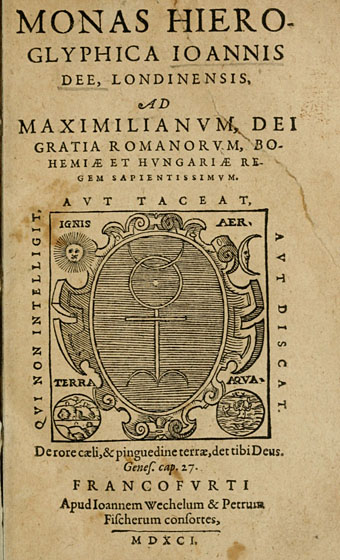
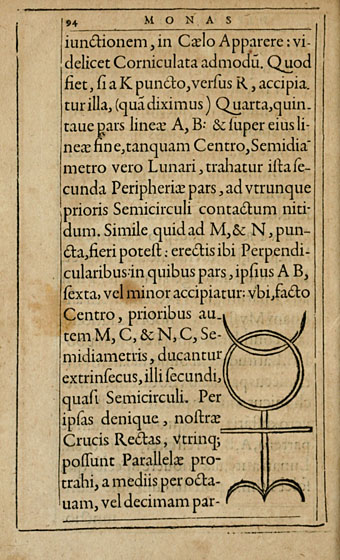
I swear I didn’t go hunting for this. Among the various library collections at the Internet Archive one can find The Getty Alchemy Collection, a substantial gathering of very old alchemical texts scanned in a variety of formats. John Dee’s Monas Hieroglyphica caught my eye during a random search, a third edition of his treatise from 1564 in which he describes his Monas Hieroglyphica, a glyph designed to combine symbols of the Sun, the Moon, the Elements and Fire in a single figure.

monas2.jpg

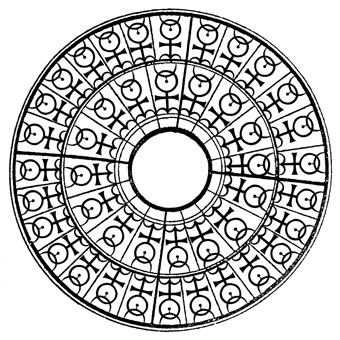
The glyph also intentionally resembles a human form, and Dee relates its individual parts to various astrological and chemical symbols. I’ve mentioned before that Dee scholar Derek Jarman deliberately based Prospero on John Dee in his 1979 film of The Tempest, giving the magus a scrying wand shaped to resemble the Monas Hieroglyphica.

monas3.jpg

I produced my own variations on the glyph in 2009 when working on the cover of Jeff VanderMeer’s novel, Finch. The symbol recurs in Jeff’s fictional city of Ambergris and I seem to recall there being some discussion about including this doorway design somewhere in the book. In the end it was incorporated into the cover design in a rather subtle fashion. I think this is the first time the design alone has appeared in public.

The Internet Archive has a few other Dee-related items, including Lists of manuscripts formerly owned by Dr. John Dee; with preface and identifications (1921), a 500-page book by antiquarian and ghost story writer MR James.

Previously on { feuilleton }
Mister Jarman, Mister Moore and Doctor Dee
Alchemically Yours
Laurie Lipton’s Splendor Solis
The Arms of the Art
Splendor Solis
Amphitheatrum Sapientiae Aeternae
The Tempest illustrated
Cabala, Speculum Artis Et Naturae In Alchymia
Digital alchemy
Designs on Doctor Dee

Clive Hicks-Jenkins: A Retrospective

chj1.jpg

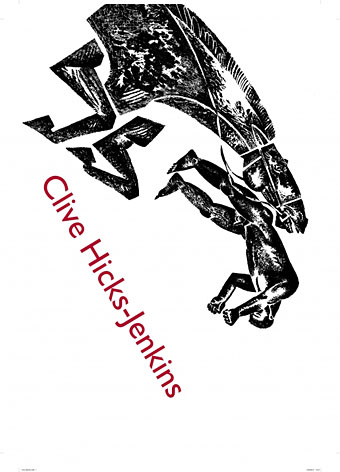
I know I’m not the only person capable of grumbling about London’s monopoly on art exhibitions so I’m a little mortified to find I’ve not mentioned Clive Hicks-Jenkins: A Retrospective, an exhibition which has been running at the National Library of Wales, Aberystwyth, since May. There’s no excuse for the oversight since I read all of Clive’s blog posts and most of the recent ones have concerned the exhibition and an accompanying monograph published by Lund Humphries.

chj2.jpg

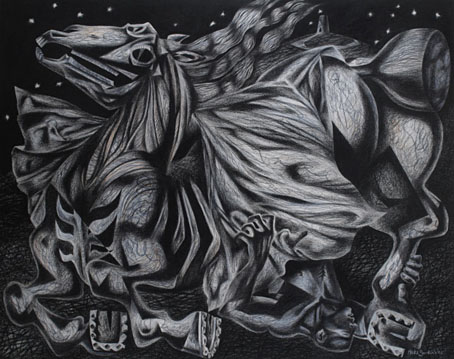
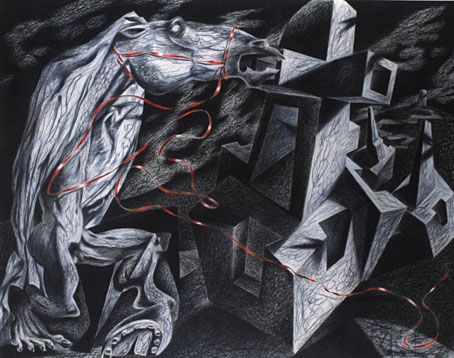
Both Fall (2001).

Among the pieces on display are some of his large Mari Lwyd drawings from 2001, two of which are shown here. I think these were the first works I saw of Clive’s and they remain favourites of mine despite their sombre subject matter. The combination of Picasso-like figures, disjunctive perspectives and monochrome nocturnal landscapes make for a very powerful series which Clive discusses in recent blog posts. Not everyone who’s this good with monochrome can handle a combination of tones effectively but Clive’s recent paintings use colour in a manner which is both confident and immediately striking. Form is Void has a small collection of some recent works but if you can get to Aberystwyth you can see them up close. Clive Hicks-Jenkins: A Retrospective runs to August 20th, 2011.

chj3.jpg

Red Flow (2001).

Previously on { feuilleton }
Equus and the Executionist
Dark horses

Ceramic Buddha Machines

fm3.jpg

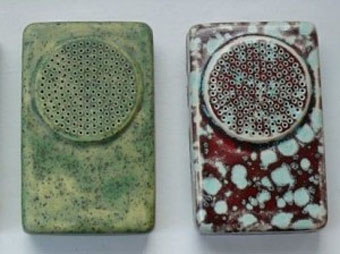
The experimentalists at Fm3 continue to impress with their commitment to unorthodox music delivery when the trend remains digital and ephemeral. Back in April they announced a new line of ceramic-bodied players for their series of Buddha Machines, that essential collection of ambient loops in a case the size of a box of matches. The new players will be available at the end of the year. Being ceramic they’re probably a little less portable than the plastic versions, and might also be more fragile. For durability and retro cachet I would have opted for Bakelite if that material is still being manufactured anywhere. (It seems it is, thanks Wikipedia.)

Back in the digital and ephemeral world, Fm3 also have a Buddha Machine app for iPhones and iPads. If that seems to defeat the object of the loops being encased in a box of their own you do at least have the option of mixing six of the machines at once. For an idea of how far the mixing and extrapolation of these sounds can be taken, Robert Henke’s two ambient mixes of Buddha Machine samples from 2007 and 2008 are still available as free downloads on his website.

Previously on { feuilleton }
Gristleism
Uncopyable
Buddha Machine Wall
God in the machines
Layering Buddha by Robert Henke

Weekend links 68

dorosheva.jpg

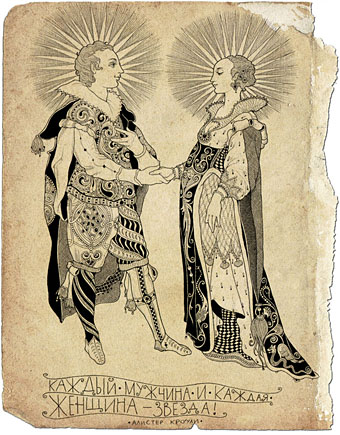
Every man and every woman is a star by Sveta Dorosheva.

• Matt Taylor (illustration) with Gregg Kulick and Paul Buckley (design) provide new Penguin covers for John Le Carré. I love the look which seems inspired by Daniel Kleinman’s title sequence for Casino Royale even if it doesn’t quite suit the shabby world of George Smiley and the Circus.

[Deborah Kass] told me that when she was going to art school in the ’70s, she tripped on LSD almost every week and she said she felt it was her “moral duty as an artist to take the trip.” […] I think psychedelic experience makes you think that there are multiple realities, that there isn’t just this one normal real world to which we’re supposed to conform, but that the reality changes depending on the state of consciousness that we’re in when we’re experiencing it. So, any different kind of art kind of posits a different reality. (more)

New York Times art critic Ken Johnson discussing his new book Are You Experienced?: How Psychedelic Consciousness Transformed Modern Art.

• “That got me thinking that evolution really isn’t survival of the fittest, when it comes to these things, it is more like survival of the interesting, survival of the beautiful, survival of the weird, cool stuff that managed to evolve.” Laurie Anderson and David Rothenberg discuss music and animals.

• Laura Cumming on the late Lucian Freud. And Stephen Heller on Alex Steinweiss, the originator in 1939 of the artistic record sleeve who also died last week.

• Alan Moore says “Think Locally: Fuck ‘Globally'”. He and Queen Calluz explain how Dodgem Logic magazine puts their ideas into practice.

Adam Curtis gets interviewed while Alan Bennett returns to Armley Public Library in Leeds.

Peacock’s Garden, a celebration of pavonine splendour.

• A visit to Seher Shah’s studio in Brooklyn, New York.

• Maximum androgyny at Epicenity, a Tumblr.

Does your god have a penis?

Chrysalide (1978) is an album of “cosmic” guitar instrumentals by Michel Moulinié which sounds at times like a French equivalent of Manuel Göttsching. It’s never been released on CD but a copy can be found here.