Troutsdale Press bookplates

troutsdale4.jpg

Amy M Sacker.

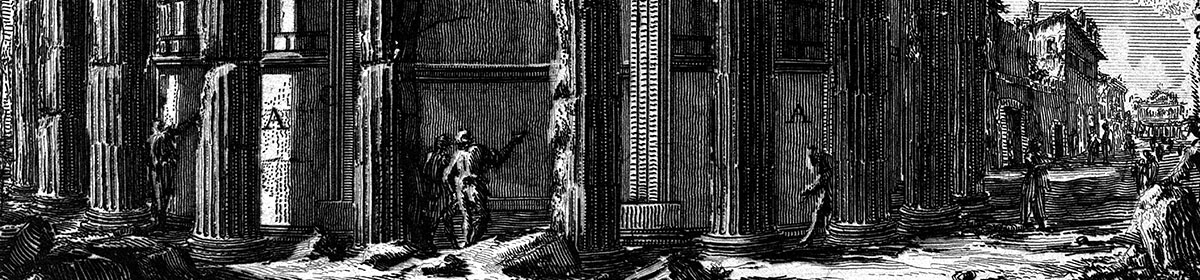
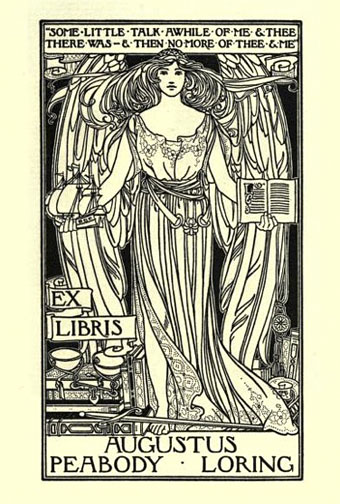
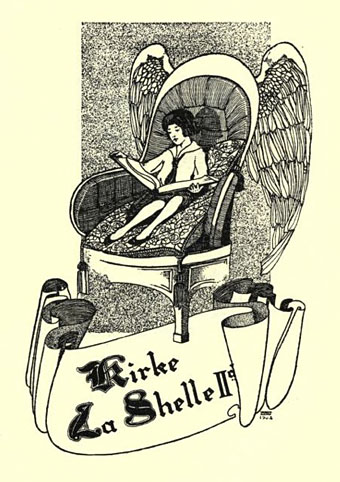
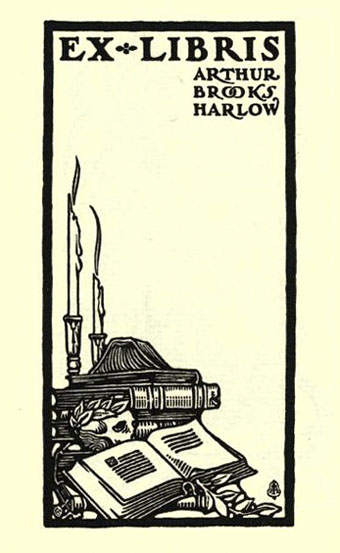
The work of four bookplate artists printed by the Troutsdale Press, Boston, in 1903 and 1904 is contained in these small volumes at the Internet Archive. None of the artists featured are names I’d come across before. Amy M Sacker’s work is of note for being that of a woman given equal status among her male colleagues, and a nice clear-line style reminiscent of Walter Crane. The short text at the beginning of her volume runs through the history of the female contribution to bookplate art, drawing the conclusion (in the usual chauvinistic terms of the period) that women can indeed compete with men at this game.

Amy M Sacker | Elisha Brown Bird | F Arthur Jacobson | Adrian J Lorio

troutsdale1.jpg

The artist’s own bookplate by Elisha Brown Bird.

troutsdale2.jpg

F Arthur Jacobson.

troutsdale3.jpg

Adrian J Lorio.

• At the LA Times: What’s sticky and can be found in old books?

Previously on { feuilleton }
Bookplates from The Studio
Yuri Yakovenko bookplates
Tranquillo Marangoni bookplates
Book-plates of To-day
Louis Rhead bookplates
Pratt Libraries Ex Libris Collection
The Evil Orchid Bookplate Contest
The art of Oleg Denysenko
David Becket’s bookplates

Mervyn Peake in Coronation Street

gormenghast1.jpg

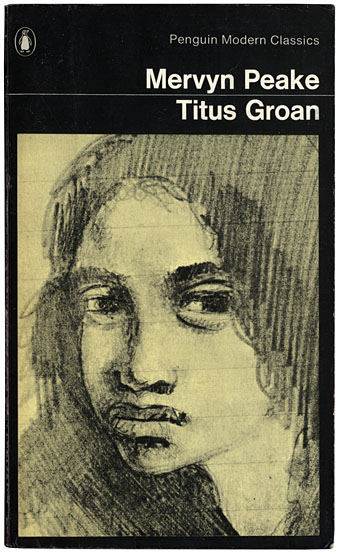
First paperback edition of Titus Groan, 1968.

If you’re British then, no, it isn’t what you think. Having mentioned my hometown of Blackpool yesterday there’s one detail about the town I usually regard as an annex of Hell which, if not quite a saving grace, raises it into some lesser locus of perdition.

There are many Coronation Streets in Britain (and Coronation Roads, Terraces, etc), Manchester has several real ones besides the fake one which provides the setting for the world’s longest-running soap opera. Most are named after a royal event, of course, although I don’t know when the one in Blackpool was built, possibly around 1911 which would mean it takes its name from the coronation of George V. I remember it as being a very undistinguished street of shops, and had no idea all the time I was in Blackpool that Mervyn Peake had lived for a short period in that street (no. 62) with wife Maeve Peake (later Gilmore) and son Sebastian in 1940. Mervyn was in the Royal Artillery in the early years of the war, and was posted to Blackpool as part of an Anti-Aircraft Training Regiment. Once established he found there was little for him to do so he continued work on the manuscript of Titus Groan, still at that point being referred to as Goremenghast (with an extra “e”). Later on the family moved to Bloomfield Road, the home of Blackpool’s football club, before Maeve and Sebastian returned to London.

All this detail can be found in G. Peter Winnington’s Peake biography, Vast Alchemies (2000), and came as something of a shock to me. One thinks of Peake as an inhabitant of Sarke and London, not Blackpool, however brief his stay. But I was stunned most of all to hear about him writing there as well. Peake noted on his manuscript where the chapters were written so Winnington can tell us that some of Titus Groan was set down on the town’s North Pier. The piers are one of the few things I liked about Blackpool, North Pier most of all for being the longest structure with the best views of the sea. It’s also notable for me in being the place where I began my first (and strongest) acid trip in 1980. That’s nothing to do with Peake, of course, but the significance of these separate events tangles in a curious and unexpected way, so that I can’t think of that pier now, or of the early chapters of the Gormenghast trilogy, without this knowledge coming to the surface.

This year is the Peake centenary, and I wrote at the beginning of the month about some of the events and exhibitions being staged in the UK. One of these, Mervyn Peake: A Celebration, will take place at the British Library, London, on Tuesday, 26th July. Described as “an evening of words, memories and images with Peake’s associates, experts and family members”, the speakers will include Fabian Peake, Sebastian Peake, Clare Penate, Brian Sibley, Hilary Spurling and others, with a specially filmed contribution by Michael Moorcock. Further details here. Don’t expect Peake’s presence in Blackpool to be acknowledged this year; the philistine nature of the place is one reason I escaped as soon as I could.

Update: Mervyn Peake’s war paintings unveiled by National Archives.

• G. Peter Winnington’s Peake Studies

Previously on { feuilleton }
The Worlds of Mervyn Peake
A profusion of Peake
Joseph Cavalieri’s stained glass
Mervyn Peake at Maison d’Ailleurs
Peake’s Pan
Buccaneers #1
Mervyn Peake in Lilliput
The Illustrators of Alice

Anatomy of Norbiton

norbiton.jpg

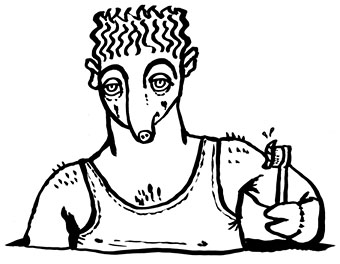
I nearly called this post “Topology of a phantom city” after Alain Robbe-Grillet (and Paul Schütze) but was concerned that might confuse matters. On the other hand, such a title is probably pompous, elitist and obscure enough for the subject in question. Today’s post is necessarily brief since the trouble I keep having with my net connection has recurred this week (rain in the wires) so doing anything at all online is difficult.

Toby Ferris was in touch recently to alert me to the existence of Anatomy of Norbiton which he describes as “a website/work in progress dedicated to the propagation of what can only be described as the (fairly unsuccessful) cult of the Failed Life.” I’d already been pointed to this by Mr BibliOdyssey, and having enjoyed what I saw was surprised it hasn’t been receiving more notice elsewhere. As to the question of what Norbiton is, the inhabitants provide their own description:

The citizens of NORBITON: IDEAL CITY are lazy, idle, negligent, feckless, unrepentant, useless, parasitical. We are false. We are pompous, elitist, obscure, self-indulgent, fat, ugly and old. We are not living life to the full, not making the most of ourselves, not going the extra mile, not putting ourselves on the line. In the great Factory of the World, we are the muck in the kiln, the impurity in the ore, the pollution in the earth, the by-product, the waste, the clutter, the extended tea break, the poor working practice. We are the enemy of self-reliance, productivity, efficiency; of the rewards of labour, the solidarity of the working poor, and the communion of saints.

Sounds to me like Blackpool if it was moved fifty miles inland and deprived of its Pleasure Beach. Or is that merely a description of Blackburn? If you read one of the growing number of Norbiton essays you can decide for yourself how much the place resembles (or doesn’t) somewhere you know but try not to think about. It’s witty and it’s clever and it will reward your attention.

Jean-Philippe Guillemain’s dancers

guillemain1.jpg

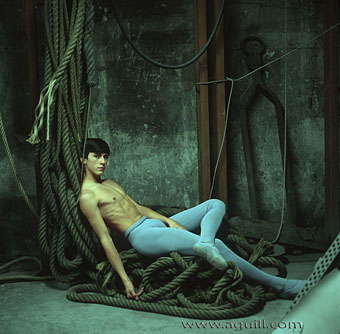
Mathieu by Jean-Philippe Guillemain.

A collection of male dancers pose beside the usual complement of agency models in the portfolio of French photographer Jean-Philippe Guillemain. Are all European dancers this attractive or does he just have a good eye? See the others on his site.

Previously on { feuilleton }
Danseur Noble
The tights have it
Torero
Eonism and Eonnagata
Tiger Lily
Chris Nash
Peter Reed and Salomé After Dark
Felix D’Eon
Dancers by John Andresen
Youssef Nabil
Images of Nijinsky

Hello Dali!

hellodali.jpg

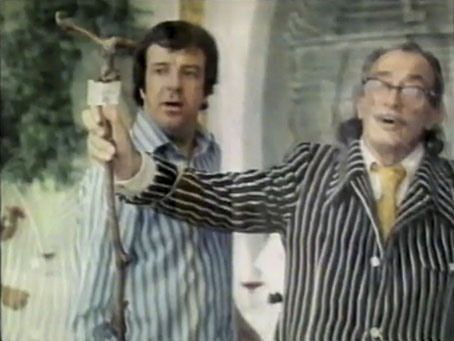
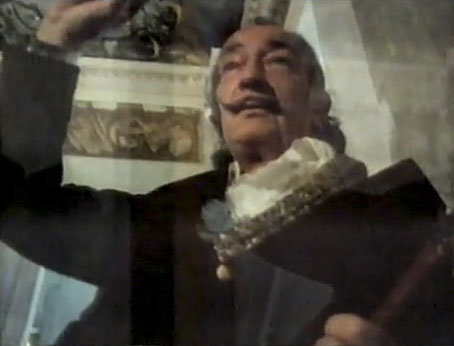
Russell Harty and Salvador Dalí, 1973.

This would have been a real find if the quality wasn’t so poor. Hello Dali! was a 50-minute documentary film about Salvador Dalí broadcast in the UK in 1973 as part of ITV’s Aquarius arts strand. The whole thing is on YouTube chopped into five parts and is unfortunately blighted by severe ghosting throughout. Apart from that it’s perfectly watchable.

hellodali2.jpg

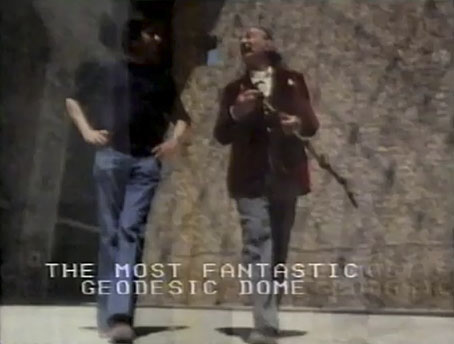
Some conversations are subtitled so viewers are better able to make sense of Dalí’s English/Spanish/French dialect.

Brits who are old enough may remember Aquarius which was replaced in the late 70s by The South Bank Show, a programme using the same format of a short studio introduction followed by a self-contained film. In place of the SBS‘s Melvyn Bragg we have Humphrey Burton introducing a film directed by Bruce Gowers. Russell Harty is the front man, seen here in the days before he achieved greater fame as a gossipy chat-show host. I’d been wanting to see this for a long time, having lost a video tape of it years ago. I never saw the original broadcast but it was screened again after Dalí’s death in 1989, and I remembered it as being particularly good for showing a slightly more human side to the eccentric and occasionally annoying artist. So it is, giving us a brief portrait of Dalí in his 69th year, preoccupied at that time with the construction of his museum in Figueres. The nature of Harty and Gowers coup in getting the artist to allow a film crew into his home can be found in subsequent documentaries many of which use uncredited extracts from these interviews. It’s the brief moments of interview which make this even though they reveal little, it’s refreshing seeing Dalí talking conversationally rather than putting on a performance.

hellodali3.jpg

The early 70s saw the last flare of real interest in Dalí from the world at large. Dalí and Surrealism in general had a resurgence of popularity in the late 60s as a consequence of psychedelic culture: a number of books by or about the artist were published or reprinted, among them Peter Owen’s 1973 revival of the novel Hidden Faces which Dalí had written in 1944. About the same time Alejandro Jodorowsky was circling the Dalí camp trying to inveigle the artist into portraying the Emperor in his planned film adaptation of Dune. One detail worthy of note in the conversation with Russell Harty is mention of a golden toilet, something which Jodorowsky says Dalí wanted as his throne if he was going to be filmed. We never got to see Jodorowsky’s Dune but it’s good to find this documentary available once again. Here’s hoping a better copy turns up eventually.

Hello Dali! Pt 1 | Pt 2 | Pt 3 | Pt 4 | Pt 5

Previously on { feuilleton }
Dalí and the City
Dalí’s Elephant
Dalí in Wonderland
Alejandro Jodorowsky’s Dune
Dirty Dalí
Impressions de la Haute Mongolie revisited
Dalí and Film
Salvador Dalí’s apocalyptic happening
Dalí Atomicus
Impressions de la Haute Mongolie