OffOn by Scott Bartlett

bartlett1.jpg

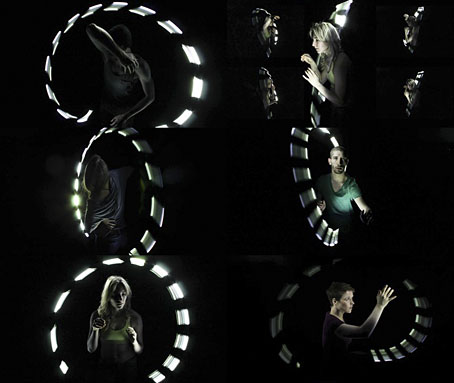
Another gem of experimental filmmaking, Scott Bartlett’s short from 1967 hits all the buttons of psychedelic imagery: disembodied eyes, moiré patterns, solarisation, dancing figures, naked women, oil effects, oversatured hues, and superimposition. The difference between this film and others of the period is that OffOn is largely a product of video techniques, some of which—video feedback, for example—are unique to the medium. As a bonus there’s that standard feature of so much experimental film from the period, the electronic score. The soundtrack for OffOn is by Manny Meyer, and sounds in places like a precursor to Gil Mellé’s buzzing and shrieking music for The Andromeda Strain (1971).

bartlett2.jpg

Elsewhere on { feuilleton }
The abstract cinema archive

Michael Powell’s Bluebeard revisited

powell1.jpg

Yesterday’s post prompted me to look again for one of Michael Powell’s scarcest films, his television version of Bartók’s Bluebeard’s Castle made for  Süddeutscher Rundfunk in 1963. Sure enough, it’s now on YouTube in a watchable copy taken from VHS tape. Herzog Blaubarts Burg (to use its German title) was made post-Peeping Tom when the director’s career was at its lowest ebb, and while the production values don’t match those he’d been used to in the 1940s he was no doubt happy to be working at all after being vilified by the UK press. Norman Foster is Bluebeard and Ana Raquel Satre plays Judith, with the libretto being a German translation with English subtitles. I ought to note here that I’ve not read the second volume of Powell’s biography (mea culpa) so the only information I have about this comes from Ian Christie’s Arrows of Desire: The Films of Michael Powell and Emeric Pressburger (1985). Christie doesn’t have much to say about it other than pointing out that Norman Foster financed the film, and that it’s seldom been screened in Britain: IMDB has the first UK screening as 1978, just prior to the time when Powell and Pressburger began to receive to some belated recognition.

powell2.jpg

The YouTube copy suffers in the sound department by being a muffled mono transmission but it’s the visuals which will be of most interest to Powell aficionados. Powell & Pressburger’s regular production designer Hein Heckroth created the multi-coloured labyrinth which serves as the castle. The overall effect is stagey but contains some unique details, such as the rune-etched standing stones shown at the opening and close, and also some painted moments similar to those seen during the celebrated dance sequence in The Red Shoes (1948). Powell’s staging is much more vivid and artificial than Leslie Megahey’s 1988 adaptation whose Gothic gloom remains a personal favourite. Despite its shortcomings, when compared to the other Powell films that came after—the two Australian features, the Children’s Film Foundation commission which reunited him with Pressburger—this is far closer to the greatest works of the Archers era, and provides a more satisfying career coda for the man who directed The Red Shoes and The Tales of Hoffmann.

Previously on { feuilleton }
Joseph Southall’s Bluebeard
Leslie Megahey’s Bluebeard
Powell’s Bluebeard
The Tale of Giulietta

Joseph Southall’s Bluebeard

southall01.jpg

The Charles Perrault fairy tale given an Arts and Crafts interpretation by British artist Joseph Southall (1861–1944). This is a slim volume from 1895 with illustrations very much in the manner of Walter Crane’s work for William Morris. As with all such stories from the Victorian era, the grim nature of the tale is buried under a profusion of ornament and painstaking detail. Browse the rest of the book here or download it here.

southall02.jpg

southall03.jpg

southall04.jpg

Continue reading “Joseph Southall’s Bluebeard”

Le labyrinthe and Coeur de secours

kamler1.jpg

Le labyrinthe (1969).

Among the new arrivals at Ubuweb there’s the very welcome addition of more animated films by Polish director Piotr Kamler. Kamler’s incredible Chronopolis (1982) was posted there late last year, a longer work than these shorter films which are nonetheless fascinating in themselves. For a start they show the range of Kamler’s animation which differs radically from film to film. Le labyrinthe is the kind of thing SF artist Richard Powers might have made had he been offered an animation commission: a human figure paces through increasingly threatening corridors and empty spaces until the winged creatures that haunt the zone bear down on him. Coeur de secours is more a sequence of events than anything that might be easily summarised; I’d seen this one years ago on Channel 4 but didn’t remember a thing about it. Chronopolis was notable for its electronic score by Luc Ferrari, and both the earlier films have similar soundtracks created by Bernard Parmegiani and Francois Bayle respectively. All these films, Chronopolis included, are collected on a recent DVD which I’ll definitely be buying. Kamler’s work, like that of Patrick Bokanowski and the Quay Brothers, goes places that films with much larger budgets can never reach.

kamler2.jpg

Coeur de secours (1973).

Previously on { feuilleton }
Chronopolis by Piotr Kamler

Ezio Anichini postcards

anichini2.jpg

More from Ezio Anichini (1886–1948), the Italian artist responsible for yesterday’s Salomé, these are part of a series of postcards on the theme of sacred music dated from between 1915 to 1920. The precision of these drawings is remarkable. See the (complete?) set here.

anichini3.jpg

Elsewhere on { feuilleton }
The illustrators archive

Previously on { feuilleton }
Ezio Anichini’s Salomé