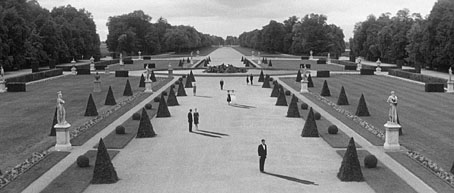
Last Year in Marienbad (1961). Via.
In our age of cultural plenitude it can be salutary to remember the time when many things were easy to discover but often impossible to experience; albums, books, and especially non-American films could all too frequently exist as rumours, referenced but always out of reach. Two films in particular dogged me for years in this remote manner: The Saragossa Manuscript (1965) by Wojciech Has, and Last Year at Marienbad (1961), the film that Alain Resnais made from a very novelistic screenplay by Alain Robbe-Grillet. Philip Strick alerted me to this pair of films with tantalising descriptions in a time-travel chapter of his book-length study, Science Fiction Movies (1976). Marienbad isn’t a time-travel film as such (a later Resnais film, Je t’aime, je t’aime [1968] does deal with the subject, however, and even features an actual time machine), but it is sufficiently open-ended to allow a science-fictional rationale into its enigmatic spaces. Strick’s book covered all the familiar SF territory as well as looking beyond the clichés of Hollywood and the SF genre, hence the inclusion not only of Marienbad and Saragossa, but also Je t’aime, je t’aime, Chris Marker’s La Jetée (1962), Bergman’s The Hour of the Wolf (1968), Pasolini’s Teorema (1968), and Buñuel’s Discreet Charm of the Bourgeoisie (1972). Most of these films, which were seldom shown on TV, I had to wait years to see.
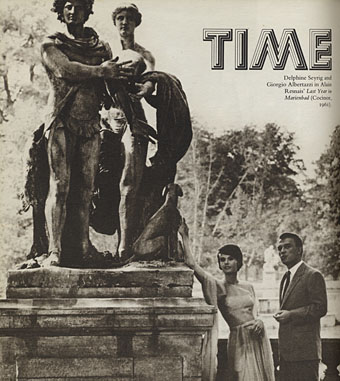
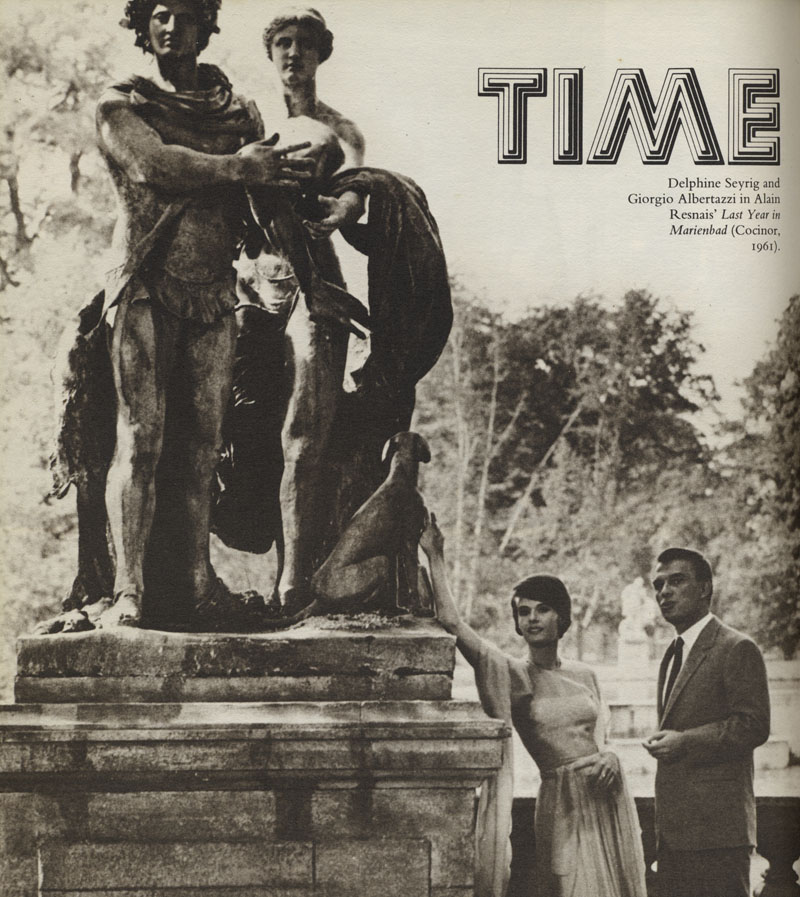
Marienbad page from Strick’s Science Fiction Movies.
I was reading Strick’s book in 1979, and since I was bored with generic clichés, and also reading a lot of reprinted stories from New Worlds magazine, I became a little obsessed with these inaccessible films, Marienbad especially. It’s difficult to say what was so fascinating about a few words of description, and a single photograph, but the picture seemed an unlikely inclusion amid so many pages filled with robots and spaceships. It promised a film that approached the themes of science fiction at the same oblique angle as many of the stories in New Worlds. A couple of years later I found a copy of the Robbe-Grillet screenplay whose pages of dogged description read like the kind of forbidding and formal exercise that Brian Aldiss had attempted in Report on Probability A (1967), a novel that first appeared in New Worlds. Among other similarities, both works share a dismissive attitude to character, presenting a trio of ciphers indicated by no more than their gender, and some initial letters. This confluence of influences, Marienbad included, fed into the chunks of New Worlds-derived prose I was writing at the time, trying to fix inchoate impressions on the page. I always failed each time I returned to that photo from Marienbad, the real charge—as I didn’t see at the time—being a result of the gap between the promise of the image and the inaccessible film itself. Finally seeing Marienbad in the late 1980s was a curious thing, like meeting somebody face-to-face after years of remote correspondence; the same readjustments needed to be made to accept that this was the reality of the work of art, not Robbe-Grillet’s embryonic version, or my own baroque imaginings.
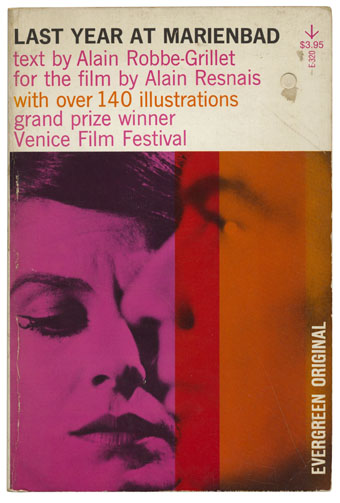
Screenplay book, 1962. Cover design by Roy Kuhlman.
If the above seems to strain for association by hauling a celebrated work of the Nouvelle Vague into a disreputable area then this essay by Thomas Beltzer is worth a read. Beltzer’s “Intertextual Meditation” compares Marienbad to The Invention of Morel (1940), a science-fiction novel by Adolfo Bioy Casares which Jorge Luis Borges described as “perfect” (and which I really ought to read). If I’ve not written much about Marienbad itself that’s because it really needs to be experienced rather than described or explained. It’s a film that’s easier to admire than actually enjoy—I need to be in the right mood to accept its formalities—and given the choice I’d often sooner watch Providence (1977). But where Providence and other Resnais films have inevitably dated, Last Year in Marienbad remains out of time, a 20th-century dream held captive in 18th-century architecture where the airless rococo chambers might easily share a labyrinth with the hotel waiting-room at the end of 2001: A Space Odyssey.
• Alain Resnais obituaries: The Guardian | The Telegraph
• Last Year in Marienbad at film|captures
• Marienbad (2012) by Julia Holter