Recent signals

signals1.jpg

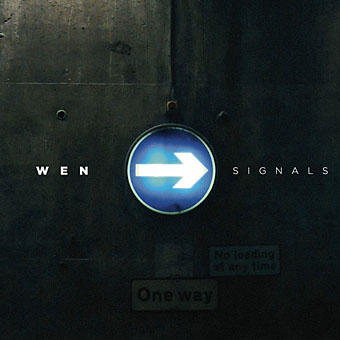
Signals (2014): vinyl front cover. Photo by Nico Hogg.

Seeing as my design for the recent Signals album by Wen has been deemed one of the best covers of the year so far I thought I ought to mention some of the other albums I’ve worked on over the past few months. I tend to give the most attention here to my book designs and illustrations but I’m still working on music releases, albeit with less regularity.

One reason the book work receives more attention is that there’s more of my input involved. Almost all these recent releases have begun as picture selections from the artist which it’s been my job to work into a printable form then place the relevant information in a suitable typeface. This isn’t to downplay the work involved: the careful placing of type becomes more critical the more the design tends to minimalism, and even the best photo can be ruined by clumsy typesetting or an unsympathetic typeface. The challenge of working in a more minimal direction can be a refreshing one when much of the work I do tends to visual excess.
signals2.jpg

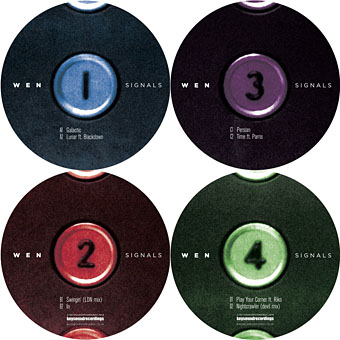
Signals (2014): vinyl labels. Photos by Nico Hogg.

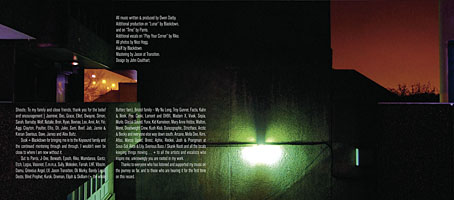
Wen’s album for Keysound Recordings is a collection of dark urban rhythms for which Nico Hogg provided some suitable views of nighttime London. The numbers on the vinyl labels are lift buttons from a high-rise block, while the abstract scene below is a photo of the Thamesmead housing estate.
signals3.jpg

Signals (2014): CD interior. Photo by Nico Hogg.
Continue reading “Recent signals”

Borges and the cats

borges1.jpg

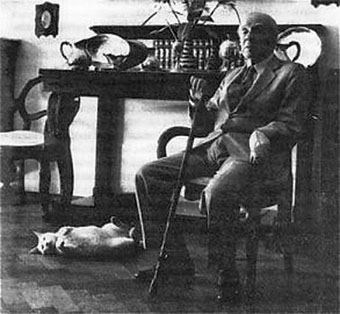
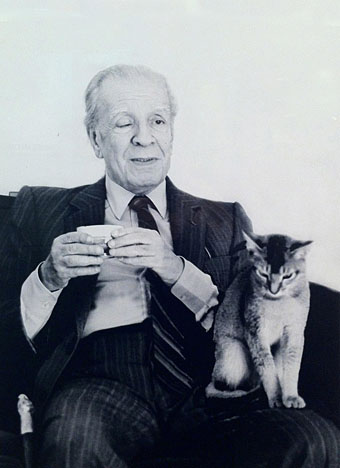
To a cat

Mirrors are not more wrapt in silences
nor the arriving dawn more secretive;
you, in the moonlight, are that panther figure
which we can only spy at from a distance.
By the mysterious functioning of some
divine decree, we seek you out in vain;
remoter than the Ganges or the sunset,
yours is the solitude, yours is the secret.
Your back allows the tentative caress
my hand extends. And you have condescended
since that forever, now oblivion,
to take love from a flattering human hand.
You live in other time, lord of your realm —
a world as closed and separate as dream.

Jorge Luis Borges (translated by Alastair Reid, 1977)

There are many tigers in the writings of Borges—the poem above is from a collection entitled The Gold of the Tigers—so it’s no surprise that the author would pay his respects to their domestic relatives. Regarding translations (and this is something I’ve noted before), those by Anthony Kerrigan, Alastair Reid, Norman Thomas di Giovanni and others were made with the author’s approval, and sometimes with his collaboration. The more recent translations by the Borges estate are poor in comparison.

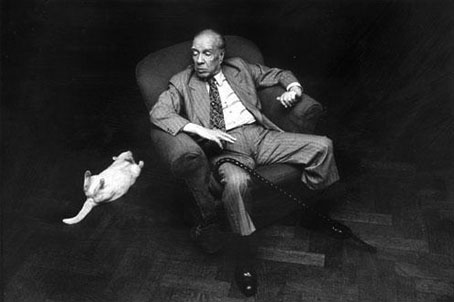
Many more photos of cats with their writers may be seen here.

borges4.jpg

Grove Press, 1994.

borges2.jpg

borges5.jpg

Debolsillo, 2011.

borges6.jpg

Previously on { feuilleton }
Invasion, a film by Hugo Santiago
Spiderweb, a film by Paul Miller
The Library of Babel by Érik Desmazières
Books Borges never wrote
Borges and I
Borges documentary
Borges in Performance

Invasion, a film by Hugo Santiago

invasion1.jpg

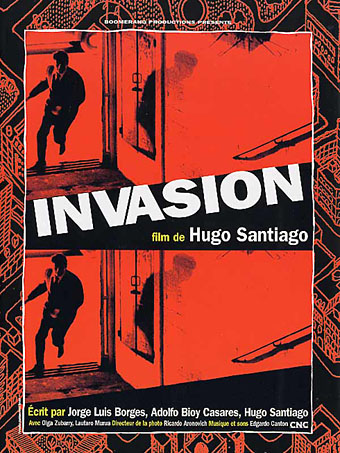
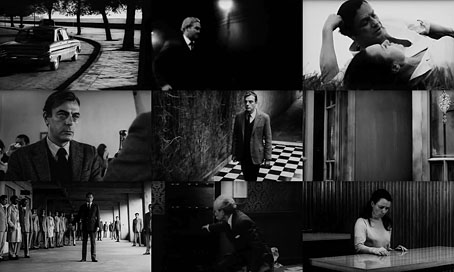
From a film adapted from Borges to a film co-written by the man himself. Invasion (1969) is not to be confused with the British science fiction film of the same name made three years earlier, this is an Argentinian production and a much stranger piece of work. Hugo Santiago is an Argentinian director who moved to France where he worked for a while as assistant to Robert Bresson before establishing himself with this debut feature. Borges’ co-writer was his friend and regular collaborator Adolfo Bioy Casares.

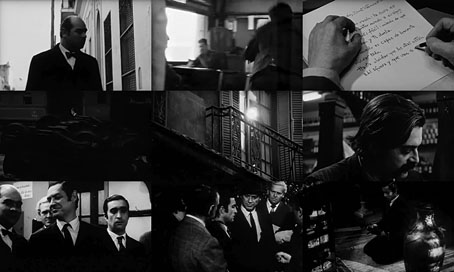
I’ve not watched this yet, the two copies on YouTube are in Spanish with no subtitles but this is a blog with an international readership so there’s no need to exclude it on that account. Even without subtitles the film is visually intriguing, possessed of a moody and enigmatic style which online reviewers compare favourably to Antonioni and some of the Nouvelle Vague directors.

invasion2.jpg

In 1957, a small group of middle-aged men fight a clandestine battle against forces quietly invading and taking control of their city, Aquilea. Enigmatic in its story-telling, Hugo Santiago’s once-lost film obscures the motivations of either side, leaving only a series of moves and counter-moves that evokes past dictatorial oppression and those still to come.

This post at Make Mine Criterion—a site dedicated to potential Criterion DVD releases—goes into considerable detail examining the film they describe as “part fantasy, part science fiction, part political thriller”. Given this and the rest of the film’s evident qualities it’s surprising it isn’t better known. I only have one Borges biography, The Man in the Mirror of the Book (1996) by James Woodall, but there’s no mention in there of Santiago’s film or of The Others (1974), a later Santiago feature that was also scripted by Borges and Bioy Casares. For those wishing to pursue the film further there are subtitles available if you can be bothered searching for them then trying to synch them up with a YT rip. It might be better to look for a Spanish DVD and hope it has a good choice of subtitles.

invasion3.jpg

Previously on { feuilleton }
Spiderweb, a film by Paul Miller
The Library of Babel by Érik Desmazières
Books Borges never wrote
Borges and I
Borges documentary
Borges in Performance

Spiderweb, a film by Paul Miller

spiderweb.jpg

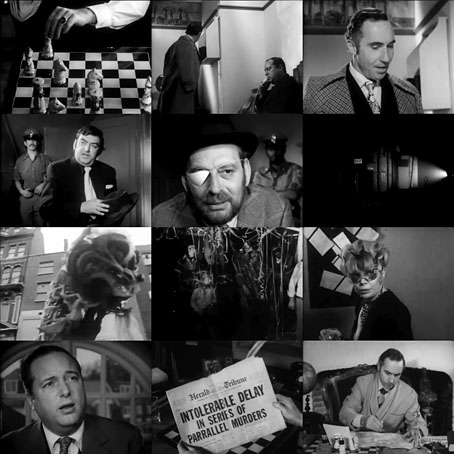
The Spider’s Stratagem (1970) is Bernardo Bertolucci’s adaptation of the Jorge Luis Borges story The Theme of the Traitor and the Hero; Death and the Compass (1992) is Alex Cox’s adaptation of the story Death and the Compass by the same author; Spiderweb (1977) is an earlier adaptation of Death and the Compass which is both shorter than Cox’s film, and also a more successful Borgesian drama.

Borges’ story plays Kabbalistic games with the familiar shapes of detective fiction, creating its frisson in the tension between an elaborate murder mystery and the intellectual puzzle which leads to its solution. In Cox’s extended version this is presented in an overbearing style reminiscent of Terry Gilliam at his most exasperating; despite a decent cast it’s also rather poorly directed in places. By contrast, Paul Miller’s adaptation runs for 30 minutes and conveys the story very smartly and efficiently. The setting is “Borghesia” rather than Argentina but the general style is that of a Hollywood detective story, American accents and all. The always reliable Nigel Hawthorne plays the cerebral detective Erik Lönnrot. Considering this was a graduation film it’s an excellent piece of work which the director himself has made available on YouTube. Watch it here.

Previously on { feuilleton }
The Library of Babel by Érik Desmazières
Books Borges never wrote
Borges and I
Borges documentary
Borges in Performance

June

june10.jpg

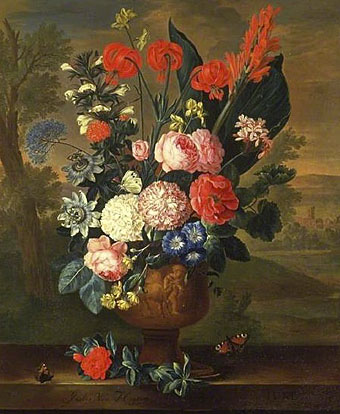
Twelve Months of Flowers: June (no date) by Jacob van Huysum.

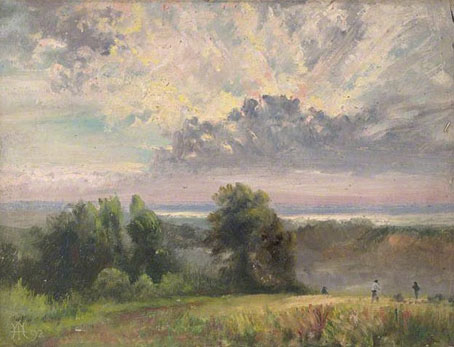
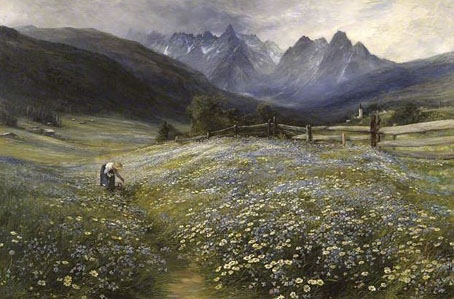
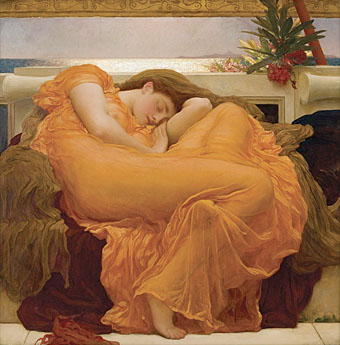
The month of June in paintings is overburdened by bland pastoral scenes and views of battles, the summer months being favourable ones for warfare. Pastoral content is still present in the following selection albeit with an attempt to show some variety. Leighton’s Flaming June is the most famous picture here. It’s also the most popular of the artist’s paintings, understandably so given its radiating an atmosphere of luscious (and possibly inadvertent) eroticism that he seldom achieved elsewhere.

june03.jpg

From Croham Fields, Croydon, Surrey, Just before the First Thunderstorm, Tuesday 28 June 1892 (1892) by William Henry Hope.

june07.jpg

June in the Austrian Tyrol (1892) by John MacWhirter.

june02.jpg

Flaming June (1895) by Frederic Leighton.

Continue reading “June”