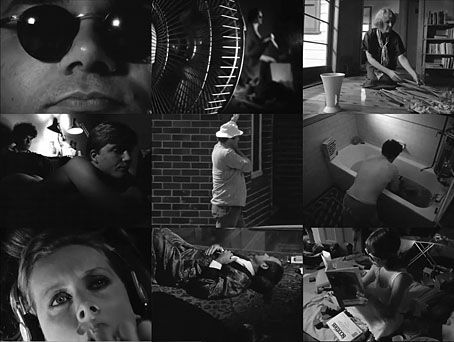
Before she directed Sweetie (1989) Jane Campion made a handful of short films all of which are worth seeking out. Passionless Moments (1983) is a 10-minute collection of musings, reflections or simple awkwardness among the inhabitants of Sydney, Australia on a single day in October. Gerard Lee was the writer, and among the rest of the crew there’s some photography by Alex Proyas, later to be a successful director himself.
Edmund J. Sullivan’s Sintram and His Companions

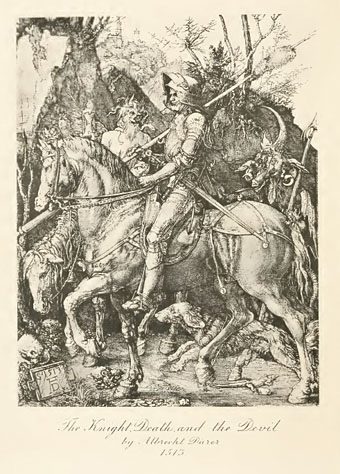
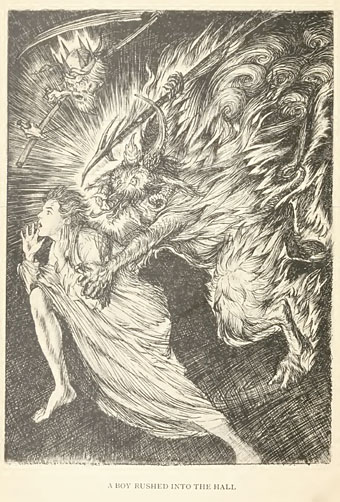
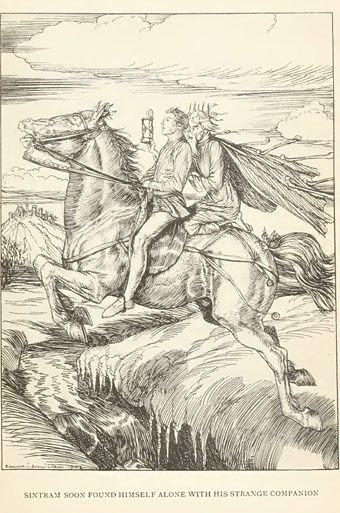
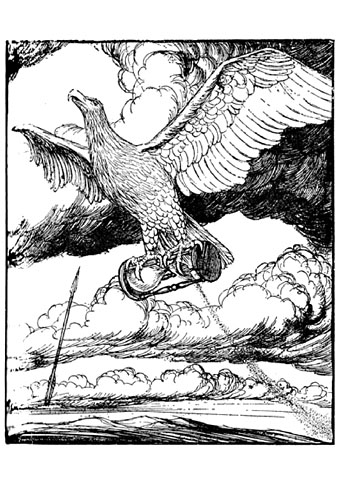
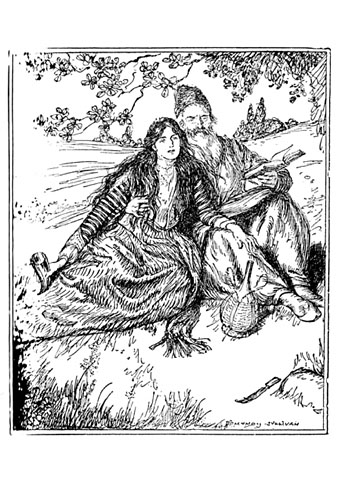
More Sullivan, the illustrations this time being for a 1908 edition of Sintram and His Companions by Friedrich de la Motte Fouqué. This is one of Fouqué’s lesser known works, a tale of a Norwegian knight which the author based on the famous etching by Albrecht Dürer, The Knight, Death and the Devil (1513). The etching is shown as a frontispiece which Sullivan then has to follow, not an enviable task for any artist. If the subsequent drawings can’t match Dürer’s meticulous rendering they nonetheless base their characters on Dürer’s figures, the dog included. This kind of repurposing is commonplace today but it was very uncommon in 1908, and offhand I can’t think of an earlier example. It’s also worth noting the discussion in the comments for yesterday’s post about the influence of Edmund J. Sullivan on the young Austin Osman Spare. Sullivan and Spare knew each other, and Phil Baker’s Spare biography mentions Sullivan’s work being an influence, but I’d not given the matter much attention until this week. The influence is easy to see when you view their drawings together.
To return to Dürer, the sight of his etching always makes me think of a later piece of fiction, A Dog in Dürer’s Etching “The Knight, Death and the Devil” (1966) by Marco Denevi. A short tour-de-force that may be read in full here.


Continue reading “Edmund J. Sullivan’s Sintram and His Companions”
Edmund J. Sullivan’s Rubáiyát

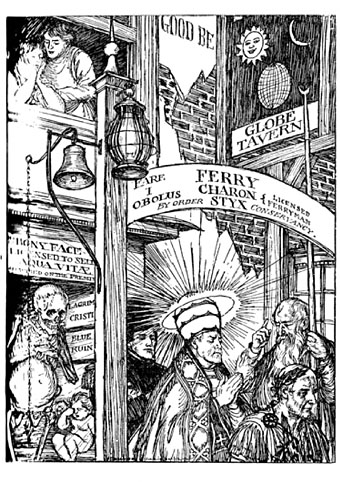
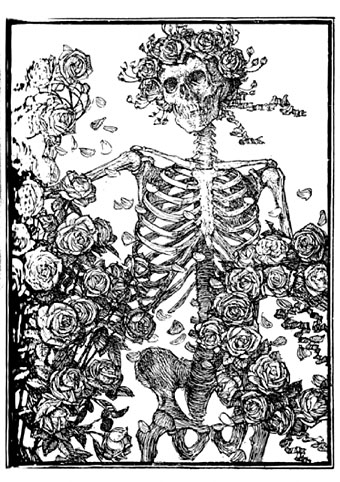
Mention yesterday of Edmund J. Sullivan’s illustrations for The Rubáiyát of Omar Khayyam made me realise that I’d never seen a complete set of Sullivan’s illustrations for this volume (75 in all) despite one particular drawing (the rose-crowned skeleton) being very familiar. Sullivan’s Rubáiyát was published in 1913, and the translation is the Edward Fitzgerald version. These copies aren’t the best quality but they’re good enough at a small size to give an idea of Sullivan’s renderings which feature more occult references than usual for this title. Browse the rest of the pages here or download the book here.


John Austen’s Little Ape

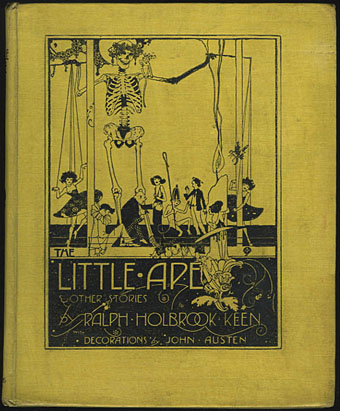
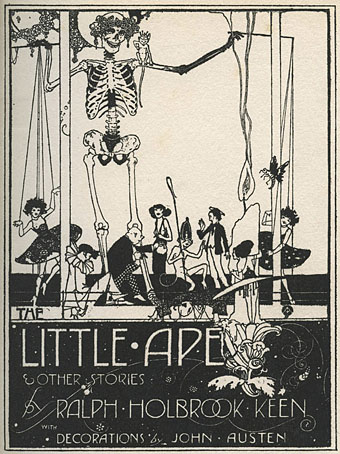
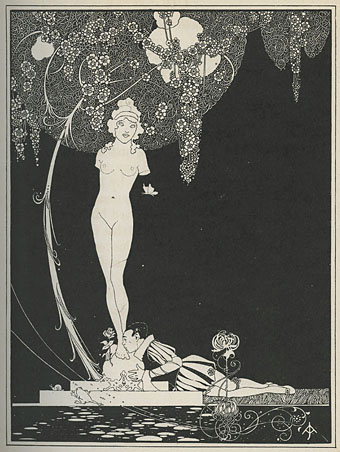
British illustrator John Austen (1886–1948) illustrated many classic works of fiction throughout the 1920s, one of which, Hamlet, was recently reprinted by Dover Publications. His other work isn’t so easy to find, however, and I’d not seen Little Ape and Other Stories (1921) until Nick H drew my attention to a copy for sale at silver-gryph’s eBay pages. (Thanks, Nick!)
Ralph Holbrook Keen’s story collection was Austen’s first illustrated edition although you wouldn’t necessarily take it for a debut work. There are the familiar nods to Beardsley—the black-and-yellow cover especially—and possibly Harry Clarke whose influence is more evident in the Hamlet drawings. Clarke and Austen exhibited together in 1925. The skeleton with a floral crown makes me think of the rose-crowned skeleton in Edmund J. Sullivan’s Rubáiyát (1913), although this may be a result of Sullivan’s drawing having been made very familiar by its use on Mouse & Kelley’s posters for the Grateful Dead. One of the many connections between the Golden Age of Illustration and the Golden Age of Psychedelia.


Weekend links 235
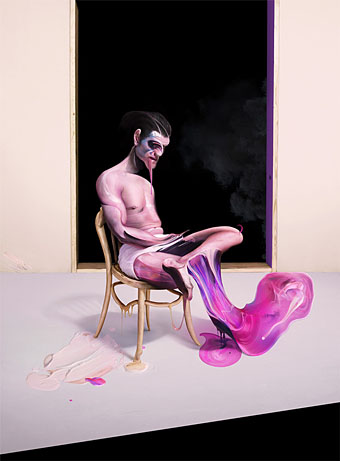
Shadows (1974) by Pawel Nolbert & Lukasz Murgrabia, one of three images recreating Francis Bacon’s Triptych–August 1972.
• Breaking the Code (1996), a BBC film by Herbert Wise based on Hugh Whitemore’s stage play about Alan Turing. Wise’s film has been linked here before but it’s relevant again thanks to the release of The Imitation Game. Derek Jacobi played Turing on stage and screen, and Whitemore’s script managed to deal with Turing’s life and work without insulting the man or the intelligence of its audience.
• “…if you listen to A Beacon From Mars by Kaleidoscope or if you listen to some Turkish taxim then something starts happening.” Robert Plant talking to Julian Marszalek about the music that excites him.
• “CGI has become wearingly dull and clichéd. Can its deep weirdness be recovered and filmgoers’ minds stretched again?” asks Jonathan Romney.
The cult of the Thirty-Seven Nats is unique to Burma. […] The junta’s attempts to subdue nat worship had an unintended effect: the role of the nat wife was embraced by an already marginalized group. Homosexuality is illegal in Burma and has been since its British colonizers instituted a late-nineteenth-century ban on “intercourse against the order of nature”. Government restrictions opened a professional vacuum, says scholar Tamara C. Ho. Becoming a nat kadaw offered the achauk—a Burmese term for gay and transgender men—both “a vocation and queer visibility”.
After the Green Death by Will Boast
• “Cat memes and other frivolities aren’t the work of an Internet culture. They’re the work of an American one, ” says Caitlin Dewey.
• Hear the cavernous reverb of Berlin’s Kraftwerk captured by Emptyset’s James Ginzburg and Yair Elazar Glotman.
• Take part in the first #psychedelicpride photoshoot in central London on Saturday, December 13th.
• Mix of the week: FACT Mix 470 by Jonny Trunk who also appears in the list of vinyl hoarders below.
• Queer Noise: Abigail Ward on the history of LGB music and club culture in Manchester.
• More photos of the steampunk exhibition at 751 D-Park, Beijing, China.
• A chronological list of synth scores & soundtracks.
• Animated photography by Julien Douvier.
• A Third Ear Band archive at SoundCloud.
• The secret lives of vinyl hoarders.
• Taxim (1968) by Kaleidoscope | Water (1970) by Third Ear Band | Love Is The Devil (1998) by Ryuichi Sakamoto