Edmund Dulac’s Sinbad the Sailor

dulac17.jpg

I mentioned Edmund Dulac’s Sinbad book in an earlier post but didn’t show many his illustrations on that occasion so here they are. Most of these pictures are a long way from Ray Harryhausen’s Sturm und Drang but they’re not without their complement of monsters and afreets.
dulac01.jpg

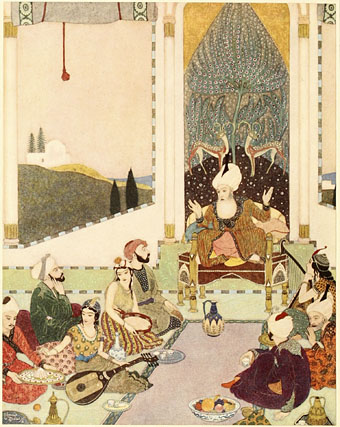
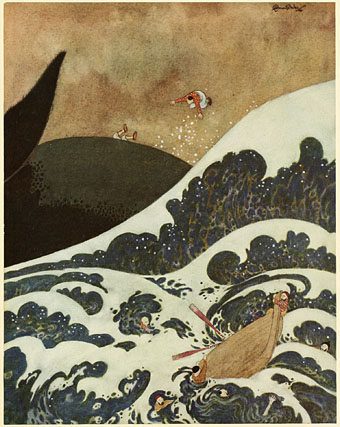
Sinbad the Sailor & Other Stories from the Arabian Nights was published in 1914. No author is credited, which suggests the text might have been by Dulac himself but it’s more likely to be another retelling of the tales by Laurence Housman with whom Dulac collaborated on similar titles. Sinbad the Sailor is one of Dulac’s best books, a prime example of the ease with which he could combine influences from Persian miniatures, Chinese painting and Japanese prints all done in the watercolour technique employed by contemporaries such as Arthur Rackham.
dulac02.jpg

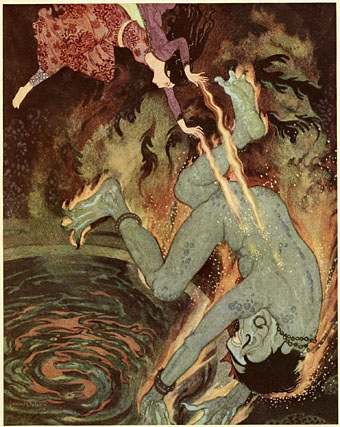
The plate at the top of this post showing a princess battling an afreet made a striking cover image for the American edition of Fantasy: The Golden Age of Fantastic Illustration (1975) by Brigid Peppin, a study of book illustration from the 1860s to the 1920s. The British edition used a Dulac illustration from The Snow Queen which seems dull in comparison, and an odd choice for a volume filled with so much exceptional art. The book itself is an excellent collection, however, and one I’d recommend to anyone interested in this period of illustration.
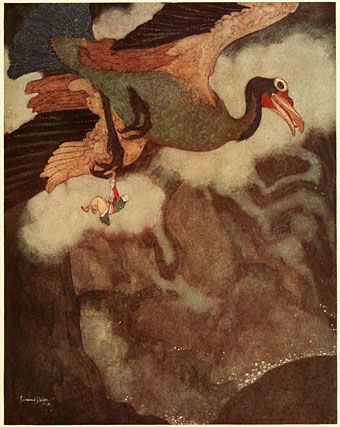
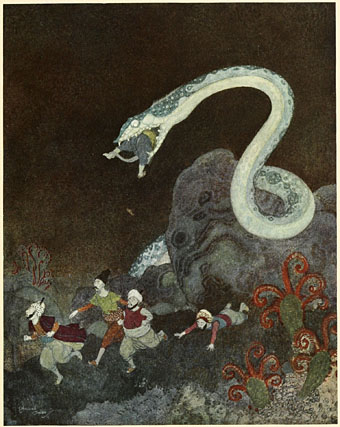
dulac03.jpg

dulac04.jpg

Continue reading “Edmund Dulac’s Sinbad the Sailor”

Ray Harryhausen’s swords and sorceries

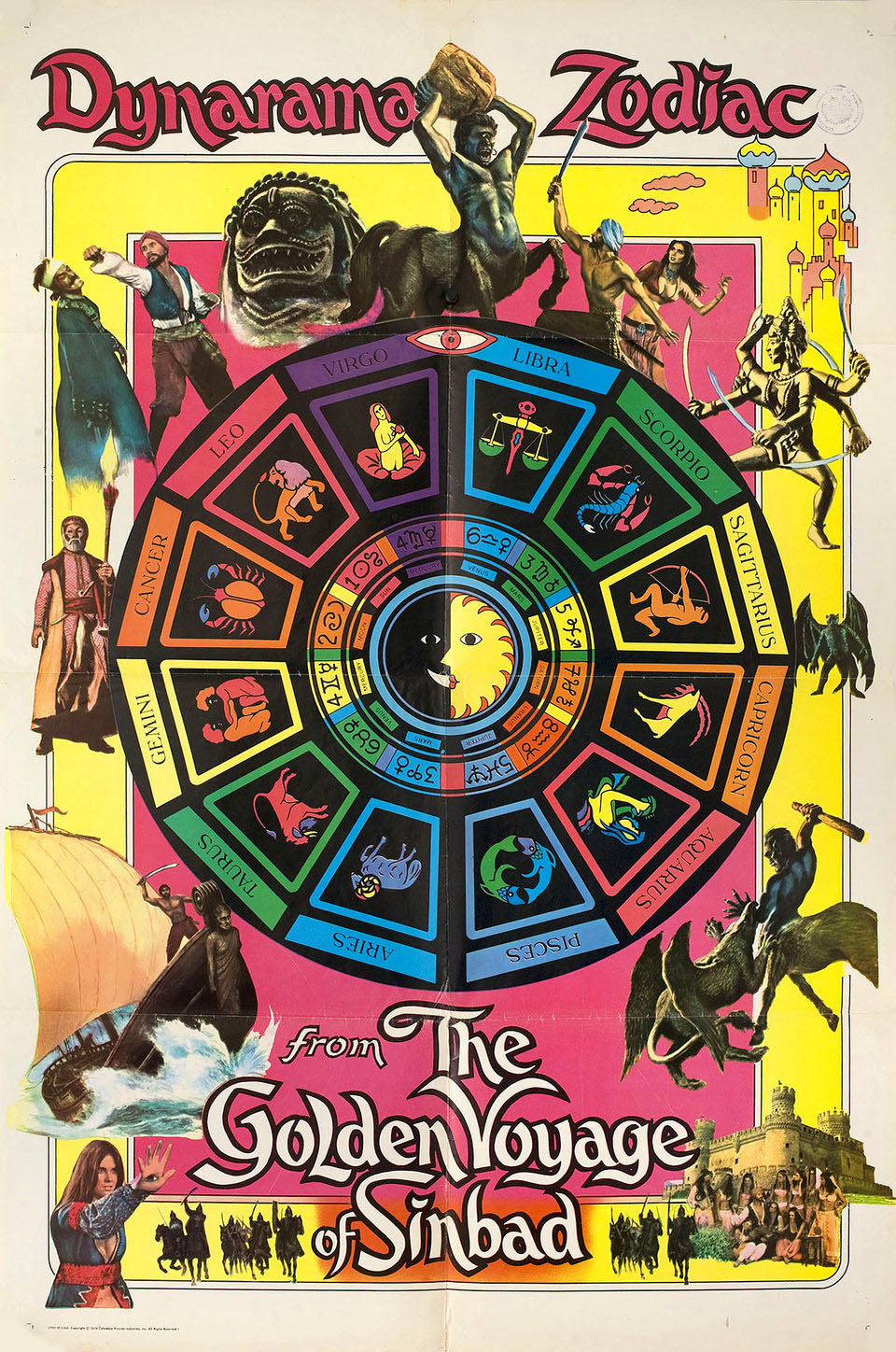
golden1.jpg

It was the 1970s: promoting Sinbad with a Zodiac poster for the blacklight brigade.

Last month I took advantage of the recent Indicator sale to buy blu-rays of a couple of favourite Ray Harryhausen films, together with Indicator’s reissued box of the three Harryhausen Sinbad features: The 7th Voyage of Sinbad (1958), The Golden Voyage of Sinbad (1973), and Sinbad and the Eye of the Tiger (1977). I’m very familiar with these films but hadn’t seen them for many years. Watching them again made me realise for the first time what perfect examples they are of sword-and-sorcery cinema even though you never see them classed as such. I’ve been reading sword-and-sorcery fiction for almost as long as I’ve been watching Ray Harryhausen films but this rather obvious insight hadn’t occurred to me before, no doubt because I’d always regarded the Sinbad cycle as Arabian Nights fantasies in the manner of The Thief of Bagdad. The 1940 version of the latter happened to be a Harryhausen favourite which prompted his decision to film an Arabian adventure following his monster-on-the-rampage pictures of the 1950s. He subsequently asked The Thief of Bagdad‘s composer, Miklós Rózsa, to score The Golden Voyage when Bernard Herrmann was unable to do so.

seventh.jpg

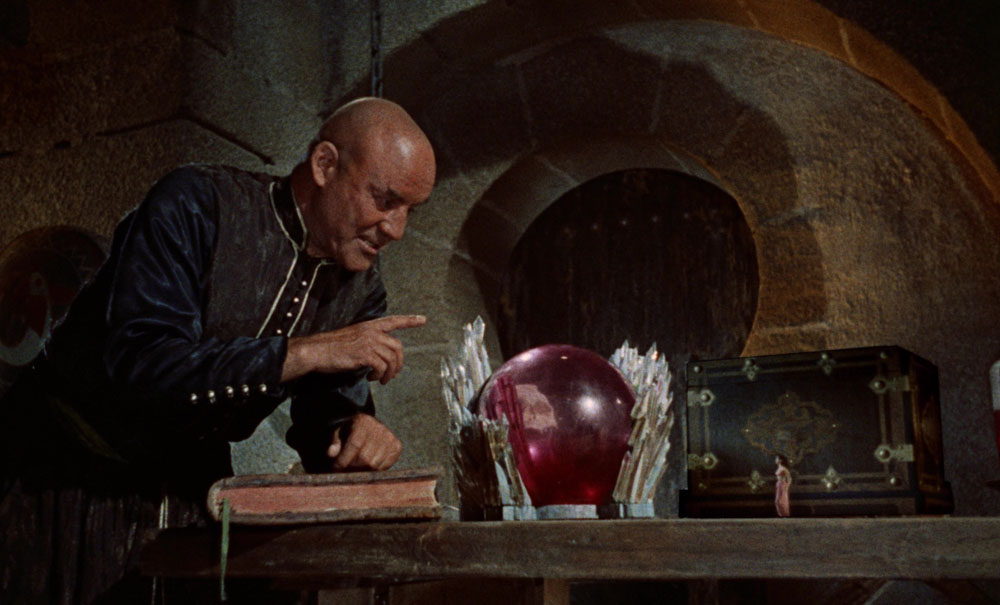
Sokurah (Torin Thatcher) with a shrunken Princess Parisa (Kathryn Grant).

The 7th Voyage is at least based on the original Sinbad tales but the second and third films have little to do with The Arabian Nights beyond Sinbad’s persona and a handful of cultural references. If you swapped the Arabian names for invented ones then you’d be even closer to the stories of Clark Ashton Smith and his colleagues at Weird Tales than the films already are. Smith’s sorcery-infused fiction is the key here even though his stories are light on sword-play. The sight of a shaven-headed Torin Thatcher as Sokurah, the duplicitous magician in The 7th Voyage, was so strongly reminiscent of one of Smith’s many sorcerers—he even looks a little like Virgil Finlay’s depiction of Dwerulas from The Garden of Adompha—that I couldn’t help but watch the films this time as though they were adaptations of Smith’s fantasies. In The 7th Voyage the similarity is most evident in the scene where Sokurah demonstrates his powers to the caliph by temporarily turning a handmaiden into a serpent-woman, and the later scenes in Sokurah’s underground fortress. Smith and his cohorts in the pulp magazines were of course refashioning elements from The Arabian Nights and from other legends so none of this should be surprising. The 7th Voyage may take some of its scenes from The Arabian Nights but the story establishes the template which the sequels follow, with Sinbad pitted against a magic-wielding adversary.

Continue reading “Ray Harryhausen’s swords and sorceries”

Weekend links 596

hoshiyama.jpg

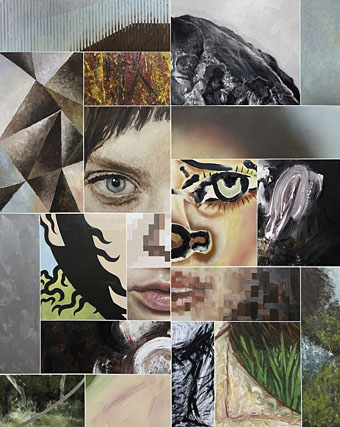
Jam III (2021) by Kotaro Hoshiyama.

• “Powell and Pressburger are peerless in realizing what Orson Welles would term plotless scenes—extra bits that ostensibly do not advance the story, but are a story unto themselves, and aggregate such that they’re vital to how we understand the characters who are living the story.” Colin Fleming says thanks for the Archers.

• A short promo for The Incal: The Movie. Hmm, okay. A film that adapted all 300 pages of the original story without changing anything or trying to explain away the weirdness would be worth seeing. But I doubt that’s what this will be. Read the book.

• “If a single word distills the New Wave aesthetic, it’s plastic…ironically flaunted artificiality became a leitmotif of the era.” Simon Reynolds reviews Reversing Into the Future: New Wave Graphics 1977–1990 by Andrew Krivine.

• Mixes of the week: a mix by Princess Diana Of Wales (not that one) for The Wire, and At The Outer Marker Part I, a Grateful Dead Twilight Zone mix by David Colohan.

The Bloomingdale Story: read the never-before published Patricia Highsmith draft that would become Carol (aka The Price of Salt).

• At Spoon & Tamago: Multiple panels form collaged portraits painted by Kotaro Hoshiyama.

• New music: Pyroclasts F (excerpt) by Sunn O))), and Loop return with Halo.

• At Dennis Cooper’s: William E. Jones Day.

Plastic Bamboo (1978) by Ryuichi Sakamoto | Barock-Plastik (2000) by Stereolab | Black Plastic (2002) by Ladytron

11 Preliminary Orbits Around Planet Lem by the Brothers Quay

lem.jpg

Here come the Quays again with another short documentary for the Polish Cultural Institute. This was posted only a few days ago to acknowledge the centenary of the birth of writer Stanisław Lem. It’s only the briefest run through Lem’s career as a writer of science fiction but it does include a sequence that lists the films adapted from his work which is a useful reminder of all the ones I’ve yet to see. And the piece ends with an extract from Maska, the Quays’ own adaptation of a Lem short story, and a favourite of mine among their recent films. (Thanks to Tomas for the tip!)

Elsewhere on { feuilleton }
The Quay Brothers archive

VadeMecum by the Brothers Quay

quays1.jpg

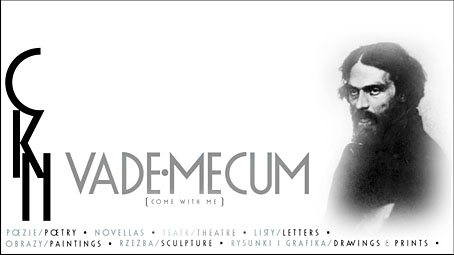
After mentioning the Brothers Quay last week it occurred to me that I hadn’t searched around for a while to see what they might have been up to recently. They continue to be productive, and only a couple of months ago released a new 12-minute short, VadeMecum, which was produced for the Polish Book Institute. This is the Quays in their documentary mode, presenting the troubled life of Polish poet and artist Cyprian Kamil Norwid, together with extracts from his poetry and examples of his drawings. Norwid’s existence was news to me so the piece successfully achieved its goal of informing the unenlightened. Last month the brothers talked to Mikolaj Glinski at Culture.pl about their fascination with Polish art and literature.

quays2.jpg

Meanwhile, the Quays are no doubt continuing to work on their third feature film, Sanatorium Under the Sign of the Hourglass, in which they return to the writings of Bruno Schulz. Schulz’s story collection was adapted by Wojciech Has in 1973 as The Hourglass Sanatorium, a film I recommend most highly. The quality of the Quays version may be judged by this six-minute preview which immediately sets itself apart from the Has film with its puppets modelled on Schulz’s illustrations. I’ll be waiting impatiently for this one.

Elsewhere on { feuilleton }
The Quay Brothers archive