Weekend links 125

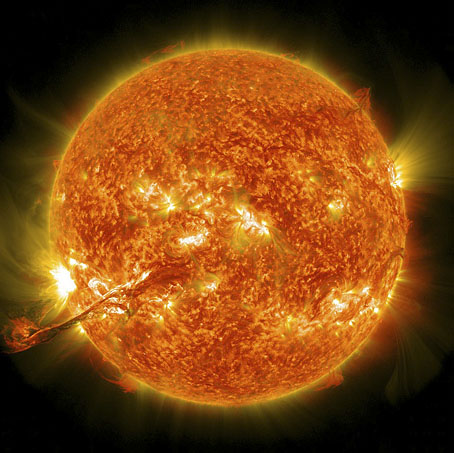
cme.jpg

Coronal Mass Ejection from the surface of the Sun, August 31st, 2012.

• “Most of the main parts were recorded in a single day using Vangelis’s famous technique: try to play as many synths as possible at once.” Simon Drax on the prolific musical output of Zali Krishna. The new Krishna opus is Bremsstrahlung Sommerwind, free to download at the Internet Archive.

• The Northants International Comics Expo (N.I.C.E.) opens on September 22nd. Among the many attendees there will be Mr Alan Moore making his first convention appearance since 1987.

• “Isolated for one night in a boat overlooking the Thames, Geoff Dyer explores representations of reality through the lens of Joseph Conrad’s Heart of Darkness.”

Now seems the right time to revisit this secret archive of public broadcasting. It’s an antidote to the celebrity-led, format-driven nature of so many arts documentaries made today. It shows that it’s possible to produce TV that is both populist and experimental. And it also refutes the cliché that the 1970s was a decade only of crisis and downturn. “Feminism, political theatre, Ways of Seeing: I wasn’t thinking, ‘what a terrible time’. It was very dynamic, activist, political. Creatively it was very exciting. Yet all they show on those television retrospectives are episodes of Top of the Pops.”

Sukhdev Sandhu talks to Mike Dibb, the director of Ways of Seeing.

• From 1999: Colm Tóibín reviews A History of Gay Literature: The Male Tradition by Gregory Woods.

What We See: a song by Julia Holter & Nite Jewel with a film by Delaney Bishop & Jose Wolff.

Rick Poynor on The crash test dummy: from subcultural fringes to pop culture mainstream.

In his 1973 book on Joyce, Joysprick, Burgess made a provocative distinction between what he calls the “A” novelist and the “B” novelist: the A novelist is interested in plot, character and psychological insight, whereas the B novelist is interested, above all, in the play of words. The most famous B novel is Finnegans Wake, which Nabokov aptly described as “a cold pudding of a book, a persistent snore in the next room.” The B novel, as a genre, is now utterly defunct; and A Clockwork Orange may be its only long-term survivor.

Martin Amis on A Clockwork Orange, fifty years on. My old post about the film’s record shop scene continues to be one of the most popular pages here.

• Wild Boys: David Bowie and William Burroughs in 1974, hand-coloured by DB.

Alfred Kubin‘s illustrations for Haschisch (1902) by Oscar AH Schmitz.

• Revolution off: industrial ruins photographed by Thomas Jorion.

• Tetrahedra of Space: 22 pulp illustrations by Frank R. Paul.

The Blue Boy Studiolo: a Tumblr.

Marina Warner visits Hell.

• The art of Casey Weldon.

RainyMood.com

Third Stone From The Sun (1967) by The Jimi Hendrix Experience | Sunrise In The Third System (1971) by Tangerine Dream | 3rd From The Sun (1982) by Chrome.
Three stages of Icarus

icarus1.jpg

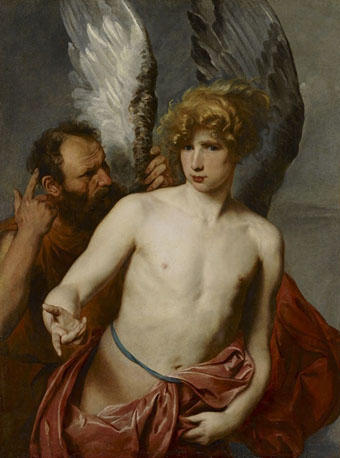
Daedalus and Icarus (1615–1625) by Anthony van Dyck.

The story of the doomed youth as seen via the few Icarus works at the Google Art Project. Brueghel’s famous painting is absent, unfortunately, so I won’t quote the equally famous lines by Auden either. Van Dyck gives us a golden-haired twink that Auden might approve of although I seem to recall the poet preferred rougher trade. No indication as to how those wings are supposed to function when they don’t seem to be attached to anything. The father points ominously skyward while the boy already knows where he’s headed.


icarus2.jpg

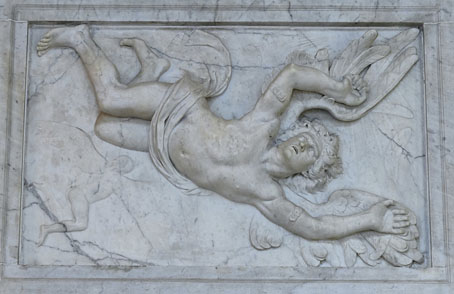
Icarus (1655) by Artus Quellinus.

Artus Quellinus was a Flemish sculptor whose work is a deliberate harking back to Classical antecedents.


icarus3.jpg

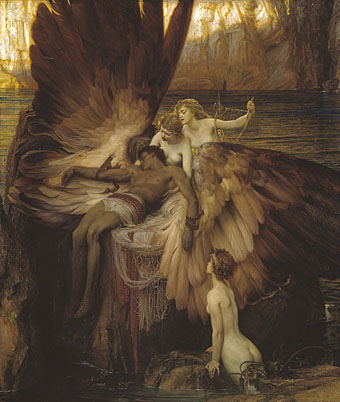
The Lament for Icarus (1898) by Herbert Draper.

Herbert Draper has been dismissed for years as a late-Victorian kitsch-monger, far too academic to be worthy of consideration. Since I often feel an affection for anything that upsets art critics I rather like his brand of fin-de-siècle soft porn. Many artists of the period at least varied their output often enough to avoid accusations of unseemly interests. Not so Draper, whose oeuvre runs the gamut of wet mythological females: naiads, sirens, kelpies, mermaids, etc. Even with dead Icarus as a subject he has to throw in a naiad or three. Van Dyck’s twink has transmuted here into a muscular hunk; he’d need to be strong to wield those colossal wings. Interesting to see from the study below that the figure was developed considerably from the original model. The study is also a better piece of draughtsmanship than the painting where the right arm seems wrong somehow, and the legs appear to be melting down the rock on which he’s beached. Barry Windsor Smith produced a variation on the theme in the 1980s that may have been inspired by the Draper, something he called Self-Portrait with Wings.

icarus4.jpg

Study for Icarus (1898) by Herbert Draper.

Previously on { feuilleton }
The end of Orpheus

Patrick Procktor, Art and Life

procktor.jpg

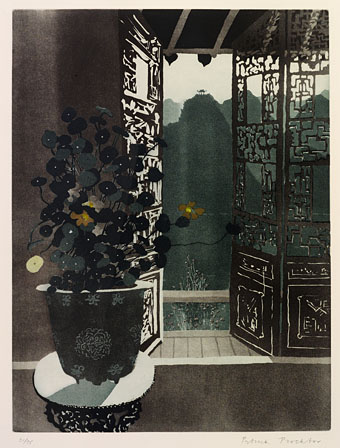
Nasturtiums, Wusih (1980) by Patrick Procktor.

Ian Massey was in touch last week to alert me to Patrick Procktor, Art and Life, an exhibition of Patrick Procktor’s art he’s curated at the Huddersfield Art Gallery in Yorkshire:

Patrick Procktor was part of a bohemian circle in 1960s and 1970s London that also included his great friends the artist David Hockney and the fashion designer Ossie Clark.

The focus of this exhibition is on the artist’s paintings on canvas and works on paper, and includes portraits of quintessential Sixties figures including Derek Jarman and Jimi Hendrix, alongside topographical pictures painted in countries such as India, Italy, Egypt and China.

I really like that nasturtiums print. For those who can’t get to Huddersfield there’s Ian’s monograph of the artist, also entitled Patrick Procktor, Art and Life, which was published by Unicorn Press in 2010. The exhibition runs to 10th November, 2012.

procktor2.jpg

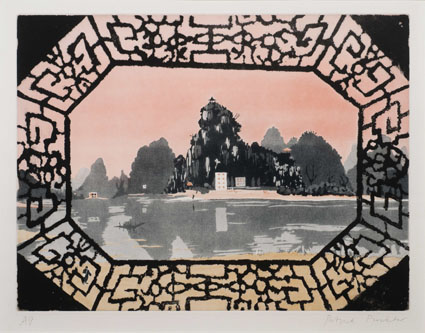
Da Miou Mountains, Kweilin, aquatint (1980).

Update: Ian says although the nasturtiums are on the gallery website they aren’t in the show because the print was sold just beforehand. He’s sent this print from the same series. The exhibition was reviewed by Charles Darwent in The Independent on Sunday.

Previously on { feuilleton }
Gervase and Patrick

Raymond Bertrand paintings

bertrand19.jpg

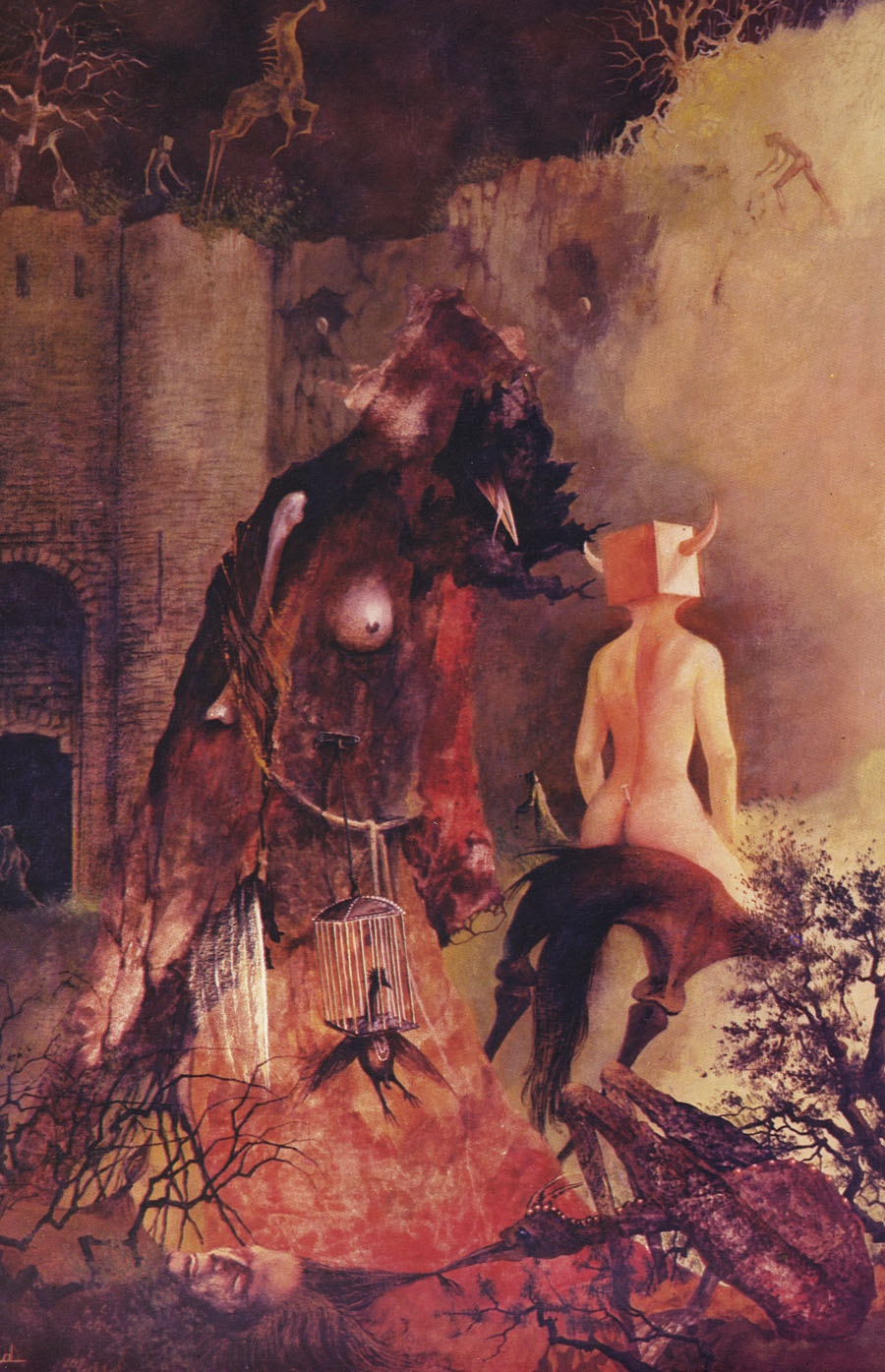
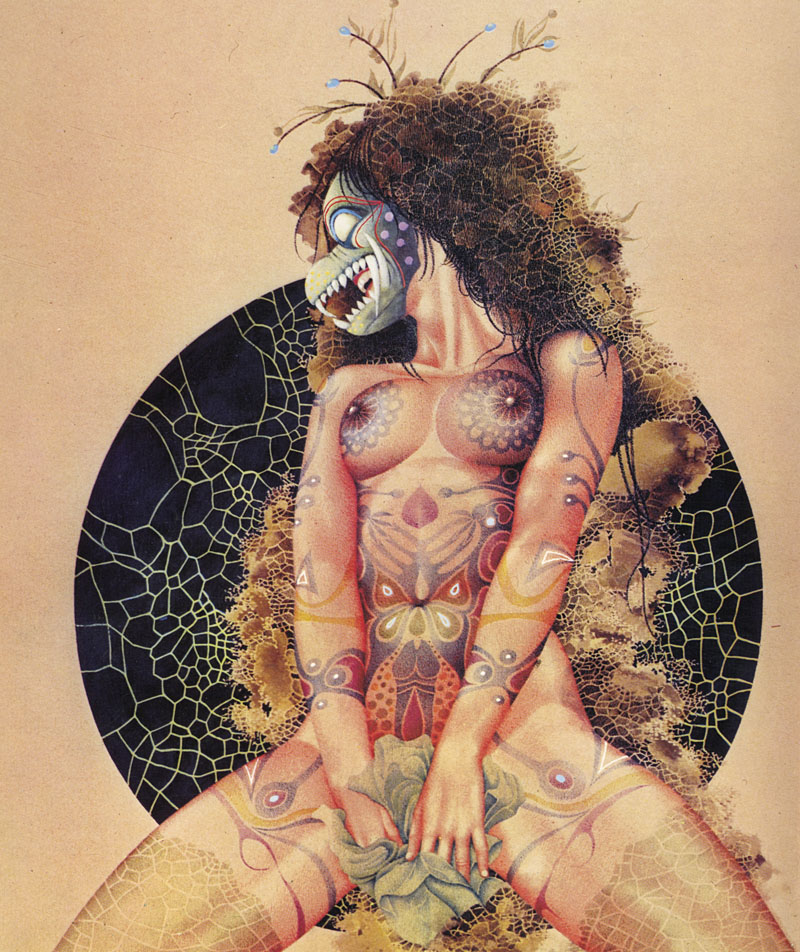
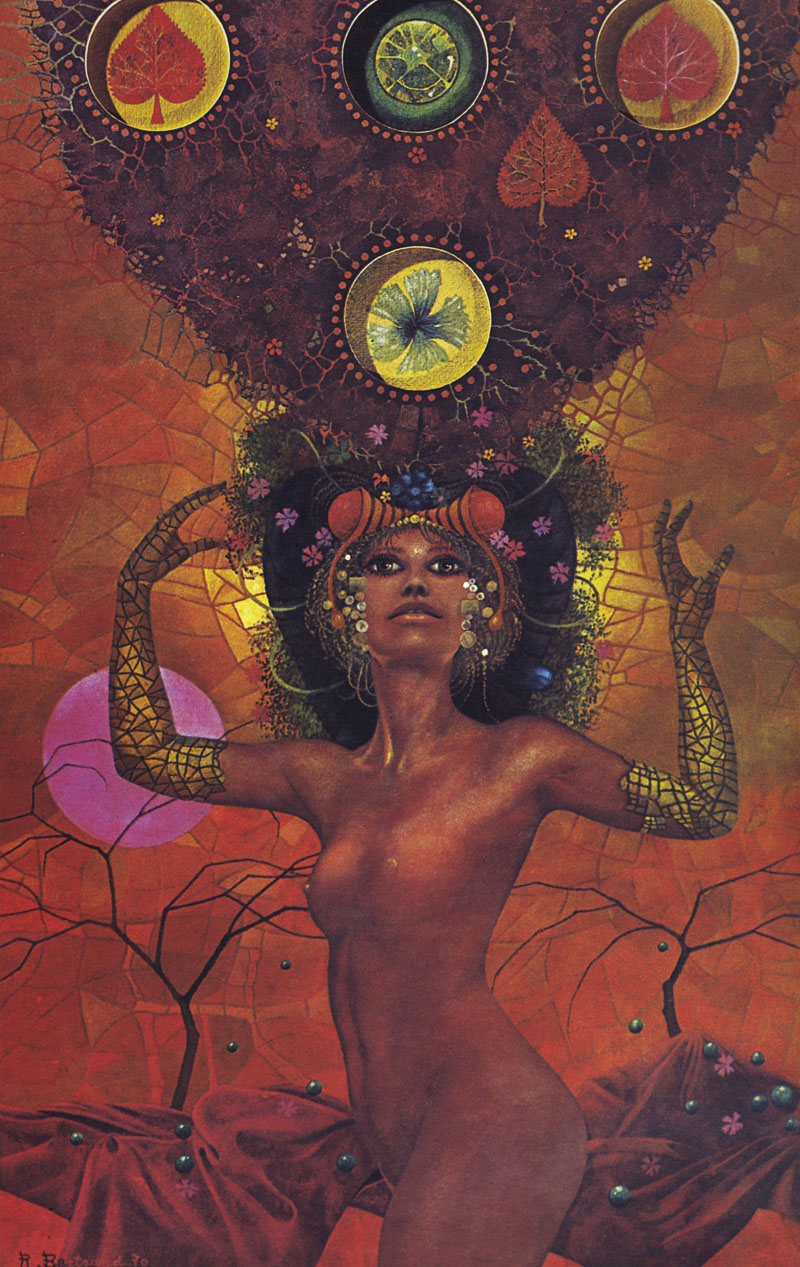
Scanning some of my work today I thought I’d follow yesterday’s post with a few scans of the colour plates in the second Eric Losfeld volume of Bertrand’s work, Dessins Erotiques II (1971). None of the pictures in the book are titled, and there’s little detail either about their production. Among the colour works is the Boschian piece above which for once doesn’t have one of the artist’s strange women as its sole subject. A few more scans from the same book can be seen at this earlier post.

bertrand16.jpg

bertrand17.jpg

Continue reading “Raymond Bertrand paintings”

Visionaries: The Art of the Fantastic

hoffman.jpg

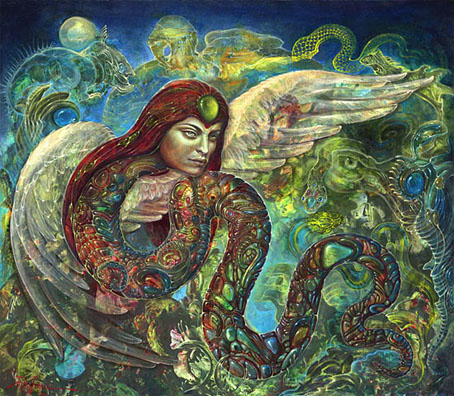
Curandera (2011) by Martina Hoffman.

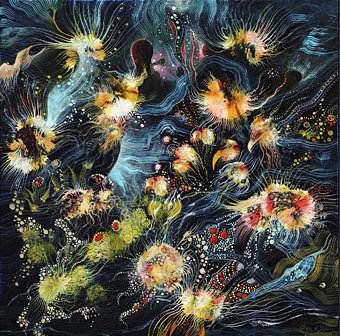
Another US art exhibition, Visionaries: The Art of the Fantastic has been running since mid-July at the QCC Art Gallery, New York. I’d have mentioned this sooner but last month has been rather hectic, work-wise. A great opportunity for anyone in the NY area to see original works by artists such as Ernst Fuchs, HR Giger and the late Sibylle Ruppert, plus many works by newer artists. It also shows how fantastic art (as opposed to fantasy art) continues to pursue its parallel course and draw fresh talent despite never attracting attention from the art critics with the largest megaphones. Not everything in the show is to my taste—I’ve a low tolerance for saccharine, New-Agey things—but the quality and range of the exhibition is impressive. Visionaries: The Art of the Fantastic runs to 20th September, 2012.

abrams.jpg

The Revelation of the Turtle Pond (2010) by Isaac Abrams.

ruppert.jpg

Chant de Mald (1978) by Sibylle Ruppert.

Elsewhere on { feuilleton }
The fantastic art archive