Layered Orders: Crowley’s Thoth Deck and the Tarot

magus.jpg

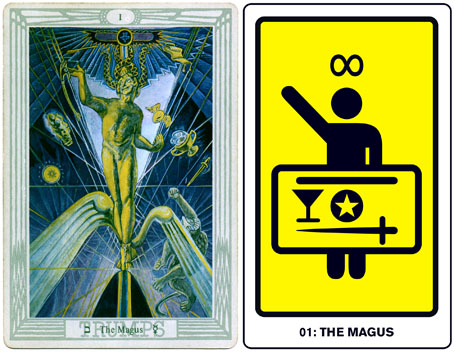
left: The Magus from the Thoth Tarot by Frieda Harris and Aleister Crowley (1938–1940?); right: The Magus from The Major Arcana by John Coulthart (2006).

Phantasmaphile presents another magickal art event in NYC next week. Layered Orders: Crowley’s Thoth Deck and the Tarot is described as “a personal narrative by Jesse Bransford”, an artist with a very distinctive approach to traditional occult symbolism. Bransford’s talk will focus on the peerless Thoth Tarot deck which Frieda Harris painted over several years under the careful direction of Aleister Crowley. The Thoth deck for me is still the ultimate Tarot deck. Crowley and Harris sought to create a Tarot for the 20th century, throwing out much of its tired and degraded iconography. This they replaced with dramatic interpretations which brought new layers of symbolism to the cards—including references to contemporary science—and also acknowledged the developments of Cubism and Futurism in the visual sphere. Tarot decks have proliferated since the 1960s but the Thoth deck has few (if any) rivals. I made use of Crowley’s controversial reordering and renaming of the cards in 2006 when I produced my set of Major Arcana designs based on international symbol signs.

The Tarot in general and Aleister Crowley’s Thoth Tarot in particular represent a miasmic confluence of image and thought into a single structure that is both liberating and overwhelming in its scope. In creating the deck, Crowley (in collaboration with painter Lady Frieda Harris) sought to integrate the mythological structures of the major mystical systems of both Western and Eastern occult traditions and to bring them into line with contemporary scientific thinking. The symbolism of the cards blends Kabbalah, Alchemy, Astrology, Egyptian mythology, quantum physics and even the I-Ching in ways that are at the same time clear and utterly confounding.

In an image-soaked personal narration Bransford, whose research-based artwork has delved into many of the territories Crowley sought to unify, will discuss some of the basic concepts of Tarot symbolism, returning to Crowley’s deck as among the most total example of the cards’ syncretism and as the most controversial.

Layered Orders: Crowley’s Thoth Deck and the Tarot takes place at Observatory, 543 Union Street, Brooklyn, NYC on Friday, July 17 at 7:30pm. Admission is free and there are further details at the Observatory website and Phantasmaphile.

Previously on { feuilleton }
Fata Morgana: The New Female Fantasists
Aleister Crowley on vinyl
The Man We Want to Hang by Kenneth Anger
The art of Cameron, 1922–1995

Real Unreal: Best American Fantasy 3

baf3.jpg

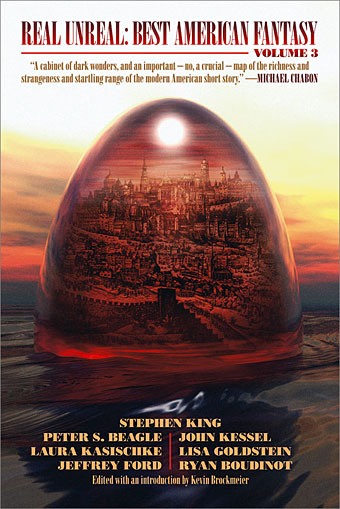
Another work update and another cover for Underland Press, this being the third volume in the Best American Fantasy series. The picture is based on a description from Jeffrey Ford’s story although I don’t know how accurate this may be since I only had a précis to go on, not the story itself; I hope Mr Ford will forgive the necessary artistic licence. The book will be published in January 2010.

Medicine Road by Charles de Lint

delint.jpg

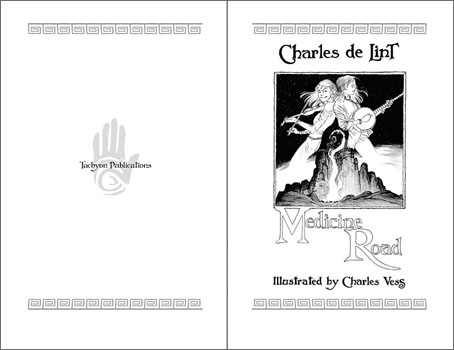
The second of my book designs for Tachyon Publications is published this month and it was good to receive a copy in the same week as getting a load of new CDs. Medicine Road is a contemporary fantasy of shape-shifting and shamanic magic set in the American South West. This job was particularly pleasurable for being illustrated by Charles Vess, celebrated among other things for his many collaborations with Neil Gaiman, including Stardust. I embellished the opening pages with designs based on Native American petroglyphs, a couple of which are from the tribes mentioned in the text.

Laurel and Bess Dillard are charismatic bluegrass musicians enjoying the success of their first Southwestern tour. But the Dillard girls know that magical adventures are always at hand. Upon meeting two mysterious strangers at a gig, the red-headed twins are drawn into a age-old, mystical wager along the Medicine Road.

One day, seeing a red dog chasing a jackalope, Coyote Woman gave them human forms. They became Jim Changing Dog and Alice Corn Hair. In return, both of them must find true love within a hundred years or their “five-fingered” forms will be forfeit. Alice has found her soul mate, but trickster Jim is unwilling to settle down — until he sets eyes upon free-spirited Bess Dillard.

Yet time is running out for the red dog and the jackalope. In just two weeks they will journey to their reckoning at the Medicine Wheel. Meanwhile, a motorcycle-riding seductress and a vengeful rattlesnake woman are eager to meddle, and Bess and Laurel, caught in a web of love and lies, must find their own paths into the spirit world.

Next up from Tachyon will be a book by Kage Baker. More about that later.

Previously on { feuilleton }
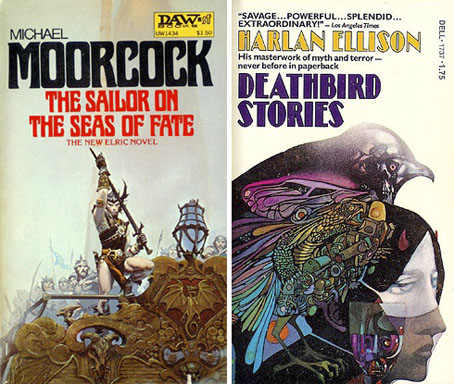
The Best of Michael Moorcock

New music and design

cds.jpg

A visit to Baked Goods distribution this week brought me a haul of new releases, all items I’ve either designed or overseen the production of. Among the new CD designs I’ve already mentioned the Tectonic Plates compilation, a really excellent collection of dubstep singles with a bonus disc of mixes by Pinch. Related to Tectonic’s Bristol underground is a compilation of singles from the Caravan label mixed by DJ October. I’ve put together the labels for Caravan’s vinyl over the past year and assisted with the layout of this, their first CD. The other new design (which I’ve yet to add to the site) is a collection of live improvisations by Mojo-tipped Liondialer (influences: Supersilent, Talk Talk, Ornette Coleman, Tony Conrad, Stars of the Lid, Jandek, Loren Connors, Ben Frost, Shearwater…), aka Greg Haines and Danny Saul. This is another release on the White Box label and was recorded, edited and sequenced by my good friend Gav whose knowledge of music esoterica has been drawn upon for previous posts here.

Also new: a clutch of recent vinyl (I really need to add a vinyl section to my pages), a Tectonic promo T-shirt (!), and two releases which I helped guide through the production process, Cloaks Versus Grain and The Sleeper by The Leisure Society, the latter being a very well-received release which was nominated earlier this year for an Ivor Novello award.

Meanwhile, there’s more book work turning up but I’ll talk about that when I’ve had a chance to further update the site.

Previously on { feuilleton }
Plates: Volume 2

The Metamorphoses of Don José

velasquez1.jpg

Las Meninas (1656) by Diego Velázquez.

The sight of one of Picasso’s many versions of Las Meninas (The Maids of Honour) by Velázquez earlier this week prompts this post. An endlessly fascinating painting whose influence runs through three hundred years of art history. That influence isn’t so surprising if you consider this as a painter’s painting; it certainly never seems to figure in the canon of favourite works among the wider public. But artists are beguiled by the games it plays with our ways of seeing: a self-portrait of the artist painting a subject (the royal couple) standing where the viewer would be, with the couple seen in reflection in the mirror on the back wall. We are the watchers and the watched. Wikimedia Commons has a decently large copy of the painting.

velasquez2.jpg

I’ve long been fascinated by the detail of the queen’s chamberlain, Don José Nieto Velázquez, standing on the steps at the back of the picture. Lines of perspective draw our attention to his figure, not only the perspective of the room but also the line which can be drawn across the heads of the three figures in the foreground right. I always look to see how Don José is treated in subsequent variations, some of which appear below.

goya.jpg

Las Meninas, after Velázquez (c. 1778) by Francisco de Goya y Lucientes.

One of the commonplaces of contemporary art is artworks about other artworks. Goya’s etching shows that this idea is by no means a new one. Goya was apparently dissatisfied with his attempt, and its main interest is the degree to which he distorts various parts of the picture.

clarke.jpg

The Facts in the Case of M Valdemar (1919) by Harry Clarke.

Harry Clarke scholar Nicola Gordon Bowe proposed in The Life and Work of Harry Clarke (1989) that the figure in the background of this Poe illustration was a version of Don José. Clarke’s picture also has a similar grouping of foreground figures which adds to the speculation. The division of space in the Velázquez painting would have held considerable appeal for an artist used to dealing with similar divisions in his stained glass window designs. Will at A Journey Round My Skull recently uploaded a set of high-resolution scans of Clarke’s Poe drawings and paintings.

picasso.jpg

Las Meninas (after Velazquez) (1957) by Pablo Picasso.

In the 1950s Picasso took to producing a series of variations on favourite paintings. There are 44 versions of Las Meninas, some more abstract than others. This one reminds me of Guernica and I like the humour of presenting Velázquez’s dog—one of the great dogs of art history—as though it’s been drawn by Nicolas Pertusato, the child who attempts to rouse the animal with his foot. Velázquez here has a head surmounting a spindly body comprised of the Order of Santiago cross.

dali.jpg

Las Meninas (1960) by Salvador Dalí.

Salvador Dalí venerated Velázquez and he happily quoted other artists throughout his career so it’s no surprise to find variations of Las Meninas. This wins the award for the most eccentric, with the figures reduced to numerals. Closer examination shows it to be quite clever the way each number corresponds to a different figure. The use of the number 7 for the artist and for Don José makes sense when you consider that they share the same surname. Don José turns up alone is another painting the same year, a work entitled Maelstrom: Portrait of Juan de Pareja fixing a string of his mandolin.

hamilton.jpg

Picasso’s Meninas (1973) by Richard Hamilton.

Richard Hamilton’s aquatint is equally playful, substituting Velázquez with Picasso and his works.

haunter.jpg

The Haunter of the Dark (1986).

I seem to have referred to my own work quite a lot recently, and here’s some more of it. The panel on the right quotes from Harry Clarke’s Poe illustration and so can be considered as continuing a trace element of the shadowy Don.

witkin.jpg

Las Meninas (Self Portrait) (1987) by Joel-Peter Witkin.

Joel-Peter Witkin has quoted Picasso’s works frequently in his photo-tableaux so the Picasso-esque figure on the right is perhaps inevitable. Witkin also has a considerable fondness for dead things so it’s quite likely that the dog in this photograph isn’t sleeping.

I’ll be surprised if there haven’t been a lot more variations during the past twenty years. If anyone knows of any which are better than this item by Antonio Guijarro Morales, please leave a comment.

Previously on { feuilleton }
Picasso-esque
Reflections of Narcissus
My pastiches
Guernica, seventy years on
The art of Harry Clarke, 1889–1931