All Clouds are Clocks: György Ligeti

ligeti1.jpg

It’s unlikely that anyone will be stuck for anything to watch during the next few days but you could do worse than spend an hour with this documentary about the music of composer György Ligeti. I’ve mentioned this several times over the years, it’s one of my favourite films by the late Leslie Megahey, my favourite director of TV arts documentaries. All Clouds are Clocks was made for the BBC’s long-running Omnibus arts strand, and is unique among all the films made for that series in being broadcast twice (in 1976 and 1991), with the second broadcast appending new footage to the original film.

ligeti2.jpg

The film as a whole is fairly simple by today’s standards, an interview with the composer in his studio intercut with extracts from Ligeti recordings and performances. After years of documentaries filled with hyperactive editing and inane comments from celebrity interviewees Megahey’s straightforward approach is a considerable relief. You have the music, and you have the composer talking about the music; that’s it. Especially commendable is that there’s no mention at all of the use of Ligeti’s recordings as film scores. If the BBC made a film like this today (which they wouldn’t in any case) the first thing you’d see would be clips from Stanley Kubrick films.

ligeti3.jpg

As is often the case in Megahey’s documentaries, the director himself is the narrator, and in this one he’s also the off-screen interviewer as he was in his celebrated Orson Welles documentary. The illustrative episodes include melting plastic clocks, the slow awakening of a wooden puppet, and a performance of Poème symphonique, the composition which requires the priming and operation of 100 metronomes. Ligeti comes across as good-humoured and approachable, a serious artist but one whose general demeanour never seems loftily superior to ordinary human concerns the way Stockhausen often did. Ligeti’s manner confirms the sense of humour behind compositions like the one for the metronomes, and even more so in the choral/orchestral work Nouvelles Aventures. The latter is shown in an extract from a filmed performance at the Roundhouse, London, in 1971, a concert conducted by Pierre Boulez which provokes raucous laughter from the audience when a tray loaded with crockery is hurled into a bin. There’s humour of a blacker variety in the 1991 section which includes a description of Ligeti’s “anti-anti-opera”, Le Grande Macabre, based on a play by Michel de Ghelderode. This was Ligeti’s only operatic work, and I think it may be the only Ligeti composition I still haven’t heard in full. Most stagings are a riot of grotesque costuming and set design (the setting is a place called “Breughelland”) so it obviously needs to be seen as well as heard.

Previously on { feuilleton }
György Ligeti, a film by Michel Follin
Leslie Megahey, 1944–2022
Le Grand Macabre
Leslie Megahey’s Bluebeard
Metronomes

The Magic Shop, a film by Ian Emes

magic1.jpg

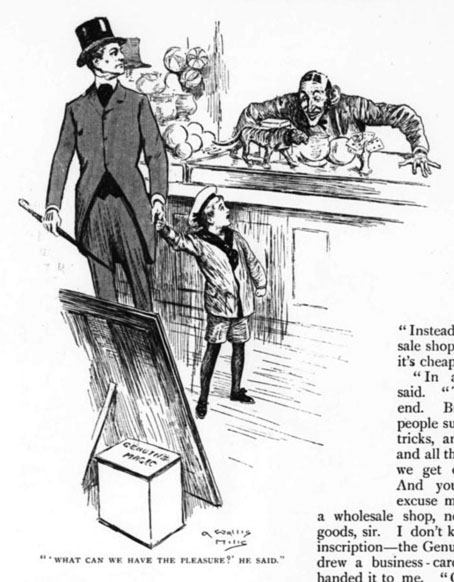
An illustration by Arthur Wallis Mills from The Strand Magazine, June, 1903.

I had not thought the place was there, to tell the truth—a modest-sized frontage in Regent Street, between the picture shop and the place where the chicks run about just out of patent incubators—but there it was sure enough. I had fancied it was down nearer the Circus, or round the corner in Oxford Street, or even in Holborn; always over the way and a little inaccessible it had been, with something of the mirage in its position…

Despite writing about an HG Wells adaptation only a week ago I hadn’t gone searching for more of them when this one turned up anyway, rather like Wells’ mysterious shop. I’d actually been looking at the filmography of the late Ian Emes, a director best known for the short animations he made for Pink Floyd’s concerts, although his career encompassed animated shorts like The Beard as well as longer films for television and the cinema. The Magic Shop, which was made in 1982, looks as though it might have been another of those shorts that used to be programmed as supporting titles for first-run features in British cinemas. Andrew Birkin’s Sredni Vashtar was one of these, a film which is also under 30 minutes in length and an adaptation of a popular piece of Edwardian fiction.

magic2.jpg

HG Wells’ story was first published in The Strand Magazine in June 1903 then collected in Wells’ Twelve Stories and a Dream a few months later. It’s been one of my favourite Wells stories since I first read it at the age of 11, as I mentioned in this review of the 1964 TV version. Wells’ fantasy reached me just as I was beginning to get very interested in conjuring tricks. I’d also been reading Victorian ghost stories in the reprint collections being published by Puffin and Lion, so a story about a shop that sold magic tricks, where the premises and proprietor had a slightly sinister quality, was exactly the kind of thing I wanted to read.

magic3.jpg

Ian Emes’ adaptation is a more successful Wells film than The Door in the Wall, and a much better adaptation of the story itself than the attempt to update the tale for The Alfred Hitchcock Hour, but Emes still doesn’t really capture the spirit of the story. The main flaw is that the actor playing the boy who wants to explore the shop is too old for the role. The narrator’s son in the story is around five or six years old, and much of the tension in the telling comes from the way that the boy sees everything that’s happening as delightful and magical while the father experiences rising alarm at the unfolding events and the situation in which the pair find themselves. The second half of the story, in which father and son are led by the shopowner into the labyrinthine warehouse behind the shop, is also lacking. Emes’ production may have been compromised by its budget but there’s no sign of the surprises that you might have expected to be filmed by a former animator. Derek Jarman regular Karl Johnson plays the father, Ron Cook is the shopowner, and there’s a cameo near the beginning from William Rushton as the man whose whining son is denied admittance to the shop. (Rushton had earlier provided the voice of the afflicted shaver in The Beard.) At the end of Emes’ film father and son find themselves teleported to what looks like a back street somewhere near the river instead of being returned to a busy London street. This reminds me that the first time I visited Regent Street myself at the age of 13 I had half a mind to go looking for the “Genuine Magic Shop”—or to try and identify the place where it might have been. The elusive nature of Wells’ establishment makes it the forerunner of the chemist shop owned by the malevolent Grail-seekers in Charles Williams’ War in Heaven, which makes me wonder now whether Williams borrowed the idea from Wells.

Ian Emes’ film may be seen at his Vimeo channel (log-in required, or you can use the Vimeo app). The story can be found in a collection of fifty-four of Wells’ short stories at Standard Ebooks, the home of free, high-quality, public-domain texts.

Previously on { feuilleton }
The Door in the Wall, 1956
Claude Shepperson’s First Men in the Moon
The Beard, a film by Ian Emes
Uncharted islands and lost souls
Doctor Moreau book covers
The Island of Doctor Moreau
Harry Willock book covers
The Time Machine
The Magic Shop by HG Wells
HG Wells in Classics Illustrated
The night that panicked America
The Door in the Wall
War of the Worlds book covers

Weekend links 749

carriage.jpg

Fantastic Sea Carriage (1556) by Johannes van Doetecum the Elder & Lucas van Doetecum, after Cornelis Floris the Younger.

• “Preiss and McElheny have acknowledged the influence of Jorge Luis Borges’s short story ‘The Library of Babel’ (1941), which offers a brilliant, brain-scratching disquisition on bibliotecas as conduits both of infinity and meaninglessness. I also found myself thinking of Arthur Fournier, in D. W. Young’s documentary The Booksellers (2019), who spoke of ‘the psychic dreaming that paper allows.'” Sukhdev Sandhu on The Secret World, a film by Jeff Preiss and Josiah McElheny about the books collected by Christine Burgin.

• Most people know Burt Shonberg’s paintings—if they know them at all—from their appearance in Roger Corman’s Edgar Allan Poe films. But Shonberg had a career outside the cinema, something explored in Momentary Blasts of Unexpected Light: The Visionary Art of Burt Shonberg, an exhibition currently running at the The Philosophical Research Society in Los Angeles.

Warriors (1996), an ad for Murphy’s Irish Stout directed by the Quay Brothers. Samurai warriors in an Irish pub scored to the theme from Yojimbo.

The Grand Jeu group have been neglected, at least in English-speaking history, from the general consciousness of “Surrealism” but they remain among its most interesting dissidents. The teenage Simplistes, led by [René] Daumal and [Roger] Gilbert-Lecompte, collectively experimented with consciousness and investigated wildly syncretic modes of destroying and recombining selves: diverse hermetic and occult systems, extrasensory perception, trances and somnambulism, mediumistic practice and collective dreaming.

[…]

The Grand Jeu was a project of paradox: artistic and ascetic, indulgent and severe, political, and mystical, ecstatic and negating, egoistic and selfless, graceful and violent. It sought to continually weave between collectivity and individuality, of art and life, multiplicity and unity, fed by a brew of political radicalism, inspired by Rimbaud’s germinal poetics of revolt and illumination, a utilitarian embrace of occult traditions and ideas, drug experimentation, Hindu sacred texts (Daumal would become an expert in Sanskrit) and some of Bergson’s philosophy. They were, in their own words, “serious players.” It was a mad mix, and in retrospect, clearly doomed to a short life—so, it turned out, were most its members.

Gus Mitchell on the “experimental metaphysics” of the Grand Jeu

• At Smithsonian magazine: Lanta Davis and Vince Reighard on the sculpted monsters and grotteschi that fill the Sacro Bosco at Bomarzo, Italy.

• At Bandcamp: George Grella compiles a list of “spooky sounds and spooky music, things to haunt nights and dreams”.

• At Colossal: Kelli Anderson’s amazing pop-up book, Alphabet in Motion: How Letters Get Their Shape.

• “The play that changed my life: Jim Broadbent on Ken Campbell’s electrifying epic Illuminatus!

• DJ Food browses some of the many album covers designed by the versatile Robert Lockhart.

Winners of the 2024 Nikon Photomicrography Competition.

• Mix of the week: XLR8R Podcast 873 by Andy Graham.

• The Strange World of…Lou Reed.

• The Internet Archive is back!

Warriors (1990) by Jon Hassell | Red Warrior (1990) by Ronald Shannon Jackson | Bhimpalasi Warriors (2001) by Transglobal Underground

Magic Lantern: A Film about Prague

prague1.jpg

There are many documentary films about the city of Prague but Magic Lantern is the only one written and presented by playwright Michael Frayn. Very good it is too, a personal view of the city’s political and cultural history which takes in the usual names and subjects: Rabbi Loew and his Golem, Emperor Rudolf II, Rudolf’s alchemists, artists and scholars, photographer Josef Sudek, the ubiquitous Franz Kafka, puppets, automata, and so on. While Frayn discusses the Communist and post-Communist periods there’s a brief clip of Jan Švankmajer’s The Death of Stalinism in Bohemia.

prague2.jpg

Frayn’s film was directed by Dennis Marks, and broadcast in 1993 as part of the BBC’s long-running Omnibus strand. (There’s a further Švankmajer connection in the person of executive producer Keith Griffiths whose Koninck company produced this film at a time when they were also helping Svankmajer make his features.) Magic Lantern wasn’t the only film that Marks and Frayn made together, and not their first metropolitan essay either. Imagine a City Called Berlin (1974) is a portrait of the former capital of Germany during its Cold War isolation; there’s also The Mask of Gold: A Film about Vienna (1977), and Jerusalem: A Personal History (1984), all of which may be seen at The Dennis Marks Archive. My complaints about YouTube are copious enough to paper the walls of the Hradčany, but the site is at its best when it provides this kind of haven for television history that would be impossible to find elsewhere.

Previously on { feuilleton }
Le Golem, 1967
Gustav Meyink’s Prague
Stone Glory, a film by Jirí Lehovec
The Face of Prague
Josef Sudek
Liska’s Golem
Das Haus zur letzten Latern
Hugo Steiner-Prag’s Golem
Karel Plicka’s views of Prague

MacKellar, Smiths & Jordan’s mortised card cuts

cut01.jpg

This one is partly intended as an aide-memoire for my future self should I need to recall where these particular illustrations are located. The Internet Archive has a good collection of specimen books created by type foundries, most of them American volumes although there are a few from Britain, France and Germany. The bulk of these books comprise typeface samples which I usually ignore, my interest being in the sections near the end which contain all manner of decorative detail: borders, ornaments and the small illustrations (“cuts”) that today would be classed as clip art. A few of these books have proved very useful when I’ve been working on a design that requires imitation of the decoration found in 19th-century print design (my cover for The Atropine Tree is a recent example) but I don’t always remember which book contains the elements I might want, hence this post.

cut02.jpg

Another of those cannibalistic advertising animals.

If you’re looking for antique print decoration then the catalogues published by the Johnson Type Foundry of Philadelphia (later MacKellar, Smiths & Jordan) are the ones to go for. I’ve copied or adapated ornaments and decorative details from this book on many occasions over the past ten years. The Internet Archive had a more substantial MSJ catalogue in their collection but it was a bad scan, one that was poor enough to receive some rare complaining comments from other Archive users. Happily another copy of the same book, The Eleventh Book of Specimens of Printing Types (1878), arrived there recently. The Johnson/MSJ catalogues are a much better source of decorative material than those created by their competitors, with a wider variety of combination ornaments (tiny details which could be pieced together to create unique borders or other peripheral decorations) and, in the eleventh volume, a larger stock of illustrations for advertising purposes. Before discovering these scanned catalogues I’d been relying on books from Dover and Pepin Press as source material for antique design. Pepin published a book/CD-ROM collection in 1999, Graphic Frames, which reproduces a number of the advertising cuts from the eleventh MSJ catalogue, including a couple of the ones shown here. The scans are seldom ideal in their raw state, I usually end up tracing the required design as a new version which I then convert to a vector shape. But they’re valuable in being the actual print decoration from the period, not modern reconstructions (or interpretations) of “Victorian” design.

cut12.jpg

The “Mortised Card Cuts” and “Mortised Comic Cuts” in the MSJ catalogue were comic illustrations intended for advertising purposes, although any “comic” quality is more likely to appear grotesque to our eyes. Shouting figures with very large, yawning mouths are popular in these kinds of drawings, as are dogs with singularly ugly faces. You can even see a forerunner of the “Kilroy” graffiti in the figure with a nose poking over the advert. I used a few of these faces for my Alice in Wonderland picture series in 2009: the top half of the smoking figure appears in “Advice from a Caterpillar” while other faces may be seen in the background of “Who Stole the Tarts?”.

cut07.jpg

Sondheim enthusiasts may recognise this particular figure as the origin of the razor-wielding character on the poster for the original Broadway run of Sweeney Todd – The Demon Barber of Fleet Street. Designer Frank Verlizzo (aka “Fraver”) shows how easily an old illustration can be made to slip from the comic to the sinister.

cut14.jpg

And from the comic to the plain bizarre… The past is often revealed to be a weirder place than you’d imagine once you start rummaging in its ephemera. The illustrations in most print catalogues are seldom this peculiar but until you go looking you don’t know what else might be out there.

cut13.jpg

Continue reading “MacKellar, Smiths & Jordan’s mortised card cuts”