Folk Horror Revival: Field Studies

folkhorror.jpg

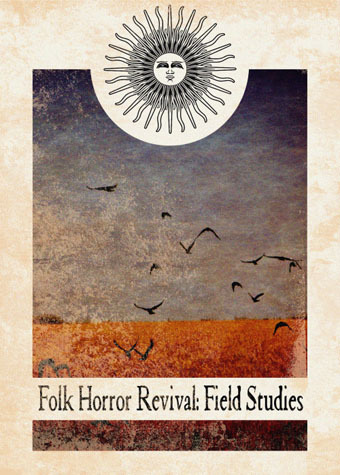
The particularly British sub-genre of folk horror receives a substantial examination in Folk Horror Revival: Field Studies, a 500-page collection of essays, interviews and artwork edited by Andy Paciorek.

Featuring essays and interviews by many great cinematic, musical, artistic and literary talents, Folk Horror Revival: Field Studies is the most comprehensive and engaging exploration to date of the sub-genre of Folk Horror and associated fields in cinema, television, music, art, culture and folklore.

Includes contributions by Kim Newman, Robin Hardy, Thomas Ligotti, Philip Pullman, Gary Lachman and many many more.

100% of all profits from sales of the book will be charitably donated to environmental, wildlife and community projects undertaken by The Wildlife Trusts.
sun2.jpg

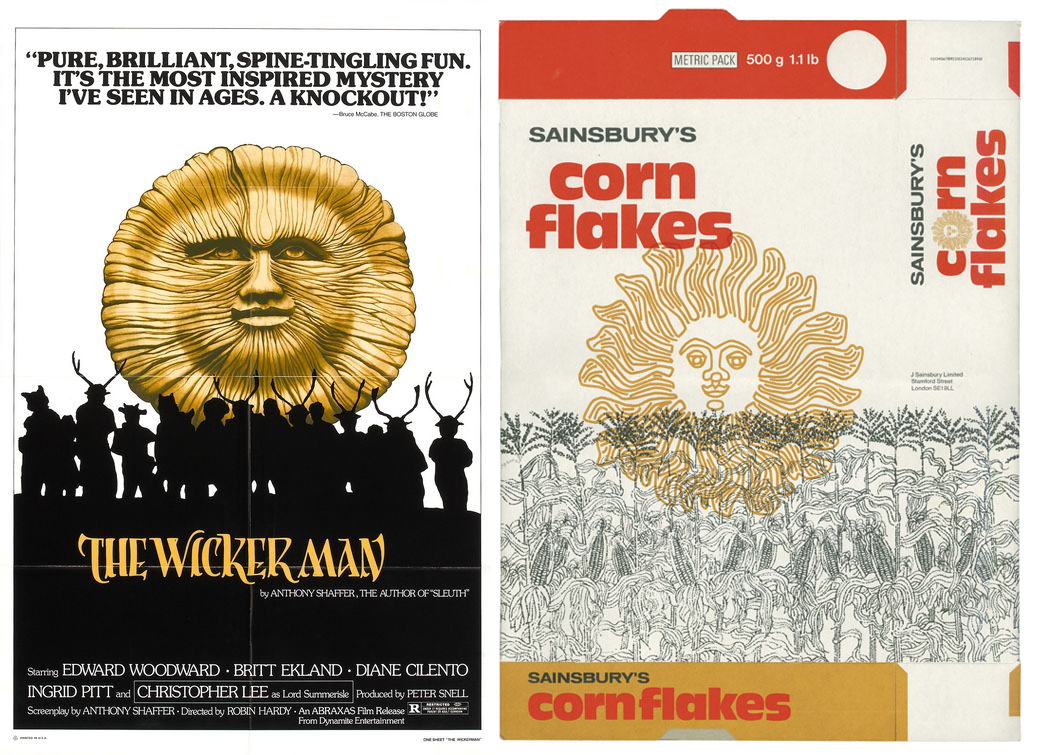
Nuada rising, 1973 & 1976.

Among the contents there’s my 4000-word essay Sacred Demons: The Dramatic Art of David Rudkin, parts of which will be familiar to readers of my previous posts about Rudkin’s work. I’m not sure Rudkin would appreciate being subjected to such a narrow focus when his plays and TV films are much more personal and cerebral than most generic entertainments. But there is an intersection in a number of them with folk horror at its widest reach, and Rudkin did happen to adapt The Ash-Tree (1975) by MR James for the BBC’s series of ghost stories at Christmas. My piece covers this along with other TV films such as Penda’s Fen (1974) and Artemis 81 (1981), and many of the stage plays including Afore Night Come (1962), The Sons of Light (1965/76) and The Saxon Shore (1983). The stage plays I only know from their scripts which makes them difficult to appraise; maybe the renewed interest in Rudkin’s work will spur some revivals.
oldweird.jpg

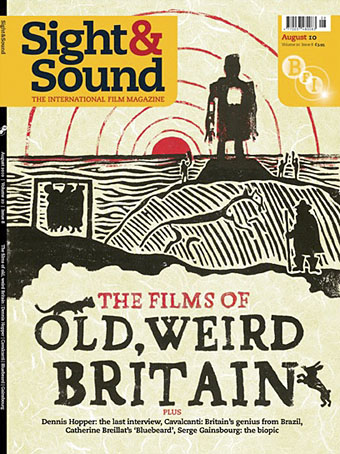
Sight and Sound, August 2010. Illustration by Becca Thorne.

Paciorek’s book isn’t solely concerned with British subjects, other essays include studies of Weird Americana, the music of The Cremator and Morgiana, and Czech folk horror. The Lulu page apparently didn’t allow the listing of a full table of contents so I’m posting the details below.
Continue reading “Folk Horror Revival: Field Studies”

Hugo Steiner-Prag’s The Ancestress

steinerprag08.jpg

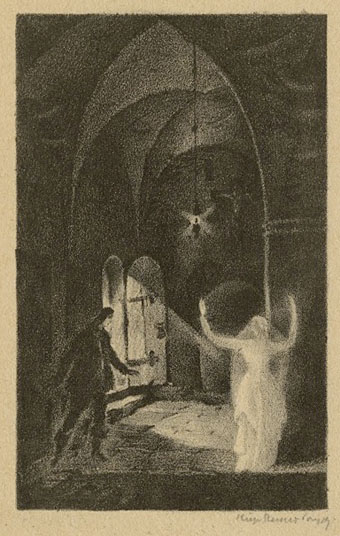
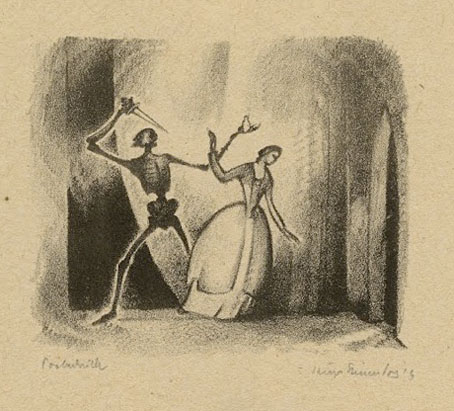
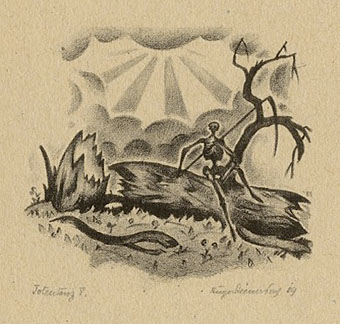
Another handful of macabre illustrations by Hugo Steiner-Prag. As before, these are minor works compared to the Golem illustrations and his illustrated Poe but it’s good to find something new. The Ancestress (1816) was a tragedy by Austrian dramatist Franz Grillparzer in which a woman killed by her husband for infidelity returns to haunt future generations. Steiner-Prag’s illustrations date from 1919, and may be seen at the Google Cultural Institute.

steinerprag09.jpg

steinerprag10.jpg

Continue reading “Hugo Steiner-Prag’s The Ancestress”

Orson Welles: The One-Man Band

omb1.jpg

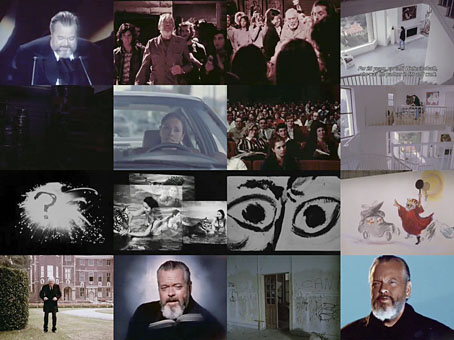
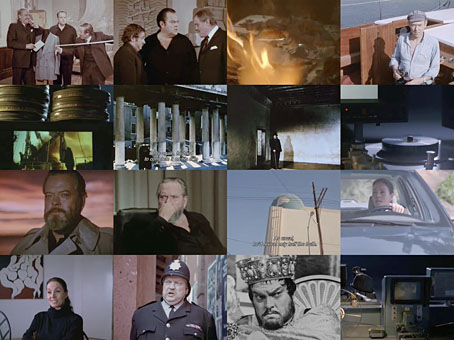
Vassili Silovic’s 90-minute documentary about the uncompleted films of Orson Welles’ later years was a revelation when it appeared in 1995. Orson Welles: The One-Man Band was shown on UK TV as The Lost Films of Orson Welles but “one-man band” is more appropriate, not only because of the bizarre song-and-dance sequence he filmed in London, but also because it’s an apt description of Welles’ approach to filmmaking. Directors who also write and produce are rare but not too uncommon; directors who write, produce and also act in major roles are in a minority. Welles did all those things and often much more, including editing, set decoration and providing voices for minor characters. The latter habit can be distracting in some of the films, especially Mr Arkadin where it often seems he was doing the voices for everyone who wasn’t already a known actor.

omb2.jpg

The One-Man Band is a compendium of clips from footage bequeathed to his partner, Oja Kodar, together with interviews, TV appearances, a witty and duplicitous trailer for F for Fake, and other odds and ends. This was the first public airing of scenes from The Deep, an unfinished feature based on a thriller, Dead Calm (1963) by Charles Williams (later filmed by Philip Noyce as Dead Calm in 1989.) There’s also a sequence from The Other Side of the Wind, another feature that was closer to completion, and which may yet receive a proper release. The sequence showing Welles discussing The Trial with an audience is now available in full on YouTube. The London clips were intended for US TV, part of an unfinished special entitled Orson’s Bag. These were filmed in the late 60s, and the song-and-dance sequence is probably the strangest thing he directed. I’m more taken with the Tailors sketch which has Jonathan Lynn and the wonderful Charles Gray as a pair of disrespectful outfitters.

Previously on { feuilleton }
The Immortal Story, a film by Orson Welles
Welles at 100
The Fountain of Youth
The Complete Citizen Kane
Return to Glennascaul, a film by Hilton Edwards
Screening Kafka
The Panic Broadcast

Welles at 100

welles.jpg

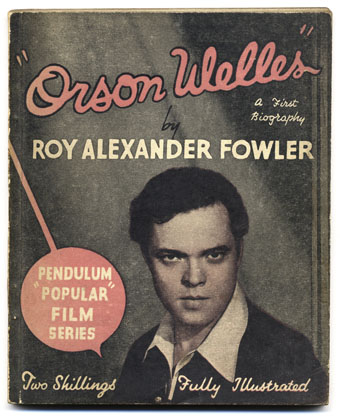
Orson Welles: A First Biography (1946) by Roy Alexander Fowler.

Happy birthday, Orson. The premature celebrity biography is nothing new, as this small volume from the Coulthart library demonstrates. Welles was only 31 in 1946 but was already the director of three feature films. If I’m less of a Welles obsessive today it’s because many of the films and radio plays that were once inaccessible can now be easily seen and heard, although a handful of unfinished projects still wait in the wings. The following is a selection of some favourite Wellesiana, old and new.

• The Mercury Theatre On The Air: Recordings of Welles’ theatre troupe at the Internet Archive and at the dedicated website. The Mercury production of The War of the Worlds is the essential one, of course, but I’m also partial to their production of Dracula which featured Agnes Moorehead playing Mina Harker, Welles as the Count, and a suitably spooky score by Bernard Herrmann. The production of Around the World in 80 Days was later expanded by Welles into an ambitious (and expensive) stage musical in collaboration with Cole Porter.

The Night America Trembled (1957) is a TV dramatisation of the alarmed reaction of some Americans to the War of the Worlds broadcast. Presented live by Ed Murrow, the drama features Warren Beatty, James Coburn, Warren Oates, and Ed Asner (who later presented the BBC’s RKO Story). Closer to Welles is The Night That Panicked America (1975) a TV movie recreation of the original broadcast with Paul Shenar as the director.

Newsreel footage of the final scenes of the so-called Voodoo Macbeth from 1936. As part of the WPA program to return Americans to work, Welles directed an all-black cast with the action of the play moved to Haiti. As usual, Welles wasn’t afraid of rearranging the Bard’s words, and this staging ends with the same lines as his 1948 film version: “Peace! The charm’s wound up.”

• My favourite Welles book is still This is Orson Welles (1992), a collection of Peter Bogdanovich’s interviews edited by Jonathan Rosenbaum. Bogdanovich’s interview tapes can be heard at the Internet Archive.

Orson Welles’ Horrorshow: Colin Fleming on Welles’ Macbeth, “the horror film no one likes to call a horror film”.

Peter Bradshaw on Citizen Kane and the meaning of “Rosebud”.

Six actors who have played Orson Welles onscreen

Previously on { feuilleton }
The Fountain of Youth
The Complete Citizen Kane
Return to Glennascaul, a film by Hilton Edwards
Screening Kafka
The Panic Broadcast

John Yunge-Bateman’s King Lear

yunge01.jpg

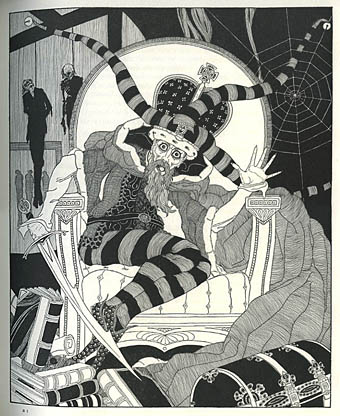
When Majesty turns to folly!

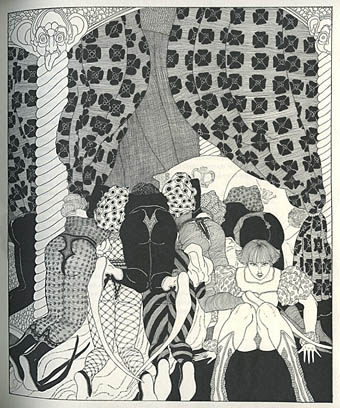
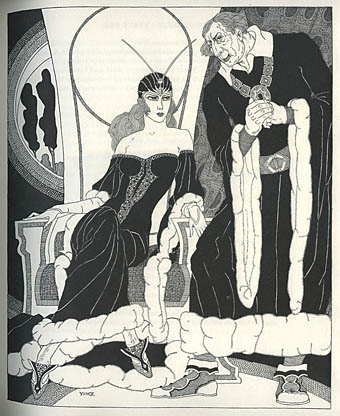
John Yunge-Bateman (1897–1971), aka “Yunge”, is another British illustrator whose work I’d not noticed until now, possibly because this 1930 edition of King Lear is an early creation in a derivative style the artist abandoned. The ten black-and-white drawings are closer to Harry Clarke than Aubrey Beardsley, and a couple of them even try to match Clarke’s more grotesque inventions albeit with variable results. Some of the faces are rather dopey for my taste but I like the use of solid blacks. These samples are taken from a scarce copy currently up for auction at silver-gryph’s eBay pages should anyone be interested. (Thanks again to Nick for the tip!)

yunge02.jpg

Than doth, within a dull, stale, tired bed, go to the creating a whole tribe of fops.

yunge03.jpg

If you come slack of former services you shall do well.

Continue reading “John Yunge-Bateman’s King Lear”