Weekend links 660

freas.jpg

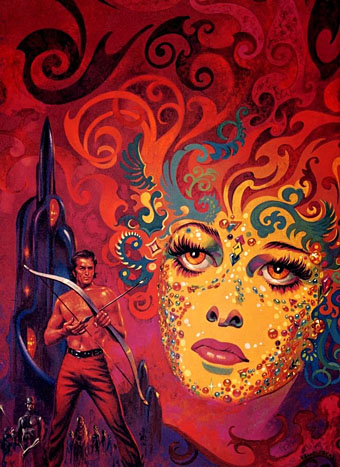
Cover painting by Kelly Freas for Mayenne (1973) by EC Tubb.

• “The kamishibai (literally “paper play”) is a Japanese form of storytelling that involved a narrator using illustrated paper boards to tell stories. As the story would progress, a new board would replace the previous board, propelling the story forward. This concept served as the inspiration for graphic designer Katsuhiko Shibuya and his class of students at Joshibi University of Art and Design. The task, however, was to deconstruct fairy tales even further using only graphic symbols.” Graphic design kamishibai tell visual fairytales at Spoon & Tamago. Great stuff.

• “If it’s not magical it’s not worth doing it… Without magic there’s no quality.” Musician/producer/catalyst Bill Laswell in conversation.

• At Public Domain Review: Lara Langer Cohen on the emancipatory visions of a sex magician: Paschal Beverly Randolph’s Occult Politics.

• At Smithsonian Magazine: Nicola Jones on the scientific history of cannabinoids.

• “Deep beneath the streets of London, musical wax cylinders reveal lost histories.”

• “The Moon smells like gunpowder.” And all that fine dust is bad for your lungs.

• At Aquarium Drunkard: Guiding Light : A Tom Verlaine Appreciation.

• New music: Sacred Tonalities by Mike Lazarev.

Supernatural Fairytales (1967) by Art | X-Rated Fairy Tales (1985) by Helios Creed | The Fairy Tale (1991) by Biosphere

Weekend links 658

ein-dor.jpg

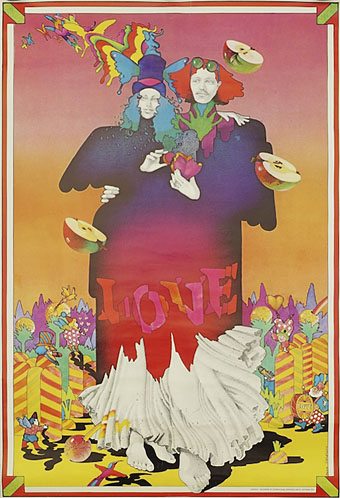
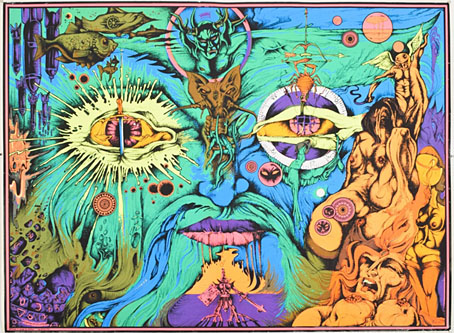
Also Sprach Zarathustra (1972), a blacklight poster by Asher Ein Dor.

• “Squaring the Circle (The Story of Hipgnosis) is a reasonably informative, if rather dry, look at a subject with much more potential for exploration,” says Dan Shindel, reviewing Anton Corbijn’s feature-length documentary about the album-cover design team. Sounds like a missed opportunity, on the whole, although the history of Hipgnosis has been so thoroughly explored over the course of several books (including a very recent one by Aubrey Powell) that any documentary seems almost superfluous. What I’d most like to see is something we’ll never have, a film about the company directed by the late Storm Thorgerson. And on that note, Thorgerson’s two-part documentary about art and drugs, The Art of Tripping (previously), has resurfaced on YouTube here and here.

• “LunaNet consists of a set of rules that would enable all lunar satellite navigation, communication and computing systems to form a single network similar to the Internet, regardless of which nation installs them. Setting lunar time is part of a much bigger picture. ‘The idea is to produce a Solar System internet,” says Gramling. ‘And the first part would be at the Moon.'” Elizabeth Gibney reports on plans to create a consistent time zone for the Moon.

• “Listening to 12, one cannot help but be struck by this deep expression of Sakamoto’s pain, of his human frailty, strength, and uncertainty about the future.” Geeta Dayal on Ryuichi Sakamoto’s latest album.

• At Public Domain Review: Illusory Wealth: Victor Dubreuil’s Cryptic Currencies by Dorinda Evans.

• At Aquarium Drunkard: Journey to inner space with The Groundhogs.

• DJ Food investigates the High Meadows psychedelic poster site.

• New music: Sub-Photic Scenario by Runar Magnusson.

• At Wyrd Daze: Disco Rd: 23 pages 23 minutes.

The Strange World of…Chris Watson.

Lunar Musick Suite (1976) by Steve Hillage | Lunar Cruise (1990) by Midori Takada & Masahiko Satoh | Luna Park (2006) by Pet Shop Boys

Dazzle

dazzle1.jpg

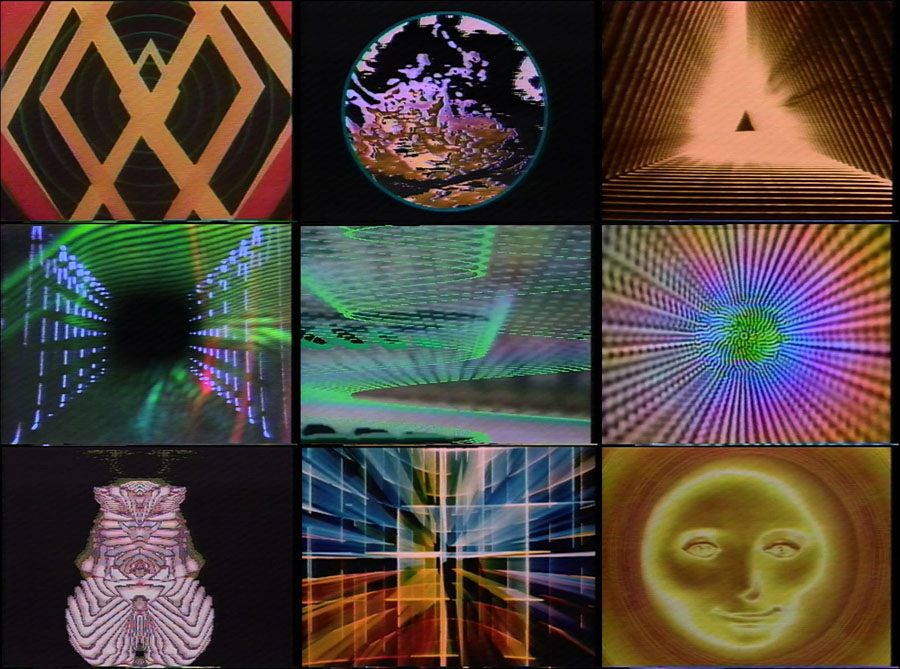
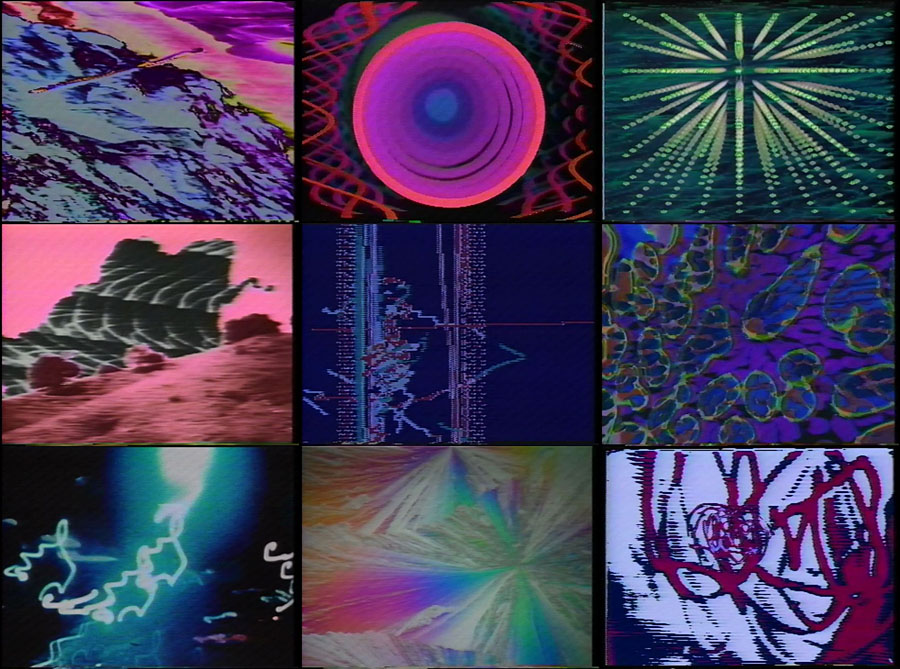
One of the things I used to enjoy doing with my old Sinclair Spectrum computer was stitching together short pieces of graphics-generating BASIC code in order to create a much longer compilation of the same, a visual mix comprised of the Spectrum’s crude logarithmic spirals, nested polygons and blinking squares. From the looks of it, Dazzle (1993) is a similar process applied to slightly more sophisticated computer graphics (made with an Amiga?), and with additional help from a vision mixer.

dazzle2.jpg

The graphics were created to accompany 45 minutes of electronic music by Jonn Serrie, so this is essentially a video album although it also looks like another of those Laserdisc releases targeted at psychedelic voyagers. As I’ve noted before, the Internet Archive now has a lot of this stuff, none of which seems likely to ever be reissued so it may as well be archived there. Dazzle is simpler than the tripping discs but its formal qualities place it closer to abstract cinema than all those reels of dated 3D renderings.

Previously on { feuilleton }
The abstract cinema archive

Pixillation, a film by Lillian Schwartz

pixillation.jpg

A new arrival at Rarefilmm, Pixillation (1970) is another example of short, abstract film-making which nevertheless may be unique in its combination of early computer graphics with organic effects created by illuminated oils and crystalline growths. This was Lillian Schwartz’s first film (made in collaboration with Ken Knowlton) after she become artist-in-residence at Bell Labs. Many more such films followed, continuing her exploration of computer graphics.

The electronic score for Pixillation is by Gershon Kingsley, a composer best known for the albums he recorded with Jean-Jacques Perrey, and for writing one of the first synthesized pop hits, Popcorn, although it was a cover of Kingsley’s tune that became an international success in 1972. Kingsley made a lot of electronic music but this is the first time I’ve encountered any of it as a film soundtrack. I think it’s also the first piece I’ve heard of his that isn’t a light-weight novelty.

Elsewhere on { feuilleton }
The abstract cinema archive

Previously on { feuilleton }
Switched-On… hits and misses

Weekend links 651

kleen.jpg

The Horror of Living (1907) by Tyra Kleen. Via

• “Voss suggests Af Klint was a pioneer of abstract painting, a label that fits in some ways – her work certainly isn’t representational in the normal sense – but jars in others. She saw her work as a spiritual calling, supercharged with meaning in ways most of her contemporaries struggled to grasp. Most, but not all. Af Klint socialised and collaborated with other visionary women. Some were artists, others were writers, but all were adherents of the new philosophies sweeping Europe in the late 19th century: spiritualism, Rosicrucianism, theosophy.” Madoc Cairns reviewing Hilma af Klint: A Biography by Julia Voss.

• “I want to insist on an amateur internet; a garage internet; a public library internet; a kitchen table internet. At last, in 2023, I want to tell the tech CEOs and venture capitalists: pipe down. Buzz off. Go fave each other’s tweets.” Robin Sloan looking for new avenues away from the corporate cul-de-sacs of social media.

• “Even when subjects take psychedelics in clinical environments devoid of nature…many of them still emerge with stronger relationships to the natural world.” Simran Sethi on the connections between psychedelic use and eco-activism.

• At A Year In The Country: A Shindig! Selection: From Celluloid Hinterlands to Children of the Stones via The Delaware Road and a Sidestep to the Parallel World of él Records.

• At Public Domain Review: Mighty Mikko: A Book of Finnish Fairy Tales and Folk Tales (1922) by Parker Hoysted Fillmore.

• “When coffee is all gone. It’s over.” Spoon & Tamago gets existential at Tokyo’s Museum of Wonky English.

The “S” Word: Spirtuality in Alternative Music is a book-length study by Matthew Ingram (aka Woebot).

• New music: Does Spring Hide Its Joy by Kali Malone (featuring Stephen O’Malley & Lucy Railton).

• Steven Heller’s font of the month is Geetype.

Spiritual Awakening (1973) by Eddie Henderson | Spiritual Blessing (1974) by Pharoah Sanders | Spiritual Eternal (1976) by Alice Coltrane