Frans De Geetere’s illustrated Maldoror

geetere1.jpg

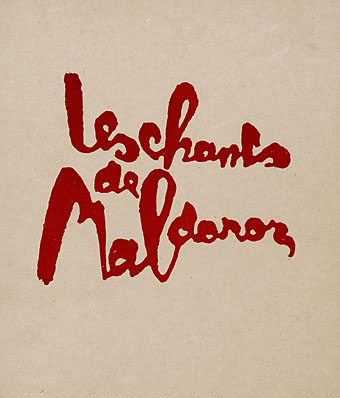
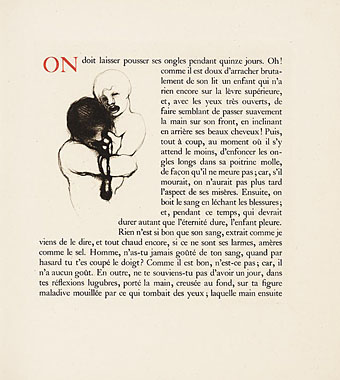
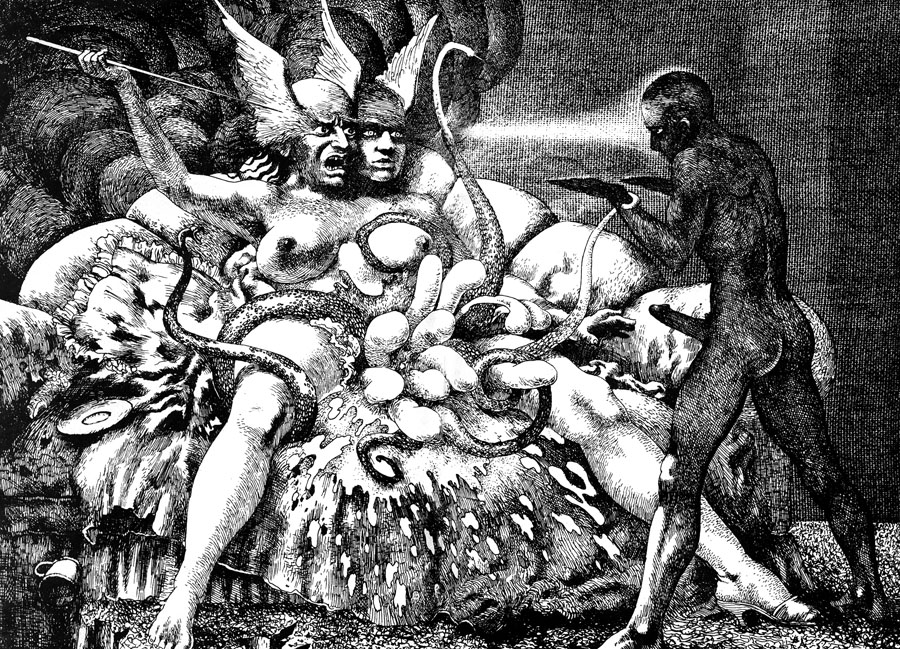
Calling this 1927 edition “illustrated” perhaps stretches the point seeing as Frans De Geetere’s illustrations are rather more minimal and restrained than you’d expect for Lautréamont’s proto-Surrealist masterwork. The Koopman Collection’s page for this book lists 65 Geetere’s etchings but only shows a handful. I’d like to see more of these even if the samples here are representative, Les Chants de Maldoror being a book more deserving of illustration than most.

geetere2.jpg

Frans De Geetere (1895–1968) was Belgian and there’s a Symbolist lineage in this work with his naming Fernand Khnopff and other Belgian Symbolists as influences. He was also a friend of the wealthy arts patron Harry Crosby whose note about the artist promises more than the artwork here delivers:

The darkness of the forest where he was born, the sombre curriculum of the monks together with the rich darkness of ecclesiastical music, the spark of revolt kindled at the Academy of Brussels and whipped into a flame of hatred by the frescoes his father compelled him to paint in the neighboring churches, his first escape (if artists can be said to escape), the year of hunger whitewashing the walls of houses (le soleil contre le mur blanc) and, at nineteen, night duty as guardian in a maison de fous, these were, for M. Frans de Geetere, the foundation stones of that strange building men call the soul. In the madhouse he worked at his painting by day, and by night snatched unsettled hours of sleep, and in this environment developed those queer, abnormal faces that stare out at us from the pages of Maldoror. …And if “Lautreamont has liberated the imagination and dispelled our fear to enter into darkness” as Mr. Jolas so significantly remarked, M. de Geetere with a smoldering rage and fearlessness of creation followed the poet into darkness–“into the occult beyond” to quote Mr. Jolas again, “where new and demonic visions” (I am reminded of Beardsley and Redon and Alastair) “people our solitude.”

geetere3.jpg

Elsewhere on {feuilleton }
The illustrators archive
The etching and engraving archive

Previously on {feuilleton }
The art of Sibylle Ruppert
Maldoror illustrated

Jugend, 1897

jugend-97-01

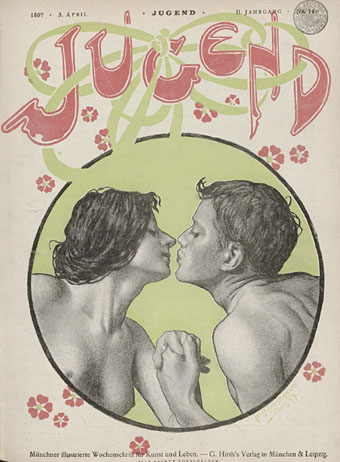
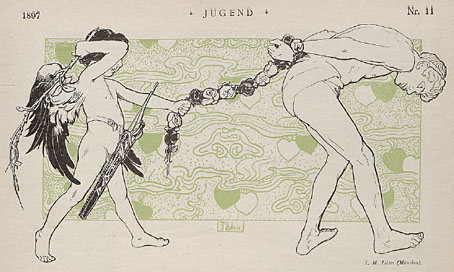
Continuing the series of posts about Jugend magazine, all these samples are from the issues for 1897. This is where things start getting really interesting graphically so I’m only posting a very small selection from 900 pages of content. As before, anyone interested is advised to examine the complete volumes which can be viewed and downloaded here and here.

jugend-97-02

jugend-97-03

Cupid drawings abound in early issues of Jugend, with men and women falling prey to love’s vicissitudes. This is one of the more unusual examples.

Continue reading “Jugend, 1897”

Jugend, 1896

jugend-96-05.jpg

So, then, I’ve now looked through several thousand pages of Jugend magazine and a few things have become apparent. If you’re interested in fin de siècle art and design then all the most interesting material is in the first four years of the magazine’s run, from 1896 on. After 1900 there are still examples of the florid Art Nouveau motifs which filled their earlier pages but the overall style becomes progressively dull, with endless pictures of German towns and hearty country folk. The magazine also begins to reflect an obviously belligerent mood in the country as a whole, pictures of military types and patriotic themes proliferate and the satirical material grows overtly aggressive towards neighbouring nations. Racist cartoons are to be expected—British magazines of the period are much the same—but there’s also a vicious antisemitism boiling away in later issues of Jugend which creates a toxic mix when seen beside the war-mongering on display elsewhere.

jugend-96-01.jpg

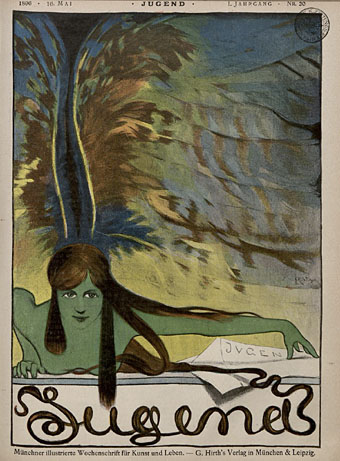
Politics aside, these magazines are still a revelation. Pan magazine was being published at the same time (its entire run is also available in the Heidelberg archives) and is the finer journal if it’s art you’re interested in. But Jugend, being a lighter read, contains a wealth of strange and surprising illustrations. Many are naive or just plain bad, of course, but some are quite remarkable. This is the first of a number of posts I’ll make which highlight illustrations that catch my eye. I’ll also be making some follow-up posts about individual artists as the magazine has been a great introduction to minor illustrators I’ve not come across before. This first post is from the two volumes covering 1896 which can be browsed and downloaded here and here.

Continue reading “Jugend, 1896”

Jugend Magazine revisited

jugend1.jpg

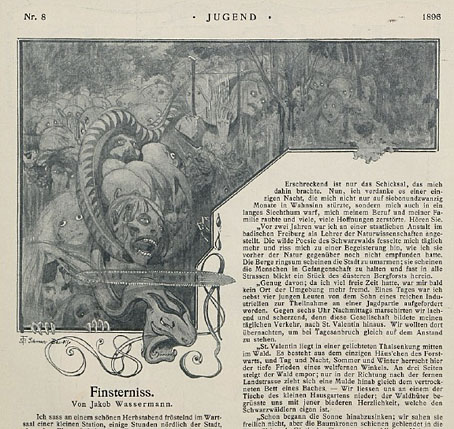
It was just over a year ago that I was wishing there was some way to see whole issues of Jugend magazine, the German periodical launched in 1896 whose Art Nouveau style gave its name to the movement in Germany, Jugendstil. Yesterday’s search for Heinrich Vogeler artwork turned up that very thing, scanned editions of Jugend at the University of Heidelberg’s digital archive. Whole numbers from 1896 to 1925! I am aghast. As well as the scanned pages being very high quality you can download the bound collections as PDFs, each one totalling over 400 pages. Leafing through pages of old magazines in a foreign language doesn’t sound very stimulating if you can’t read German but Jugend was a very visual publication. Each issue is crammed with a variety of drawings in styles which range from black-and-white Art Nouveau motifs and quasi-Symbolist illustration to humorous drawings and cartoons. Each issue also featured a large drawing or painting on a fold-out spread.

jugend2.jpg

Continue reading “Jugend Magazine revisited”

A=P=P=A=R=I=T=I=O=N

apparition.jpg

A=P=P=A=R=I=T=I=O=N is a collaboration between artist Cerith Wyn Evans and Throbbing Gristle, the once notorious Industrial music act now enjoying a resurgence of activity and attention. Evans and TG have an earlier connection via Derek Jarman, for whom Evans worked as an assistant. Given how much I enjoy seeing mirrors used in art, I’m very taken with these, and knowing that they function as drifting speakers transmitting specially recorded TG audio makes them doubly interesting. The mirrors-plus-audio aspect is reminiscent of Josiah McElheny’s recent Island Universes with Paul Schütze but that’s not to imply any influence, both artists have been following their individual paths for some time.

The title of this work comes from a poem by Stephan Mallarmé (1842–1898), a poet closely associated with the Symbolists. Looking at an English translation, the piece ends with the line “a snow of white bouquets of perfumed stars”; that final, impossible flourish—perfumed stars—is a very Symbolist touch. Claude Debussy, who took the title of his Prélude à l’après-midi d’un faune from Mallarmé, set Apparition to music in 1884.

A=P=P=A=R=I=T=I=O=N can be seen at Tramway, Glasgow until September 27, 2009.

A=P=P=A=R=I=T=I=O=N test run on Chris Carter’s Flickr pages.

Previously on { feuilleton }
In the Shadow of the Sun by Derek Jarman
The art of Josiah McElheny