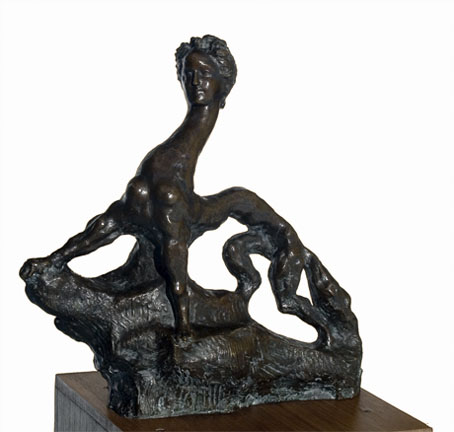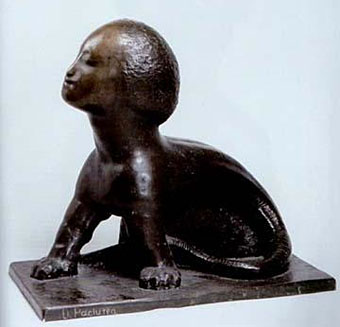
The chimeras of Dimitrie Paciurea

paciurea2.jpg

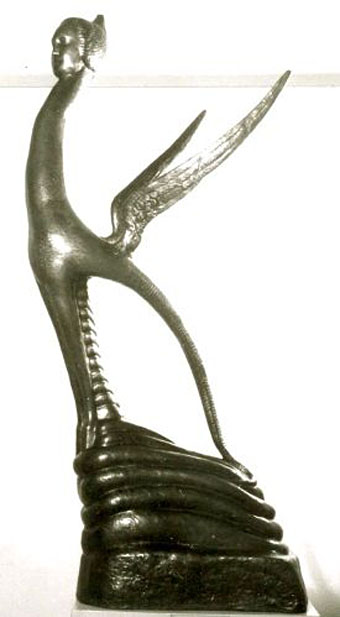
Chimera (1923).

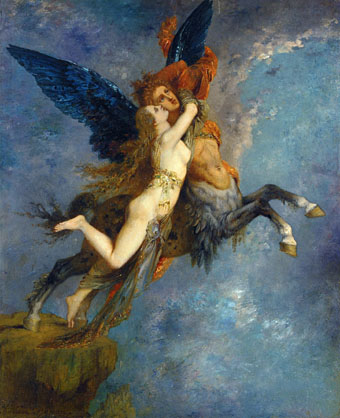
One of the many commendable things about Dreamers of Decadence (1971) by Philippe Jullian is the use of the figure of the chimera to describe the impulse that drove the development of Symbolist art in the late 19th century. A chimera is a fabulous, hybrid creature which is also a metaphor for an unfounded conception or mental phantasm, and chimeras happen to be as popular in Symbolist art as the more familiar sphinx. Both creatures had been given a heady promotion in the fin de siècle imagination thanks to Gustave Flaubert’s extravagant Temptation of Saint Anthony whose final version appeared in 1874; the fluid and metaphoric nature of the chimera, however, makes for a more useful image in art.

Romanian sculptor Dimitrie Paciurea was born around 1874 (his birthdate is uncertain), and is one of those artists who perpetuated Symbolist themes in the 20th century by which time they were rapidly losing the little grace they once possessed. In addition to the profusion of chimeras seen here Paciurea was also sculpting fauns and Pan figures, further hybrids from the Symbolist menagerie. These photos are from WikiPaintings where the artist is rather fatuously categorised as an Impressionist.

paciurea7.jpg

Chimera of the Earth.

paciurea3.jpg

Chimera of the Sky.

Continue reading “The chimeras of Dimitrie Paciurea”

Big fish

undying.jpg

Illustration by Lawrence for The Undying Monster (1946) by Jessie Kerruish.

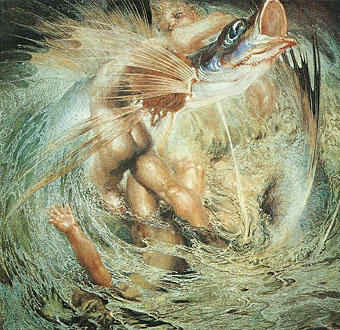
Another of those collisions between fine art and pulp fiction that I like to note now and then. The drawing above by Lawrence Sterne Stevens (from this page) I immediately recognised as borrowing its fish from the painting below by Néstor Martín-Fernández de la Torre (1887–1938), or Néstor as he’s usually known. Stevens was also usually credited by the single name Lawrence, and this is one of his many first-rate contributions to Famous Fantastic Mysteries. I’ve already noted a similar borrowing by his contemporary, Virgil Finlay, so this example isn’t too surprising. It’s unlikely that many of the readers eagerly devouring Jessie Kerruish’s tale would have been familiar with Néstor’s paintings. On the same Lawrence page there’s his illustration for Arthur Machen’s The Novel of the Black Seal which ran in the same issue.

nestor1.jpg

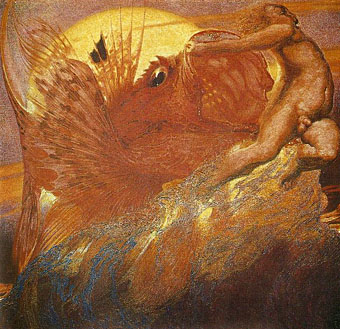
Poema del Mar: Noche (1913–1924).

Néstor is distinguished by a predilection for aquarian scenes and writhing figures, all of which are presented in a very distinctive and recognisable style. He also happens to be one of the few major artists to come from the Canary Islands which no doubt explains his interest in the sea. The Poema del Mar series, and other works such as this satyr head, often find him numbered among the Spanish Symbolists although he’s rather late for that movement, and this assumes that every artist has to be placed in one box or another whether they belong there or not. These giant fish could just as well make him another precursor of the Surrealists, and they do occasionally receive a mention for their similarity to (and possible influence upon) Dalí’s enormous Tuna Fishing (Homage to Meissonier) (1966–67). There’s more of Néstor’s work over at Bajo el Signo de Libra (Spanish language).

nestor2.jpg

Poema del Mar: Tarde (1913–1924).

nestor3.jpg

Poema del Mar: Reposo (1913–1924).

Continue reading “Big fish”

Le Cantique des Cantiques

kupka1.jpg

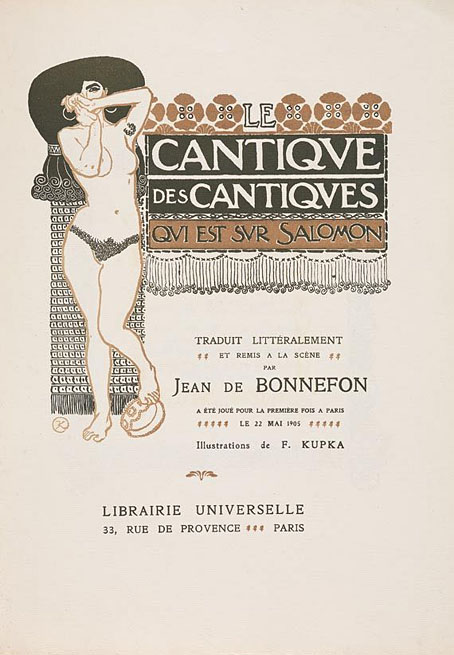
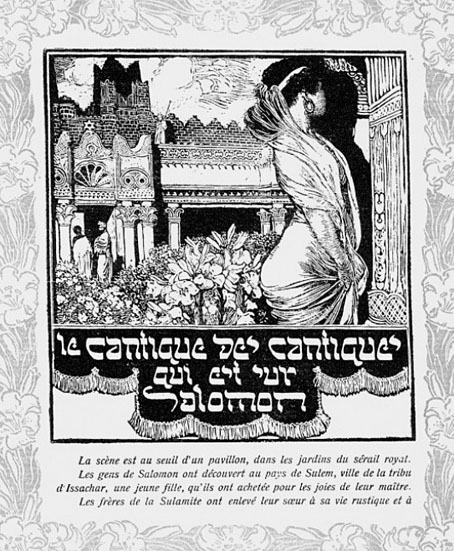
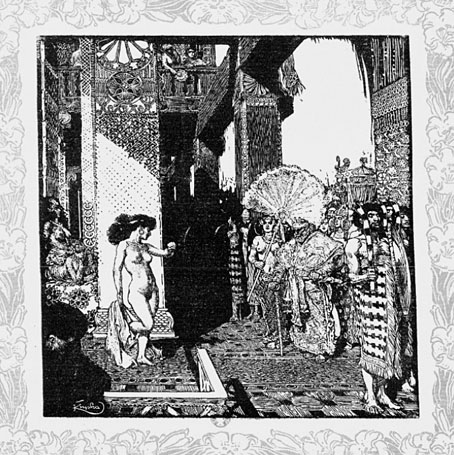
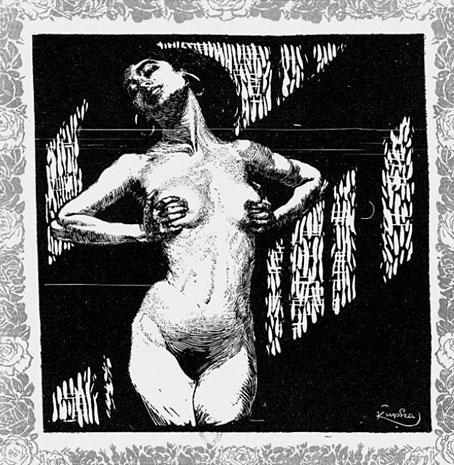
An oddity from the career of František Kupka, Le Cantique des Cantiques (1905) in this version is a stage presentation of the Song of Solomon by Jean de Bonnefon. Kupka provided a series of illustrations in a style similar to his Symbolist paintings which in the original printing are decorated with coloured borders. The copies here are from a bad scan at Gallica whose page I’ve been unable to find again. For the moment there are better copies to be seen at eBay. The drama is very much oriented towards the sexual exotica which Oscar Wilde had rendered notorious in Salomé, and which underpins so many of the obsessions of the period. A few years after this Kupka was in a different world entirely, following new directions into abstract art.

kupka6.jpg

kupka5.jpg

kupka3.jpg

Continue reading “Le Cantique des Cantiques”

Jean Delville album covers

delville12.jpg

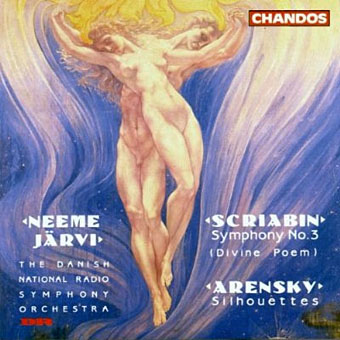
Scriabin: Symphony no 3; Arensky: Silhouettes (1992) by Neeme Järvi.

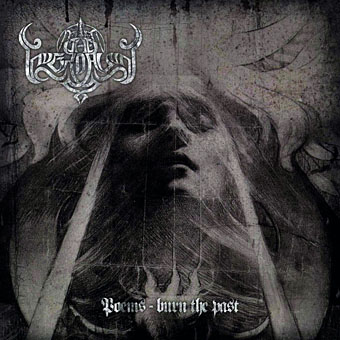
The Delville painting from yesterday’s post seems popular with classical recordings, this is only one example of its use, chosen here because some of the music is Scriabin for whom Delville created a sheet music illustration in 1912. Delville’s other work is understandably popular in the metal world among whose adherents there’s now a kind of tradition for using interesting paintings as album art. Examples of some of these follow.

delville3.jpg

The Treasures of Satan (1895).

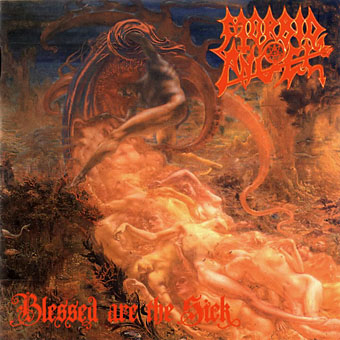
Morbid Angel beat everyone to Delville’s masterwork. I wrote something about using the same painting on a book cover design here.

delville4.jpg

Blessed Are The Sick (1991) by Morbid Angel.

parsifal.jpg

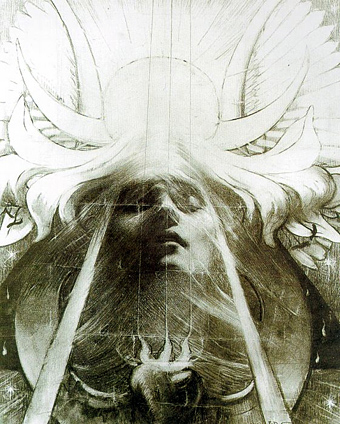
Parsifal (1890).

Another very popular Delville image, that face was used by Stanley Mouse in a poster design in 1991, and even crept into my adaptation of The Call of Cthulhu.

delville6.jpg

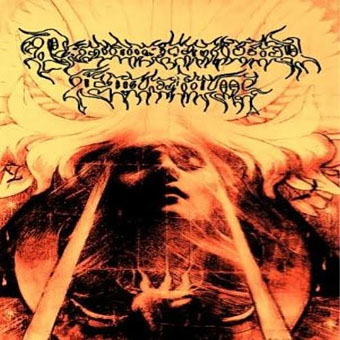
Into The Flames (2004) by Pseudostratified Epithelium.

Pseudostratified Epithelium are a death metal band from Costa Rica. A shame they stretched Delville’s drawing; The Everdawn make a better fist of it.

delville7.jpg

Poems – Burn The Past (2012) by The Everdawn.

Continue reading “Jean Delville album covers”

L’amour des âmes

delville1.jpg

L’amour des âmes (1900) by Jean Delville.

Another of the many connections between the Symbolism and psychedelic poster art, the mystically-inclined Jean Delville (1867–1953) may at least have approved of the addition of a yin-yang symbol to his painting of drifting souls. I was originally going to post Delville’s Pour L’art poster design since I’ve not seen a copy on the web as good as the one below which is scanned from a book. (The principal Delville site has many of his works but in variable quality.) Delville’s pair of floating lovers happen coincidentally to suit the preoccupations of February 14th.

grimshaw.jpg

MC5 at the Grande Ballroom, Detroit (1967) by Gary Grimshaw.

Pour L’art was a Belgian circle of artists formed in Brussels in 1892 to stage exhibitions promoting their work. Delville was the most notable of the group as well as being one of its prime movers. Looking on the Delville website it’s good to see there’s a major study of the artist’s life and work in progress, with publication scheduled for later this year. Too many artists from the late 19th century have been neglected for far too long but attitudes are slowly changing. Anyone interested in Jean Delville is advised to also look at this site which is dedicated to that apostle of androgyny, Joséphin Péladan. One of the strangest characters in the Symbolist menagerie (and the competition for that label is fierce), Péladan’s occult theories inspired Delville and a number of other artists in Belgium and France. It’s good to see he’s also gaining some serious study at last.

delville2.jpg

Pour L’art (1892) by Jean Delville.

Previously on { feuilleton }
Philippe Jullian, connoisseur of the exotic
Delville, Scriabin and Prometheus
The faces of Parsifal
Masonic fonts and the designer’s dark materials
Angels 4: Fallen angels