Recovering Viriconium

viriconium01.jpg

Detail from Assassination in the Night (c. 1600?) by Monsù Desiderio.

Yesterday’s post looked at some of the past cover designs for M. John Harrison’s Viriconium books. This post makes a few suggestions for how they might be presented in the future. Since these are mostly covers that I’d like to see they’re not necessarily ideal for the audience a publisher might be aiming at, cover design is usually a three-way process involving designer, author and publisher. In the end I’ve resisted the temptation to draft a range of original cover proposals—writing these posts has taken long enough—so almost everything here uses pre-existing art. If I was designing covers for all four Viriconium books, however, and the brief was to orient them towards a fantasy readership, the first thing I’d try would be a series of four imaginary Tarot designs. A peculiar pack of Tarot cards is a recurrent feature of the books so I’d create four emblematic cards that featured significant elements and characters from each. The characters wouldn’t be too well defined, they’d be stylised, maybe even silhouettes. Each card would feature a dominant presence: offhand these would be one of the geteit chemosit for The Pastel City, a locust for A Storm of Wings, the Barley Brothers for In Viriconium and a Mari Lwyd horse skull for Viriconium Nights. These presences together with the human characters would loom over a silhouette city at the foot of each card whose outlines would change appearance from book to book, evolving gradually from a fantastic outline of domes and towers to something that resembles a contemporary city. The colours and treatments would show a similar evolution from the bright and bold styles of the Pamela Colman Smith Tarot deck to something more photographic, collaged from elements closer to our world. Maybe.

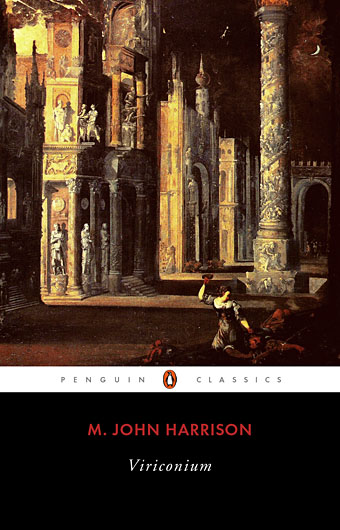
That’s an idea for the four individual books. All the examples here use the convenience of the omnibus edition so a single image (or pair of images) has to somehow represent the entire series. To save time and effort I’ve taken the liberty of hijacking a couple of Penguin Books layouts. I hope Penguin doesn’t mind, and I should also apologise to Harrison’s UK publishers, Gollancz, for making one of their authors jump ship. The Viriconium omnibus is certainly good enough to be considered a modern classic. Penguin’s recent template for its Modern Classics series happens to be very easy to apply to a wide range of artwork.
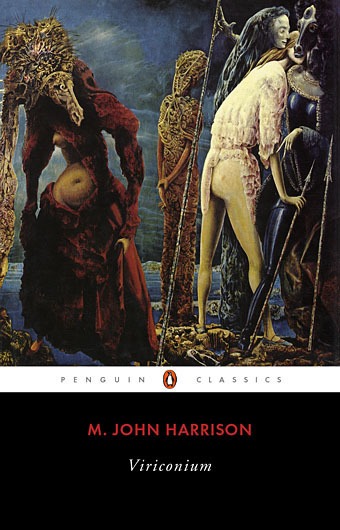
viriconium04.jpg

The Anti-Pope (1942) by Max Ernst.

Penguin has a long tradition of using pre-existing art on its covers, especially on those in its Penguin Classics series. You can almost make this into a parlour game: match your favourite novel with the best choice of painting. The tradition was extended to its science fiction titles in the early 1960s when the art of Max Ernst was featured several times along with the work of other Surrealists. Max Ernst is a favourite artist of mine so this is one I can’t resist. Many of Ernst’s decalcomania paintings of the 1940s would suit Viriconium but The Anti-Pope with its horse heads seems especially suitable.

Also on the Penguin sf covers was a picture by the mysterious “Monsù Desiderio” one of whose works can be seen at the top of this post. Desiderio was a 17th-century painter with a vague enough presence—works have been attributed to both François de Nomé and Didier Barra—and a line in gloomy architectural fantasias to make him an ideal Viriconium artist.
Continue reading “Recovering Viriconium”

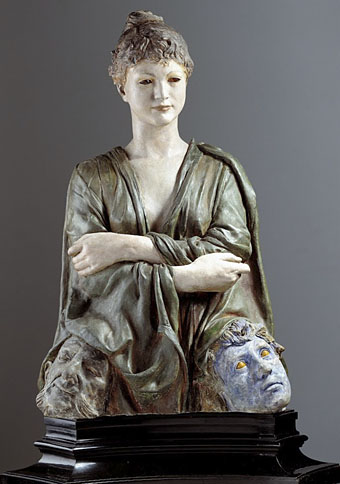
Max Klinger’s New Salomé

klinger.jpg

The New Salomé (1887–1888) by Max Klinger.

The German Symbolist Max Klinger (1857–1920) is celebrated today for the etchings which comprise his Ein Handschuh (A Glove) series, ten prints that in their curious details and dream-like quality prefigure Surrealism and Giorgio de Chirico’s “metaphysical” paintings. During his life Klinger was highly regarded for his sculpture as well as his etchings: his Beethoven was a centrepiece of the Secession building in Vienna in 1902. His New Salomé is one of the handful of Klinger works at the Google Art Project where I still feel we ought to be able to view sculpture in the round. I’ve seen many photos of this piece before but hadn’t realised until now that the eyes were…what? Rubies? Amber? Whatever they are, their fiery cast ensures that his imperious female sits unequivocally with the Evil Women that proliferated in the late 19th century.

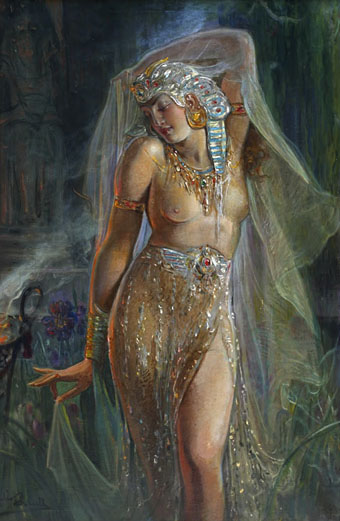
pla.jpg

Salomé (c.1910) by Julio Borrell Pla.

Klinger’s sculpture may have been fashionably misogynist but it was at least a serious piece of art. Twenty years later the Salomé theme had devolved to little more than titillating exotica, as with this vaporous painting by Julio Borrell Pla which I hadn’t come across before. The last gasp of this exhausted trend is William Dieterle’s 1953 film in which Rita Hayworth plays Herod’s daughter as all titillation and little else.

Elsewhere on { feuilleton }
The Salomé archive

The art of Juan de Valdés Leal, 1622–1690

leal1.jpg

In ictu oculi (1672).

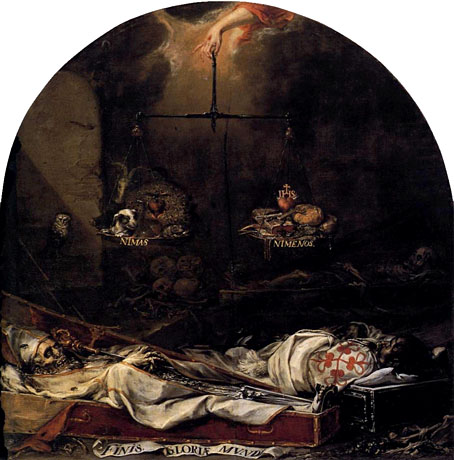
Having castigated Somerset Maugham yesterday for a novel that even he professed to dislike, thanks can be offered for the passage in The Magician which draws attention to a painter I hadn’t come across before. With a scythe-wielding skeleton snuffing a candle flame, and a bishop rotting in his casket, these are a very Spanish take on the vanitas genre. Some of the subsequent works of Salvador Dalí and Luis Buñuel are less surprising when you see art that’s this grotesque.

leal2.jpg

Finis gloria mundi (1672).

Previously on { feuilleton }
Alfred Rethel’s Totentanz
The art of Jacopo Ligozzi, 1547–1627
Massachusetts memento mori
Skull cameras
Walmor Corrêa’s Memento Mori
The skull beneath the skin
Vanitas paintings
Very Hungry God
History of the skull as symbol

Weekend links 109

magritte.jpg

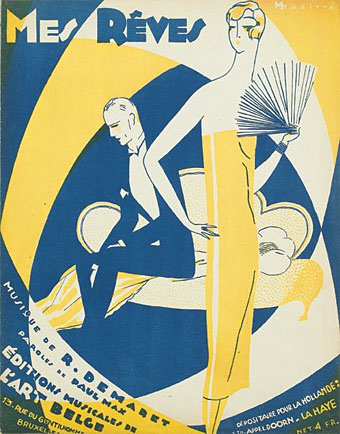
Dreams before Surrealism: a sheet music cover from 1926 by René Magritte.

• The week in music: Listen to compositions by Annea Lockwood. | At the Free Music Archive: Uncomfortable Music, a tribute to David Lynch’s Eraserhead (and, it should be said, to Alan Splet’s unique soundtrack). | Alan Licht plays a track from Trout Mask Replica then loops some Donna Summer and improvises guitar noise over it. | Music Experiments with Terror: The Spooky Isles presents Joseph Stannard‘s list of recent eldritch sounds from British musicians.

Great art, or, let’s just say, more modestly, original art is never created in the safe middle ground, but always at the edge. Originality is dangerous. It challenges, questions, overturns assumptions, unsettles moral codes, disrespects sacred cows or other such entities. It can be shocking, or ugly, or, to use the catch-all term so beloved of the tabloid press, controversial. And if we believe in liberty, if we want the air we breathe to remain plentiful and breathable, this is the art whose right to exist we must not only defend, but celebrate. Art is not entertainment. At its very best, it’s a revolution.

Salman Rushdie on the censorship of art

• All Diamond, No Rough” says the School Library Journal about the first volume of The Graphic Canon. Volume two should be out in August.

Scientific American asks: Do Psychedelics Expand the Mind by Reducing Brain Activity?

• From 2010: A Dandy in Aspic – A letter from Derek Marlowe.

Tom Phillips and A Humument: how a novel became an oracle.

Timeline Maps at the David Rumsey Map Collection.

• Happy 50th birthday, A Clockwork Orange.

Jim Dandy (1956) by LaVern Baker | Larks’ Tongues in Aspic, part one (1972) by King Crimson, live on Beat Club.

Un Chien Andalou

andalou.jpg

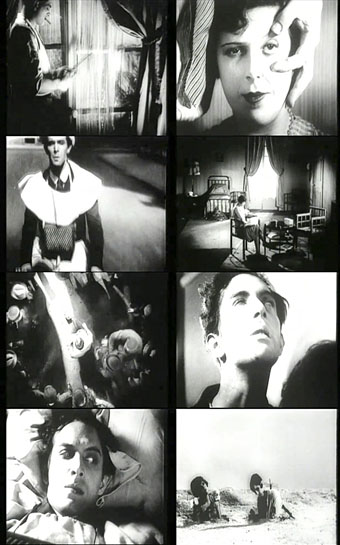
What is there to say about Buñuel and Dalí’s timeless film that hasn’t already been said? It’s one of the primary Surrealist documents and something that everyone should see at least once. Cyril Connolly attended the Paris premiere in 1929:

The picture was received with shouts and boos and when a pale young man tried to make a speech, hats and sticks were flung at the screen. In one corner a woman was chanting, “Salopes, salopes, salopes!” and soon the audience began to join in. With the impression of having witnessed some infinitely ancient horror, Saturn swallowing his sons, we made our way out into the cold of February, 1929, that unique and dazzling cold…

Why does this strong impression still persist? Because Un Chien Andalou brought out the grandeur of the conflict inherent in romantic love, the truth that the heart is made to be broken, and after it has mended, to be broken again. For romantic love, the supreme intoxication of which we are capable, is more than an intensifying of life; it is a defiance of it and belongs to those evasions of reality through excessive stimulus which Spinoza called “titivations.” By the law of diminishing returns our desperate century forfeits the chance of being happy and, because it finds happiness insipid, our world is regressing to chaos.

The film comes and goes on YouTube so serious viewers are directed to the BFI DVD/Blu-ray release which comes twinned with Buñuel’s L’Age D’Or.

Previously on { feuilleton }
Dreams That Money Can Buy
La femme 100 têtes by Eric Duvivier
Entr’acte by René Clair