Futurismo!

pirateutopia.jpg

It’s good to finally have some new work posted on the front page of this website. I’ve been busy since before Christmas but everything I’ve been working on for the past few months is waiting to be revealed until the scheduling wheels have turned their revolutions.

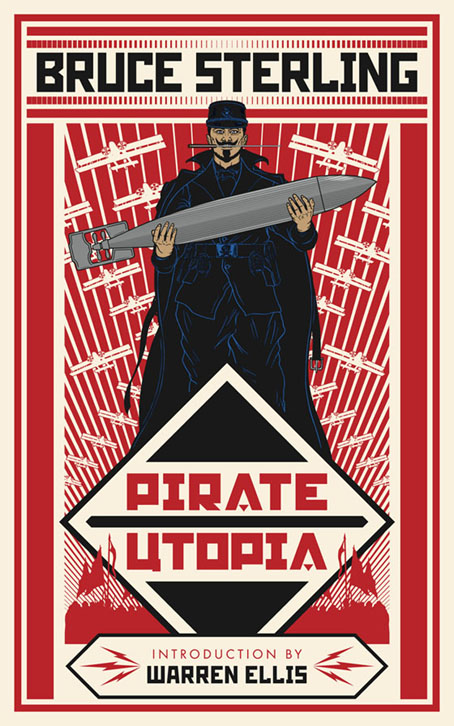
And speaking of revolutions… Pirate Utopia is a novel by Bruce Sterling that will be published by Tachyon later this year. The cover was made public this week so I can post it here. I’m also designing and illustrating the interior but it’ll be a while before I can show off any of the rest of the design, especially since I’m still working on it. Bruce Sterling is a well-known writer and futurist (with a small “f”) who was one of the leading cyberpunk authors in the 1980s; with William Gibson he collaborated on The Difference Engine (1990), an early steampunk novel. Pirate Utopia is shorter and less ambitious than The Difference Engine although both books are alternate histories, the new title being a dieselpunk affair set in the Free State of Fiume, (now Rijeka, Croatia) in 1920. The story concerns the exploits of a torpedo engineer and his gang of rude mechanics, and features appearances from some real-life characters whose identities I won’t spoil. It’s a fun book to read, and it’s great fun to work on. The brief from Tachyon was for a cover design riffing on classic Soviet propaganda posters, hence the vaguely Constructivist style. There will be more of the same inside although I’ve been poring over the works of the Italian Futurists recently, and borrowing motifs and typographic cues from designers like Fortunato Depero. Stock up on the Campari for this one.

Foreign appearances

steam1.jpg

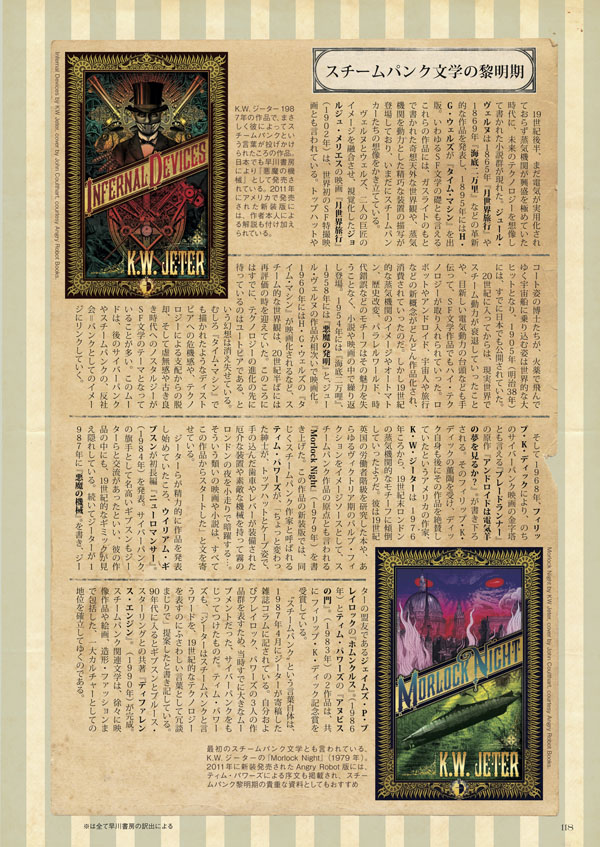
My work has appeared in a couple of foreign collections recently, each approaching popular culture from very different directions. The volume above is called Steampunk Japan Fashion Book according to a German bookseller although the title may read differently to Japanese speakers. This was published at the end of last year, and features my ever-popular covers for the Angry Robot editions of two steampunk novels by KW Jeter, Infernal Devices and Morlock Night. The book is the work of a collective who call themselves The Japanese Steampunkers.

steam2.jpg

popculture1.jpg

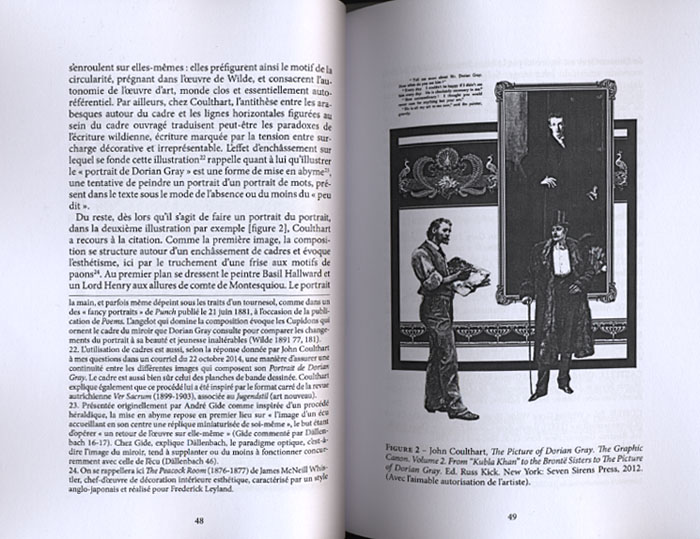
Meanwhile in France, Imaginaires #19: Les cultures populaires aujourd’hui is a collection of academic pieces about popular culture published by ÉPURE, Éditions et Presses universitaires de Reims. Inside there’s an essay by Xavier Giudicelli (University of Reims Chamapgne-Ardenne), The Picture of Dorian Gray et la culture populaire: du texte à la bande dessinée, which compares Wilde’s novel to various graphic adaptations. Xavier wrote to me some time ago about my Dorian Gray adaptation for the Russ Kick-edited Graphic Canon (2012) so the piece includes some of my remarks about my interpretation together with two of the pages.

popculture2.jpg

Previously on { feuilleton }
Picturing Dorian Gray

Weekend links 292

splendor.jpg

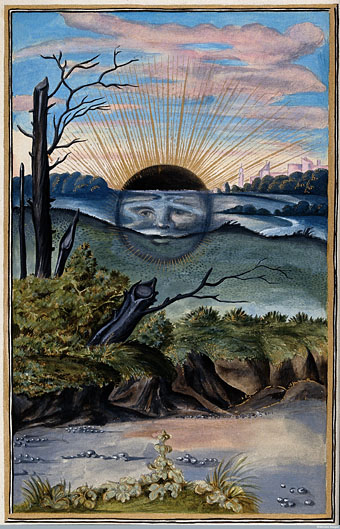
The Black Sun from Splendor Solis (1582) “attributed to the legendary figure Salomon Trismosin”.

Topic B predominates this week. The Black Sun of alchemy was the first thing I thought of when the title of David Bowie’s final album was announced late last year. The Black Sun symbolises the nigredo stage of the alchemical process when putrefaction or decomposition takes place; Carl Jung in Psychology and Alchemy equates the nigredo with the dark night of the soul. At the time I didn’t seriously think that the Bowie of 2015 would have had this in mind as a primary reference even though the Bowie of the early 1970s was immersed in Golden Dawn occultism, the Kabbalah, and a reader of Pauwels & Bergier’s The Morning of the Magicians, a book that informs the lyrics of the Hunky Dory album, and which contains a great deal of discussion about alchemy and other esoteric matters. And yet… Of all the outfits that Bowie might have worn in his final video the one that he chose for Lazarus is a match for the one he wore during the Station To Station Kabbalah-drawing photo session. At Sol Ascendans Alex Sumner and his commenters explored this twilight zone.

Back in the sublunary world, Jonathan Barnbrook’s cut-out sleeve design for the Blackstar album gained additional resonance this week: the black star as the hole that’s left when a more familiar star has been removed from its setting. Hindsight also makes poignant the observation that this was the only album without a picture of the artist on the cover. Elsewhere there were speculations about the title being a reference to Black Star by Elvis Presley (who shared a birthday with Bowie) or a term from oncology, two suggestions that fit so well they’re hard to ignore.

He began to develop a science fiction sensibility, drawing on the New Wave SF movement of Michael Moorcock and JG Ballard, other writers who used the genre such as Anthony Burgess and William S Burroughs, and an older fantasy tradition found in HP Lovecraft and Edward Bulwer-Lytton (whose The Coming Race is name-checked in Oh! You Pretty Things, 1971).

Jake Arnott on David Bowie’s literary influences

• In something-else-also-happened-this-week news, 2016 may see the long-awaited release of Andrei Tarkovsky’s films on Region B Blu-ray. Fingers crossed.

• International posters for The Man Who Fell To Earth. More Nicolas Roeg (and more shiny discs): Eureka (1983) will receive a Blu-ray release in March.

• Cracking the codes of Leena Krohn: Peter Bebergal on the Finnish writer of strange stories.

• Anthems for the Moon: Jason Heller examines David Bowie’s connections to science fiction.

• From 2013: Jon Savage on Bowie’s first meeting with William Burroughs in 1974.

• Mixes of the week: Bowie-esque Vol 1 and Bowie-esque Vol 2 by Abigail Ward.

David Bowie Doing Shit: a Tumblr

“Heroes” (1978) by Blondie & Robert Fripp | “Heroes” (2003) by King Crimson | “Helden” (2007) by Apocalyptica ft. Till Lindemann

Neutron designs

neutron2.jpg

The Bowie overload this week had me thinking again about Derek Jarman’s unmade science-fiction film, Neutron, an apocalyptic work that would have starred David Bowie if the finance had been forthcoming. Jarman’s description in an earlier post about the film remains tantalising:

There are six published manuscripts of Neutron, which zig-zag their anti-heroes Aeon and Topaz across the horizon of a bleak and twilit post-nuclear landscape. ‘Artist’ and ‘activist’ in their respective former lives, they are caught up in the apocalypse, where the PA systems of Oblivion crackle with the revelations of John the Divine. Their duel is fought among the rusting technology and darkened catacombs of the Fallen civilization, until they reach the pink marble bunker of Him. The reel of time is looped—angels descend with flame-throwers and crazed religious sects prowl through the undergrowth. The Book of Revelations is worked as science fiction.

Lee [Drysdale] and I pored over every nuance of this film. We cast it with David Bowie and Steven Berkoff, set it in the huge junked-out power station at Nine Elms and in the wasteland around the Berlin Wall. Christopher Hobbs produced xeroxes of the pink marble halls of the bunker with their Speer lighting—that echo to ‘the muzak of the spheres’ which played even in the cannibal abattoirs, where the vampire orderlies sipped dark blood from crystal goblets.

neutron.jpg

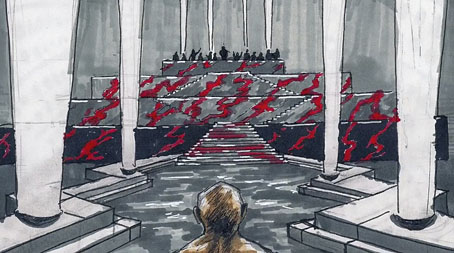
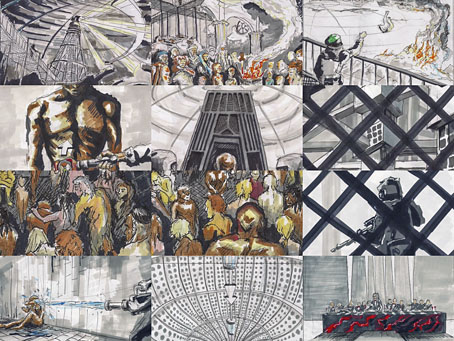
This is one of those great what-if projects along with Jodorowsky’s film of Dune, Nicolas Roeg’s Flash Gordon, and others, so it was a surprise to discover a handful of recent designs for Neutron produced by students at the Wimbledon College of Art. The video here is a short collection of stills by Jonny Blackmore. There’s another of his pieces here, and further designs by Gabrielle Cole here and here. I’m guessing that these were part of a college assignment but if anyone knows otherwise please leave a comment. As to the original Neutron, some version of the script must still exist (Jon Savage was apparently involved in later stages) as must Christopher Hobbs’ designs. Maybe we’ll see them in a book one day.

Previously on { feuilleton }
Derek Jarman’s Neutron

Weekend links 291

brooks.jpg

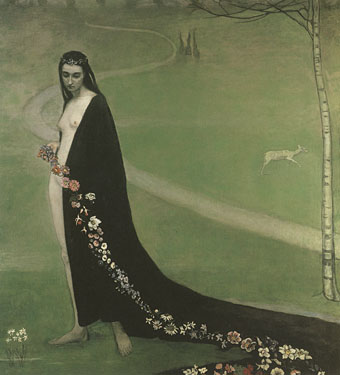
Femme avec des fleurs (1912) by Romaine Brooks.

• This week’s anniversary of the Charlie Hebdo murders was noted by some of those who defended the magazine last year. “I don’t write about Charlie Hebdo in France,” said Robert McLiam Wilson, “they have plenty of people who can do that. But I’ll do almost anything I’m asked to do in the anglosphere. Why? Well, two reasons. Because none of the other Charlie people bothers to do it. And because, really, that’s where all the bullshit lives.” A year on, and the bullshit-mongers seem to have fallen silent, what with knee-jerk outrage being a short-lived affair, and the Bataclan massacre having demolished one of the main criticisms, namely that the magazine wouldn’t have been attacked if the artists and writers had shown some respect. “[Charlie Hebdo‘s] real crime is not racism but its challenge to what has become an unbreakable commandment for many contemporary liberals: ‘Thou shalt not cause offence’,” says Kenan Malik. At Literary Hub Adam Gopnik explored the same issue in a foreword for Stéphane Charbonnier’s Open Letter.

• “Immersion in the past is no escape from the present, but it supplies a constant corrective to the narrative spit out daily by media, advertising, politics, and all those other forces that attempt to mould our thinking like jelly in a pan.” Luc Sante (again) talking to Simone Wolff about his books, Low Life and The Other Paris.

• “…throwing a lot of money behind vintage equipment? Well, that’s just a millionaire’s game. Dave Grohl can do that, but David Bowie doesn’t care about that. Just stick a microphone in front of him and he’s really happy.” Tony Visconti talking to Allyson McCabe about the music business and producing Bowie.

• “Nico Hogg’s photography captures the transformation of urban London,” says George Kafka who talks to Nico about a collection of his work, Sign & Signifiers, which I designed late last year.

• At Strange Flowers: James Conway talks to Cassandra Langer about her recent biography of artist Romaine Brooks (1874–1970).

• At Dangerous Minds: Godzilla, girls and guns, the science-fiction art of Noriyoshi Ohrai. There’s more at Pinterest.

• Mixes of the week: XLR8R Podcast 420 by Andrey Pushkarev, and Secret Thirteen Mix 172 by Julien Bayle.

• Alan Moore’s magnum opus, Jerusalem, will be published later this year. Gosh Comics has a teaser.

New York Public Library makes 180,000 high-res images available online.

Prints of darkness: macabre vintage posters

Scarfolk Television is coming

Godzilla (1977) by Blue Öyster Cult | Giant Robot / Machines in the Modern City / Godzilla (1992) by Praxis | Free-Bass (Godzillatron Cush) (1995) by Axiom Funk