Winter light

friedrich1.jpg

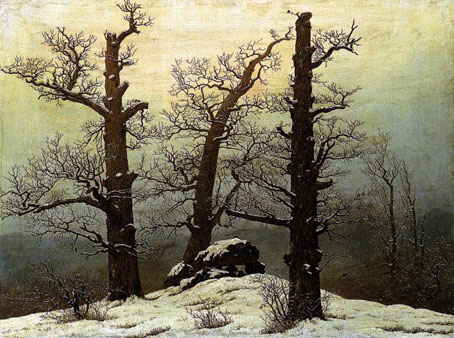
Dolmen in the Snow (1807).

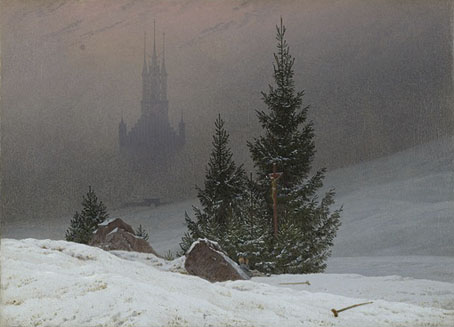
Some paintings for the Winter Solstice by one of my favourite Romantic artists, Caspar David Friedrich (1774–1840). Snow scenes tend to inspire picturesque cliché but in Friedrich’s paintings winter is merely another season in which to evoke his Christian mysticism through the depiction of landscape. The pagan dolmen above is an unusual subject, far more common are churchyard ruins and mountainside crosses although he was also happy enough painting luminous landscapes, especially of mountains and the sea. His treatment of natural light is quite extraordinary and his photo-realist style makes an interesting contrast with the similar effects captured by JMW Turner‘s palette of blurs and smears.
friedrich2.jpg

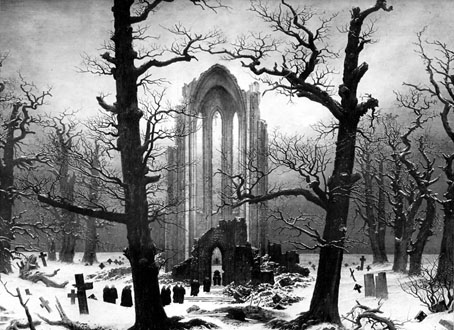
Monastery Graveyard in the Snow (1819).

I hadn’t noticed before until I looked through some online galleries that Friedrich was painting the same trees over and over. The gnarled trunks in the dolmen painting are almost identical (but reversed) to the foreground trees in the graveyard picture and similarly-shaped trees occur in other paintings. If you’re wondering why the graveyard picture is in black and white, the original was destroyed during the Second World War. Colour copies can be found but I think these may have been tinted from a monochrome photo print.
friedrich3.jpg

Winter Landscape (1811).

Previously on { feuilleton }
Winter Solstice
The art of John Atkinson Grimshaw, 1836–1893
The art of Karl Friedrich Schinkel, 1781–1841
Temples for Future Religions by François Garas

garas1.jpg

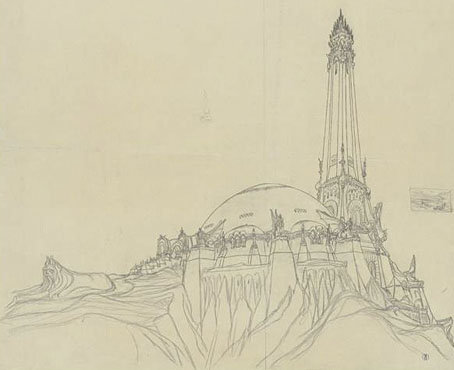
Temple à la Pensée, dédié à Beethoven, vue en cours de construction (1897).

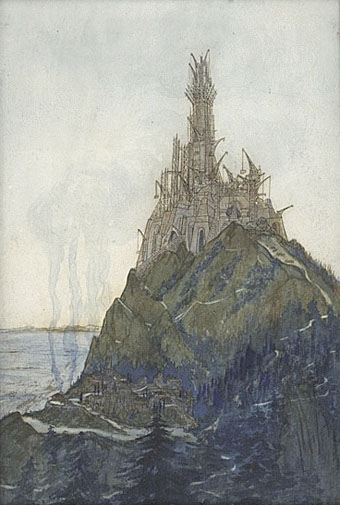
Another artist discovered whilst searching for something quite unrelated. The Musée d’Orsay are custodians of this drawing by François Garas (1866–1925), and they also have the most substantial appraisal of his career.

François Garas remains a mysterious architect, whose artistic pantheon included Baudelaire and Edgar Allan Poe, as well as John Ruskin, Richard Wagner, Jean Carriès and Edouard Manet. He obtained his diploma in 1894, and until 1914 regularly exhibited utopian architectural projects at the Salon de la Société Nationale des Beaux Arts. His career started with the exhibition Architects’ Impressions in 1896 at the Le Barc de Bouteville gallery, alongside his fellow architects Henri Sauvage, Henry Provensal and Gabriel Guillemonat. This exhibition, accompanied by a rebellious booklet by the architect Frantz Jourdain, wanted to get rid of “the mental slavery produced by the exclusive study of Greek and Roman architecture, and by a knowledge of nothing but the Italian Renaissance”. This drawing featured in the exhibition; then it was seen again, the same year, in an exhibition by the Société Nationale des Beaux Arts, as part of a collection entitled Artists’ Interiors.

From 1897, Garas exhibited increasingly oneiric projects at the Salon – “temples for future religions”, dedicated to Beethoven, Wagner, Life, Death and Thought. While his companions from the early days were designing social housing, Garas continued along the same fanciful path, then disappeared from the architectural scene without any of his projects ever having been built.

garas3.jpg

Temple à la Pensée, dédié à Beethoven, vue perspective depuis l’arrière du temple (1897).

garas4.jpg

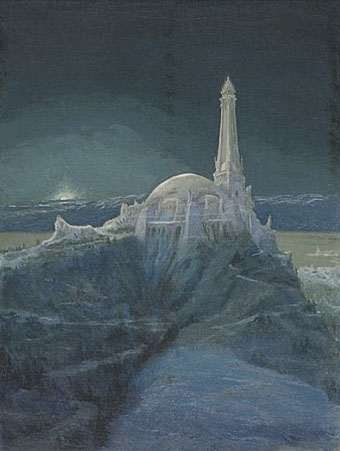
Temple à la Pensée, dédié à Beethoven, visions du temple, clair de lune (1900).

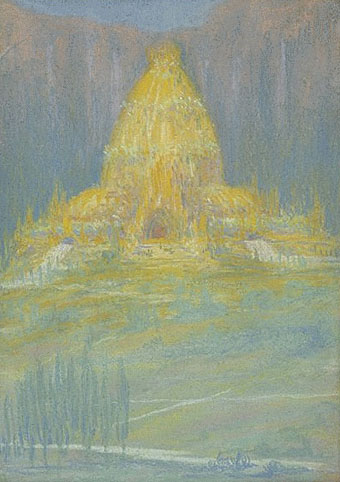
The museum has several pages of various plans and sketches for these Temples for Future Religions, and also some quasi-Gothic designs for “Artist’s interiors” which would benefit from being seen at a larger size. Among his other works are a series of very diffuse pastel studies which look more like Claude Monet drawing the ruins of Angkor than architectural designs.

garas2.jpg

Un temple pour les religions futures (1901).

Previously on { feuilleton }
Exposition Universelle publications
Exposition cornucopia
Return to the Exposition Universelle
The Palais Lumineux
Louis Bonnier’s exposition dreams
Exposition Universelle, 1900
The Palais du Trocadéro
The Evanescent City

Harry Lachman’s Inferno

inferno1.jpg

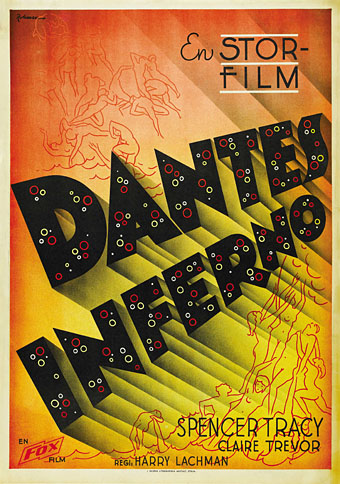
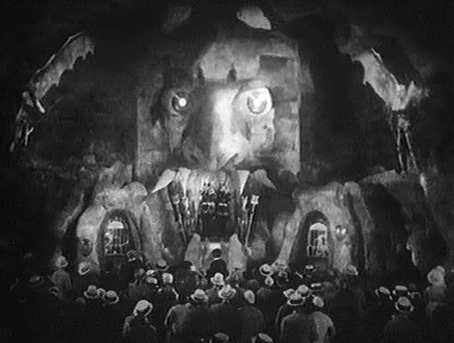
Looking at Willy Pogány’s work last week I was reminded that as well as illustrating books he worked in Hollywood for a while as an art director and set designer. Among those jobs was a credit for “Technical staff” on the only film for which director Harry Lachman is remembered today, a curious 1935 melodrama, Dante’s Inferno. This stars Spencer Tracy as a fairground barker whose talent for drawing an audience helps an old showman boost the attendance at his moralising “Dante’s Inferno” attraction.

inferno2.jpg

Entrance to the fairground attraction.

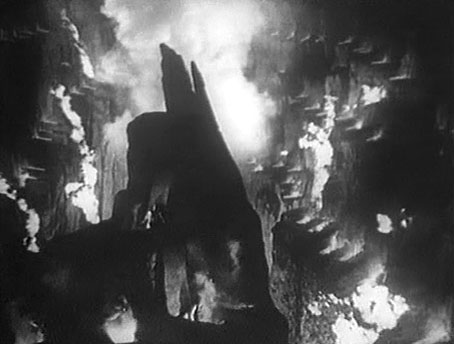
A hubristic rise and fall follows for Tracy, and the film spends much of its running time in routine business and family scenes. What sets it apart is some striking fairground designs (no doubt Pogány’s involvement) and a truly startling self-contained sequence when the old showman describes for Tracy the true nature of the Inferno. This sequence takes Gustave Doré’s celebrated illustrations and brings them to life in a series of atmospheric tableaux which even manage to contain brief glimpses of nudity. Hell, it seems, is the one place you can get away with not wearing any clothes. I’ve read many times that this sequence was borrowed from an earlier silent film, also called Dante’s Inferno, but have yet to come across any definite confirmation. It’s certainly possible since studios at that time treated other films in a very cavalier fashion; when a film was remade the studio would try to buy up and destroy prints of the earlier film. If anyone can point to more information about the origin of the Hell sequence, please leave a comment.

inferno3.jpg

Stone tombs from the Inferno sequence.

If the Inferno sequence wasn’t already stolen in 1935, it works so well that it’s been plundered many times since; Kenneth Anger borrowed shots which he mixed into Inauguration of the Pleasure Dome (1954), Derek Jarman did the same for TG: Psychick Rally in Heaven (1981), and Ken Russell slipped some tinted scenes into Altered States (1980). I tinted the entire sequence red and dumped it into the one-off video accompaniment I made for Alan Moore and Tim Perkins’ stage performance of Angel Passage in 2001; it wouldn’t surprise me if it’s been used elsewhere. As with many of Hollywood’s products, Lachman’s film pretends to condemn prurience—Tracy’s character exploits Hell’s lurid attractions for gain—while revelling in the opportunity to show as much bare flesh as the censors would allow. As with Doré, Lachman’s Inferno seems populated solely by men and women in the peak of physical fitness.

Inevitably, you can see the Inferno sequence on YouTube here and here. The film doesn’t seem to be available on DVD but it’s worth seeking out to watch in full. In addition to the infernal delights, you also get to see 16-year-old Rita Hayworth’s screen debut as a dancer on a cruise ship.

Previously on { feuilleton }
Willy Pogány’s Lohengrin
Willy Pogány’s Parsifal
Maps of the Inferno
A TV Dante by Tom Phillips and Peter Greenaway
The art of Lucio Bubacco
The last circle of the Inferno
Angels 4: Fallen angels