Dead monuments

mosfilm.jpg

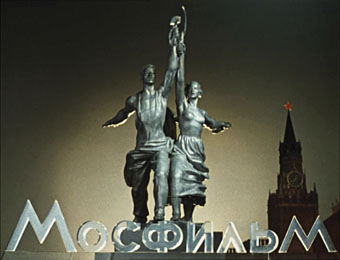
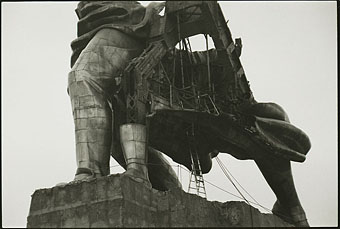
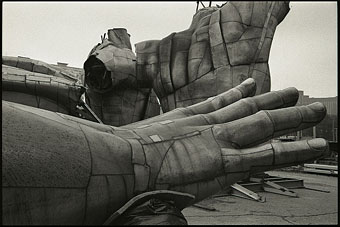
Anyone who’s seen a Soviet film from 1947 onwards will recognise the logo of the Mosfilm studio which featured a model of Vera Mukhina’s Worker and Kolkhoz Woman monument. This 24-metre tall steel-plate statue proved surplus to requirements after the collapse of the old order, like so many monuments of that period. English Russia has a series of moody photographs of the structure lying in pieces whilst being dismantled.

monument1.jpg

monument2.jpg

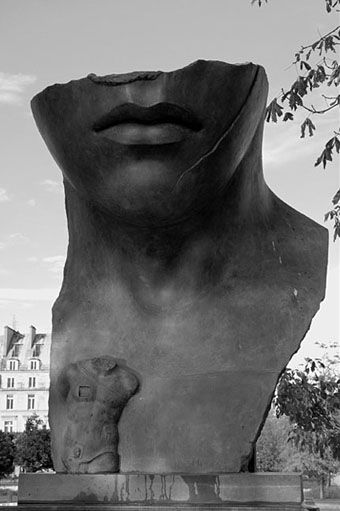
Poor Vera, who died in 1953, must have thought her work would last a very long time; these pictures are a poignant reminder of the ephemeral nature, not only of art, but of whole ideologies. They’re also reminiscent of the deliberately degraded sculptures made by Igor Mitoraj (below) which trade for their effect on exactly this disjunction between delusions of permanence and the ravages of history.

mitoraj.jpg

And on these Flickr pages you can see one of Mitoraj’s influences from a ravaged past, the fragments of the Colossal Statue of Constantine in the Palazzo dei Conservatori, Rome.

Previously on { feuilleton }
The Stalker meme
The art of Igor Mitoraj
Enormous structures II: Tatlin’s Tower
Solaris

31 days in Iraq

“If you look at what’s transpired in Iraq, Chris, we’ve made enormous progress.”
US Vice President Dick Cheney, Fox News interview, January 14th, 2007.

iraq_january_07.jpg

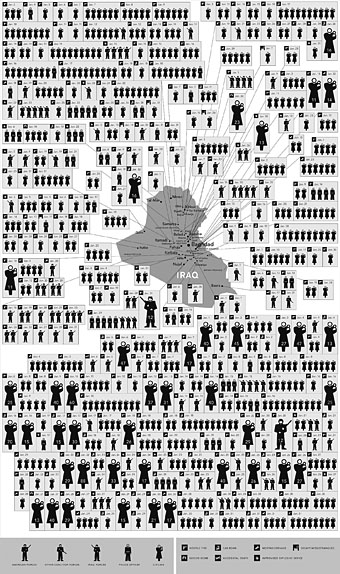
A visual depiction of the continuing human cost of the Iraq war,
by Adriana Lins de Albuquerque and Alicia Cheng. From the NYT.

In January more than 1,900 people—soldiers, security officers and civilians—were killed in the insurgency in Iraq, up from 800 in January 2006. Many corpses showed signs of torture, meaning the victims were probably killed by religious and tribal death squads. This map, based on data from the American, British and Iraqi governments and from news reports, shows the dates, locations and circumstances of deaths for the first month of the year. Given the vast size of Iraq and the communications difficulties inherent in war, the information may be incomplete. Nonetheless, it is our effort to visually depict the continuing human cost of the Iraq war.

Adriana Lins de Albuquerque is a doctoral student in political science at Columbia.
Alicia Cheng is a graphic designer at mgmt. design in Brooklyn.

Update: Seems like The Independent was taken with this as well.

Previously on { feuilleton }
Liberty 2006

Noxious administrations

nixon.jpg

President Nixon by Gerald Scarfe (1972).

“Nixon was a professional politician, and I despised everything he stood for—but if he were running for president this year against the evil Bush-Cheney gang, I would happily vote for him.” Hunter S Thompson, Fear and Loathing, Campaign 2004.

Hunter S Thompson wasn’t the only Nixon critic to regret the passing of his old enemy with the advent of the current regime. Watergate reporter Carl Bernstein was saying pretty much the same thing in 2004; two years on, his opprobrium is a lot more severe.

Carl Bernstein: Bush Administration Has Done ‘Far Greater Damage’ Than Nixon

Editor & Publisher
Published: January 24, 2007 4:00 PM ET updated Thursday

NEW YORK In an online chat at washingtonpost.com on Wednesday afternoon, Carl Bernstein, the famed Watergate reporter at that paper and now writing articles for Vanity Fair, took several hard shots at the current Bush administration—almost every time he was asked about the Nixon era. It came just as news of the death of former Watergate ringleader E. Howard Hunt was circulating widely.

After a long explanation of how the American system “worked,” eventually, with Watergate, Bernstein said:

“In the case George W. Bush, the American system has obviously failed—tragically—about which we can talk more in a minute. But imagine the difference in our worldview today, had the institutions—particularly of government—done their job to ensure that a mendacious and dangerous president (as has since been proven many times over, beyond mere assertion) be restrained in a war that has killed thousands of American soldiers, brought turmoil to the lives of millions, and constrained the goodwill towards the United States in much of the world.”

Later, asked if the Nixon administration was unique in hiring disreputable characters, he replied: “Until the Bush-43 administration, I had believed that the Nixon presidency was sui generis in modern American history in terms of your question…

“In terms of small-bore (but dangerous) characters like Howard Hunt and Gordon Liddy with their schemes, I doubt that any presidency approaches the criminality of the Nixon White House. But the Watergate conspiracy—to undermine the constitution and use illegal methods to hurt Nixon’s political opponents and even undermine the electoral system—was supervised by those at the very top.

“In the current administration we have seen from the President down—especially Vice President Cheney, Attorney General Gonzales, Condoleeza Rice, Donald Rumsfeld—a willingness to ignore the great constitutional history of the United States—to suspend, really, many of the constitutional guarantees that have made us a nation apart, with real freedoms unknown elsewhere, unrestricted by short-term political objectives of our leaders.

“Then there are the Geneva conventions: Who would have dreamed that, in our lifetime, our leaders would permit their flagrant abuse, would authorize torture, ‘renditions’ to foreign-torture chambers, suspension of habeus corpus, illegal surveillance of our own citizens….

“But perhaps worst, has been the lying and mendacity of the president and his men and women—in the reasons they cited for going to war, their conduct of the war, their attempts to smear their political opponents.

“Nixon and his men lied and abused the constitution to horrible effect, but they were stopped.

“The Bush Administration—especially its top officials named above and others familiar to most Americans—was not stopped, and has done far greater damage. As a (Republican) bumper-sticker of the day proclaimed, ‘Nobody died at Watergate.’ If only we could say that about the era of George W. Bush, and that our elected representatives in Congress and our judiciary had been courageous enough to do their duty and hold the President and his aides accountable.”

Bernstein was also asked about the CIA leak case and the leaking of Valerie Plame’s name, which he called “a truly Nixonian event, a happenstance not atypical of the take-no-prisoners politics of the Bush presidency. But it pales in comparison to the larger questions of the Constitution, of life and death, of the Geneva conventions, of the expectation that our leaders—from Condoleeza Rice to Dick Cheney, to the attorney(s) general to Paul Wolfowitz and on down and up the line speak truthfully to the American people and the Congress. They have consistently failed to do so.”

Michael Petry’s flag

petry.jpg

Monument to an Unknown Soldier: Portrait of an American Patriot (detail) by Michael Petry.

American artist Michael Petry has made works in the past using freshwater pearls threaded on sheets of black velvet. Viewers can admire the pearls then be disconcerted when given the additional information that the shapes they make are derived from those produced by human seminal emissions. A new work by Petry uses the same effect with a full-size US flag taking the place of the black velvet. The emission pattern in this case was produced by a gay American soldier and serves as a comment on the US military’s ridiculous “Don’t ask, don’t tell” policy towards gay servicemen and women. The soldier in this instance must remain unknown or risk expulsion from the army.

It remains to be seen what reaction this will provoke when the work goes on display at the Sundaram Tagore Gallery in New York as part of the America the Beautiful exhibition. The flag in the United States is a sacred object in a way it could never be here and many patriots won’t take kindly to seeing it “besmirched” even if it is by a small arrangement of pearls. In this kind of work context is all. If people were told the pearls were arranged in the shape of the Marshall Islands (where the US conducted its nuclear tests) they’d be less upset than when informed as to the real origin of the design. Yet nothing would physically change; the flag and pearls would remain the same, all that would alter would be a single piece of information and the perception of the viewer.

johns.jpg

White Flag (1955) by Jasper Johns.

Petry isn’t the first artist to use the American flag as a subject, of course, Jasper Johns (another gay artist, incidentally) produced a number of flag-derived paintings in the 1950s and 60s. His famous White Flag of 1955 was intended to be abstract rather than political (although it’s debatable how using such a highly-charged symbol could ever be unpolitical) but it’s interesting to consider how this would be viewed if it had been painted today. White flags are only used to signify surrender; in time of war Johns’ exercise in abstraction gains a new resonance.

Sundaram Tagore Gallery
547 West 27th Street,
New York.

Via Towleroad.

Elsewhere on { feuilleton }
The gay artists archive

Previously on { feuilleton }
Army Day