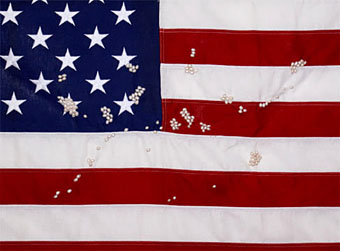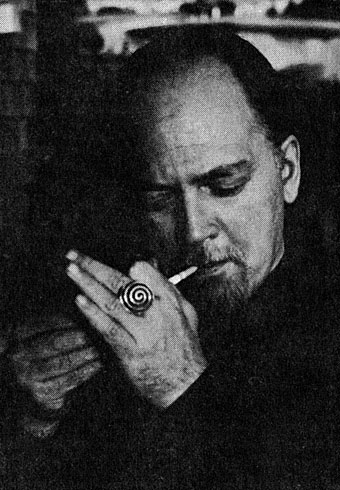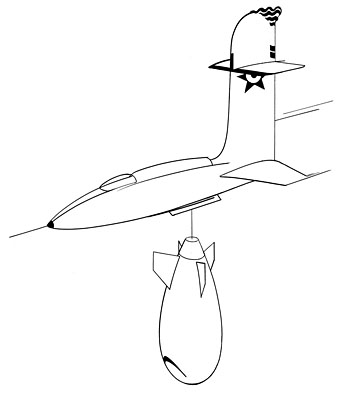
President Nixon by Gerald Scarfe (1972).
“Nixon was a professional politician, and I despised everything he stood for—but if he were running for president this year against the evil Bush-Cheney gang, I would happily vote for him.” Hunter S Thompson, Fear and Loathing, Campaign 2004.
Hunter S Thompson wasn’t the only Nixon critic to regret the passing of his old enemy with the advent of the current regime. Watergate reporter Carl Bernstein was saying pretty much the same thing in 2004; two years on, his opprobrium is a lot more severe.
Carl Bernstein: Bush Administration Has Done ‘Far Greater Damage’ Than Nixon
Editor & Publisher
Published: January 24, 2007 4:00 PM ET updated Thursday
NEW YORK In an online chat at washingtonpost.com on Wednesday afternoon, Carl Bernstein, the famed Watergate reporter at that paper and now writing articles for Vanity Fair, took several hard shots at the current Bush administration—almost every time he was asked about the Nixon era. It came just as news of the death of former Watergate ringleader E. Howard Hunt was circulating widely.
After a long explanation of how the American system “worked,” eventually, with Watergate, Bernstein said:
“In the case George W. Bush, the American system has obviously failed—tragically—about which we can talk more in a minute. But imagine the difference in our worldview today, had the institutions—particularly of government—done their job to ensure that a mendacious and dangerous president (as has since been proven many times over, beyond mere assertion) be restrained in a war that has killed thousands of American soldiers, brought turmoil to the lives of millions, and constrained the goodwill towards the United States in much of the world.”
Later, asked if the Nixon administration was unique in hiring disreputable characters, he replied: “Until the Bush-43 administration, I had believed that the Nixon presidency was sui generis in modern American history in terms of your question…
“In terms of small-bore (but dangerous) characters like Howard Hunt and Gordon Liddy with their schemes, I doubt that any presidency approaches the criminality of the Nixon White House. But the Watergate conspiracy—to undermine the constitution and use illegal methods to hurt Nixon’s political opponents and even undermine the electoral system—was supervised by those at the very top.
“In the current administration we have seen from the President down—especially Vice President Cheney, Attorney General Gonzales, Condoleeza Rice, Donald Rumsfeld—a willingness to ignore the great constitutional history of the United States—to suspend, really, many of the constitutional guarantees that have made us a nation apart, with real freedoms unknown elsewhere, unrestricted by short-term political objectives of our leaders.
“Then there are the Geneva conventions: Who would have dreamed that, in our lifetime, our leaders would permit their flagrant abuse, would authorize torture, ‘renditions’ to foreign-torture chambers, suspension of habeus corpus, illegal surveillance of our own citizens….
“But perhaps worst, has been the lying and mendacity of the president and his men and women—in the reasons they cited for going to war, their conduct of the war, their attempts to smear their political opponents.
“Nixon and his men lied and abused the constitution to horrible effect, but they were stopped.
“The Bush Administration—especially its top officials named above and others familiar to most Americans—was not stopped, and has done far greater damage. As a (Republican) bumper-sticker of the day proclaimed, ‘Nobody died at Watergate.’ If only we could say that about the era of George W. Bush, and that our elected representatives in Congress and our judiciary had been courageous enough to do their duty and hold the President and his aides accountable.”
Bernstein was also asked about the CIA leak case and the leaking of Valerie Plame’s name, which he called “a truly Nixonian event, a happenstance not atypical of the take-no-prisoners politics of the Bush presidency. But it pales in comparison to the larger questions of the Constitution, of life and death, of the Geneva conventions, of the expectation that our leaders—from Condoleeza Rice to Dick Cheney, to the attorney(s) general to Paul Wolfowitz and on down and up the line speak truthfully to the American people and the Congress. They have consistently failed to do so.”