Abraxas 4

abraxas4.jpg

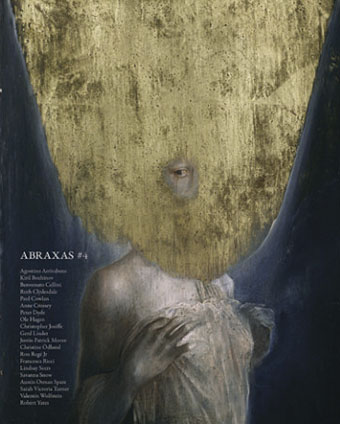
My thanks to Livia Filotico at Fulgur Esoterica for sending these previews from the forthcoming issue of Abraxas, the Journal of Esoteric Studies. Abraxas is a beautifully produced large-format book whose artist interviews—as I’ve mentioned before—are especially valuable. Issue 4 will include:

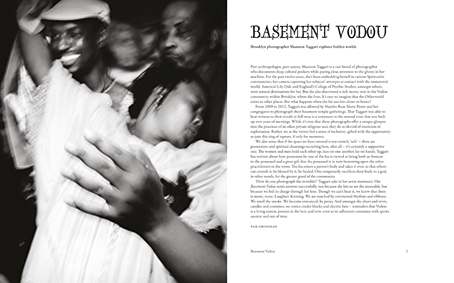
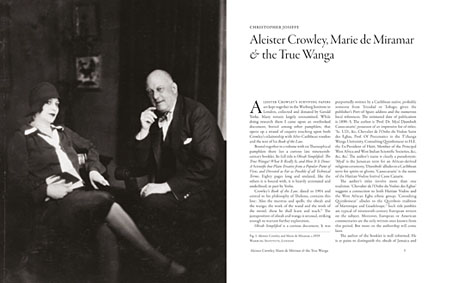
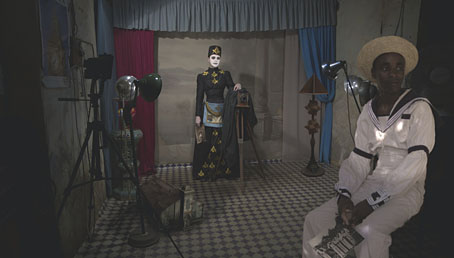
Prof. Sarah Victoria Turner’s interview with artist Christine Ödlund on theosophy and synaesthesia, a special feature on the Italian artist Agostino Arrivabene, a documentation of Art Angel artist Lindsay Seer’s ancestral performance/installation Nowhere Less Now, Shannon Taggart’s extraordinary photographs of Brooklyn vodou and Valentin Wolfstein insightful analysis of the Mystic Fool. Following this tarot theme, the artist Francesca Ricci provides an account of her working with urban symbols, and their subsequent transformation into a unique tarot, titled Anarca.

Mention of combining urban symbols with the Tarot sounds especially interesting after I’ve recently dealt with that challenge myself. Those who buy the limited edition hardback will receive a signed suite of Francesca Ricci’s Tarot cards. Abraxas 4 is published on September 22nd. Further details and page previews here.
abraxas1.jpg

Nowhere Less Now by Lindsay Seer.

abraxas2.jpg

abraxas3.jpg

Previously on { feuilleton }
Abraxas: The International Journal of Esoteric Studies
Alas Vegas Tarot cards

alasvegasdevil.jpg

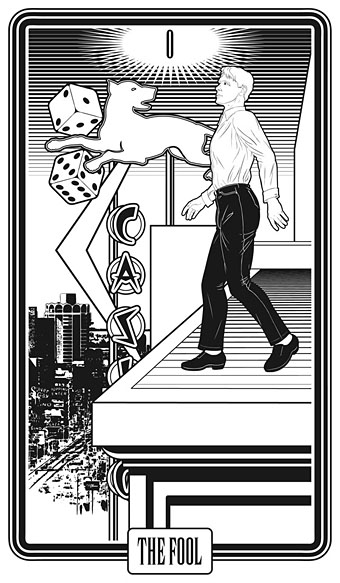
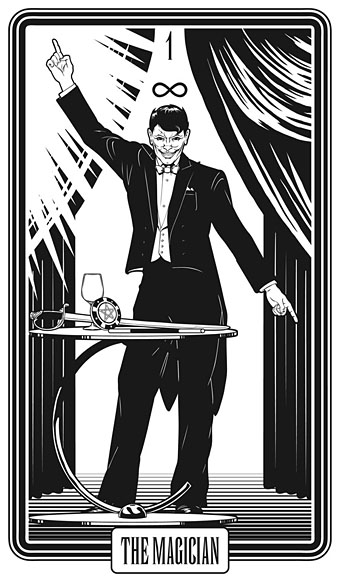
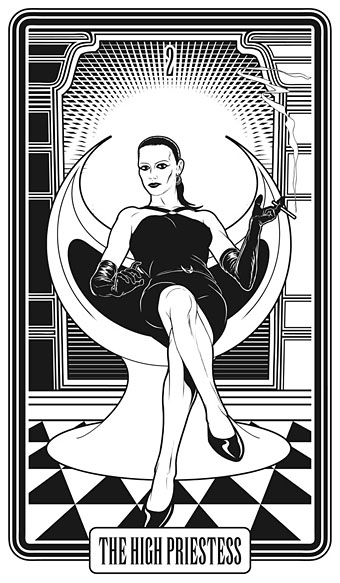
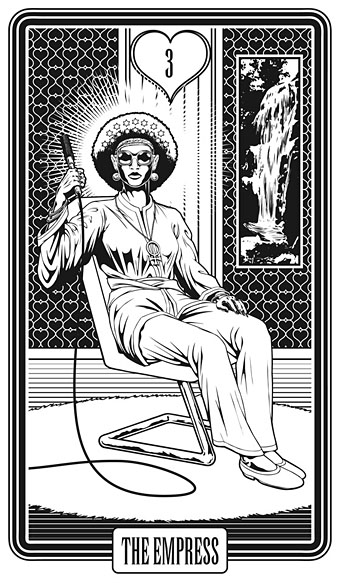
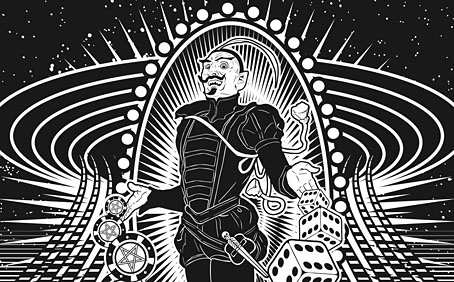
Back in February I bought a Wacom drawing tablet and said I’d show some proper results from its use later. For the past few months I’ve been working on this project using a combination of Wacom drawing and vector graphics. The initial brief from games designer James Wallis was for six Tarot-style card designs for his Alas Vegas role-playing game which has as its theme a fantasy extrapolation from Las Vegas and its gaudy mythology. The Kickstarter funding for the game turned out to be more successful than was anticipated so James asked me to expand the six cards idea into a full set of black-and-white Major Arcana designs.

This has been a fun series to work on although a number of the cards presented problems at first, the antique nature of the Tarot symbolism being a difficult thing to map across a very commercial American city. The symbolism from the Rider-Waite-Smith (RWS) deck was used as a rough guide although we deviated in a few places from the more traditional attributes. Las Vegas has changed over the years so rather than represent a single period of the city’s history there are references to different eras, from the huge casinos of today back to the buildings of the 50s and 60s with their distinctive “Googie” architecture. Notes for the cards follow below. The artwork can be seen at larger size here.

alasvegas00.jpg

The Fool is usually a young man about to step off a cliff edge with a dog barking a warning at his heels, hence the dog on the sign.

alasvegas01.jpg

Several of the cards convert the Tarot characters into cabaret acts. This one was pretty inevitable, and I’m sure it’s not the first time a stage conjuror has appeared on this card.

alasvegas02.jpg

The chair is based on the 1965 “Ball Chair” design by Eero Aarnio (as seen in The Prisoner TV series), adapted here to resemble the Priestess’s crescent moon.

alasvegas03.jpg

The style on this one is more 70s than 60s: patterned wallpaper (the hearts derive from the symbolism of The Empress, and from playing cards, of course), white rug, Kung Fu pyjamas.

Continue reading “Alas Vegas Tarot cards”

More Cameron

cameron3.jpg

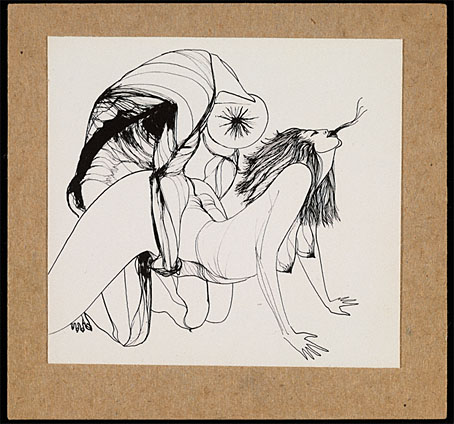
Untitled (Peyote Vision), 1955, Cameron (from Semina journal, no. 1).

Thanks to Erik Davis for drawing my attention to a small online exhibition of Marjorie Cameron artwork and documentary material. Semina was the magazine founded by Cameron’s artist friend, Wallace Berman. The exhibition note tells us that:

Wallace Berman’s only exhibition at Ferus Gallery in 1957 was raided by the LAPD vice squad because of the small reproduction of this sexually graphic work by Cameron that was part of Berman’s assemblage, Temple.

Allen Ginsberg’s Howl successfully fought off an obscenity charge in the same year but the immediacy of visual art means it always fares less well with disapproving authorities. We can assume that Cameron had personal experience of peyote given some verse written by her husband, Jack Parsons, that Robert Anton Wilson quotes in Cosmic Trigger (1977):

I hight Don Quixote, I live on peyote,
marjuana, morphine and cocaine,
I never know sadness, but only a madness
that burns at the heart and the brain.

cameron4.jpg

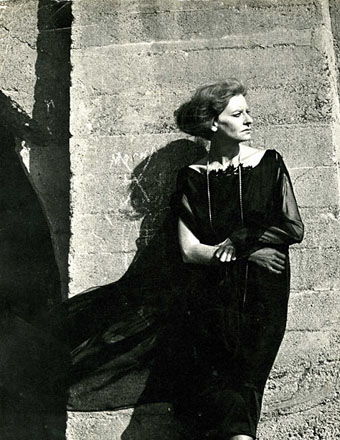
On the same site is this wonderful still (or is it a location photo?) from the shooting of Curtis Harrington’s Night Tide in 1961. Seeing this makes me want to watch the film again.

Previously on { feuilleton }
The Wormwood Star
Street Fair, 1959
House of Harrington
Curtis Harrington, 1926–2007
The art of Cameron, 1922–1995

Inauguration of the Pleasure Dome: The Eldorado Edition

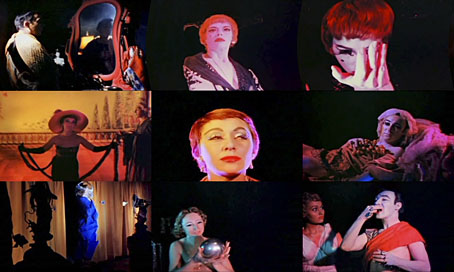
anger.jpg

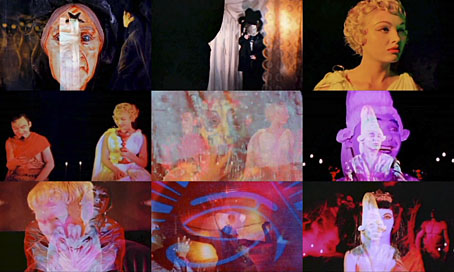
More Cameron, and her finest cinematic moment as she plays two roles—The Scarlet Woman and Kali—in Kenneth Anger’s erotic/psychedelic/thaumaturgic Bacchanal from 1954. Ordinarily there wouldn’t be much reason to draw attention to this, it’s been available on DVD and Blu-ray for several years, and various plunderings are scattered all over YouTube. The version here, however, gives an opportunity to experience the film as it was screened in the 1970s.

anger2.jpg

Inauguration of the Pleasure Dome, like many of Kenneth Anger’s films, existed in several different forms, with the tinkering and re-editing going on for years after the original footage had been captured. An early edit made in the 1950s was fashioned into a version known as the “Sacred Mushroom Edition” which Anger screened to acid heads in the 1960s. I’ve never seen any mention of the soundtrack used for this version, or the other early editions, but in 1978 Anger released a new version with the film soundtracked by most of the Eldorado (1974) album by the Electric Light Orchestra. The note on the Vimeo page says the 1978 edition has only ever been publicly screened once but this isn’t the case. My first viewing of the film was in 1990 when the Magick Lantern Cycle was touring arts cinemas in the UK, and I very well remember sitting in the dark thinking “What the hell?… Is this the Electric Light Orchestra?” The version that’s seen today is soundtracked with Janácek’s Glagolitic Mass, a choice that seems much more suitable. For some time I’d thought of getting hold of the ELO album and running it with the film to remind myself of that initial viewing but there’s no need now that this version exists. The implication is that what you see here is the actual 1978 edit but the footage seems no different from the DVD version aside from missing a few seconds of credits at the beginning. The ELO album came with a cover photo showing Dorothy’s ruby slippers from The Wizard of Oz, a detail that may explain why the Hollywood-obsessed Anger was drawn to the album in the first place.

Previously on { feuilleton }
Brush of Baphomet by Kenneth Anger
Anger Sees Red
Kenneth Anger’s Hollywood Babylon
Lucifer Rising posters
Missoni by Kenneth Anger
Anger in London
Arabesque for Kenneth Anger by Marie Menken
Edmund Teske
Kenneth Anger on DVD again
Mouse Heaven by Kenneth Anger
The Man We Want to Hang by Kenneth Anger
Relighting the Magick Lantern
Kenneth Anger on DVD…finally

The Wormwood Star

cameron1.jpg

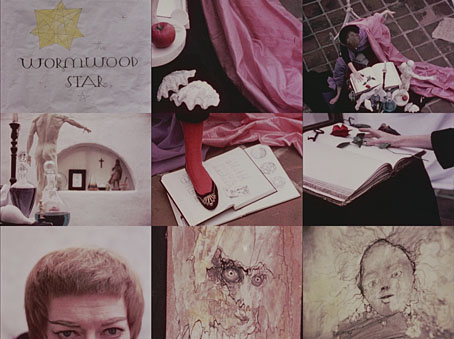
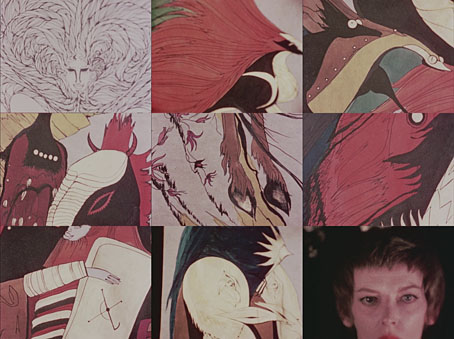
I’ve waited about 20 years to see this one, after first learning of it via a Curtis Harrington interview in Michael Weldon’s Psychotronic magazine in the 1990s. The Wormwood Star (1956) is a 10-minute study of the occult art and witchy persona of Harrington’s friend Marjorie Cameron (1922–1995), best known these days for her memorable incarnation as the Scarlet Woman in Kenneth Anger’s Inauguration of the Pleasure Dome (1954), a film in which Harrington also appeared. With her flame-red hair, green eyes and basilisk gaze, Cameron (as she preferred to be called) would have made an impression wherever she landed. Her presence in Anger’s film is so striking that stills of her face have often been used to stand for the entire Magick Lantern Cycle.

cameron2.jpg

In The Wormwood Star Harrington ramps up the mystique with oblique shots and at least half the running time given to Cameron’s strange drawings and paintings. The subtitle, “Concerning the Knowledge and Conversation of the Holy Guardian Angel” harks back to the 1940s and her husband, Jack Parsons, a rocket researcher and, for a time, the American head of Aleister Crowley’s Ordo Templi Orientis. Harrington later gave Cameron a wordless role as the “Water Witch” in his low-budget horror film, Night Tide (1961), where she drifts around Venice Beach looking suitably mysterious. Night Tide is out-of-copyright so can be watched in full at YouTube. The Wormwood Star appeared on a Curtis Harrington DVD only last month which is no doubt where this copy originates. It may not stick around so watch it while you can.

Previously on { feuilleton }
Street Fair, 1959
House of Harrington
Curtis Harrington, 1926–2007
The art of Cameron, 1922–1995
Kenneth Anger on DVD…finally