The art of Fay Pomerance, 1912–2001

pomerance1.jpg

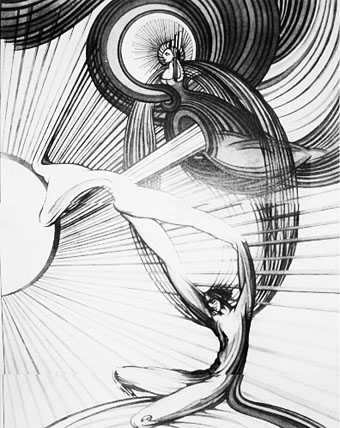
The Sixth Palace of Hell (1945).

Fay Pomerance’s painting of Lilith makes a startling appearance in a book I have about the history of magic symbols, and it’s that appearance which prompts this post since I’ve never seen her work given any attention elsewhere. This seems surprising when women artists, and artists whose concerns encompass mysticism or the occult, are receiving greater attention than ever before.
pomerance2.jpg

The Union of Isis and Osiris (1959).

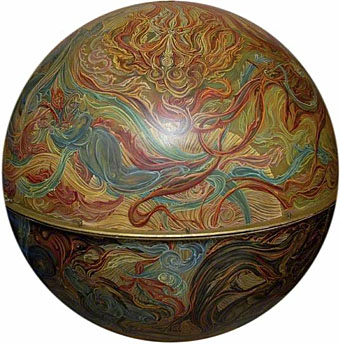
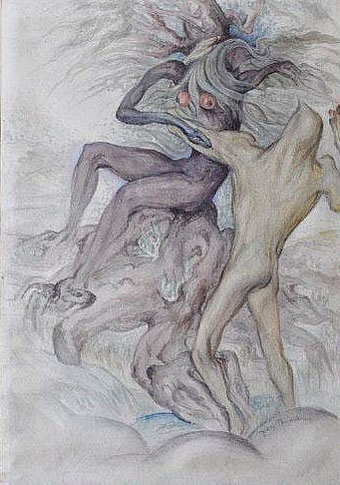
Pomerance was British, and had the misfortune to be working during a lengthy period when expressions of the imagination or unorthodox spirituality in visual art were regarded as suspect or even disreputable. Her work also stands apart from any of the prevailing movements which provide such convenient labels for those art critics and writers who dislike anything that won’t fit into one of their boxes. The Lilith picture shows an obvious debt to another British artist who stands apart from the crowd: William Blake. The BBC’s Your Paintings site has a few of Pomerance’s larger works from the collection at Durham University, including the Sphere of Redemption below which is painted on a fibreglass globe, but for the moment there isn’t a dedicated site representing her art.
pomerance3.jpg

The Temptation (date unknown).

pomerance4.jpg

The Sphere of Redemption (date unknown).
Paul Konewka’s Faust

faust01.jpg

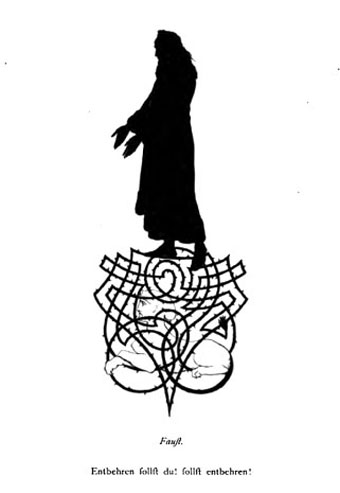
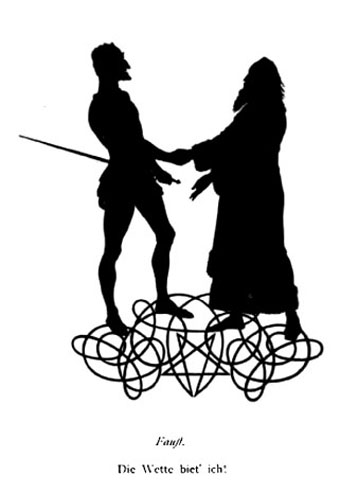
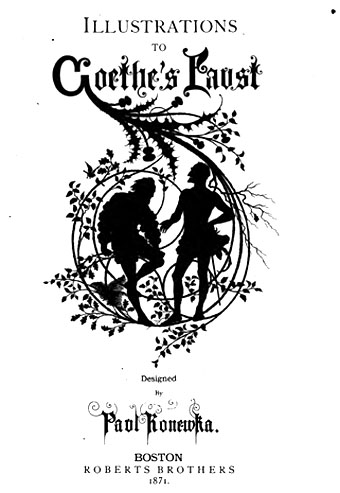
Discovered via the GoetheZeitPortal, these illustrations for Faust by German artist Paul Konewka (1841–1871) date from 1865, although the copies here are from a later edition. Konewka was a silhouette cutter so while these may look like ink illustrations they’re actually paper silhouettes displaying a formidable level of detail and complexity. Whatever the technique, the story itself is immediately recognisable from the characters even if none of the more dramatic scenes are represented. There aren’t many books you could treat in this fashion since the story has to be almost universally familiar; Shakespeare would be an obvious candidate—Konewka subsequently produced illustrations for A Midsummer Night’s Dream—fairy tales (like Arthur Rackham’s Sleeping Beauty), and also Lewis Carroll’s Alice books come to mind.

The copies shown here are from another shoddy Google scan at the Internet Archive but you do get to see all the pages. The Goethe site has better copies of the illustrations.

faust02.jpg

faust03.jpg

faust04.jpg

Continue reading “Paul Konewka’s Faust”

Walpurgisnacht

walpurgisnacht.jpg

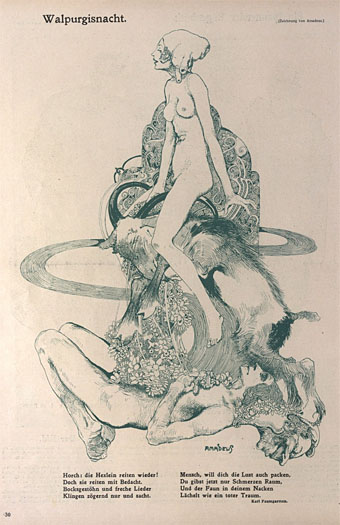
Walpurgisnacht (1917) by Amadeus.

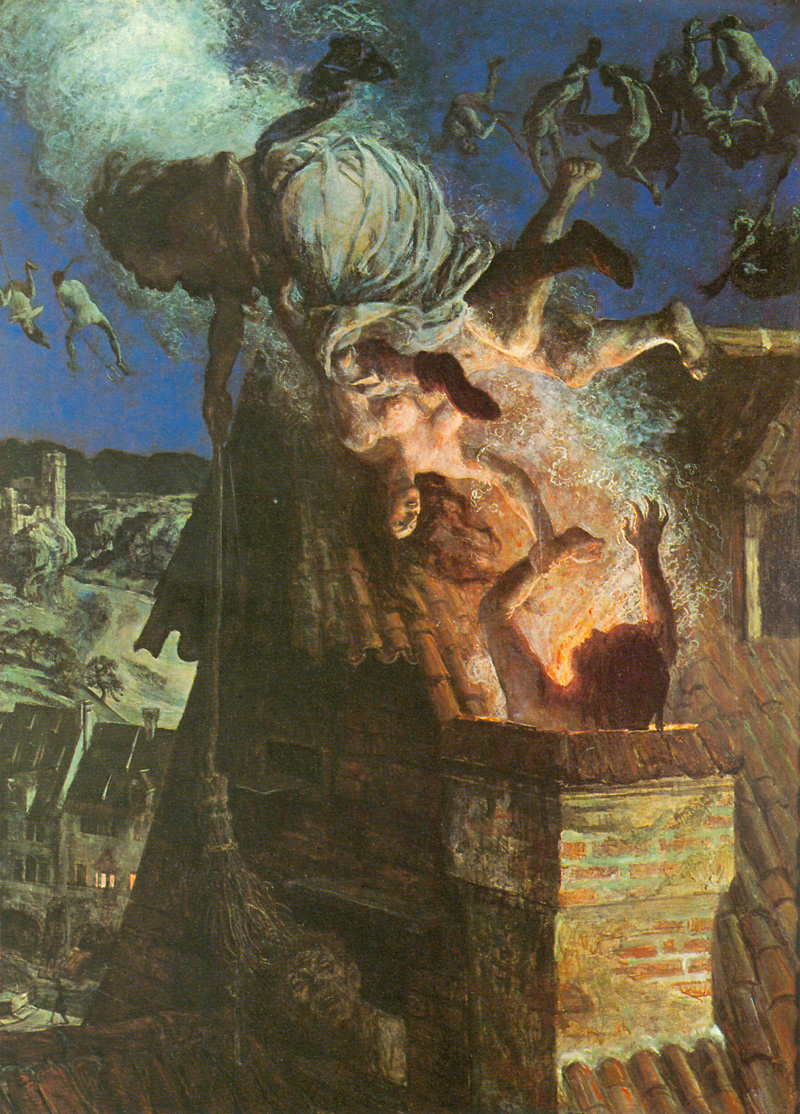
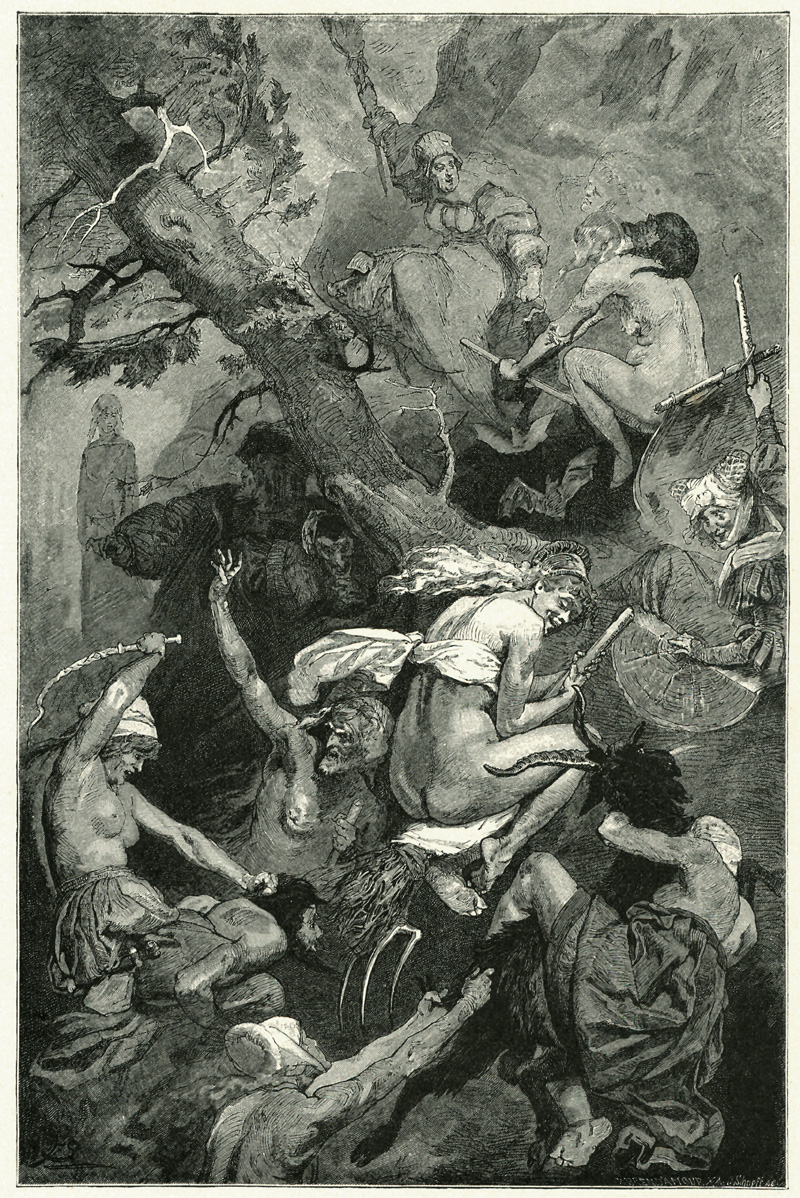
April 30th gives me an opportunity to repost this drawing by “Amadeus” which could easily have come from an underground magazine of the late 60s. The works below are some of the many Faust-related illustrations at GoetheZeitPortal, a great resource although it helps if you can read a little German to navigate. This page has more Hexentanz scenes, while the complete series of Franz Xaver Simm’s academic illustrations may be seen here. Over at 50 Watts there’s Stefan Eggeler’s illustrations for Gustav Meyrink’s Walpurgisnacht (1917).

walpurgisnacht3.jpg

Walpurgisnacht (1897) by Albert Welti.

walpurgisnacht2.jpg

Walpurgisnacht (1899) by Franz Xaver Simm.

Previously on { feuilleton }
The art of Luis Ricardo Falero, 1851–1896
Weel done, Cutty-sark!

Weekend links 209

soundcarriers.jpg

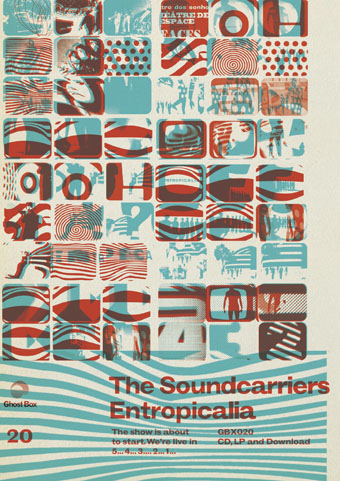
Soundcarriers poster by Julian House.

A new release on the Ghost Box label is always a welcome thing but Entropicalia by The Soundcarriers, out on May 20th, is one I’m especially looking forward to. Julian House has made a video for new song Boiling Point, and there’s also the poster above which can be downloaded at larger size here. The Ghost Box Guest Shop has a couple of new additions including the recent Man Woman Birth Death Infinity album by Raagnagrok.

• “It’s a funny time to be making music, because we’re a generation of people who make music with screens instead of with ears.” Ben Frost talking to Tristan Bath.

• At Dangerous Minds: You Gotta Say Yes to Another Excess, a rare glimpse of Yello live in concert, 1983.

Our movements about London are closely circumscribed, and while we may imagine ourselves to be free, the truth is that the vast majority of our journeys are undertaken for commercial imperatives: we travel either to work or to spend. All about us during our daily existence we are presented with buildings we cannot enter, fences we cannot climb and thoroughfares it would be foolhardy to cross. We are disbarred from some places because we don’t have the money — and from others because we don’t have the power. The city promises us everything, but it will deliver only a bit.

The place-hackers draw our attention to how physically and commercially circumscribed our urban existence really is. […] As more and more international capital flows into London, so public space is increasingly eroded — it’s just too valuable for us ordinary folk to paddle about in any more.

Give the freedom of the city to our urban explorers, says Will Self. Related: Robert Macfarlane accompanied urbexer Bradley Garrett on a night-time jaunt.

Black Sabbeth: Metal band Gonga covering a classic with Portishead’s Beth Gibbons on vocals.

• Pelican books take flight again; Paul Laity on the resurrection of the non-fiction imprint.

• Finland’s homoerotic stamps are an ocular feast for women, too, says Nell Frizzell.

• “I guess you could say I am a Pagan.” Kenneth Anger on the occult.

• “How much gay sex should a novel have?” asks Caleb Crain.

• Mix of the week: Secret Thirteen Mix 112 by Kyoka.

The Gibraltar Encyclopedia of Progressive Rock

Zombi’s Guide to Goblin

Decadence Comics

Zombie Warfare (1979) by Chrome | Escape From The Flesheaters (Zombie) (1979) by Fabio Frizzi | Zombie’ites (1993) by Transglobal Underground

Weekend links 207

barker.jpg

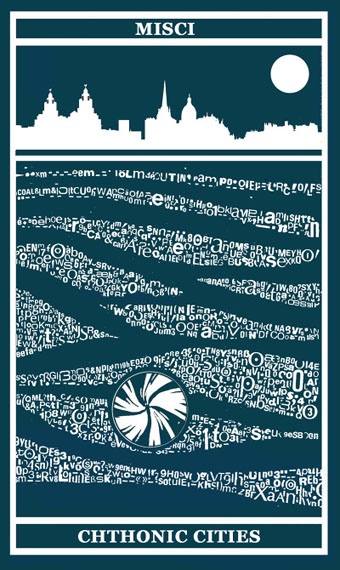
Chthonic Cities by David Chatton Barker. One of a series of Folklore Tapes screenprints available from Bleep.

• The original version of Kenneth Anger’s Lucifer Rising, the one with the Jimmy Page soundtrack that was completed in 1973, has always been described as lost/stolen/buried or otherwise gone forever. So you’d think the news that a print had been discovered recently by Brian Butler would have received greater attention. There’s a screening in Los Angeles this Thursday. When do the rest of us get to see it?

Chris Marker: A Grin Without a Cat, an exhibition and series of Marker-related events at the Whitechapel Gallery, London. Related: The Encounter of M. Chat & Chris Marker as Told By Louise Traon.

• The trailer for The Gospel According to St Derek, a forthcoming documentary about Derek Jarman. Related: Carl Swanson on why Tilda Swinton is not quite of this world.

Maybe there’s just something conservative at the bedrock of American fiction. […] Or maybe it’s just another symptom of the creeping conservatism that’s infected so many aspects of the culture.

Eric Obenauf talks to author Jeff Jackson whose comments about cultural conservatism could equally be applied to the UK.

• Primitive graphics, inventive graphics, budget Surrealism, and some great theme tunes; it’s Trunk TV, Episode 1: Title Sequences.

• Mixes of the week: Secret Thirteen Mix 110 by Black To Comm, and Intro To Drone For Debcon 1, almost 7 hours of music!

Joseph Burnett reviews Ett, an album of electronic music by Klara Lewis.

The Delian Mode (2009), a film about Delia Derbyshire by Kara Blake.

• Extracts from Tokyo Reverse by Simon Bouisson and Ludovic Zuili.

Dan Piepenbring on The Haunting Illustrations of Alfred Kubin.

• At Strange Flowers: Photos of arcades by Germaine Krull.

• Fish, Fiends, and Fantasy: The Gothic Art of Ian Miller.

• At 50 Watts: Richard Teschner and His Puppets.

• Sonic Foam: Ian Penman on Kate Bush and Coil.

Bits and Pieces

Lucifer (1968) by The Salt | Experiment IV (1986) by Kate Bush | Methoxy-N, N-Dimethyl (5-MeO-DMT) (1998) by Coil