Evoluon

evoluon1.jpg

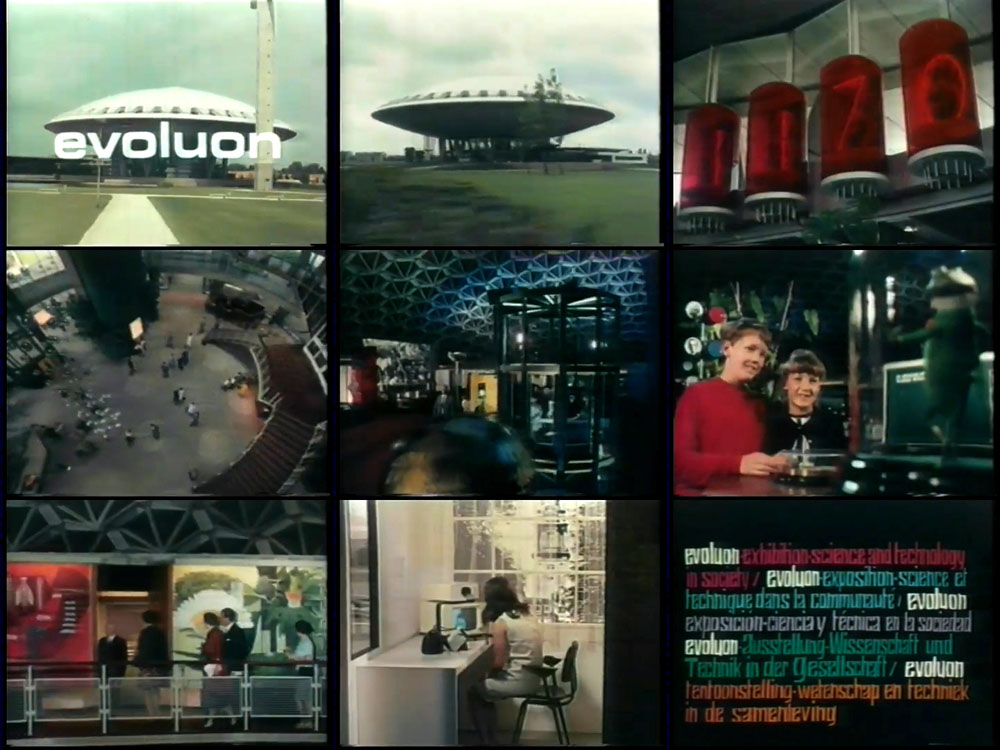
“Evoluon”: a Space Age name for a Space Age building in Eindhoven, Holland, constructed in 1966 by the Dutch electrical and electronics company, Philips. The building was designed by Leo de Bever and Louis Christiaan Kalff, and functioned for a number of years as a science museum, combining exhibits of innovative gadgetry with a three-dimensional representation of “the future” familiar from exposition architecture. I’d guess that Kalff was responsible for the flying-saucer shape, having already designed a range of lamps for Philips with similar shapes in the 1950s.

evoluon2.jpg

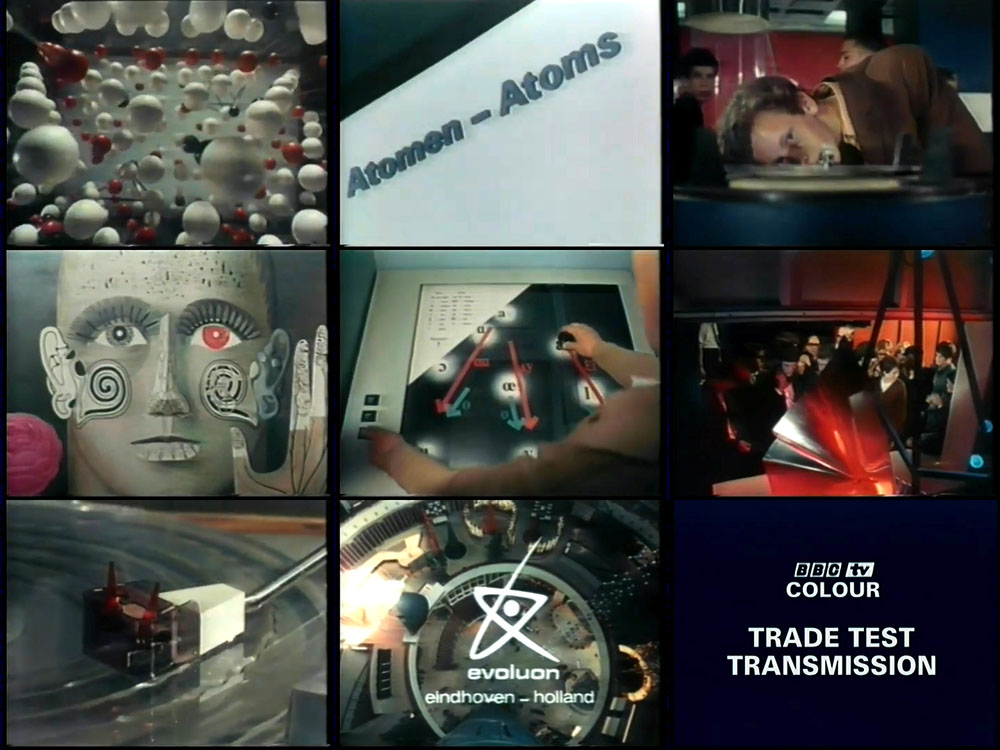
Bert Haanstra’s Evoluon was a short promotional film which was broadcast regularly by the BBC from 1968 to 1972 for trade test purposes, although I don’t recall ever seeing it before. Being someone who’s always liked architecture that looks like it fell out of a science-fiction magazine (preferably with a name to match: Skylon, Atomium, Space Needle, etc), an exhibition centre shaped like a flying saucer would have made an impression. British TV schedules were often empty during the daytime so films like this were broadcast for the benefit of TV retailers who needed something better than the testcard flickering on the screens of their brand-new colour boxes. As a science museum Evoluon looks like it was more fun to visit than the London Science Museum, with a profusion of interactive exhibits. (Although this isn’t to say that the London museum isn’t worthwhile, I went there several times in the 1970s. They have many large historical exhibits in the bigger halls, including the re-entry module from Apollo 10.) The music in Haanstra’s film isn’t much better than the bland testcard soundtracks but you do hear a snatch of eerie sound produced by a Cristal Baschet when the unique instrument makes a brief appearance. Philips’ own record division had many more suitable soundtracks at this time via their very collectable Prospective 21e Siècle recordings of avant-garde music. Most of these records aren’t easy listening by any means but the series was aiming at the same idea of a shiny future filled with surprising novelties.

spacelab.jpg

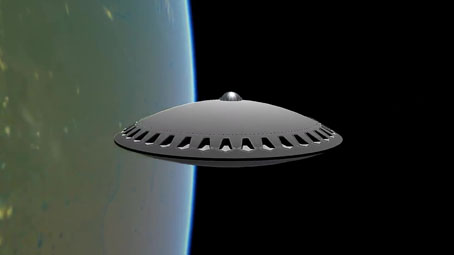
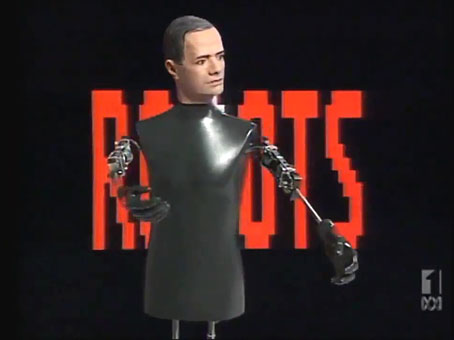
And speaking of “futuristic” music, a computer-generated Evoluon may be seen flying through the 3-D concert visuals for Spacelab by Kraftwerk who also played one of their recent concerts inside the building. I thought they could have done more with the visuals for this number, and with some of the other videos in the 3-D collection. Maybe they look better through 3-D glasses. I wouldn’t know, my eyesight has always been (and will remain) resolutely two-dimensional.

Previously on { feuilleton }
• The world of the future
• Space Needle USA

The Van den Budenmayer connection

vdb1.jpg

Three Colours: Red.

Van den Budenmayer was a Dutch composer. He was born in 1755 and died in 1803. We know what he looked like from the engraved portrait that appears on recordings of his music but his first name has never been revealed. The most pertinent thing to know about him is that he never existed at all outside a handful of films, being the invention of director Krzysztof Kieślowski and soundtrack composer Zbigniew Preisner. A composer invented to enrich a scenario isn’t usually worth mentioning but Van den Budenmayer is a cinematic rarity, a recurrent presence in four different films, only two of which have any internal connection to each other. This is a common technique in literary fiction—writers love to invent details which turn up in otherwise unconnected stories or novels—but it’s uncommon in cinema.


Dekalog 9 (1988)
vdb2.jpg

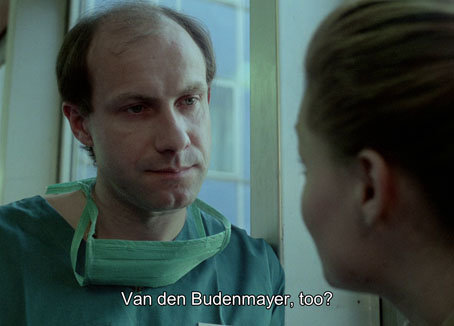
The first mention of the composer’s name occurs in the penultimate story of the Dekalog cycle, a drama about a surgeon (Piotr Machalica) who suspects his wife is having an affair. One of the surgeon’s patients is a young woman who tells him that her potential singing career has been compromised by her heart condition. During the course of their conversation she mentions favourite composers: Bach, Mahler and Van den Budenmayer. The surgeon, curious about the latter, is subsequently shown listening to a recording by the composer when the wife’s lover happens to call on the phone. The musical theme, which is reprised throughout the film, thereby becomes linked with the episode’s theme of infidelity. And since Preisner himself wrote this music, some tonal continuity is maintained with the scores for the other films in the cycle. Dekalog was Preisner’s first soundtrack work for Kieślowski, a collaboration that continued with the following feature films.


The Double Life of Veronique (1991)
vdb3.jpg

Kieślowski’s first feature made outside Poland connects his Polish years with the final films of the Three Colours Trilogy in a story that begins in Poland before moving to France. The music of Van den Budenmayer links these episodes via the lives of two more young women, both played by Irene Jacob, who share similar interests and histories. What’s notable here is that the predicament of the young woman in Dekalog 9—a weak heart endangering a potential singing career—is shared by Weronika in Poland and Veronique in France.

In the Polish sequence, Weronika passes an audition to sing in concert as a soloist with an orchestra, the composition she sings being another piece by Van den Budenmayer although we don’t know this until later on. This is where Kieślowski and Preisner’s invention is transformed from an expedient story detail to an actual character. The composition is never named in the film but the soundtrack album gives us two versions of the same piece, complete with a name and catalogue number: Concerto En Mi Mineur (SBI 152)—Version De 1798 and Concerto En Mi Mineur (SBI 152)—Version De 1802.

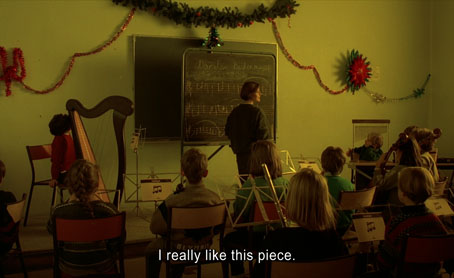
In the French section of the film Veronique is a teacher at a junior school where she takes the music class. An early view inside one of these classes shows her chalking the name of the composer on a blackboard together with the years he was alive. “He was only recently discovered,” Veronique tells the children, before she listens to them play a Portsmouth Sinfonia version of the piece we heard earlier.


Three Colours: Blue (1993)
vdb4.jpg

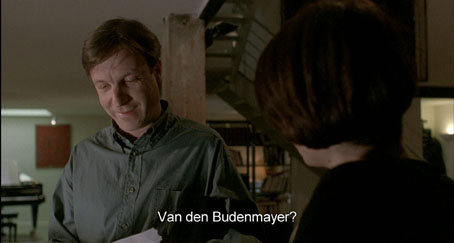
Music is a central element in the first film of the Three Colours trilogy, with Julie (Juliette Binoche) haunted by memories of an unfinished composition by her husband, an internationally famous composer who died with their daughter in a car crash. Julie eventually feels compelled to help her husband’s friend, Olivier (Benoît Régent), complete the composition which turns out to be based on a Purcell-like funeral theme by Van den Budenmayer.


Three Colours: Red (1994)
vdb5.jpg

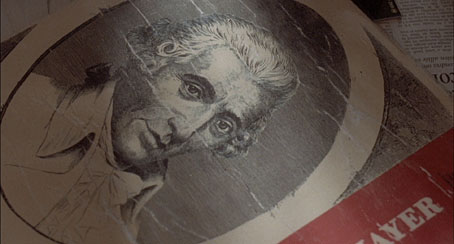
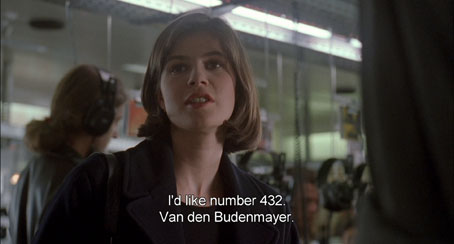
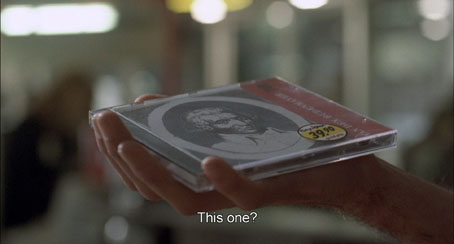
Everything comes full circle in the final part of the trilogy, with fashion model Valentine (Irene Jacob again) listening to the music from Dekalog 9 in a record shop, a piece which the Red soundtrack album has titled as Do Not Take Another Man’s Wife. This is doubly significant for a very tangled story since Joseph Kern (Jean-Louis Trintignant), the retired judge that Valentine meets, was betrayed by his girlfriend years before in a predicament mirrored by that of a legal student (and future judge) who lives near Valentine. The embittered Kern spends all his time listening to his neighbours’ phone conversations with a scanner; he also likes Van den Budenmayer’s music enough to have an album lying around although we never see him listening to it. We do, however, hear the Dekalog theme when Kern is alone in his house. (The camera lingers briefly on the composer’s portrait but it’s left to eagle-eyed viewers to make sense of that “…ayer” on the album cover.) The later scene in the record shop seems superfluous at first but I take it as a sign of the growing friendship between Valentine and Kern, especially after Valentine has melted Kern’s cynicism enough for him to tell her about his past. I only spotted the connection with Dekalog 9 after watching all these films again, also the connection between Kern and the surgeon, both of whom are victims of infidelity who eavesdrop on phone conversations.
vdb6.jpg

It’s tempting to construct an elaborate explanation for all of this—parallel time-stream, Borgesian game—but the simplest rationale, beyond the mere pleasures of pastiche, would be that inventing a composer allowed Zbigniew Preisner to imitate older musical styles which were still in keeping with his own compositions. The Dekalog theme may have originated elsewhere but it doesn’t sound at odds with the beautiful bolero that Preisner composed for Red. Kieślowski and screenwriter Krzysztof Piesiewicz (who co-wrote all of these films) evidently loved constructing patterns and finding connections between their characters; Dekalog is like Joyce’s Dubliners crossed with the “Wandering Rocks” chapter of Ulysses. In these intricate scenarios Van den Budenmayer and his music become yet more tiles added to the mosaic.

Previously on { feuilleton }
• The car in the snow
• Dekalog posters by Ewa Bajek-Wein

Weekend links 683

inshaw.jpg

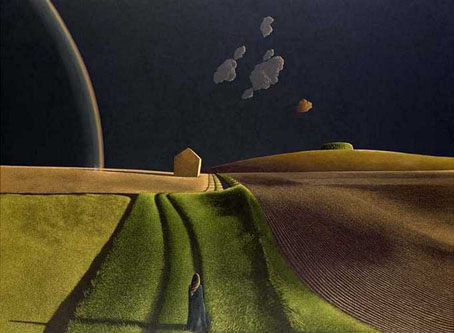
She Did Not Turn (1974) by David Inshaw.

• “Pauline Kael compared Bruce Lee to Fred Astaire; I think the comparison works better with Rudolf Nureyev. Astaire had a besuited, playful grace, while Nureyev was shirtless, dramatic, and muscular. Astaire moved with athletic modesty, while Lee’s bravura dominated the screen.” Micah Nathan on 50 years of Enter the Dragon.

• New music: This Stolen Country Of Mine by Alva Noto, and Denshi Ongaku No Bigaku (The Aesthetics of Japanese Electronic Music) Vol.1 by Cosmocities Records.

• At Cartoon Brew: A profile of Sally Cruikshank. The spooky psychedelia of Face Like a Frog has long been a favourite round here.

• “My Life in a Hop, Skip and a Jump!” Clive Hicks-Jenkins answers a few questions about his art.

• At Public Domain Review: Hokusai’s Illustrated Warrior Vanguard of Japan and China (1836).

• More martial arts: Tom Wilmot on Bruce Lee’s greatest fight scenes at Golden Harvest.

• Submissions to the Astronomy Photographer of the Year Awards.

• At Dennis Cooper’s: Lucrecia Martel Day.

• RIP Jane Birkin.

• Enter The Dragon (1974) by The Upsetters | Dragon Power (A Tribute To Bruce Lee) (1978) by JKD Band | Edit The Dragon (1985) by Colourbox

Weekend links 682

barbier.jpg

La Voie Lactée (1921) by George Barbier.

• Fun news of the week: “The Taylor Swift vinyl haunted by Britain’s weirdest musicians.” The “weirdness” is tracks from Happy Land: A Compendium of Electronic Music from the British Isles 1992–1996 which have been mispressed onto Swift’s latest, the re-recorded Speak Now. One of the offending pieces is Soul Vine (70 Billion People) by Cabaret Voltaire, a relatively understated instrumental from the Plasticity album which features samples from the Demon with a Glass Hand episode of The Outer Limits. “It’s possibly the most subversive thing we’ve ever done,” says Stephen Mallinder. Adventurous Swifties looking to broaden their horizons are advised to try The Crackdown next.

• “For McCarthy, violence is the signature of God: God, who cannot be seen, who is only indicated by an absence, who no amount of experimenting or observing will reveal, but whose existence is in evidence all around us, every day, through the apocalyptic and apophatic violence that makes up the very stuff of the world.” JC Scharl on the violent faith of Cormac McCarthy.

• Strange news of the week: Reclusive guitarist Master Wilburn Burchette (age 84) was found dead in a house with the body of his younger brother (age 76) after decades spent avoiding anyone showing an interest in his music. Numero Group, the label behind the recent reissues of Burchette’s albums, posted an interview from 2018.

• Takrar by Waref Abu Quba is “an experimental film that celebrates the timeless and intricate beauty of ancient craftsmanship. Filmed in Istanbul, the film takes us on a mesmerizing journey into the past, paying homage to Islamic, Ottoman, Greek, and Byzantine art forms.”

• “Could an industrial civilization have predated humans on Earth?” Probably not, but if it was in the deep past how would we know? Joel Froelich investigates.

• At Dennis Cooper’s: Visual evidence from almost every museum devoted to prestidigitation in the world (for Derek McCormack).

• At Spoon & Tamago: Osaka celebrates Star Festival with river of 40,000 LED lights evoking the Milky Way.

• At Unquiet Things: Even more sneak peeks from The Art of Fantasy.

• Mix of the week is DreamScenes – July 2023 at Ambientblog.

• At The Daily Heller: Sign writing and glass engraving.

• Out Of Limits (1963) by The Marketts | Trip Through The Milky Way–An Electronic Panorama (1969) by Raymond Moore | Milky Way (1971) by Weather Report

Kling Klang rundfunk

kraftwerk10.jpg

Kraftwerk on film and video, courtesy of recent uploads at the Internet Archive. These are mainly promotional clips, together with a few choice TV appearances. I’ve never liked music videos very much, even ones made for music that I enjoy a great deal, but I’m always curious to see how Kraftwerk portrayed themselves at different stages of their career, especially the early years when they were still tuning the group persona. I’m fairly sure I hadn’t seen the videos for Radioactivity and Antenna before, while some of the later videos are present in two or more versions. The quality is variable but that’s how things go with this group; everything from 1970 to 73 is treated like a period that never happened, while the years from 1974 to 1981 have been subject to continual revision. Kraftwerk is unique in being a very popular group that buries or reworks much of its own history, record covers included, leaving us with a trail of deleted or neglected “produkt” that ends up circulating secondhand or in bootleg form. A couple of these promo videos have been attached to CD singles but only a small portion of this material has been recycled into the official catalogue as it stands today.


Winter Soest (1970)

kraftwerk01.jpg

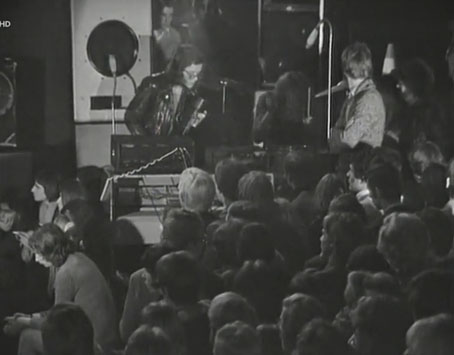
The group in their rock-freakout period playing to an audience of bored/bewildered/enthusiastic German hippies. With Klaus Dinger on drums and Ralf playing some kind of portable keyboard. Spot the leitkegel.


Pop2 (1973)

kraftwerk02.jpg

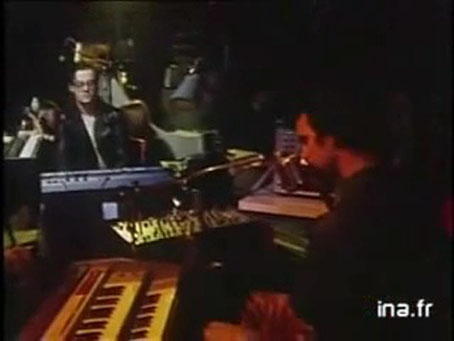
Pop2 was French TV’s equivalent of Germany’s Beat Club and the BBC’s Old Grey Whistle Test. This clip is from a programme devoted to “Kosmische” German music which also featured Tangerine Dream, Guru Guru, Klaus Schulze, and (in conversation) comic artist Philippe Druillet. The music here is very much in the melodic mode of the third album, Ralf & Florian. This is also about the last time you see Ralf wearing his leather jacket. The spectacles didn’t remain for long either.


Radioactivity (1975)

kraftwerk03.jpg


Antenna (1975)

kraftwerk04.jpg


Continue reading “Kling Klang rundfunk”