Alex Steinweiss: creator of the album cover

steinweiss2.jpg

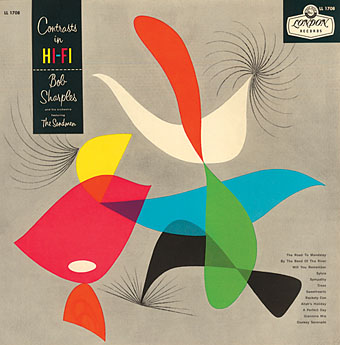
Contrasts in Hi-Fi by Bob Sharples.

A Tribute to Alex Steinweiss
The Creator of the Album Cover

Robert Berman Gallery announces an exhibition of Alex Steinwiss. Original album covers, paintings, and collages by Steinweiss, and special tribute by selected artists. Co-curated by Kevin Reagan and Greg Escalante.

In 1939, a 23 year-old graphic designer revolutionized the music industry. No longer would records come in plain brown wrappers. As Art Director at Columbia Records, Steinweiss created the ‘album package.’ His idea was to create a visual to complement the musical. It was an instant success, and spawned an entire new field of illustration and design: Album Cover Art. Steinweiss was the king of the genre; his covers are still regarded as icons.In his four decade career, Steinweiss created album covers for musical luminaries such as Louis Armstrong, Duke Ellington, Igor Stravinsky and Benny Goodman.
steinweiss1.jpg

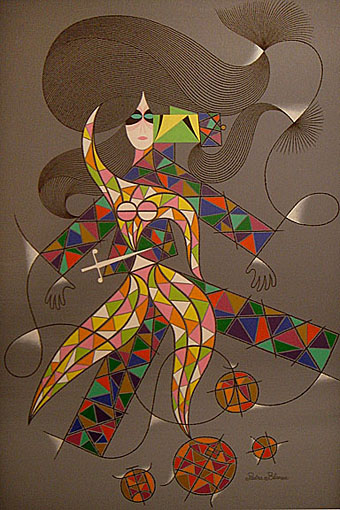
The Miraculous Mandarin (circa 1977).

The Steinweiss exhibition will feature 50 of his original cover designs, plus 50 original ‘tribute’ works, created specifically for this show. Artists that are honoring Steinweiss in the show include: Clive Barker, Bill Barminski, Ron English, Mick Haggerty, Raymond Pettibon, Shag, and Glenn Wexler. The featured artists have created album covers for a wide range of musicians, including Black Flag, Dixie Chicks, Goo Goo Dolls, Supertramp, and Rob Zombie.

“Steinweiss is 90 years old this year; this tribute is long over-due. The art community is excited to have a chance to pay homage to Alex’s unprecedented contribution to album cover art,” says Kevin Reagan, three time GRAMMY winning Art Director.

“It’s amazing to discover this one man, this un-sung hero, who is responsible for inventing the album. Steinweiss should be a household name,” says Greg Escalante, curator of Juxtapoz, and co-founder of Copro-Nason Gallery.

“The opportunity to highlight ‘the art of music’ is exciting. You have the energy of two different genres, and their combination is explosive,” says gallery owner Robert Berman. “Just plain design didn’t mean a damn thing,” Steinweiss says. You had to know music. I had to find a way to bring out the beauty of the music and the story.” (dwell, 10/07)

Alex Steinweiss lives in Sarasota, Florida, where he continues to design and paint.

A Tribute to Alex Steinweiss
Gala Opening: January 19th
Show runs through February 12th, 2008

Robert Berman Gallery
Bergamot Station Arts Center
2525 Michigan Avenue, C2
Santa Monica, CA 90404

• Alex Steinweiss at the Art Director’s Club Hall of Fame
• For the Record: The Life and Work of Alex Steinweiss at Amazon
• Alex Steinweiss at Soundfountain

Elsewhere on { feuilleton }
• The album covers archive
Design as virus 2: album covers

mcgriff.jpg

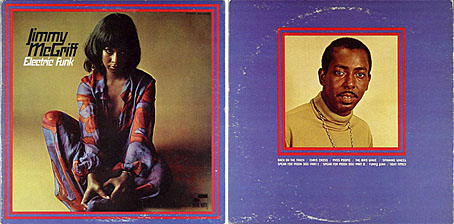
Electric Funk by Jimmy McGriff (1969).

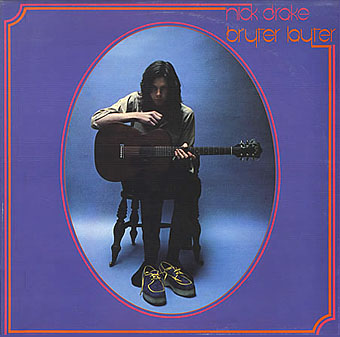
Okay, so the graphical similarity between Jimmy McGriff’s album sleeve and Nick Drake‘s, which appeared a year later, is probably coincidence but I couldn’t help noting it. Electric Funk was released on the Blue Note Records label which was highly regarded for its sleeve design so it wouldn’t be too surprising if someone at Island Records had seen it.

drake.jpg

Bryter Later by Nick Drake (1970).

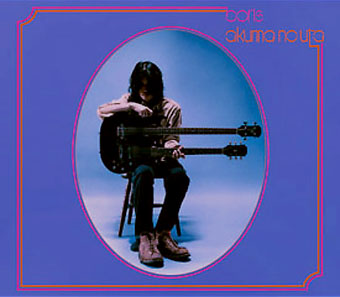
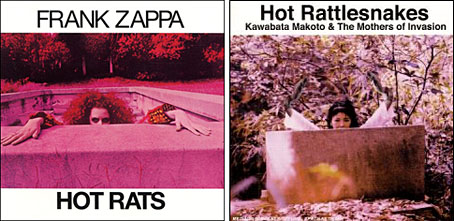
The album below by Japanese band Boris is a copy of Nick Drake’s, of course, a pastiche technique they’ve adopted for a couple of their other releases. The Japanese seem to be especially fond of this approach, Kawabata Makoto and Acid Mothers Temple (also below) having released many CDs which work playful riffs on western rock history.

boris.jpg

Akuma No Uta by Boris (2003).

hot_rats.jpg

Hot Rats by Frank Zappa (1969); Hot Rattlesnakes by Kawabata Makoto and the Mothers of Invasion (2001).

Elsewhere on { feuilleton }
• The album covers archive
Previously on { feuilleton }
• Design as virus 1: Victorian borders

Blog this: tits out for the future

blogs.jpg

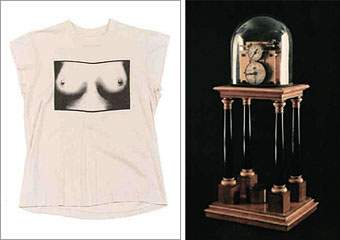
left: tits t-shirt by Vivienne Westwood and Malcolm McLaren.
right: the Hipp Chronoscope via io9.

A new year brings new blogs which is perhaps just as well seeing as the old year drew a line under some regular reads.

The Look, “Adventures in pop and rock fashion”, began posting a couple of weeks ago, spinning off from Paul Gorman’s book of the same name. Pieces there which immediately catch my eye are a skate through Billy Bowers’ outrageous clothing designs and a nice potted-history of the “tits tee”. I’d not realised before that the history of this latter creation goes back beyond punk to the early Seventies, another example of the evolution from post-psychedelic freakery to punk being a process of gradual elision, not the clean break that lazy commentary often suggests.

Also arriving (and noted everywhere by now) is io9, a new addition to the Gawker network, which looks at sf-related culture. I’ve already had a traffic spike from there after they linked to my Hugh Ferriss post and it’s good to see that Bldg Blog‘s Geoff Manaugh is among their contributors.

Previously on { feuilleton }
• Ave Atque Vale!

Fragment Endloss by Robert Henke

henke.jpg

I’ve mentioned before that Robert Henke, aka Monolake, is one of my favourite electronic musicians, and it was great last year when he reinstated his habit of offering a free download each month. Unlike the short fragments or scraps that many artists throw for free to audiences there’s been some substantial work on offer, such as an hour-long live performance of his Layering Buddha set.

The download for this month is a perfect soundtrack to accompany the New Year chill, Fragment Endloss, a 30-minute piece of ambient drift from 1992, reworked slightly for 2008.

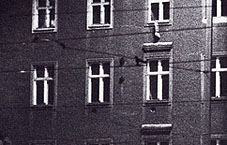
This is a very personal piece for me, created in a time where I felt quite dark and lived in an appropriate environment. I just had moved from West-Berlin, Neukoelln, to the east, to Prenzlauer Berg, which at that time was not the expensive hippster neighborhood it is now, but the very opposite. I lived in a small place on the ground floor in a backyard, with a coal oven and a toilet outside the building… It was the end of winter, cold, unfriendly, and very dark. Pretty much like on the pictures above.

Musically this is influenced by ‘The Pearl’ (Brian Eno, Harold Budd). Sound design wise it shows that I just go the TG-77 and SY-77, and then there is this one long brass-like sound that I made as a result of listening to John Chowning.

For the free track of the month version I slightly edited the original 45 minute version and added field recordings of Bahnhof Zoo and the S-Bahn here in Berlin which I also captured in 1992.

Previously on { feuilleton }
• Live Performance in the Age of Supercomputing
• Layering Buddha by Robert Henke
• New Monolake