In the Land of Retinal Delights

williams.jpg

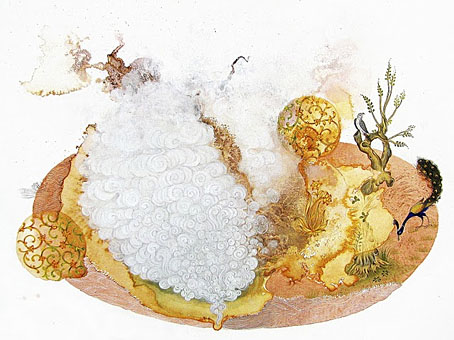
In the Land of Retinal Delights (1968) by Robert Williams.

More psychedelia. I’d wanted to link to a decent version of this painting by Robert Williams for some time but it took a while for one to turn up. When people mention psychedelic art it’s usually concert posters they’re talking about. Williams’ super-detailed canvas is a good example of psychedelic painting when it conveys particular aspects of the hallucinogenic experience such as hyper-reality and a sense of physical distortion, something that the posters and album covers seldom convey. That said, Williams’ picture did appear as a cover illustration for The Acid Trip, Vernon Joynson’s guide to psychedelic music in 1984, setting that volume apart from similar books which are often spoiled by poor artwork.

Robert Williams at Beinart

acidtrip.jpg

Elsewhere on { feuilleton }
The fantastic art archive

Previously on { feuilleton }
The art of Mati Klarwein, 1932–2002
The art of LSD

Signals from Mars

signal.jpg

Raymond Taylor’s composition, A Signal from Mars (1901).

This sheet music cover turned up recently as one of the pieces of science fiction-related graphics which will be on display at the British Library’s Out of this World: Science Fiction but not as you know it exhibition when it opens on Thursday. I don’t know what the music sounds like but the design is very familiar from a reworked version used for the cover of A Beacon from Mars, the second album by psychedelic band Kaleidoscope. It was always obvious that this cover had been copied from somewhere but I hadn’t seen the original until now. On the reissue CD there are no design credits so I’ve no idea who drew the cover; given its rather crude felt-tipped appearance that may be just as well. It’s a nice idea but poorly rendered.

beacon.jpg

A Beacon from Mars (1968) by Kaleidoscope.

There are two Kaleidoscopes among the psychedelic groups of the late 60s so it should be emphasised that it’s the American one we’re dealing with here. The UK group were very good, especially on their second album, Faintly Blowing (1969), but the US band are in a different league altogether. I’d rate them as highly as any other group you care to name from the period 1967–69, including The Beatles. A troupe of formidable multi-instrumentalists, they started out as the Baghdad Blues Band (the name change was prompted by their manager), and played a unique blend of psych-rock, blues, bluegrass, English folk and Middle Eastern instrumentals. Jimmy Page called them his favourite band of all time, and it’s notable that Led Zeppelin adopted a similarly eclectic formula shortly after. The last of Kaleidoscope’s trio of 60s albums is aptly titled Incredible; the standout piece on that opus is Seven-Ate Sweet which can be heard in its full 11-minute glory here. For more about the band, this fan site is the place to go.

Elsewhere on { feuilleton }
The album covers archive

Weekend links 59

duetemmo.jpg

Or So It Seems (1983) by Duet Emmo. Design by The Brothers Quay.

• “Make things, no rules, but be quick.” Bruce Gilbert, musician in (among others) Wire, Dome and Duet Emmo is interviewed. Related: Daniel Miller, Mute label boss and another member of Duet Emmo is interviewed (and provides a mix) at The Quietus. For more electronica with nothing at all to do with Duet Emmo there’s this Matmos interview.

donovan.jpg

Design by Dick Smith.

“It’s psychedelic not because we were stoned before we wrote the songs, or stoned during composing them, but the experiences of searching for the transcendental world though altered states of consciousness were in the songs,” he says, which sounds suspiciously like another way of saying he was stoned before he wrote them, but perhaps it’s best not to quibble with the description of the method in the face of such impressive results…

Donovan revisits one of his finest works, Sunshine Superman.

• Yet more Guardian features: A Clockwork Orange: The droog rides again | Ira Cohen: psychedelic photography master | A life in writing: China Miéville | The stars of modern SF pick the best science fiction.

• There are many stars of the gaseous variety in Nick Risinger’s 5000-megapixel photograph of the Milky Way.

“It is quite true I have worshipped you with far more romance of feeling than a man should ever give to a friend. Somehow I have never loved a woman…. From the moment I met you, your personality had the most extraordinary influence over me…. I adored you madly, extravagantly, absurdly. I was jealous of everyone to whom you spoke. I wanted to have you all to myself. I was only happy when I was with you.”

Salon reviews the new unexpurgated edition of The Picture of Dorian Gray.

• Paul Gorman discovered the gay art origins of the notorious Cowboys T-shirt.

The full complement of Saul Bass’s designs for Vertigo‘s print advertising.

Photos of the recent Dodgem Logic event by Rosie Reed Gold.

Peter Ashworth is still taking great photos.

Jodorowsky’s Dune Finally Revealed?

Sunshine Superman (1966) by Donovan | Or So It Seems (1983) by Duet Emmo.

San Francisco by Anthony Stern

sf.jpg

The flip-side of the kitsch London of Smashing Time can be found in this frenetic short made a year later which presents a fragmented view of that other locus of the Paisley Era, San Francisco. Director Anthony Stern avoids the usual longueurs of silent documentary by chopping his footage to bits to create a tour through the city streets that’s as frenzied as the films of Jeff Keen. The bonus is a score by The Pink Floyd (from the days when they still used the definite article) playing an exclusive version of Interstellar Overdrive. That alone makes one wonder why this film hasn’t received more attention over the years.

Stern’s film reminds me of Kenneth Anger’s Invocation of My Demon Brother (1969), another short work which is frequently as frenzied and also features scenes filmed in San Francisco. In addition, both films feature some ritual business: Stern shows a group of freaks in a psychedelic house with the inevitable naked woman cavorting for the benefit of clothed men; Anger is rather more serious with shots of a full-blown Crowlean ceremony. Anthony Stern today has established himself as a very accomplished glass artist; you can see his glass work here and watch San Francisco here.

Previously on { feuilleton }
Smashing Time
Berlin Horse and Marvo Movie
Kenneth Anger on DVD again

Smashing Time

st1.jpg

Writing about the late Lynn Redgrave last year I picked out this film as a career highlight despite not having seen it for a very long time. Watching it again recently was an interesting experience, not least for the way it connects to more recent points of obsession, none of them evident the first time round.

st2.jpg

Carnaby Street antics.

Smashing Time was directed by Desmond Davies in 1967, and the direction is as perfunctory as you’d expect from someone whose career before and after was mostly for television. Of more interest is the script by George Melly, a bisexual jazz singer, writer, and lifelong evangelist for Surrealist art. This was Melly’s first job as a screenwriter and he seems an odd choice. He was 41 at the time, and his portrayal of Swinging London and its denizens is often typical of the acerbic older generation’s view of the younger groovers. It’s never as cynical as the Private Eye crowd but without Melly’s humour the tone might seem patronising. That said, it was the satire magazine that originated the names of the two lead characters, Brenda (Rita Tushingham) and Yvonne (Lynn Redgrave) being Private Eye‘s names for Queen Elizabeth and Princess Margaret respectively. The story is a simple one of the pair coming to London from the north of England in search of “a smashing time”, and, in Yvonne’s case, an attempt to make it big somehow. Misadventures ensue.

st3.jpg

Brenda in the Too Much boutique.

Along the way there are digs at avant-garde artists, lecherous men, greedy pop promoters and wealthy boutique owners. Melly leavens his barbs with yet another example of the Lewis Carroll influence on late-60s culture. One of the scenes takes place in the Jabberwock Gallery, while Jabberwocky-derived character names appear throughout: Tom Wabe (Michael York), Charlotte Brillig, Mrs Gimble (the always wonderful Irene Handl), Bobby Mome-Rath (Ian Carmichael), Jeremy Tove. There’s also an Alice Boojum, and a band named The Snarks (real-life psych band Tomorrow) who don’t get to play, unfortunately. Tomorrow, who appear in the final party scene, are the sole connection with the genuinely hip London of 1967. Everything else we see is the Sunday supplement view of the city with Carnaby Street, shots of Chelsea and a dishevelled Camden. The raucous finale is staged at the top of that bright new landmark of 1960s London, the Post Office Tower.

st4.jpg

Yvonne begins her pop career.

My childhood enthusiasm was obviously taken with the film’s superficial qualities—there are so many songs it’s almost a musical—whereas now I’m impatient with the laboured slapstick but enjoy all the peripheral stuff. Many of the documentary shots of streets away from the centre are a reminder of how shabby and grimy the capital really was at that time, as was the rest of Britain when there was still a century of industrial soot on the walls. I also realise I’d missed the double-meaning of the title: “smashing time” isn’t only a modish phrase for an enjoyable experience but a nod to the way Brenda and Yvonne cause havoc wherever they go. The jabs from an older musician at brainless pop culture would have annoyed some but Yvonne’s hit song, I’m So Young (which is actually very good), has lyrics which resonate today:

I can’t sing but I’m young
I can’t do a thing but I’m young
I’m a fool
But I’m cool
Don’t put me down

Lynne Redgrave is fantastic as Yvonne, completely convincing in a part that requires her to be loud, selfish and petulant without ever being too obnoxious. She also wears a different wig in nearly every scene. Among other moments of note there’s some fleeting gay humour with a pair of waiters camping it up in the Sweeney Todd pie shop (as does Murray Melvin in another scene). And there’s also an incident which, being an Aubrey Beardsley obsessive, I have to draw attention to:

st5.jpg

Was this the first appearance of Beardsley’s work in cinema? The V&A exhibition which began the Beardsley revival had taken place only a year before, and I can’t think of any examples earlier than this. The William Morris wallpaper is a fitting touch as well.

Reservations aside, this is a film I could watch more often than “properly” psychedelic fare like Wonderwall. For a snapshot of the period, it’s still a smash, baby.

Previously on { feuilleton }
Lynn Redgrave, 1943–2010
Through the Wonderwall