Impressions de la Haute Mongolie revisited

impressions.jpg

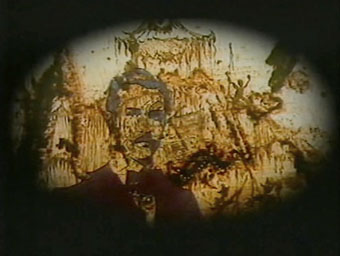
Impressions de la Haute Mongolie – Hommage á Raymond Roussel (1974-75).

When I wrote a short reminiscence about Impressions de la Haute Mongolie last March I really didn’t expect I’d be watching it again just over a year later having waited thirty years for the opportunity. But now we can all see José Montes-Baquer’s collaboration with Salvador Dalí, thanks to the indispensable Ubuweb. The copy there doesn’t have English subtitles, unfortunately, but the visuals are still beguiling and not too difficult to follow if you can understand some French and Spanish. It was a curious experience seeing this again, some parts I remembered very well, others I’d completely forgotten about. Most surprising was the soundtrack of electronic music, much of it taken from recordings by Wendy Carlos, including a part of her ambient Sonic Seasonings suite and portions of her complete score for A Clockwork Orange. There’s more about this deeply strange film in Tate Etc.

And speaking of surreal landscapes, it’s worth mentioning that I’ve spent the past few weeks working on a new piece of Lovecraft-themed artwork for an exhibition at Maison d’Ailleurs, the Museum of science fiction, utopia and extraordinary journeys in Yverdon-les-Bains, Switzerland. The exhibition of newly-commissioned work based on themes from HP Lovecraft’s Commonplace Book will be launched in October 2007. More details about the event, and my contribution, closer to that date. In the meantime, the European edition of TIME magazine has a short feature about the gallery and its ethos.

Previously on { feuilleton }
Dalí and Film
Ballard on Dalí
Fantastic art from Pan Books
Penguin Surrealism
The Surrealist Revolution
The persistence of DNA
Salvador Dalí’s apocalyptic happening
The music of Igor Wakhévitch
Dalí Atomicus
Las Pozas and Edward James
Impressions de la Haute Mongolie

White Noise: Electric Storms, Radiophonics and the Delian Mode

white_noise.jpg

Many sounds have never been heard—by humans: some sound waves you don’t hear—but they reach you. “Storm-stereo” techniques combine singers, instrumentalists and complex electronic sound. The emotional intensity is at a maximum. Sleeve note for An Electric Storm, Island Records, 1969.

An Electric Storm by White Noise is reissued in a remastered edition this week. It’s a work of musical genius and I’m going to tell you why.

Hanging around with metalheads and bikers in the late Seventies meant mostly sitting in smoke-filled bedrooms listening to music while getting stoned. Among the Zeppelin and Sabbath albums in friends’ vinyl collections you’d often find a small selection of records intended to be played when drug-saturation had reached critical mass. These were usually something by Pink Floyd or Virgin-era Tangerine Dream but there were occasionally diamonds hiding in the rough. I first heard The Faust Tapes under these circumstances, introduced facetiously as “the weirdest record ever made” and still a good contender for that description thirty-four years after it was created. One evening someone put on the White Noise album.

It should be noted that I was no stranger to electronic music at this time, I’d been a Kraftwerk fan since I heard the first strains of Autobahn in 1974 and regarded the work of Wendy Carlos, Tangerine Dream, Brian Eno and Isao Tomita as perfectly natural and encouraging musical developments. But An Electric Storm was altogether different. It was strange, very strange; it was weird and creepy and sexy and funny and utterly frightening; in places it could be many of these things all at once. Electronic music in the Seventies was for the most part made by long-hairs with banks of equipment, photographed on their album sleeves preening among stacks of keyboards, Moog modules and Roland systems. You pretty much knew what they were doing and, if you listened to enough records, you eventually began to spot which instruments they were using. There were no pictures on the White Noise sleeve apart from the aggressive lightning flashes on the front. There was no information about the creators beyond their names and that curious line about “the emotional intensity is at a maximum”. And the sounds these people were making was like nothing on earth.

Continue reading “White Noise: Electric Storms, Radiophonics and the Delian Mode”

The art of Bob Pepper

pepper1.jpg

Forever Changes (1967) by Love.
Art by Bob Pepper, design by William S. Harvey.

Following yesterday’s post about Philip K Dick covers (and Erik Davis’s appraisal of the DAW cover), I decided to check out Bob Pepper’s work a bit more and it quickly became obvious I should have joined the dots with this particular artist years ago. Pepper’s work not only decorates one of the recognisable record sleeves of the late Sixties (above), he was working shortly afterwards as an illustrator on the celebrated series of fantasy reprints edited by Lin Carter for Ballantine books. Pepper’s connections with Elektra Records also saw him provide sleeve art for some of the eclectic releases on their Nonesuch label. What’s surprising to me now is the realisation that I’d been seeing his work for years in a variety of places and never noticed it was the same artist. Better late than never, I suppose.

pepper2.jpg

Four more Dick covers for a series of six published in 1982 to coincide with the release of Blade Runner. As with the cover for A Scanner Darkly (in the earlier post) these paintings are all portraits.

pepper3.jpg

A Voyage to Arcturus (1968) by David Lindsay.

It was the success of the publication of The Lord of the Rings in America which inspired Betty Ballantine to publish a line of fantasy classics in the late Sixties. The series began its run in 1969 and continued until 1974. Lin Carter was commissioned as editor and given free reign to choose any title he thought might be suitable with the result that many of the books in the series—obscurities such as Lud-in-the-mist by Hope Mirrlees—received their first paperback publication. Carter also reprinted personal favourites which frequently shifted from fantasy to outright horror, such as the titles from HP Lovecraft and William Hope Hodgson. The range and scope of this line is what makes the series so notable today and the books have become highly-collectable as a result. Many artists were involved in producing the distinctive cover designs and Pepper’s illustrations were featured on the covers for Mervyn Peake, Lord Dunsany and James Branch Cabell, among others. Unfortunately the various pages devoted to these books aren’t very good at showing the paintings to their best advantage. For a long time Pepper’s cover for A Voyage to Arcturus was one of the few editions available that managed to show a scene from the book, rather than a generic sword-wielding barbarian.

pepper5.jpg

The Wild Bull (1968) by Morton Subotnick.

Nonesuch Records was Elektra’s subsidiary classical music label which not only produced classical recordings but also recordings from around the world in their Explorer series, and a range of original works of contemporary electronic music. I’m not positive that the sleeve above is a Pepper painting but it certainly looks like it. This is another surprise since I’ve had Morton Subnotnick‘s album on a reissue CD for years (with different artwork). The George Crumb recording below is Pepper’s work and I’ve had the original vinyl of that one for several years. The similarity between that sleeve and the one for Love is striking.

farmer.jpg

Flesh (1969) by Philip José Farmer.

pepper6.jpg

Golden Rain – Balinese Gamelan Music – Ketjak: The Ramayana Monkey Dance (1969) by Various Artists.
Art by Bob Pepper, design by William S. Harvey.

pepper4.jpg

Ancient Voices of Children (1971) by George Crumb.
Art by Bob Pepper, design by Robert W. Zingmark.

delany.jpg

Driftglass (1971) by Samuel R. Delany.

pepper7.jpg

Debussy’s Greatest Hits (1972).

pepper8.jpg

Concerto For Harpsichord And Five Instruments by Manuel De Falla (no date).

ellison.jpg

Ellison Wonderland (1974) by Harlan Ellison.

pepper9.jpg

Fiestas of Peru: Music of the High Andes (1975) by Various Artists.
Art by Bob Pepper, design by Jo Ann Gruber.

japan.jpg

Flower Dance: Japanese Folk Melodies (no date) by Kofu Kikusui, The Noday Family, Nakagawa & Oishi.
Art by Bob Pepper, direction by William S. Harvey, design by Elaine Gongora.

Pepper is retired now but produced artwork for Dark Tower, a fantasy boardgame, in 1981. The game still has its enthusiasts, and this site features a short interview with the artist.

Update: more about the Ballantine covers.

Update 2: a large scan of the George Crumb cover art.

Update 3: More album and book covers added.

Elsewhere on { feuilleton }
The album covers archive
The book covers archive
The illustrators archive

Previously on { feuilleton}
Philip K Dick book covers
Masonic fonts and the designer’s dark materials

The Séance at Hobs Lane

seance.jpg

Séance, 2001 version.

Drew Mulholland, aka Mount Vernon Arts Lab (also Mount Vernon Astral Temple and Black Noise…), has joined forces recently with the masterful Ghost Box collective, purveyors of finely-crafted and frequently creepy electronica. MVAL’s 2001 release, The Séance at Hobs Lane, is now Ghost Box release no. 9 and comes repackaged in their Pelican Books-derived livery. Inspired by (among other things) Quatermass and the Pit, Séance makes a good companion to the creepiest of the Ghost Box releases to date, Ouroborindra by Eric Zann. Further points us to Mark Pilkington’s 2001 interview with MVAL for Fortean Times.

Previously on { feuilleton }
Exuma: Obeah men and the voodoo groove
New Delia Derbyshire
The man who saw tomorrow
A playlist for Halloween
Ghost Box

New things for June II

chaoticum.jpg

Work on two very different CDs was completed this month, a pair of releases so different they’re almost polar opposites. Chaoticum describe their music as “art for your ears” and the label for this album is HORUS CyclicDaemon, producers of the Aleister Crowley anthology I designed in 2005. The package is a digipak and will include a poster which features one of my Great Old Ones portraits.

eskiboy.jpg

Eskiboy is UK Grime artist Wiley who’s proved himself notable enough to be featured on the cover of last month’s Wire magazine. This compilation was a commission from Baked Goods in Manchester. I was trying to avoid the obvious tunnel image at first but the label was keen to see something along those lines so this is the result of the usual to-ing and fro-ing which design work often entails.

Meanwhile the CD I designed earlier this year for Turisas is now in the shops and the band is interviewed in this month’s Metal Hammer. I’ll be putting the full artwork for all these releases onto the site over the next week or so.