Ghost Box

ghost_box.jpg

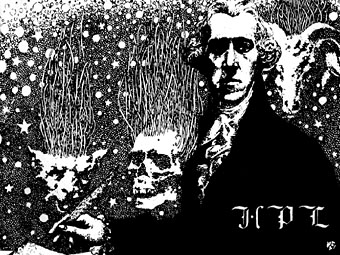
Q: What do you get when you cross analogue synthesizers, samples from obscure public information films, the graphic design of Pelican Books, Arthur Machen, HP Lovecraft, Algernon Blackwood, CS Lewis, Hammer horror, the Wicker Man and the music from Oliver Postgate’s animated films for children?

A: the CD releases by artists on the Ghost Box label. Ghost Box describe themselves as “an independent music label for artists that find inspiration in library music albums, folklore, vintage electronics, and the school music room” which, if you’re familiar with the reference points, is exactly what you get. A rather wonderful blend it is too, some of the tracks on Belbury Poly’s The Willows (named after Algernon Blackwood’s stunning horror tale) are how I expected Stereolab to sound until I heard them and was rather disappointed.

Favourite of the Ghost Box releases I’ve heard to date is (perhaps inevitably) Ourobourindra by Eric Zann (the “artist” here is named after Lovecraft’s haunted musician from The Music of Erich Zann). The website description—”Eric Zann’s radios, oscillators and recordings conjure eldritch, echoing spaces and invoke the voices of the dead that whisper within them”—again is a pretty accurate summation of this atmospheric and sinister audio collage. “Sinister” is a term that can be applied to much of this music and the Ghost Box founders, Julian House and Jim Jupp, declare in a Wire feature this month that matters spectral are of particular concern, hence the label name. Ourobourindra works especially well in this regard, sounding like the product of someone working through a trauma caused by viewing the seance scene from Dracula AD 1972 at too young an age. This is one I’ll be playing on Halloween.

Ghost Box music can be purchased online here.

Elsewhere on { feuilleton }
The album covers archive

Previously on { feuilleton }
Penguin book covers
The music of Igor Wakhévitch
The music of the Wicker Man
The Absolute Elsewhere

Reverbstorm

reverbstorm.jpg

My discipline here has rather collapsed since returning from Paris. Lots of things that required sorting out and the distraction of a new computer is the excuse. Time for a new announcement, however. Now that The Haunter of the Dark is back in print, work has begun at the Savoy HQ on the eventual reprinting of my comics magnum opus, Reverbstorm. This was the 8-part Lord Horror series I was producing for Savoy with David Britton that sprang directly out of my Lovecraft comics work and is, in some small way, a continuation of it (hence the inclusion of some pages in the final part of HOTD).

Reverbstorm was an attempt by Dave and I to produce a graphic novel (wretched term, but if the boot fits…) that was truly adult, at a time—the early Nineties—when much there was much discussion of “adult comics” but little worthy of the name being produced. Reverbstorm is adult in terms of its often aggressive and challenging content; so are many mainstream comics now. But it’s also adult in terms of style and technique, being laden with quotation and literary and artistic allusion that requires an understanding of some of the key works of the Modernist movement to fully appreciate. Being a Lord Horror work, there’s also plenty of reference to the fascist philosophy that Dave’s character (based on William Joyce, Lord Haw-Haw) subscribes to. Mix all this with a great deal of violence and you have a very dark work indeed, one that most readers and reviewers of the time were happy to ignore.

Well Reverbstorm is returning to the world in a definitive form. All the artwork is being scanned and cleaned (and in some cases, amended slightly); the eighth and final part will see its first publication in this new edition and there’ll be some previously unseen or unpublished material also. The series as a whole contains 270 pages of some of my best ever black and white artwork (and some great additional work from Kris Guidio) so I’m very pleased that this volume is set to appear in a form that will do justice to the years we spent creating it. Publication will probably be in autumn 2007 but watch this space for further details.

For more on the Reverbstorm series, read my short essay about its genesis here.

Hail, horrors! hail, infernal world!

horror.jpg

This marvellously lurid 250pp tome turned up in the post today, something I was looking forward to seeing as I wrote 30 of the reviews within, as well as some longer essays on Dracula, Lovecraft and a brief history of occult cinema. Nice layout, lots of colour and some great photos, many of which I haven’t seen elsewhere which isn’t always the case with books like this; I’ll enjoy reading the rest of it. Not sure when it’s due for publication just yet as Andre Deutsch/Carlton Books’ web presence is sketchy to say the least.

Update: The book was published on October 2nd, 2006.

Previously on { feuilleton }
The music of The Wicker Man
Nosferatu
David Rudkin on Carl Dreyer’s Vampyr

Down with human life

houellebecq.jpgSam Leith is engrossed by a formidable essay on the father of ‘weird fiction’.

HP Lovecraft: Against the World, Against Life
by Michel Houellebecq
tr by Dorna Kazheni
intro by Stephen King
256pp, Weidenfeld & Nicolson
£10 (pbk)
Saturday, August 12, 2006
The Daily Telegraph

“I AM SO BEASTLY TIRED of mankind and the world that nothing can interest me unless it contains a couple of murders on each page or deals with the horrors unnameable and unaccountable that leer down from the external universes.” So wrote Howard Phillips Lovecraft (1890–1937). His extraordinary body of work can be seen as a sustained effort to fill that prescription.

The founding father of what has become known as “weird fiction”, Lovecraft was not a congenial figure. Tall, ugly, misanthropic, snobbish, reclusive, he hated people in general, and people of other races in particular. More or less nothing happened in his life. He was 32 before he kissed a woman and his brief, unsuccessful and wholly unexpected marriage put paid to love for good. He died of intestinal cancer at 47.

His literary concerns were as follows: unkillable tentacled beings from beyond space worshipped by cannibal death cults; hideous prodigies of miscegenation; gibberings from the abyss; indecipherable languages of madness; insane architectural geometries; colours outside any nameable spectrum. Lovecraft has nothing in common with Anita Brookner.

On the surface, he has very little in common with Michel Houellebecq, either. What they seem to share, though, is an aggressive misanthropy. In this consistently engaging essay, an infatuated Houellebecq argues that Lovecraft’s work pioneered a sort of anti-literature: a great shout of “NO!” to human life.

Lovecraft was not just unrealistic, Houellebecq argues, but anti-realistic: the devotee of a sort of malevolent sublime. Religious writers see our animal lives as validated by the notion that beyond our perception lies something infinitely larger, more ancient and more benevolent. Lovecraft played with the opposite idea. If there’s something else, why should we imagine it would be benevolent? How much more likely that we have, here, a pretty disgusting animal existence; but that if we caught a whiff of what lies outside it, we’d go instantly mad—if we were lucky.

Very little of what Lovecraft wrote conforms to the conventional canons of what literature should be doing. His characters are more or less interchangeable: drab men with drab jobs, no pasts and no futures. They are there to bear witness, to have the living daylights frightened out of them and, if they are unlucky, to be “devoured by invisible monsters in broad daylight at the Damascus market square”. There’s no interest in human life, or money, or sex. The stories don’t start in the real world and amble into horror: they start midway through the screaming hab-dabs and turn up the volume from there producing what Houellebecq calls “an open slice of howling fear”. The involuted and clumsily baroque sentences disapproved of by Lovecraft’s detractors are serving, then, a singular purpose: to pile more on—to generate an intoxicating fever pitch of rhetoric.

Houellebecq’s essay is often perverse, sometimes jejune, more than occasionally downright silly. He attributes more consistency of philosophical purpose to Lovecraft than, I think, a sensible reading of the “great texts”—”The Call of Cthulhu” (1926), ‘The Colour Out of Space” (1927), ‘The Dunwich Horror” (1928), “The Whisperer in Darkness” (1930), “At the Mountains of Madness” (1931), “The Dreams in the Witch House” (1932), ‘The Shadow over Innsmouth” (1932) and “The Shadow Out of Time” (1934)—will bear.

And he on more than one occasion dismisses Lovecraft’s critics, with Houellebecquian arrogance, as “idiots” and such like. But his essay is both a formidable literary performance in itself, a work of real imaginative sympathy, and a consistently engrossing intellectual workout. It bursts with new ideas, and new ways of thinking about this oddest of writers. Bolstered by an introduction by Stephen King, and a pair of first-rate Lovecraft stories, it’s worth anyone’s tenner.

Lovecraft, as Houellebecq observes, “writes for an audience of fanatics—readers he was finally to find only years after his death”. That his work at last found those readers is beyond question. The “Cthulhu Mythos”, like Tolkien’s Middle-Earth, has become a place in which devotees live.

Ever since Lovecraft’s friend August Derleth completed some of his unfinished stories after his death, fantasy writers have done more than imitate Lovecraft’s approach: they have set their stories in his universe. The internet now throws up thousands of references to the mythos, allusions to the dread Necronomicon, and artists’ imaginings of Lovecraft’s monsters.

When I was a child, there was a Call of Cthuthu role-playing game. There’s even an internet cartoon series, “Hello Cthulhu“, that pits the Elder Gods against the overpowering cuteness of “Hello Kitty”. “Hi there! Would you like a cookie?!?” asks a fwuffy kitty with a ribbon in her hair. “No, actually. I would hate to have a cookie, you vapid waste of inedible flesh!” retorts Cthulhu. Lovecraft wouldn’t have liked it, I don’t think. But somewhere, sepulchrally, he might have been flattered.

Previously on { feuilleton }
Le horreur cosmique

Le horreur cosmique

hpllibrio.jpgI’ll be in Paris this week so some French-related postings are in order.

Michel Houellebecq’s HP Lovecraft: Against the World, Against Life (which I still haven’t read) has been in the news again recently, with a number of reviews appearing in UK newspapers and magazines, most of which present the by-now rather tired spectacle of reviewers who normally wouldn’t give any of this nasty pulp stuff a second thought having to take Lovecraft seriously because Houellebecq is a serious author. (“He’s a bad writer!” they bleat. And Lou Reed is a bad singer; you’re missing the point, you fools.) The Observer last week had one of the better ones. Last year the Guardian published an extract from Houellebecq’s book.

Curious how often it requires the French to make the Anglophone world look anew at marginalised elements of its own culture; Baudelaire championed Edgar Allan Poe, it was French film critics who gave us the term “film noir” when they identified a new strain of American cinema and the Nouvelle Vague writers and filmmakers were the first to treat Hitchcock as anything other than a superior entertainer. The French have always liked Lovecraft so it was no surprise to me at least when Houellebecq’s book appeared.

Oddly enough, the only association I’ve had so far with French publishing is the use of my 1999 picture of Cthulhu’s city, R’lyeh, on the cover of a reprint of HPL stories from Houellebecq’s publishing house (above). Something I’ll be looking for in Paris if I have the time will be more of Philippe Druillet‘s Lovecraft-inflected work. Druillet has been working with the imagery of cosmic horror since the late 60s and even illustrated the work of William Hope Hodgson, one of HPL’s influences and an English writer the broadsheet critics have yet to hear about. Take a look at these pictures for stories written before the First World War then go and look at some stills from the latest Pirates of the Caribbean movie. What was once the preserve of Weird Tales and other pulp magazines is now mainstream culture.

Previously on { feuilleton }
Davy Jones
Charles Méryon’s Paris