Schalcken the Painter revisited

schalcken1.jpg

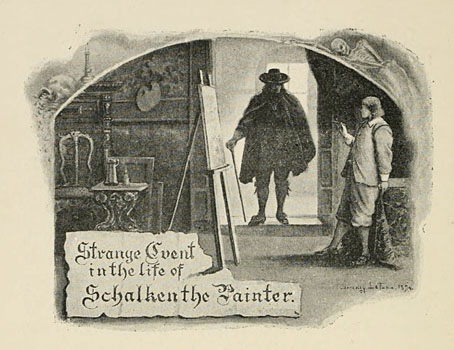
Illustration by Brinsley Sheridan Le Fanu from The Watcher and Other Weird Stories (1894) by J. Sheridan Le Fanu.

The stranger stopped at the door of the room, and displayed his form and face completely. He wore a dark-coloured cloth cloak, which was short and full, not falling quite to the knees; his legs were cased in dark purple silk stockings, and his shoes were adorned with roses of the same colour. The opening of the cloak in front showed the under-suit to consist of some very dark, perhaps sable material, and his hands were enclosed in a pair of heavy leather gloves which ran up considerably above the wrist, in the manner of a gauntlet. In one hand he carried his walking-stick and his hat, which he had removed, and the other hung heavily by his side. A quantity of grizzled hair descended in long tresses from his head, and its folds rested upon the plaits of a stiff ruff, which effectually concealed his neck.

So far all was well; but the face!

Strange Event in the Life of Schalken the Painter (1839) by J. Sheridan Le Fanu.
schalcken2.jpg

Compare this shot to the inferior YouTube version.

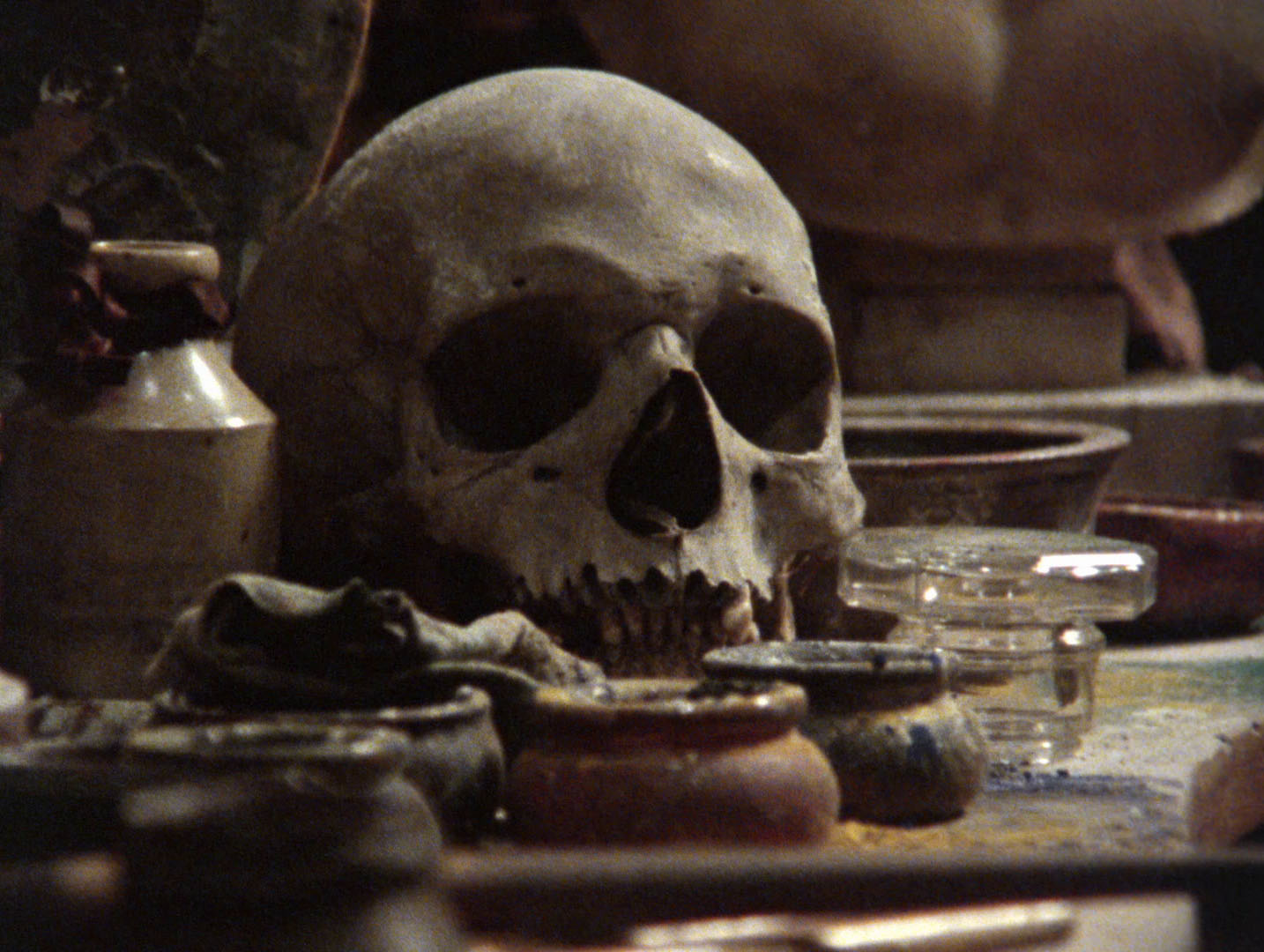
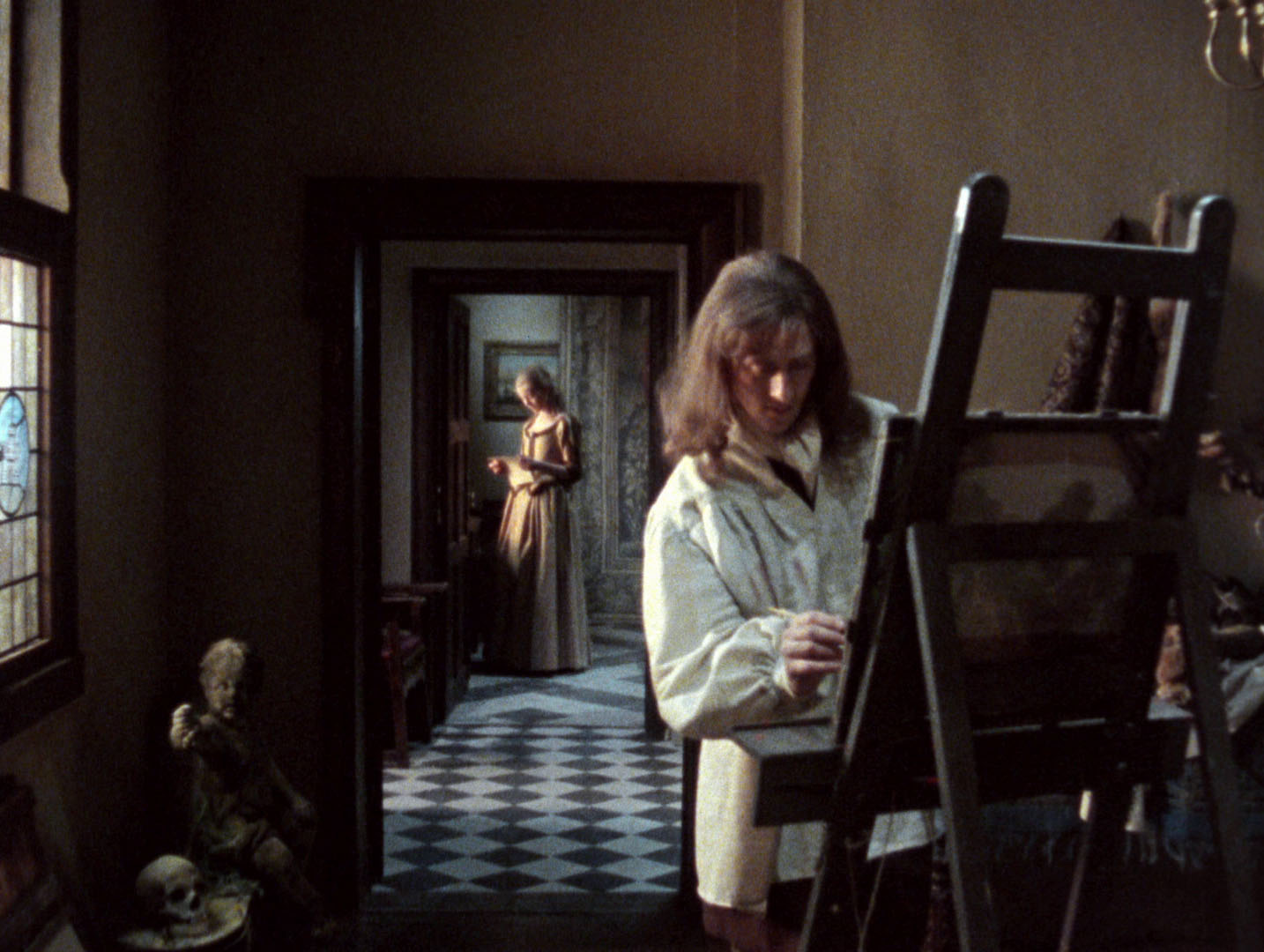
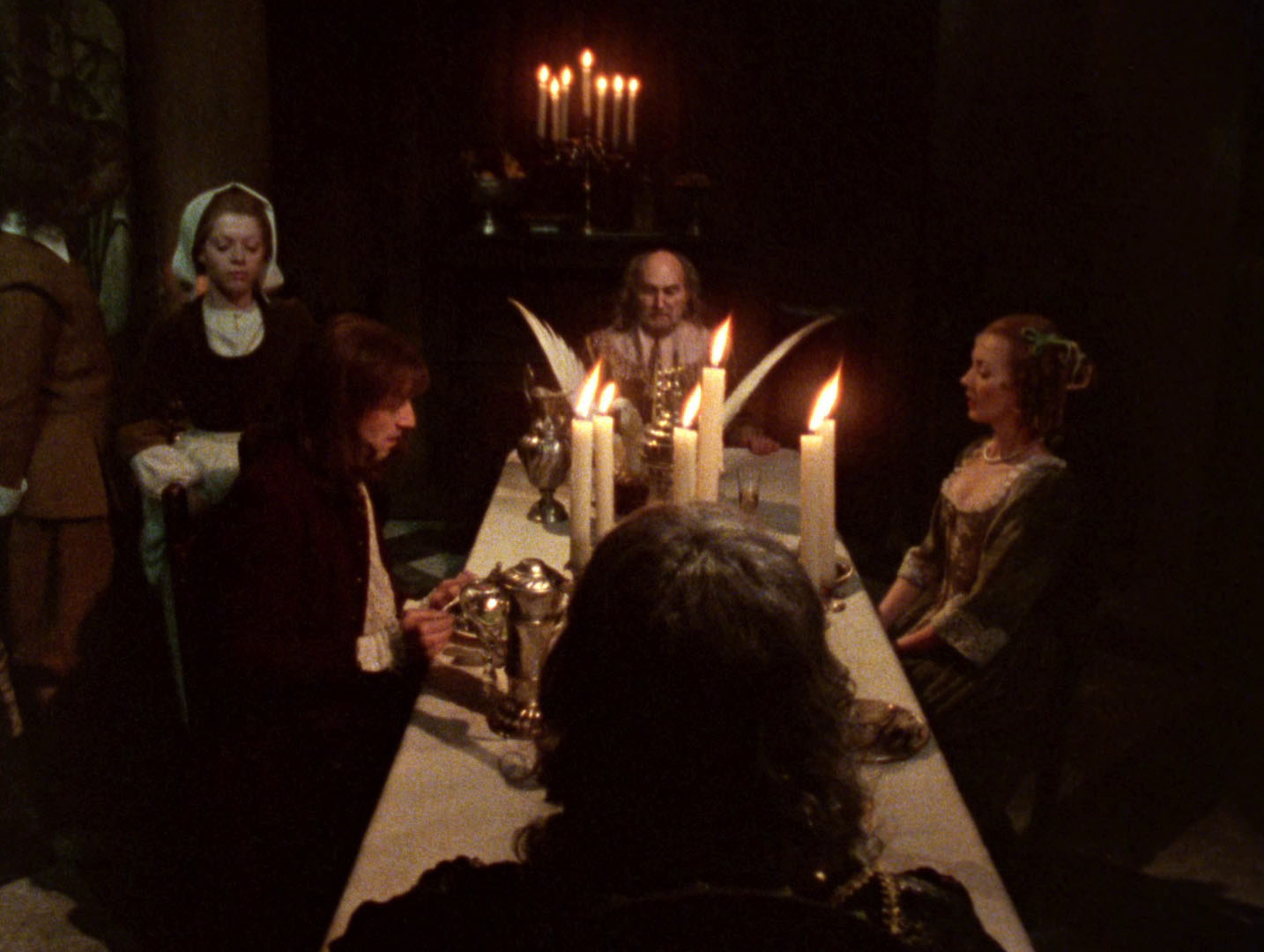
I enthused at some length about Leslie Megahey’s 1979 television film Schalcken the Painter last year so there’s no need to repeat myself. This post serves notice that the film is available at last in another marvellous dual-format release from the BFI, replete with extras, and the usual authoritative booklet notes. The Blu-ray transfer is a revelation after years spent watching an old VHS copy (the versions of YouTube are even worse). I noted before the astonishing lighting by cameraman John Hooper which successfully replicates not only the Dutch interiors so familiar from Vermeer, but also the candlelit chiaroscuro of Godfried Schalcken’s own paintings. (Le Fanu, incidentally, spelled the painter’s name “Schalken”.) Blu-ray quality might seem like overkill for a low-budget TV drama, however well-made, but this film in particular demands it, especially when the interiors begin to darken along with the story.
schalcken3.jpg

Cheryl Kennedy and Jeremy Clyde.

Among the extras there’s a 39-minute interview with Leslie Megahey and John Hooper about the making of the film. The combination of scenes based on period paintings plus candlelit interiors always makes me think of Barry Lyndon so it’s a surprise to discover that Megahey didn’t have this in mind at all. The film owes more, he says, to Blanche (1972) by Walerian Borowczyk, a period feature film which utilises a similarly flat shooting style with scenes based on medieval art. I’ve only seen Borowczyk’s earlier animated films, some of which have featured in previous posts, so this is one to look for in future.
schalcken4.jpg

In addition to the making-of piece there are two short films: The Pit (1962, 27 mins), directed by Edward Abraham, based on Poe’s Pit and the Pendulum, and The Pledge (1981, 21 mins) directed by Digby Rumsey, based on a short story by Lord Dunsany. I’ve not watched either of these yet, it seemed unfair to follow Megahey’s film with lesser fare.

After such unbridled enthusiasm it goes without saying that this is an essential purchase for anyone who enjoys the BBC’s ghost films of the 1970s. I’m biased towards Megahey’s productions but I find this a superior work to many of the MR James films. Megahey filmed another drama about a painter in 1987, Cariani and the Courtesans. It’s a non-supernatural piece but also has Charles Gray narrating and John Hooper behind the camera. I’ve not seen it for years so I’ll continue to hope it may also see a reissue soon.

Previously on { feuilleton }
Schalcken the Painter
Leslie Megahey’s Bluebeard
The Watcher and Other Weird Stories by J. Sheridan Le Fanu
Chiaroscuro

Two films by Clive Barker: The Forbidden and Salome

forbidden1.jpg

The Forbidden.

Clive Barker announced late last month that arrangements were being made for a remake of Hellraiser. This isn’t the first time such an announcement has been made so we’ll have to wait and see what comes of that. I think I’m in a minority of people who’ve always been well-disposed to Barker and his works (the early stories in particular) but have never really enjoyed Hellraiser. I saw it when it was first released, and was disappointed that Barker and co. hadn’t manage to successfully negotiate the pitfalls of making a British film for demanding American producers. The soundtrack that Barker commissioned from Coil was dropped (a serious error); the film’s awkward mid-Atlantic tone makes suspension of disbelief difficult, and considering Barker’s success as a storyteller the narrative is often confused and disjointed. Without all the memorable imagery it’s doubtful it would have had much of a lasting reputation, or birthed so many sequels.

forbidden2.jpg

The Forbidden.

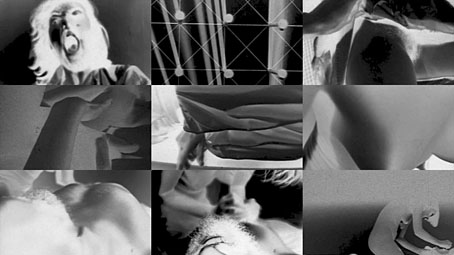
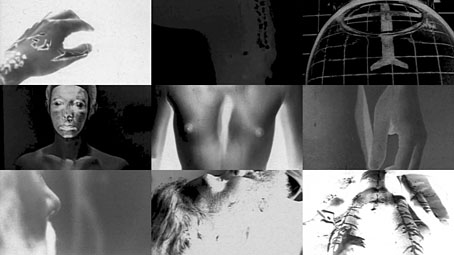
Barker and his theatre colleagues made The Forbidden in 1978, a 35-minute 16mm film of entirely negative images which shows how different Hellraiser might have been if fewer capitulations had been made to the marketplace, and to the clichés of horror cinema. Both films concern an occult ritual, an occult puzzle, and the subsequent consequences of the ritual. Where Hellraiser has to connect its most striking scenes with mundane business such as Julia’s murder spree and screaming teens, The Forbidden presents its imagery as raw data, leaving it to the viewer to piece together its fragments.

Barker’s work since Hellraiser has been almost completely generic so it’s surprising to see something of his that’s this open and abstract. In tone it’s closer to the films of Derek Jarman or Kenneth Anger than anything else, especially the sequence of Barker himself dancing with an erection, something which will ensure this doesn’t get many TV screenings. (Barker has referred to Kenneth Anger when discussing the film.) The final section, featuring a man being lovingly flayed by a number of scalpel-wielding hands, offers the same spectacle as Hellraiser‘s skinless Frank but without any of the accompanying frenzy. This won’t necessarily be on YouTube for very long so watch it while you can. The uploaded version is from the Redemption DVD, music included. Since the film is silent you can watch it with a score of your choice; I’d suggest Coil’s themes for Hellraiser.

salome.jpg

Salome.

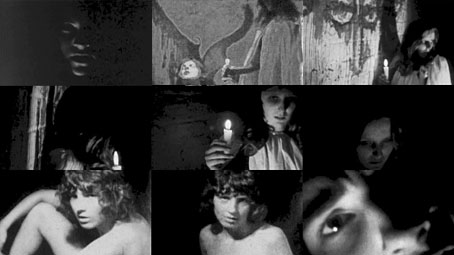
Where The Forbidden is a successful piece of avant-garde cinema, Barker’s 17-minute dramatisation of Salome (1973) is closer to a well-made home movie. This is silent as well, and even has the quality and feel of a very old silent film. For an amateur work it still manages to convey a greater sense of dread than some of the other Salomé-related films which have been featured here, and I believe that’s the director himself playing the femme fatale.

Elsewhere on { feuilleton }
The Salomé archive

Previously on { feuilleton }
Clive Barker, Imaginer

The Book of the Lost

botl.jpg

A recurrent feature of the music landscape of the late 80s and early 90s was the “soundtrack for an imaginary film”, a sub-genre that proved especially popular among the electronica crowd when DJs realised they needed a description to justify their collections of downtempo instrumentals. Two of my favourite examples were produced away from the dance world: John Zorn’s Spillane (1987), and Barry Adamson’s solo debut Moss Side Story (1989), both of which took their thematic cues from crime novels and film noir. The artists on the Ghost Box label haven’t gone down the imaginary film route but many of the tracks on the Belbury Poly and Advisory Circle albums are reminiscent of TV theme tunes from the 1970s. The closest you get to an imaginary film in the Belbury sphere is the unseen giallo horror in Peter Strickland’s Berberian Sound Studio with its score by Ghost Box allies Broadcast, and a title sequence by Julian House.

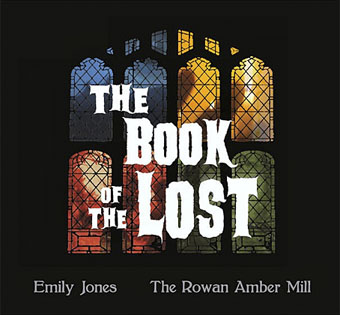
Given all of this, The Book of the Lost, a collaboration between Emily Jones and The Rowan Amber Mill, is a logical next step: a CD collection offering a theme from a forgotten TV series “shown on Sunday nights in the late ’70s and early ’80s” which broadcast four of the equally forgotten horror films upon which the accompanying songs are based. Between each song you hear a brief snatch of dialogue, just enough to whet the appetite without getting too involved. One of the films referred to, The Villagers, belongs to that current of British folk-horror that runs through Witchfinder General, and Blood on Satan’s Claw, to Ben Wheatley’s intoxicatingly weird A Field in England. Pastiching aside, all projects of this kind depend upon the quality of the music, and the folk-inflected songs here are very good, as is the Book of the Lost theme itself which is as spookily evocative as Jon Brooks’ Music for Thomas Carnaki.

botl2.jpg

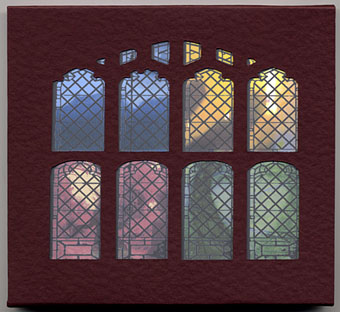
If that wasn’t enough, there’s a special numbered edition of the CD which comes packaged in a die-cut slipcase (above) containing cards giving details of each of the films. In addition to promotional artwork there’s also a synopsis, a production history and even a cast list. Other films are mentioned in passing—The House that Cried Wolf, Ghosts on Mopeds—that imply there was a lot more happening in Wardour Street in the 1970s than we previously suspected.

The Book of the Lost isn’t officially released until January but it’s available for purchase now at the project website.

Previously on { feuilleton }
The Outer Church
The Ghost Box Study Series
A playlist for Halloween: Hauntology
The Séance at Hobs Lane
Ghost Box

A mix for Halloween: Ectoplasm Forming

Ectoplasm Forming by Feuilleton on Mixcloud

Presenting the eighth Halloween playlist, and this year I decided it was time to finally make a proper mix of my own. Reluctance in years past has been mainly a result of the time it takes me to put things like this together, hours spent pondering the order of the tracks, and fine-tuning transitions.

This year’s mix is rather heavy on the drones and eldritch atmospherics with little in the way of songs. There are some rhythms, however. I’ve also taken the opportunity to highlight the ongoing excellence of Emptyset, some of whose recordings I’ve been helping design recently. Their Medium album involved installing a quantity of electronic equipment in an allegedly haunted building, a process similar to that undertaken by the unfortunate doctor in The Legend of Hell House, albeit with better results.

The tracklist is on the Mixcloud page but I’m repeating it here with dates added for each recording. One likes to be thorough.

The Legend of Hell House – Dialogue (1973)
Emptyset – Demiurge: Of Blackest Grain To Missive Ruin (Paul Jebanasam Variation) (2012)
Arne Nordheim – Solitaire (1969)
David Lynch – The Air Is On Fire Pt. 7 (2007)
Ben Frost – The Carpathians (2009)
The Wyrding Module – Subtemple Session II (edit) (2013)
:Zoviet*France: – On The Edge Of A Grain Of Sand (1996)
John Zorn – Lucifer Rising (2002)
Jarboe – A Sea Of Blood And Hollow Screaming… (2009)
The Haxan Cloak – Excavation (Part 1) (2013)
Emptyset – Medium (2012)
Jon Brooks – Experiments With A Medium (2011)
Wendy Carlos – Visitors (2005)
The Advisory Circle – Eyes Which Are Swelling (2007)
Bernard Szajner – Chant Funèbre (1981)
Emptyset – Function: Vulgar Display Of Power (Roly Porter Variation) (2012)

Previously on { feuilleton }
A playlist for Halloween: Hauntology
A playlist for Halloween: Orchestral and electro-acoustic
A playlist for Halloween: Drones and atmospheres
A playlist for Halloween: Voodoo!
Dead on the Dancefloor
Another playlist for Halloween
A playlist for Halloween

The Pendulum, the Pit and Hope

pendulum1.jpg

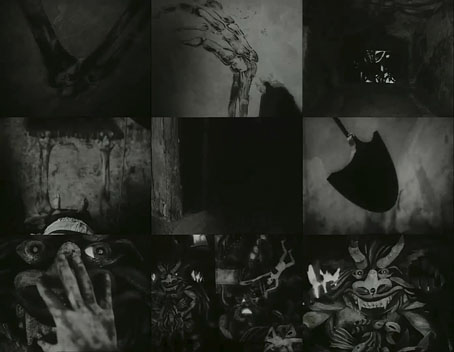
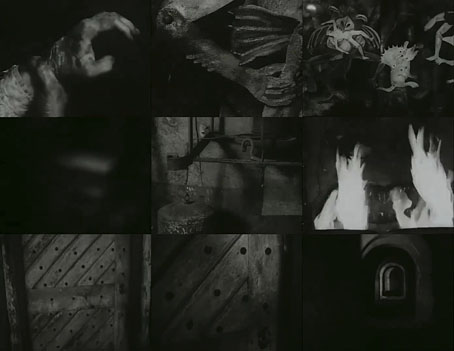
The Pendulum, the Pit and Hope (1983) is the third and best of three Gothic shorts made by Jan Švankmajer, the two earlier works being Castle of Otranto (1973–79) and The Fall of the House of Usher (1980). Švankmajer combines Poe’s famous tale of Inquistion torment with A Torture by Hope by Auguste Villiers de L’Isle-Adam, and  unlike Corman and co. reduces the story to a stark and wordless first-person ordeal in the face of clanking, fire-breathing engines of destruction. Poe’s story lets the narrator off the hook with a deus ex machina intervention, something Švankmajer evidently felt unable to swallow, hence the Villiers coda.

All the above works, and much more besides, can be found on the BFI’s collection of Švankmajer’s short films. Another short adaptation of the Poe story, The Pit (1962) by Edward Abraham, will appear next month as an extra on the eagerly-awaited DVD/BR debut of Schalcken the Painter.

pendulum2.jpg

Previously on { feuilleton }
Two sides of Liška
The Torchbearer by Václav Švankmajer