Weekend links 221

cornell.jpg

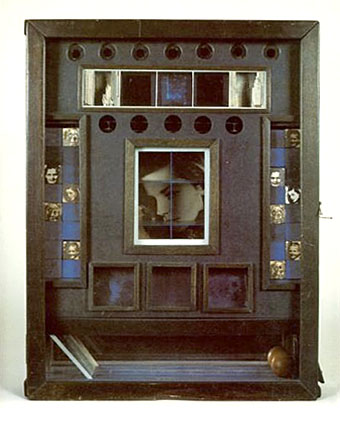
Untitled (Penny Arcade Portrait of Lauren Bacall) (1946) by Joseph Cornell.

• Having been a Bernard Szajner enthusiast for many years it’s good to see his music receiving some belated reappraisal. David McKenna talked to Szajner about his Visions Of Dune album (which is being reissued by InFiné next month), laser harps, The (Hypothetical) Prophets, and working with Howard Devoto.

• Priscilla Frank posts some big views of Marjorie Cameron’s occult paintings as a preview of the forthcoming exhibition at MOCA Pacific Design Center, Los Angeles.

• Fascinating reading in light of the recent kerfuffle over True Detective, Christopher Loring Knowles on the possible sources of HP Lovecraft’s Cthulhu Mythos.

Those who set up oppositions between the electronic technology and that of the printing press perpetuate Frollo’s fallacy. They want us to believe that the book—an instrument as perfect as the wheel or the knife, capable of holding memory and experience, an instrument that is truly interactive, allowing us to begin and end a text wherever we choose, to annotate in the margins, to give its reading a rhythm at will—should be discarded in favor of a newer tool. Such intransigent choices result in technocratic extremism. In an intelligent world, electronic devices and printed books share the space of our work desks and offer each of us different qualities and reading possibilities. Context, whether intellectual or material, matters, as most readers know.

Alberto Manguel, lucid as always, on the act and import of reading.

• “It’s time to give prog rock’s artist-in-residence Roger Dean his due,” says Amber Frost. No argument there, I did my bit in 2010.

• “Why do the covers of so many self-published books look like shit?” asks B. David Zarley.

• Mixes of the week: FACT mix 455 by Airhead, and Secret Thirteen mix 225 by Clock DVA.

• At Core77: Rain Noe chooses favourite skyscraper photos by Russian urban explorers.

• “O, Excellent Air Bag”: Mike Jay on the nitrous oxide fad of the early 19th century.

Nick Carr goes in search of Manhattan’s last remaining skybridges.

Lauren Bacall at Pinterest.

• Shaï Hulud (1979) by Zed (Bernard Szajner) | Welcome (To Death Row) (1980) by Bernard Szajner | Person To Person (1982) by The (Hypothetical) Prophets

Weekend links 220

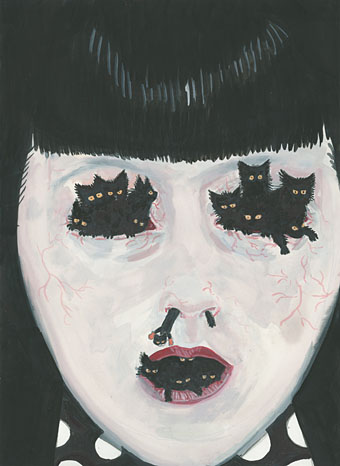
waliszewska.jpg

Untitled painting by Aleksandra Waliszewska.

• Ben Wheatley’s forthcoming film of High-Rise by JG Ballard now has its own Tumblr. This will no doubt be spoilerific so I won’t keep on visiting but it’s there if you require it. More Ballardianism: “Worshipping the Crash” at BLDGBLOG.

• “Aickman wandered through the sixties fantasy landscape like some curmudgeonly fetch, returning from the fin de siècle heyday of the ghost story.” Boyd Tonkin profiles Robert Aickman, writer of peerless “strange stories”.

• At Dangerous Minds: “Raise a glass to Cthulhu at the Lovecraft Bar”. Looks more like a Captain Nemo bar to me (not that there’s anything wrong with that) but I appreciate the gesture.

But to demand that a work be “relatable” expresses a different expectation: that the work itself be somehow accommodating to, or reflective of, the experience of the reader or viewer. The reader or viewer remains passive in the face of the book or movie or play: she expects the work to be done for her.

Rebecca Mead on The Scourge of Relatability

• “Space as a paranoid, static rumble featuring: 20jfg, Ben Frost & Daníel Bjarnason, Coil & Eduard Artemiev”. 20 Jazz Funk Greats on the pleasures of the Solaris soundtrack.

• What do Hawkwind, Harry Nilsson, Stereolab and The Supremes have in common? David Stubbs examines the legacy of Neu! and Klaus Dinger’s “Dingerbeat”.

• A reminder that A Year in the Country features a host of worthwhile links and associations for the Hauntologically persuaded.

Rouge Louboutin, an ad by David Lynch. Related: An improptu biscuit ad by the Eccentronic Research Council.

• Mix of the week (a year old but no matter): JG Ballard Zoom Lens Mix by Bernholz.

• At 50 Watts: More illustrated sheet music covers by Einar Nerman.

Five book cover designers and the books that inspire them.

Tove Jansson would have been 100 this week.

Pangaea with modern borders

Solaris: Dream (1990) by Edward Artemyev [sic] | Solaris (2000) by Photek | Simulacra I (2011) by Ben Frost & Daníel Bjarnason

Dick Smith, 1922–2014

smith1.jpg

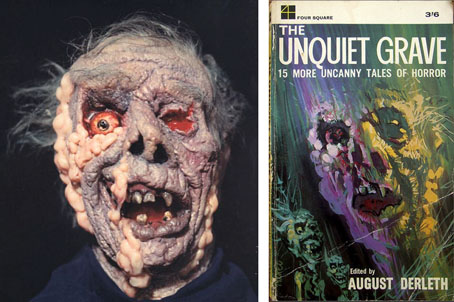
left: Dummy head by Dick Smith for The Picture of Dorian Gray (1961); right: Cover art by Michel Atkinson (aka Michel) for The Unquiet Grave (1963).

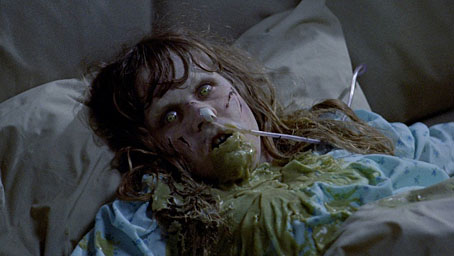
Cinema in the 1970s would have been very different without Dick Smith‘s makeup artistry.

smith2.jpg

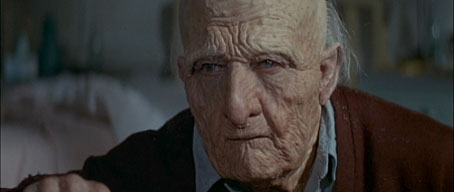
Dustin Hoffman in Little Big Man (1970).

smith3.jpg

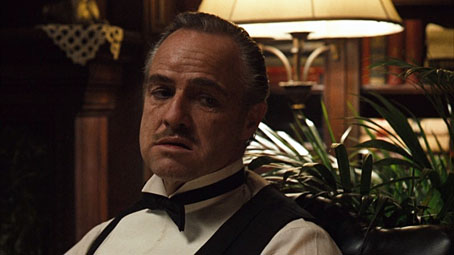
Marlon Brando in The Godfather (1972).

smith4.jpg

Linda Blair in The Exorcist (1973).

Continue reading “Dick Smith, 1922–2014”

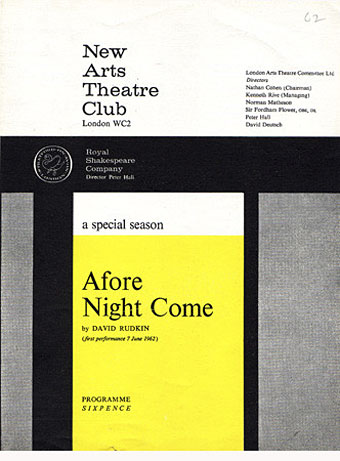
Afore Night Come by David Rudkin

rudkin.jpg

RSC programme, 1962.

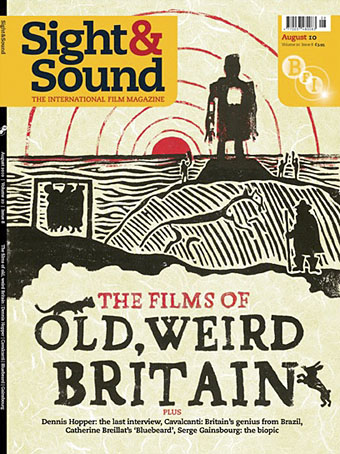
Not a review, this, you can’t really review a stage play you’ve never seen. Following the re-viewing of David Rudkin’s White Lady I’ve gone back to some of the published plays. If all you know of Rudkin’s work is his television drama, the plays are instructive for showing the consistency of his themes across the years. The recent resurgence of interest in Penda’s Fen and Artemis 81 has seen Rudkin’s work included among that group of film and TV dramas that Rob Young memorably labelled Old Weird Britain (after Greil Marcus and The Old, Weird America), a loose affiliate that would include films such as The Wicker Man and Blood on Satan’s Claw, television works by Nigel Kneale and Alan Garner (The Owl Service, Red Shift), and the BBC MR James adaptations, one of which, The Ash Tree, was also written by Rudkin.

If the Old Weird Britain lies at an intersection between different dramatic forms—ghost story, horror story, science fiction, historical drama—then not all of Rudkin’s work would fall into the intersection, but two of the plays—The Sons of Light and his first staged work, Afore Night Come—could be coaxed into the charmed circle: The Sons of Light, with its sinister human experiments taking place underground, has ties to Artemis 81, while Afore Night Come is another piece about (intentional or otherwise) human sacrifice in rural England. I hadn’t read Afore Night Come until last week, and was struck by its similarity to John Bowen’s Robin Redbreast (1970), a more deliberately ritualistic piece of work. In its first act Afore Night Come is an almost documentary-like account of a day in the life of workers hired to pick the pear harvest in an orchard outside Birmingham; the eruption of violence in the second act is certainly foreshadowed but seems less premeditated than in Robin Redbreast, a factor which has apparently shocked many audiences. During its performances in the early 1960s the tendency was to see the play in the light of Harold Pinter and Artaud’s Theatre of Cruelty, it’s only in retrospect that a connection with more generic works emerges. There’s also a connection to White Lady via the pesticide spraying about which the workers are continually warned, and whose advent coincides with the moments of violence.
oldweird.jpg

Sight and Sound, August 2010. Illustration by Becca Thorne.

A couple of other things are worth noting: until 1968 all the plays performed in Britain were vetted by the Lord Chamberlain’s office who would routinely strike out any material deemed offensive or irreligious. Knowing this I was surprised by the recurrence of the word “fuck” in Rudkin’s script, and also the hint of same-sex attraction between two of the male characters, a detail that would usually have been removed. It seems that plays pre-1968 could be performed without censorship if the theatre was declared to be a private club for the evening (a similar state of affairs helped evade some film censorship) which is what happened with Afore Night Come in 1962. Given this, and the incident of a decapitated head being rolled across a London stage (probably the first since the Jacobeans, says Rudkin), it’s easy to see why audiences at the time might have felt assaulted, although the play still won the Evening Standard Drama Award that year. Sexual ambiguity/ambivalence or outright homosexuality have been a continual thread in Rudkin’s drama yet he’s seldom been given much credit for this pioneering work. A year after Afore Night Come there was Rudkin’s first play for television, The Stone Dance, a piece which sounds like another potential addition to the works in the Old Weird Britain catalogue. Rudkin describes it thus:

A Revivalist pastor pitches his crusade tent within a Cornish stone circle. His repressed son becomes sexually obsessed with an outward-going local boy, and suffers a hysterical loss of speech. A storm blows the pastor’s tent away, and amid the stones, their primal purity reasserted, by the boy’s accepting touch the son is healed.

I believe that, prior to this, no tv play had overtly treated homosexual emotions as a central theme. (In Britain at this time, any gay sex could incur a prison sentence of up to two years.)

Many of the TV plays from the 1960s are now lost so there’s no guarantee that we’ll ever see this, a shame considering that Michael Hordern and John Hurt were the leads. No guarantee either that we’ll see any staging of the more interesting plays like The Sons of Light and The Triumph of Death which seem to be too eccentric for theatre directors. The scripts can at least be picked up relatively cheaply. To date there’s only Afore Night Come that seems to be revived with any regularity. Michael Billington, a long-time champion of Rudkin, reviews the Young Vic production from 2001 here.

Previously on { feuilleton }
White Lady by David Rudkin
The Horror Fields
Robin Redbreast by John Bowen
Red Shift by Alan Garner
Children of the Stones
Penda’s Fen by David Rudkin
David Rudkin on Carl Dreyer’s Vampyr
Lovecraft: Démons et Merveilles

hpl-pd01.jpg

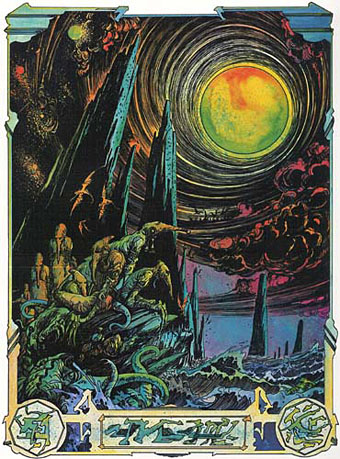
UK publisher Titan Books announced earlier this year that they’d be reprinting the first volume of Glénat’s excellent comic-strip adaptation of Michael Moorcock’s Elric novels in an English edition, a book that should be out in September. This was a surprise to me when I’ve complained for years that Titan seldom showed any interest at all in Continental comics, despite France and Belgium being over-burdened by world-class creators. I’ve been surprised again this week by the news that Titan will also be reprinting the English edition of Philippe Druillet’s The Six Journeys of Lone Sloane in March next year. Druillet’s books have been unavailable in English editions for decades so this is good news indeed, even if the attention is scandalously late.

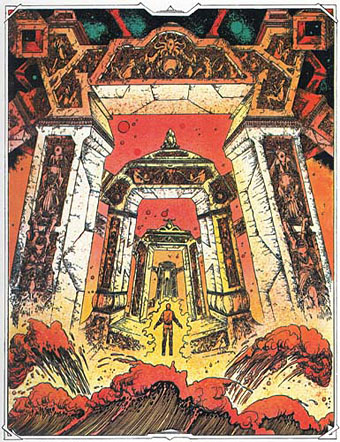
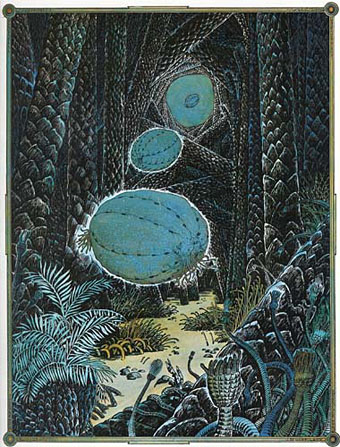
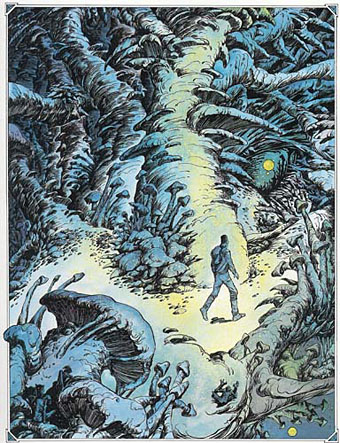
As I noted in the post about Glénat’s Elric, Druillet illustrated Moorcock’s albino anti-hero in 1973. The artist is better known for his Lovecraftian depictions, however, even when—as in the adventures of Lone Sloane—the story could easily sustain itself without all those sinister temples, fish people, Cyclopean architecture and the menace of nameless gods. The Lovecraft influence, which can be found in some of his earliest illustrations, comes to the fore in Lovecraft: Démons et Merveilles, an HP Lovecraft story collection published in an expensive limited edition by Éditions Opta/André Sauret in 1976. Druillet provided ten colour illustrations plus a design for the boards. Some of these illustrations have since been used on paperback editions of Lovecraft in France, although many of them crop the artwork. Tentacles have become a perennial cliché in Lovecraftian art (I should know, I’ve drawn enough of them) so it’s worth noting how few there are in Druillet’s drawings.

hpl-pd02.jpg

hpl-pd03.jpg

hpl-pd04.jpg

Continue reading “Lovecraft: Démons et Merveilles”