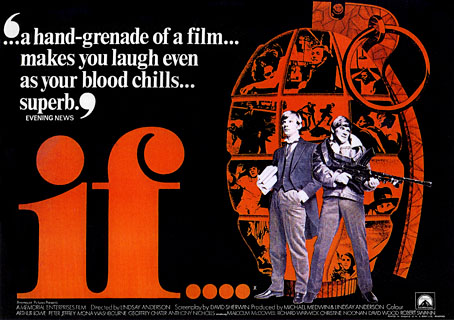
Lindsay Anderson‘s masterpiece, If…., is finally given a DVD release in the UK in June. Anderson’s film—the dramatic resistance to authority by three boys at an unnamed British school—was made in 1968 but I didn’t get to see it until (as I recall) 1977. I was 15 at the time and feeling increasingly desperate and hidebound by school-life so this film was explosive in its psychological impact as well as its story (that grenade on the poster was very apt). Given my age and the year, I’m supposed to have cult yearnings toward the wretched Star Wars but it was If…. that made the lasting impression.
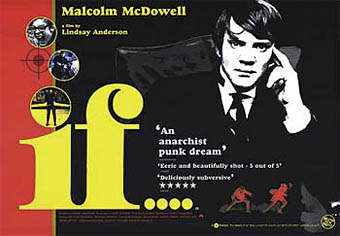
Poster for the 2002 re-release.
If…. was important for a number of reasons, not all of them obvious during that first viewing. I didn’t go to an all-boys public school (note for Americans: “public school” in Britain actually means an expensive, private establishment) but my grammar school had been an all-boys place a few years before I arrived. Some teachers wore gowns at assembly and many of the older teachers there were of a rigid, brutalist mindset exactly like the ones in Anderson’s film. Bullying was endemic, uniform rules were enforced to a degree that would make an army colonel proud and you stood out from the crowd at your peril; I had friends there but I hated every minute. So here comes young Malcolm McDowell on the television screen, effortlessly charismatic and insouciant in his first film role, portraying the ultimate Luciferan rebel, one who (as Anderson writes in the screenplay preface below) says “No” in the face of overwhelming odds. Reader, I identified so very much…. The famous ending (borrowed from Jean Vigo’s Zéro de Conduite) where Mick and the other “Crusaders” fire guns and throw grenades at the rest of the school was headily wish-fulfilling. (And given recent events, you’ll also see below that Anderson and screenwriter David Sherwin regarded that ending as metaphorical, not literal.)
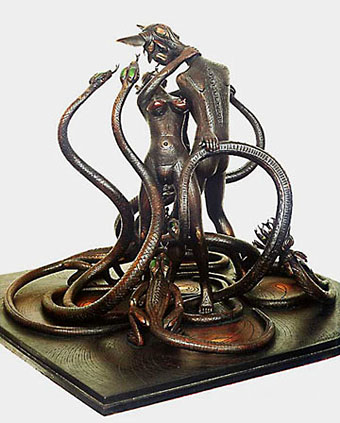
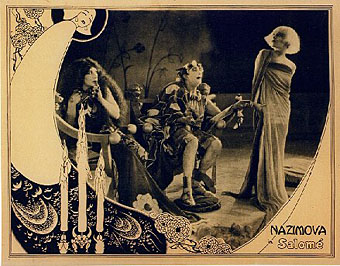
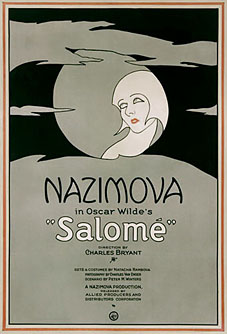 We tend to think of cinema as a modern medium, quintessentially 20th century, but the modern medium was born in the 19th century, and the heyday of the Silent Age (the 1920s) was closer to the Decadence of the fin de siècle (mid-1880s to the late-1890s) than we are now to the 1970s. This is one reason why so much silent cinema seems infected with a Decadent or Symbolist spirit: that period wasn’t so remote and many of its more notorious products cast a long shadow. Even an early science fiction film like Fritz Lang’s Metropolis has scenes redolent of late Victorian fever dreams: the vision of Moloch, Maria’s parable of the tower of Babel, the coming to life of statues of the Seven Deadly Sins, and—most notably—the vision of the Evil Maria as the Whore of Babylon. Woman as vamp or