Un Chant d’Amour (nouveau)

chant.jpg

A brief homage by Sam Scott Schiavo to Genet’s masterwork of homoerotic cinema Un Chant d’Amour (1950). Genet’s film works so well, and is so closely tied to his artistic obsessions, it’s difficult to approach but it’s good to see it still wields an influence. For comparison the original film can be watched at Ubuweb.

Previously on { feuilleton }
Jean Genet… ‘The Courtesy of Objects’
Querelle again
Saint Genet
Emil Cadoo
Exterface
Penguin Labyrinths and the Thief’s Journal
Un Chant D’Amour by Jean Genet

Terminus by John Schlesinger

terminus.jpg

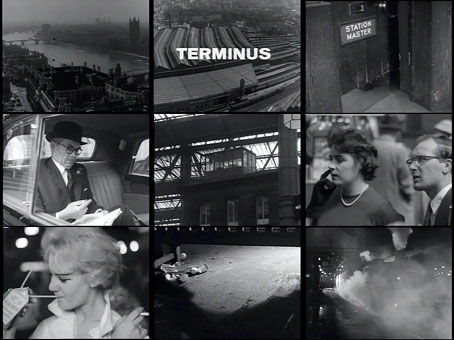
Before John Schlesinger made his debut feature, A Kind of Loving (1962), he directed a number of short documentary films. Terminus (1961), a day in the life of the Waterloo railway station in London, is the most notable of these, an award-winning snapshot of a period when Britain’s railways were still nationalised and steam trains were about to vanish from regular service. The film has that crisp, black-and-white photography so typical of the early 1960s, a look which renders close-ups with uncanny fidelity and makes the outmoded fashions—the bowler-hatted men and gloved women—seem all the more curious. A year later Orson Welles was deploying a similar style when photographing the dishevelled splendour of the Gare d’Orsay in Paris for his film of The Trial.

For a different take on London’s railway stations there’s Terminus by analogue electronic outfit Node, a track inspired by concerts they played live at Paddington station in 1995.

Previously on { feuilleton }
Screening Kafka

Weekend links 117

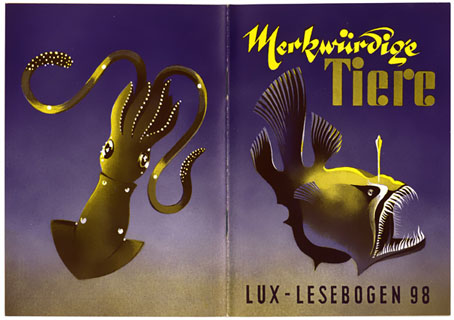
lux1.jpg

Illustration and design by Karlheinz Dobsky.

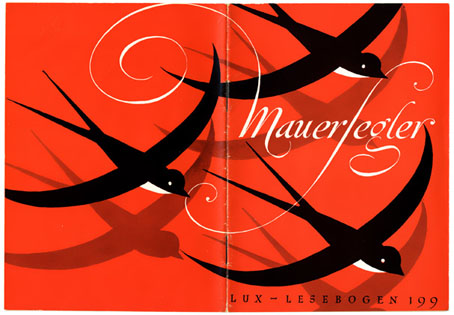
Above and below: samples from Die Lux-Lesebogen-Sammlung, an exhibition of booklets for young people published by Sebastian Lux from 1946–1964. All were designed and illustrated by Karlheinz Dobsky.

• At The American Scholar: “Vladimir Nabokov’s understanding of human nature anticipated the advances in psychology since his day,” says Nabokov biographer Brian Boyd, and An Unquenchable Gaiety of Mind: “On visits to Cambridge University late in life, Jorge Luis Borges offered revealing last thoughts about his reading and writing,” says George Watson.

• The British Library releases The Spoken Word: “A rare collection of recordings featuring the American writer William S Burroughs and the British-born artist Brion Gysin.” Related: Interzone – A William Burroughs Mix by Timewriter.

• Charting the Outlaws: Christopher Bram (again) talking to Frank Pizzoli about his recent study Eminent Outlaws: The Gay Writers Who Changed America.

• The BBC asks “Where are you on the global fat scale?” I’ve always been thin but was still surprised to find my BMI at the very bottom of the scale.

The “otherness” of Ballard, his mesmeric glazedness, is always attributed to the two years he spent in a Japanese internment camp in Shanghai (1943–45). That experience, I think, should be seen in combination, or in synergy, with the two years he spent dissecting cadavers as a medical student in Cambridge (1949–51). Again the dichotomy: as a man he was ebulliently social (and humorous), but as an artist he is fiercely solitary (and humourless). The outcome, in any event, is a genius for the perverse and the obsessional, realised in a prose style of hypnotically varied vowel sounds (its diction enriched by a wide range of technical vocabularies). In the end, the tensile strength of The Drowned World derives not from its action but from its poetry.

Martin Amis on The Drowned World by JG Ballard.

The Chickens and the Bulls: “The rise and incredible fall of a vicious extortion ring that preyed on prominent gay men in the 1960s.”

• It’s that Zone again: Jacob Mikanowski on Andrei Tarkovsky’s Stalker and Geoff Dyer’s Zona.

• Scans of the rare film programme for London screenings of Fritz Lang’s Metropolis.
lux2.jpg

Illustration and design by Karlheinz Dobsky.

• “The web is a Library of Babel that could go the way of the Library of Alexandria.

Fila Arcana: alchemy- and occult-themed embroidery by Mina Sewell Mancuso.

A Very Edgy Alice In A Very Weird Wonderland: illustrations by Pat Andrea.

Malka Spigel reveals a new track from her third solo album.

John Martin and the Theatre of Subversion.

Olafur Eliasson: Little Sun at Tate Modern.

• Meanwhile, back in 1972: Mahavishnu Orchestra live at the BBC (30 mins), and the complete performance of the MC5 on Beat Club (29 mins).


William Mortensen’s Salomés

mortensen1.jpg

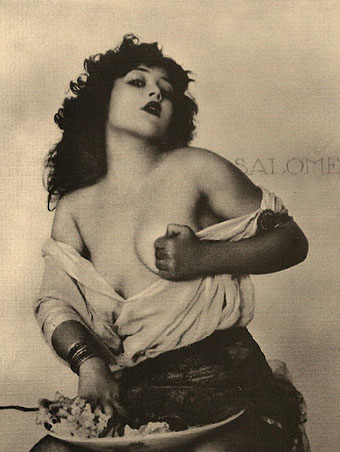
Joyzelle Joyner as Salomé.

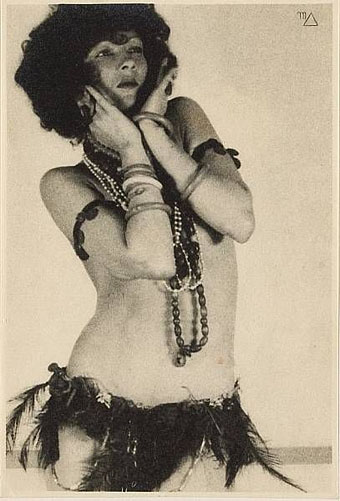
Two undated photographs by William Mortensen (1897–1965) which use the Salomé theme as a possible disguise for motives that have little to do with Biblical storytelling; looking at this collection of Mortensen’s work he evidently had a thing for arty erotica. Joyzelle Joyner was an American actress who appeared in minor roles in a number of silent films. Her lascivious scene in Cecil B. DeMille’s The Sign of the Cross (1932) was deemed scandalous enough to later be cut from the film by censors. Watch it here. (Tip via Beautiful Century.)

mortensen2.jpg

Elsewhere on { feuilleton }
The Salomé archive

The Mysterious Explorations of Jasper Morello

morello.jpg

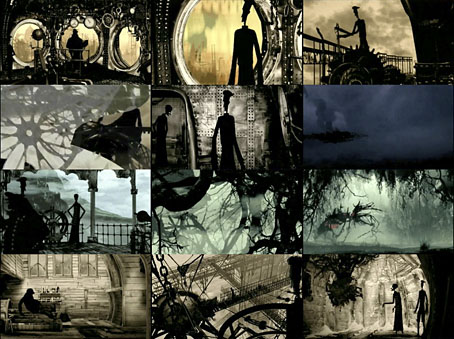
This animated short by Anthony Lucas isn’t exactly obscure but I’ve only just noticed that the distributor has the whole film available for viewing on YouTube. The Mysterious Explorations of Jasper Morello blends silhouetted characters and decor with elaborate steam-powered machinery in a manner that looks like the kind of thing Lotte Reiniger might have produced if she’d exchanged her fairy tales for Jules Verne. Impossible to watch Lucas’s film now without thinking “steampunk” but Jasper Morello was made in 2005 and so pre-dates the ongoing explosion of interest in Victoriana, dirigibles and coal-powered contraptions. For the past couple of weeks I’ve been working on two new steampunk projects which is what brought this to mind. More about those projects later.

Previously on { feuilleton }
Three Fragments of a Lost Tale
Brothers Quay scarcities
Achilles by Barry JC Purves
The Torchbearer by Václav Švankmajer