Weekend links 243

burgoyne.jpg

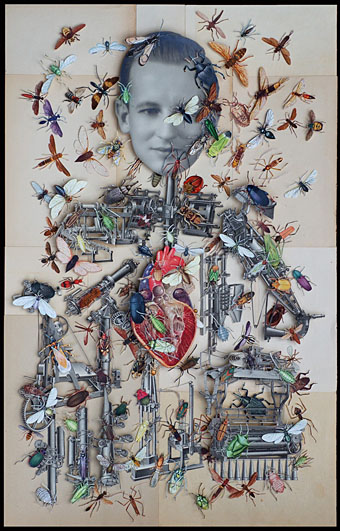
Genesia (2011) by Bette Burgoyne.

• “…so I started buying these old gay porn novels, just for the covers and kept on collecting them.” Maitland McDonagh on the underexamined world of gay pulp. McDonagh’s 120 Days Books is reprinting some of these scarce titles. More gay erotica: Plans are afoot to republish Des Grieux, the rare prequel to Teleny or The Reverse of the Medal (1893), a novel often attributed (without much evidence) to Oscar Wilde.

Merricat is the name under which the Turrell Brothers, John & Tom, produce their atmospheric “nacht music”. Albums with titles such as Oneiros, Widdershins and Zerkalo give an idea of the spheres of interest. They also make short films, clips from which may be seen here.

• “Fascists don’t like satire. They don’t like it at all. And they especially don’t enjoy visual satire. Because of its unique power to communicate.” Ralph Steadman talking to Robert Chalmers about recent events.

There is an unexamined commonplace now floating around the social media, which has it that satire derogates its proper function when it stops targeting the powerful, and targets the relatively powerless instead. Theodor Adorno has also been cited here and there with his remarks on satire in the Minima Moralia of 1951, but few have noticed that the account he offers there stands in direct contradiction to the current received wisdom. For Adorno, satire is in its essence wistful and traditionalist. It looks back to something that has been lost, and dismisses the straight-facedness of everyone who attempts, against all evidence, to maintain the illusion that there is anything respect-worthy about the present state of things. It targets not just elected officials, but the yokels who elected them; not just the honcho who runs the saloon, but the sucker who hands over his last possessions at the poker table. There is a need for this: the yokels and the suckers need it most of all. There is redemption in it, and I confess to harboring whatever amount of traditionalism it takes to appreciate this redemptive quality.

Paris, 2015: a lengthy meditation by Justin EH Smith on the responses of left and right to the Charlie Hebdo killings

• “When the surface of the world is so overloaded with competing narratives…there is an understandable impulse to go underground.” Iain Sinclair on the excavation of London.

• More German music: Sinai Desert (1981) and Kailash, Pilgerfahrt Zum Thron Der Götter (no date), two films with music by Popol Vuh.

Kim Fowley: Sins & Secrets of the Silver Sixties. UglyThings Magazine makes available its definitive Fowley interview from 2001.

• More electronica and mix of the week: the FACT guide to the Yellow Magic Orchestra and associates.

• Vegetable-snake Undersea Beings: Allen Ginsberg writes to the Paris Review about LSD in 1966.

• The Edge Question for 2015: What do you think about machines that think?

Life of Cats: Selections from the Hiraki Ukiyo-e Collection.

Lake Baikal frozen over

Serial Killer Barbie

NGC 891 (1974) by Edgar Froese | Overture (1974) by Tangerine Dream | PA 701 (1976) by Edgar Froese
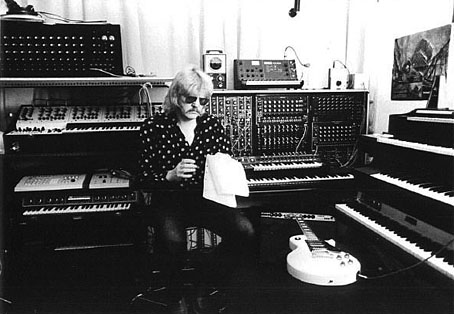
Edgar Froese, 1944–2015

froese.jpg

“I was a big fan of Kraftwerk, Cluster and Harmonia, and I thought the first Neu! album, in particular, was just gigantically wonderful,” admits Bowie. “Looking at that against punk, I had absolutely no doubts where the future of music was going, and for me it was coming out of Germany at that time. I also liked some of the later Can things, and there was an album that I loved by Edgar Froese, Epsilon In Malaysian Pale; it’s the most beautiful, enchanting, poignant work, quite lovely. That used to be the background music to my life when I was living in Berlin.”

David Bowie, Mojo magazine, April 1997

Epsilon In Malaysian Pale was Froese’s second solo album released in September 1975. That month David Bowie was in Los Angeles recording his Station To Station album, the opening of which features phased train sounds that are strikingly similar to those that run through the first side of the Froese album. I’ve never seen this similarity mentioned by Bowie scholars but if there was an influence it’s a good example of the degree to which Tangerine Dream infiltrated the wider culture as much as Can and Neu! (Kraftwerk remain in a league of their own.)

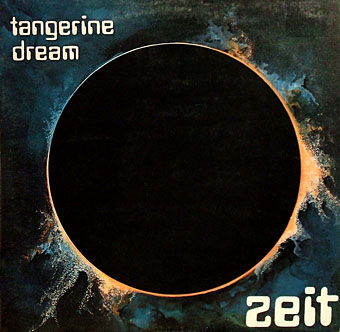
zeit.jpg

All you need is Zeit. Cover painting by Edgar Froese.

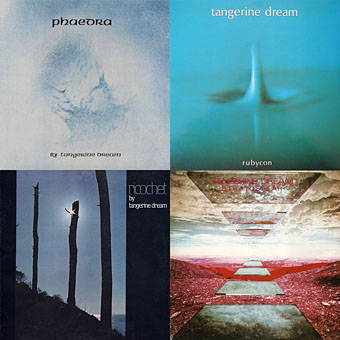
The influence of Tangerine Dream’s albums on the Ohr and Virgin labels is now so widespread that it’s difficult to compile a definitive list of those who’ve either paid homage or copied the group’s trademark style of extended sequencer runs and phased chords. Offhand I could mention the Ricochet-like tracks on Coil’s Musick To Play In The Dark Volumes 1 & 2; the many moments on the early Ghost Box albums, one of which samples from Alpha Centauri; and some of Julian Cope’s more out-there recordings from the late 1990s. There’s also all the releases by a group of loosely affiliated musicians dedicated to maintaining the 70s sound of Mellotrons and bouncing sequencers; many of these I’ve yet to hear but I’ve enjoyed the albums by Node and Redshift.

td.jpg

Tangerine Dream have been a continual fixture in my music listening since I was a teenager; I drew most of The Call of Cthulhu to a soundtrack of Rubycon and Jon Hassell’s Aka/Darbari/Java album. I kept up with them after they departed from Virgin then jumped ship in 1986 after Johannes Schmoelling left the group. The albums continued to proliferate in recent years to an extent that even the Freeman brothers only follow the discography (with some exasperation) up to 1990 in their redoubtable Krautrock tome The Crack in the Cosmic Egg. Navigating a late career is a tricky business for a popular musician so you can’t blame Froese for carrying on the project. Those early recordings are the important ones, and he was a crucial component in their creation.

There’s a lot of Froese and TD on YouTube. If you like the early material these are some of the better moments:

Bath Tube Session, 1969: TD in psych-freakout mode. Klaus Schulze on drums, and lots of German heads looking bemused/bored.
Ossiach Lake, 1971: Playing outdoors for the TV cameras.
Paris, 1973: Footage of the group improvising in the manner of the Atem album.
Coventry Cathedral, 1975: Tony Palmer’s film of one of the cathedral concerts which caused them to be banned by the Pope from playing in churches. The original sound on this one is lost so the YT version has edits of the Ricochet album as the soundtrack.
London, 1976: Great film of the Ricochet period. Total synth porn.
Thief, 1981: The opening scene to Michael Mann’s thriller, and one of their best soundtrack moments. In The Wire this month John Carpenter enthuses about the TD score for Sorcerer but I’ve always felt Mann’s crime drama was a better match for their sound.
Warsaw, 1983: A Polish TV recording of the concert documented on the Poland (1984) album.

Previously on { feuilleton }
Synthesizing
Tangerine Dream in Poland

The Invasion of Thunderbolt Pagoda, a film by Ira Cohen

invasion1.jpg

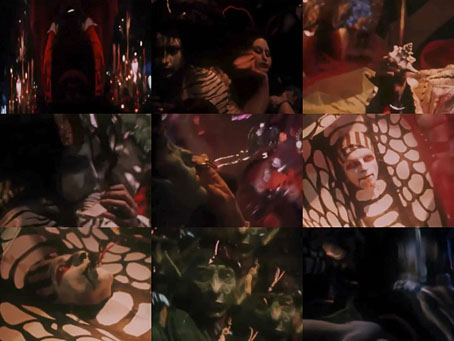
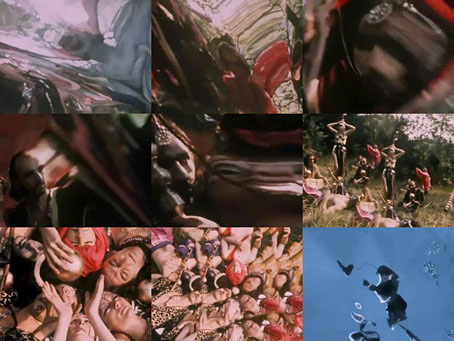
An inevitable follow-up to yesterday’s film, Ira Cohen’s fantasia from 1968 is one of the classics of psychedelic cinema, a Kenneth Anger-like delirium that makes great use of Cohen’s obsession with Mylar distortions. Anger’s Inauguration of the Pleasure Dome is the model here, with a cast of revellers adopting various guises; Cohen himself appears as The Majoon Traveler and Death. The long version of the film at YouTube is the expanded edition that Arthur magazine released in 2006. Unfortunately the original score by Angus MacLise has been replaced by something that’s even more annoying that the jokey music for NY, NY. I’d recommend finding a suitably trippy substitute.

invasion2.jpg

Previously on { feuilleton }
Ira Cohen, 1935–2011
Dreamweapon: The Art and Life of Angus MacLise, 1938–1979
William Burroughs by Ira Cohen, 1967
The Invasion of Thunderbolt Pagoda

NY, NY, a film by Francis Thompson

nyny1.jpg

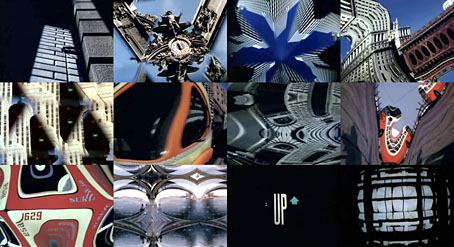
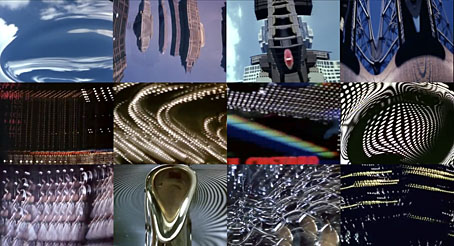
In Heaven and Hell (1956) Aldous Huxley considers various forms of art that might be said to imitate or resemble the intense visuals generated by psychedelic agents. In past centuries this would include firework displays and the vivid hues of stained glass windows; when discussing the present, mention is made of NY, NY, a short film by Francis Thompson that Huxley had recently seen.

Thompson’s film presents a day in the life of New York City with every shot being subject to some form of distortion or fragmentation via prismatic lenses or reflected surfaces. Nearly sixty years later this seems less psychedelic than it would have done to Huxley, although some of the reflections give the same effects as Ira Cohen’s later Mylar Chamber photographs. Watch NY, NY here, and if you do I’d recommend muting the Mickey Mouse score.

nyny2.jpg

Previously on { feuilleton }
Fog Line, a film by Larry Gottheim
Wavelength
La Région Centrale

Weekend links 242

kroll.jpg

Ghost in the Machine (2012) by Hope Kroll.

Nothing Here Now But The Recordings, an album of William Burroughs’ personal tapes originally released by Industrial Records is reissued on vinyl this month. Andrew Spragg reviews it here. Burroughs’ readings fill several collections but this one was the first I owned, and it’s always been a favourite. The album features recordings of early texts such as The Last Words of Hassan I Sabbah, as well as cut-up tape experiments which fuelled some of the chapters in the Nova Trilogy.

• The Melancholy of Perversion: a study of Caitlín R. Kiernan’s Metamorphosis A by Scott Dwyer. More weird fiction: “Written with real psychological depth, these enigmatic tales rise far beyond straightforward ghost stories.” Chris Power on Robert Aickman.

• At Dangerous Minds: Gay Semiotics, a taxonomy of San Francisco life in the 1970s. Related: The case of One, a gay magazine from Los Angeles prosecuted for obscenity in 1958.

Poe’s mind was by no means commonplace. In the last year of his life he wrote a prose poem, Eureka, which would have established this fact beyond doubt—if it had not been so full of intuitive insight that neither his contemporaries nor subsequent generations, at least until the late twentieth century, could make any sense of it. Its very brilliance made it an object of ridicule, an instance of affectation and delusion, and so it is regarded to this day among readers and critics who are not at all abreast of contemporary physics. Eureka describes the origins of the universe in a single particle, from which “radiated” the atoms of which all matter is made. Minute dissimilarities of size and distribution among these atoms meant that the effects of gravity caused them to accumulate as matter, forming the physical universe.

Marilynne Robinson on Edgar Allan Poe

Vanished City: London’s Lost Neighbourhoods, a book by Tom Bolton with photographs by SF Said.

• Mix of the week: Secret Thirteen Mix 143, a selection of soundtrack music by Las CasiCasiotone.

• “I am in Brussels, numbering the Bruegels.” Toby Ferris conducts a Brueg[h]el Census.

Mothmeister “taxidermy collector & curiosity cabinet”.

Ben Zurawski collects and makes flip books.

Akira Kurosawa’s 100 favourite films

The Trip (1965) by Kim Fowley | The Trip (1966) by Donovan | The Trip (1967) by Park Avenue Playground