Quay Brothers: On Deciphering the Pharmacist’s Prescription for Lip-Reading Puppets

quays1.jpg

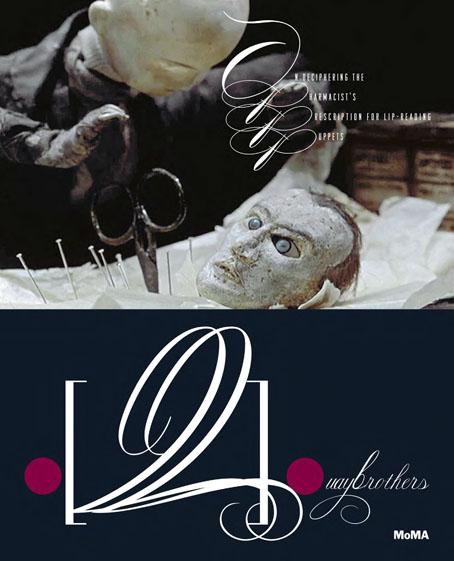
It’s not exactly the most appropriate moment to be recommending an exhibition in New York given the chaos in the city following the recent hurricane. However… Quay Brothers: On Deciphering the Pharmacist’s Prescription for Lip-Reading Puppets has been running at MoMA since August, and will continue into early 2013. A copy of the catalogue turned up this week, a slim volume of 64 pages that’s nevertheless an essential item for Quay obsessives such as myself.

quays2.jpg

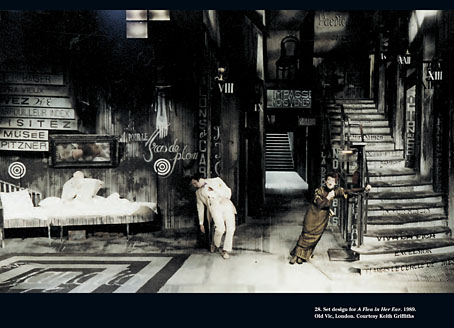
Set design for A Flea in Her Ear (1989).

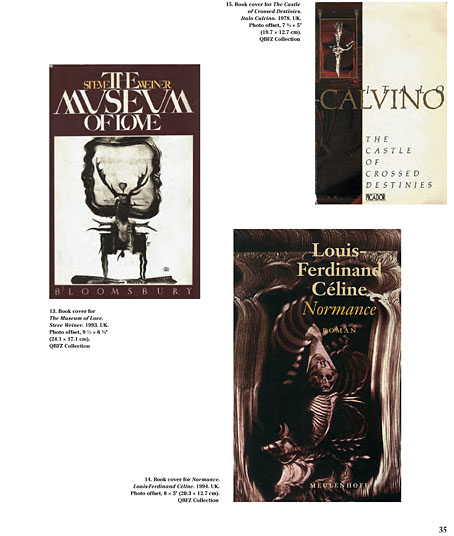
I’ve written before that while the Quays’ films are the most visible part of their oeuvre, much of their early output as artists and designers remains either obscure or unavailable. So it’s a pleasure to find a number of their early drawings, poster designs and book covers reproduced here. The catalogue also features examples of gallery installations and their designs for the stage. Ron Magliozzi, the curator, and Edwin Carels contribute essays while the Quays themselves are “interviewed” by Heinrich Holtzmüller “who was once real and now only exists under the glass of a museum vitrine in Nürnberg”. An appendix includes a thorough listing of their film works, giving me more things to chase at a later date.

quays3.jpg

In addition the Quays have also designed parts of the book, notably the title pages which feature their idiosyncratic typography. The catalogue may be purchased direct from the museum.

quays4.jpg

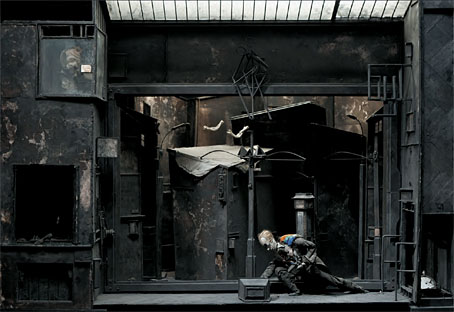
Grand Box, decor for Street of Crocodiles (1986).

Elsewhere on { feuilleton }
The Quay Brothers archive

Gloves

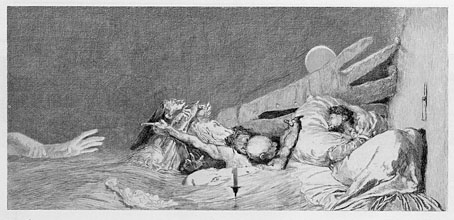
klingerglove.jpg

A Glove: Anxieties (1881) by Max Klinger.

Although the Glove‘s scenario was given its due Germanic explication by contemporary critics, it defies rational analysis. The last picture, which was seen as a kind of happy ending to the glove’s peregrinations, is particularly ambiguous and leaves the whole meaning of the series in doubt. The story is a parable of loss based on a trivial lost article, like the lost keys in Bluebeard and in Alice, like Desdemona’s missing handkerchief, or like the philosopher’s spectacles in Klinger’s own Fantasy on Brahms, which have slid out of their proprietor’s reach just as he was nearing the summit of a kind of Matterhorn. There are overtones of erotic symbolism and fetishism in the glove and the phalloid monster who abducts it, heightened for a modern viewer by the Krafft-Ebing period costumes and décors (the engravings appeared in 1881, and the drawings were apparently finished in 1878).

John Ashbery describing Max Klinger’s extraordinary series of etchings A Glove (aka Paraphrase on the Finding of a Glove) which in their inexplicable narrative of fetishist obsession anticipate Surrealism. See the entire sequence here or here. For A Glove in print there’s The Graphic Works of Max Klinger from Dover Publications.
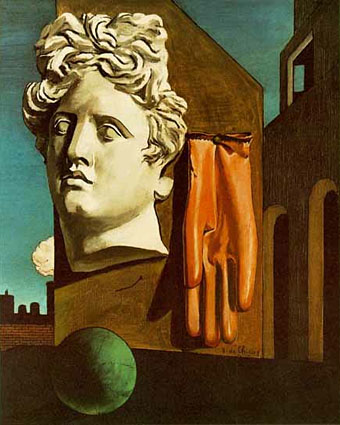
dechirico.jpg

The Song of Love (1914) by Giorgio de Chirico.

Ashbery begins by discussing Giorgio de Chirico’s enthusiasm for Klinger’s work, a passion and influence that provides one of the many connections between the Symbolists and the Surrealists. This “metaphysical” painting looks back to Klinger and forward to Magritte.
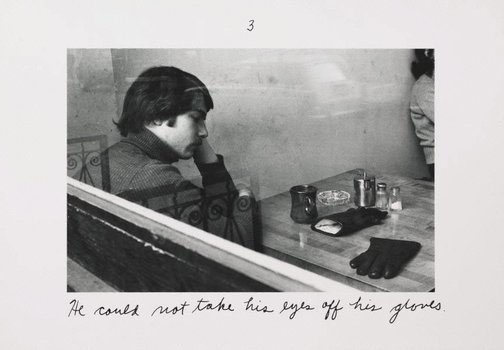
michalsglove.jpg

The Pleasures of the Glove, 3 (1974) by Duane Michals.

The enigmatic encounter of ‘The pleasures of the glove’ follows the lead character as he fantasises about a pair of gloves on the hands of a mannequin in a shopfront window. The perverse pleasure of desiring the gloves but not acquiring them leads him on a surreal adventure of first imagining his own glove as a queer furry tunnel that swallows his hand to the fantasy of stroking the naked body of a woman he sees on the bus with her own glove. (more)

A more contemporary take on the same idea, albeit without the intercession of a pterodactyl-like thief. If Klinger is pre-Surrealism then this is the post- version; Michals photographed René Magritte, and many of his other works run in a distinctly Surreal direction. (Thanks to Anne Billson for the tip!)
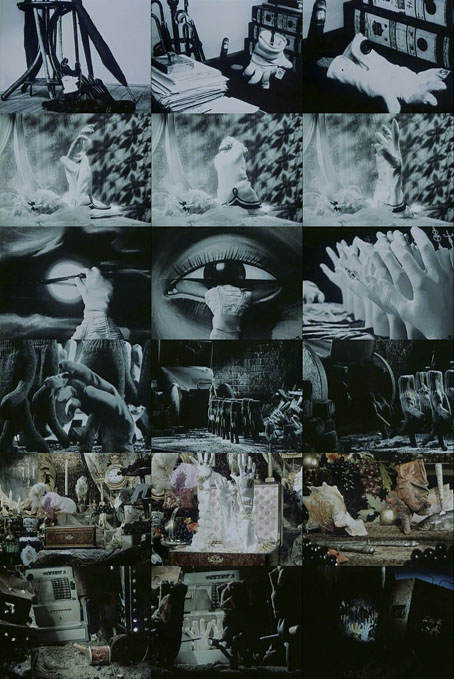
bartagloves.jpg

The Vanished World of Gloves (1982) by Czech animator Jiří Barta features sex, Surrealism and a lot more besides, all in the space of 16 minutes. A can of film is unearthed which contains a series of short episodes pastiching different cinematic styles: Chaplinesque slapstick, swashbuckling romance, Buñuel Surrealism, a war film, a Fellini orgy and a science fiction apocalypse. All the parts are played by gloves, of course, and if you didn’t see the credits you might take this at first for a Svankmajer short.

The Vanished World of Gloves: part one | part two

Update: I knew I’d forgotten something… Added de Chirico’s The Song of Love.

Previously on { feuilleton }
More Golems
Max Klinger’s New Salomé
Barta’s Golem

Weekend links 127

whirlpool.jpg

M15, The Whirlpool Galaxy photographed by Martin Pugh. The overall and deep space winner of Astronomy Photographer of the Year, 2012.

The Final Academy, the series of William Burroughs-themed events that took place in London and Manchester in 1982, will be celebrated at the Horse Hospital, London, on 27th October. Academy 23, a publication edited by Matthew Levi Stevens, will include my report on the Manchester Haçienda performances.

• “Architects are the last people who should shape our cities,” says the thrillingly pugnacious Jonathan Meades in a piece from his new writing collection Museums Without Walls. Andy Beckett reviews the book here.

• Ex-Minimal Compact singer/bassist Malka Spigel talks about her new album, Every Day Is Like The First Day, which can be streamed in full here.

What’s new about the current acknowledgments page is that it’s unsolicited—it appears like an online pop-up ad, benefiting no one but the author and his comrades. This is surely why these afterwords are often so garrulously narcissistic and strewn with clichés. The most radical experimentalist adheres to the most mindless acknowledgments-page formula; the most stinging social critic suddenly becomes Sally Field winning an Oscar.

Sam Sacks at the New Yorker on the blight of novelists’ acknowledgments pages. DG Myers at Commentary Magazine piles on.

• Another streaming album: Composed by Jherek Bischoff. Try Insomnia, Death & The Sea featuring Dawn McCarthy.

• Film of Lindsay Kemp being interviewed in 1977 about his production of Salomé.

Electronic Performers (2004): a video by Machine Molle for the song by Air.

djuna.jpg

One of a series of Beardsley-like drawings by Djuna Barnes posted at Strange Flowers. The resurgent Ms. Barnes is mentioned three times in this Terry Castle review of All We Know: Three Lives by Lisa Cohen.

Fictitious Dishes, meals from novels photographed by Dinah Fried.

• Life, the Dinosaurs & Everything: Cosmicomics by Italo Calvino.

The Baby Died: Morbid Curiosities found in Old Newspapers.

• Portishead’s Adrian Utley gives a tour of his synth collection.

• Minimal Compact: Babylonian Tower (1982) | Not Knowing (1984) | When I Go (1985) | Nil Nil (1987).

Dom by Walerian Borowczyk and Jan Lenica

dom.jpg

Dom.

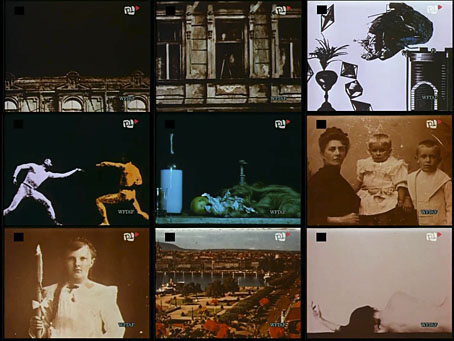
Having referred this week to individual animated films by Borowczyk and Lenica here’s their ten-minute collaboration from 1959. “Dom” means “house”, with the house in question providing a vague framing device for otherwise disconnected episodes, some of which repeat themselves. It’s more of a curio than anything, most interesting (again) for the moments that would be better explored by future directors. In addition to further collage animation there’s a short sequence which gives octopoid life to a human wig that’s very reminiscent of Jan Švankmajer. Watch the whole thing here.

Previously on { feuilleton }
Les Jeux des Anges by Walerian Borowczyk
Labirynt by Jan Lenica
Short films by Walerian Borowczyk

Les Jeux des Anges by Walerian Borowczyk

jeux1.jpg

Les Jeux des Anges.

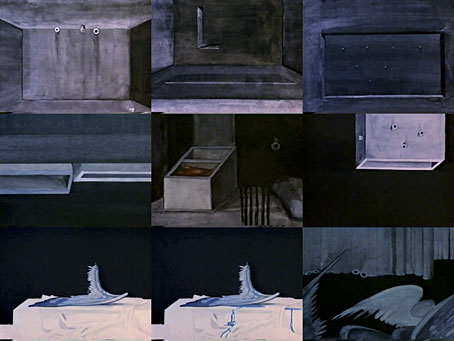
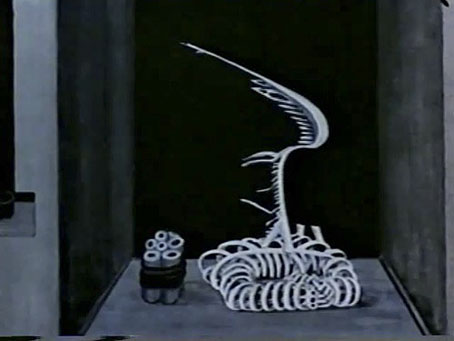
Following yesterday’s post, we can be certain that Terry Gilliam had seen Les Jeux des Anges (1964) because in 2001 he included it in a list of ten favourite animated films. Jan Lenica co-directed Dom (1959) with Walerian Borowczyk but doesn’t work on this film which is the darkest and strangest of all Borowczyk’s works I’ve seen to date. Once again there’s some unavoidable subtext, although whether that applies to the Holocaust or to Stalinist repression is for the viewer to decide. What we see is a series of painted tableaux in which various mechanical processes are butchering angels. The atmosphere isn’t far removed from the cruelties of Roland Topor while the painted scenes are very similar to those that David Lynch would be animating a couple of years later. The soundtrack is credited to electronic composer Bernard Parmegiani. Watch it for yourself here.

jeux2.jpg

Previously on { feuilleton }
Labirynt by Jan Lenica
Les Temps Morts by René Laloux
Short films by Walerian Borowczyk