Angels of Anarchy: Women Artists and Surrealism

fini.jpg

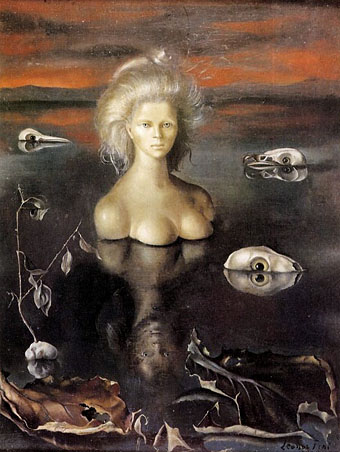
Le Bout du monde by Leonor Fini (1948).

Yes, I’ll definitely be going to see this one.

The first major exhibition of women artists and Surrealism to be held in Europe, Angels of Anarchy, opens this autumn at Manchester Art Gallery.

Featuring over 150 artworks by 32 women artists, the exhibition is a celebration of the crucial, but at the time not fully recognised, role that women artists have played within Surrealism. Paintings, prints, photographs, surreal objects and sculptures by well-known international artists including Frida Kahlo, Meret Oppenheim, Leonora Carrington and Lee Miller will be exhibited alongside works by artists less well-known in the UK, such as Emila Medková, Jane Graverol, Mimi Parent, Kay Sage and Francesca Woodman. Manchester Art Gallery is the only venue for this exhibition, making it a once-in-a-lifetime opportunity to see the works of so many significant women artists displayed together, with many of the works on loan from international public and private collections.

Angels of Anarchy runs from 26 September 2009–10 January 2010 at Manchester Art Gallery, and it’s a paying event with tickets at £6 (concessions £4, free entry for under 18s and Manchester Art Gallery Friends).

Elsewhere on { feuilleton }
The fantastic art archive

Previously on { feuilleton }
The art of Leonor Fini, 1907–1996
Surrealist women

Design as virus 11: Burne Hogarth

mighty_baby.jpg

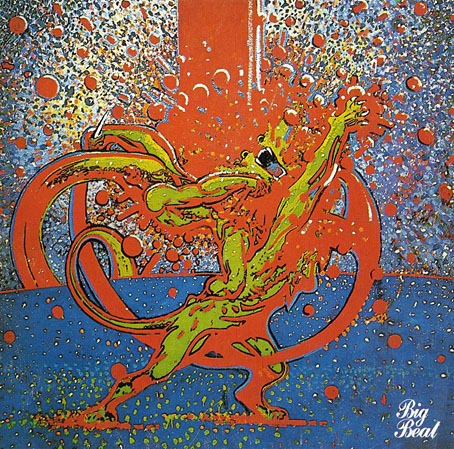
Mighty Baby (1969). Illustration by Martin Sharp.

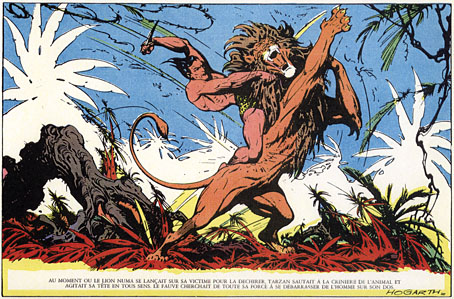
Yet another album cover prompts this post, part of an occasional series. Mighty Baby were a British rock band who formed out of psychedelic group The Action in the late Sixties, and their music is fairly typical of the period, being “heavy” without any of the psych trappings which—for me—often make everything from that time a lot more interesting. This was a journey undertaken by many groups at the end of that lurid decade, a junking of the playful and evocative side of what was now called rock music in favour of a denim-clad earnestness. This album isn’t one I like very much—I’d rather listen to their earlier incarnation—but the cover painting by psych artist Martin Sharp is certainly a startling piece, being a violent mutation of one of the most famous Tarzan drawings by comic artist Burne Hogarth.

hogarth.jpg

Tarzan by Burne Hogarth (194?).

Hogarth was drawing Tarzan for much of the 1940s and this particular panel showing the Ape-Man attacking Numa the lion dates from the latter part of his run on the series. I wish I could pin this to an actual year but I don’t have a complete set of the comics and that detail eluded me. If anyone knows the date, please leave a comment.

Continue reading “Design as virus 11: Burne Hogarth”

Echoes of the Cities

echo1.jpg

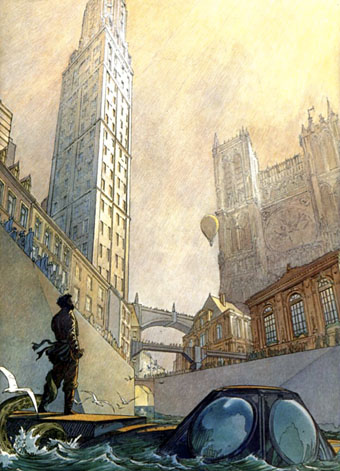
Mysterieux retour du Capitaine Nemo.

This week has been incredibly hectic work-wise but I’ve managed to keep these posts going, so here’s the last one devoted to an appreciation of the Cités Obscures of François Schuiten and Benoît Peeters. A week of posts barely scratches the surface of their vast and involved creation of alternate worlds, fantasy design and architecture, and Borges-like metaphysical speculation. When I try to explain my disaffection with the popular end of American comics, it’s works such as these which I offer as an alternative. The problem, of course, is that only a handful of the books have been translated into English, a detail which tells you all you need to know about English-speaking comics publishers and—since demand fuels the market—their readers.

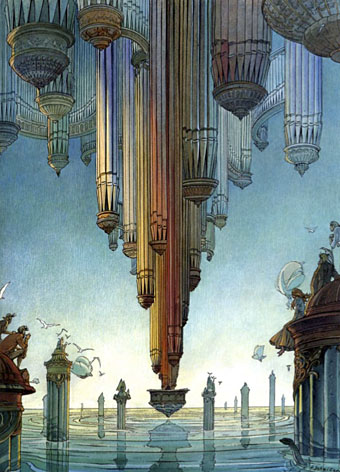
This final set of pictures is a selection from Schuiten and Peeters’ L’Echo des Cités (1993), a facsimile edition of the main newspaper which serves the cities of the Obscure World. Unfortunately, this remains untranslated but the bulk of the book is full-page illustrations, many of which are among Schuiten’s best. A number of these were later reprinted as limited lithograph prints.

echo2.jpg

Les rêves engloutis d’Oscar Frobelius.

Continue reading “Echoes of the Cities”

Further tales from the Obscure World

penchee1.jpg

L’enfant penchée.

We’re at the penultimate post in this week-long tribute to the Cités Obscures series of François Schuiten and Benoît Peeters, and there isn’t enough space left to cover some of the more recent volumes in detail. What follows is a quick skate through three more major works.

penchee2.jpg

L’enfant penchée.

L’enfant penchée (1996), or The Leaning Child, is an expanded version of a 1995 children’s story by Schuiten and Peeters, Mary la penchée. Mary is the young daughter of wealthy industrialists from Mylos struck down one day by some cosmic calamity which shifts her centre of gravity, causing her to permanently lean at an apparently impossible angle. When she’s bullied at school she runs away and joins a circus. A meeting with scientists and astronomers leads to a resolving of her affliction, and the repairing of her ruined life. This is a fascinating story for a number of reasons, not least the existence of a parallel narrative taking place in our world which is conveyed using photographs, and which unveils some of the metaphysical aspects of the Obscure World. The story of Mary is also flawlessly drawn. Schuiten uses a black-and-white style modelled on the work of old magazine illustrators like Franklin Booth, and there are further references to Winsor McCay and Jules Verne.

Continue reading “Further tales from the Obscure World”

La route d’Armilia by Schuiten & Peeters

armilia1.jpg

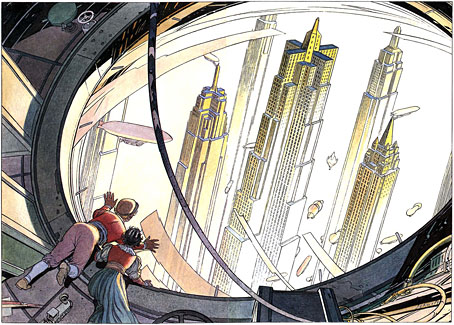
Ferdinand and Hella look down on the skyscrapers of Brüsel.

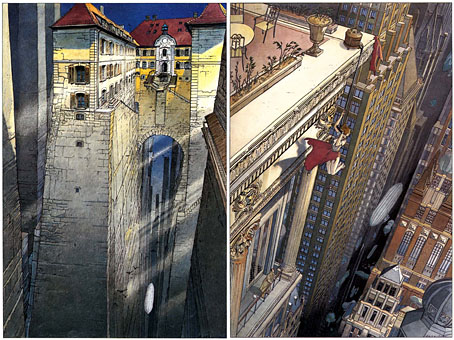
La route d’Armilia (1988) by François Schuiten and Benoît Peeters is the next substantial story in the Cités Obscures series after La Tour; there was also a book about transportation in the Obscure World, L’Encyclopédie des transports présents et à venir, published the same year. La route d’Armilia is the book where Schuiten and Peeters’ Jules Verne influence comes to the fore, with the story of a young boy whose name is derived from Verne characters, Ferdinand Robur Hatteras, undertaking an airship journey to Armilia at the Obscure World’s northern pole. As with the earlier L’archivist, this is mainly an excuse for Schuiten to demonstrate his prodigious architectural invention and draughtsmanship, although the story this time is more of a piece. The journey takes us from the city of Mylos—a dismal place of factories, chimneys and smoke, like one of the polluted cities of the early Industrial Revolution—over the cities of Porrentruy, Mukha, Brüsel, Bayreuth, Calvani, Genova and København. Each city is substantially different from the last, and one of the pleasures is seeing what the next stop along the way will be like.

armilia2.jpg

left: the airship passes through the canyon streets of Porrentruy; right: in Brüsel a woman hangs perilously from a ledge. Acrobatics or accident, we never discover which.

Continue reading “La route d’Armilia by Schuiten & Peeters”