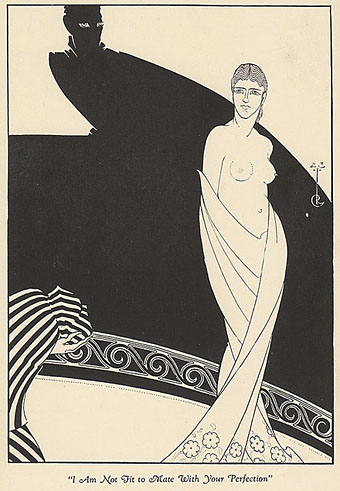
The art of Ray Frederick Coyle, 1885–1924

coyle1.jpg

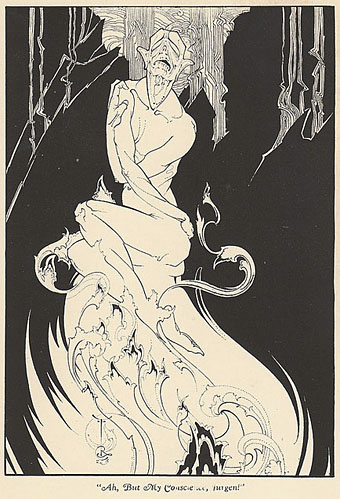
Another illustrator who died young, Ray Coyle’s short life no doubt explains why his work isn’t more visible today. The first two illustrations here are from a 1920s edition of Jurgen (1919), the scurrilous fantasy novel by James Branch Cabell which has been praised by enthusiasts of ironic comedy as diverse as Aleister Crowley and Michael Moorcock.
coyle2.jpg

Some of the illustrations in this Flickr set bear the date 1923 so they may have been Coyle’s last major work. Frank C Papé is the artist more commonly associated with Cabell, and while his art complements the author’s humour, Coyle’s elegant post-Beardsley style seems more suited to Jurgen’s worldly temperament.
coyle3.jpg

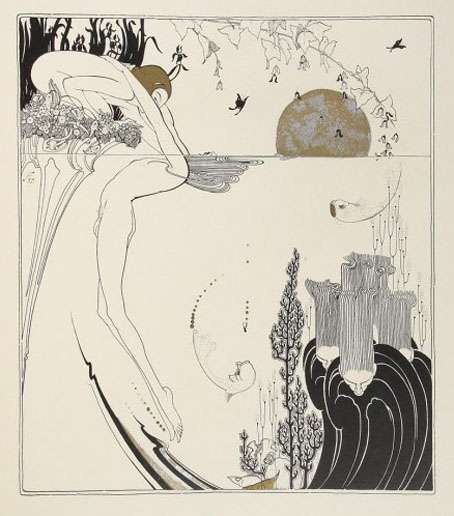
This beautiful drawing is one of six pieces from a memorial book, To Remember Ray Frederick Coyle, published in 1926. A stunning piece of art and this rebound edition has an equally stunning cover design by Jeannie Sack. If anyone has a link to other drawings in this series, please leave a comment.

Elsewhere on { feuilleton }
The illustrators archive

Previously on { feuilleton }
Fantazius Mallare and the Kingdom of Evil
The Thief of Bagdad

thief2.jpg

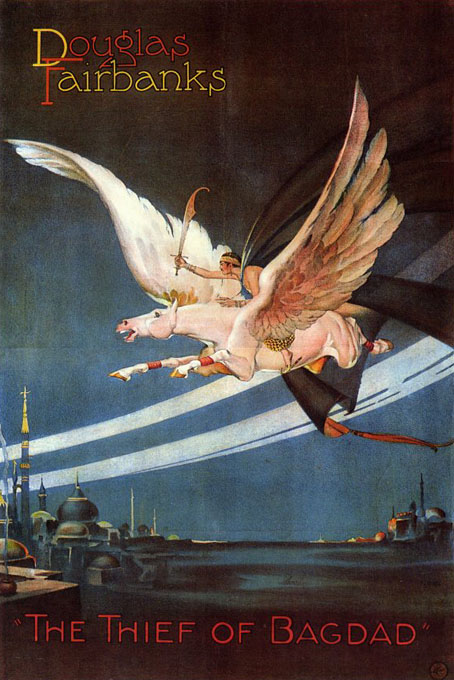
It’s the poster for the 1924 film version we’re concerning ourselves with here, not the more popular 1940 adaptation directed by Michael Powell. Both films are great but I have a special affection for Raoul Walsh’s silent version and this poster design has long been a favourite for the way it manages to condense the film’s blend of storybook graphics and Art Deco exotica. I’d wondered for years who was responsible for this design; according to various poster sites it’s the work of the film’s art director Anton Grot (1884–1974). This is one of several variations (there another here and one here) and there’s also a less interesting design which is far more typical of the period.

I often recommend the 1924 Thief of Bagdad as an introduction to silent cinema, especially if you can find a decent print. Fairbanks’ production had William Cameron Menzies as production designer and his sets are enormous Arabian Nights confections replete with minarets, onion domes and filigree screens like something from an Edmund Dulac illustration. Fairbanks gives a tremendously athletic performance and the marvellous Anna May Wong plays a Mongolian slave girl. There’s a lengthy description of the film’s production here while you can find a copy of the entire film at the Internet Archive although it really ought to be seen in a version which isn’t blighted by a company logo throughout.

Previously on { feuilleton }
More Arabian Nights
Edward William Lane’s Arabian Nights Entertainments
Alla Nazimova’s Salomé
Metropolis posters

Monsters in art

monstres1.jpg

Frontispiece for Goethe’s Faust (c. 1843) by Eugène Delacroix.

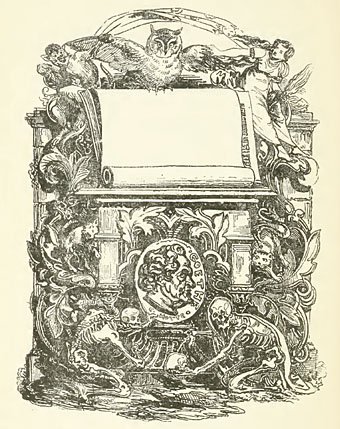
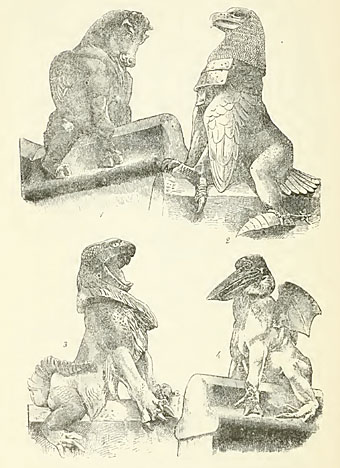
Or a couple of pages from Les monstres dans l’art; êtres humains et animaux bas-reliefs, rinceaux, fleurons, etc., a study of aesthetic teratogenesis by Edmond Valton from 1905. The Delacroix frontispiece gives a better view than the one at the Davison Art Center but they have more of the Faust lithographs. Emmanuel Frémiet’s animals were created to adorn the restored medieval Château de Pierrefonds for Napoleon III. The artist had smaller ceramic copies of the statues made later, of which the lizard is an improvement on the stone version.

monstres2.jpg

Fantastic animals (c. 1870) by Emmanuel Frémiet.

Previously on { feuilleton }
The House with Chimaeras
Frémiet’s Lizard

Liceti’s monsters

liceti1.jpg

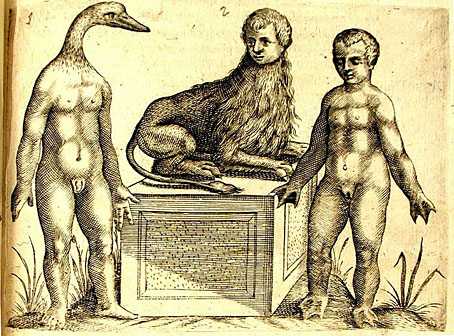
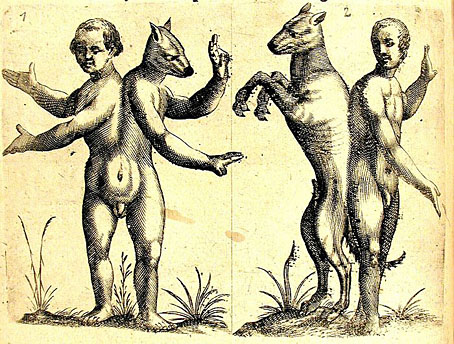
Illustrations from De monstrorum natura, caussis, et differentiis libri duo (On the nature, causes and differences of monsters, 1616) by Italian scientist Fortunio Liceti who we’re told has a crater on the Moon named after him. Further images from Liceti and his contemporaries can be found at Les Monstres de la Renaissance à l’âge classique, an online exhibition of assorted teratisms, prodigies and abominations. Via Monsieur Peacay, no monster he.

liceti2.jpg

Elsewhere on { feuilleton }
The etching and engraving archive

Schloss Falkenstein

falkenstein.jpg

Proposal for Schloss Falkenstein (c. 1883).

A slight return to Ludwig II. Schloss Falkenstein would have been another beetling edifice in the manner of Schloss Neuschwanstein had it ever been built, and judging by this view it might have been even more grandiose. The painting is one of the proposals by stage designer Christian Jank whose plans had already been used for Neuschwanstein. Philippe Jullian makes some scathing remarks about the Gothic interior of the earlier castle but he may have had more patience for the Byzantine interiors planned for Falkenstein. I’m not sure how these would be reconciled with Jank’s exterior, however, the style being Gothic enough to satisfy Viollet-le-Duc. Ludwig’s untimely death in 1886 drew a line under his architectural schemes but Bavaria’s loss eventually became Walt Disney’s gain as Jank’s fantasias provided the inspiration for the castle in Sleeping Beauty (1959) and all of the Disney theme park castles. What Ludwig would have made of this we can only guess. I suspect he’d be entranced by the fantasy but appalled by the vulgarisation. He was an elitist, after all, and the castles were always for him alone, not hordes of T-shirted proles.

Previously on { feuilleton }
Schloss Linderhof
Schloss Neuschwanstein
Pite’s West End folly
Viollet-le-Duc