Karel Zeman

zeman.jpg

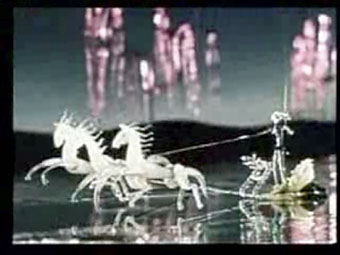
Inspiration (1949).

Karel Zemen (1910–1989) is a filmmaker I’m often telling people about but whose work isn’t easy to see, so it’s good to find that YouTube has gained some clips of his animations and examples of the partly-animated adventure films he made in the Fifties and Sixties. Zeman was yet another great Czech animator, and the YouTube collection includes his most celebrated short, Inspiration, which gives life to glass figurines, an unyielding medium that he moves as expressively as if it were clay or plasticine.
zeman2.jpg

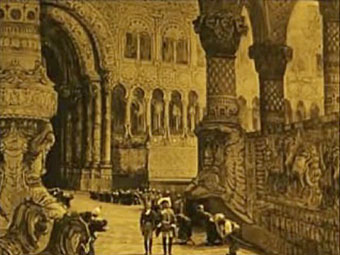
The Fabulous Baron Munchausen (1961).

The adventure films are predominantly based on Jules Verne and place live actors into animated settings, many of which are taken directly from (or intended to imitate) the engraved illustrations of the original novels. The animation enabled Zeman to fill his films with dirigibles, submarines and various steam contraptions which would be too expensive to create otherwise. Zeman’s The Fabulous Baron Munchausen took the Gustave Doré illustrations for its visual style which is something this particular Doré enthusiast appreciates, and the film is closer to the spirit of the Raspe novel than the Nazi adaptation of 1943 or Terry Gilliam’s later version. The results are a lot more artificial than the seamless blend of animation and live action attempted by Ray Harryhausen in his own Jules Verne film, Mysterious Island, but the artificiality gives the films a distinctive charm.

A Deadly Invention aka The Fabulous World of Jules Verne (1958)
The Fabulous World of Jules Verne trailer (1958)
Excerpts from Baron Munchausen (1961)
The Special Effects of Karel Zeman pt. I | pt. II

Previously on { feuilleton }
Zeppelin vs. Pterodactyls
Jan Švankmajer: The Complete Short Films
Taxandria, or Raoul Servais meets Paul Delvaux
Barta’s Golem
The Hetzel editions of Jules Verne

Cain’s son: the incarnations of Grendel

beowulf1.jpg

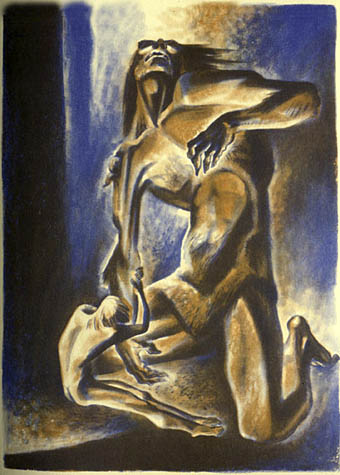
Beowulf wrestles with Grendel, Lynd Ward (1939).

There’s nothing new in pointing out Hollywood’s crimes against literature, the film business has been screwing up book adaptation since the earliest days of silent cinema. But sometimes the wound is so grievous you can’t help but speak out, in this case against Roger Avary’s Beowulf which is released next month. This is another CGI-heavy confection along the lines Polar Express, with the actors being given digital bodies via motion-capture, and it’s something I’d probably have ignored until I saw this picture of Grendel, the story’s principal monster. Beowulf is one of the earliest surviving Anglo-Saxon poems and Grendel, the bloodthirsty creature which Beowulf battles, is one of the ur-fiends of English literature, along with his equally monstrous, lake-dwelling mother and the dragon which fatally wounds the hero. The trio give us a peek back into the dark imagination from a time before recorded history and Grendel especially has always had something raw and primal about its character. So when you see a beast with such a history portrayed as little more than a diseased muppet you wonder what’s going on. Are the creators inept? Ignorant? Were studio restrictions at work? How does an industry with the talent to give splendid life to the trolls and Balrog of Lord of the Rings, or Davy Jones and crew in Pirates of the Caribbean, screw up so badly?

Continue reading “Cain’s son: the incarnations of Grendel”

Custom creatures

brewer.jpg

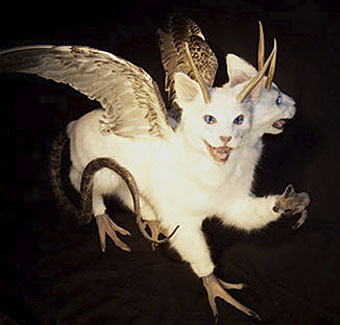
If Polly Morgan’s animal corpse art seems macabre, it looks positively mundane next to Serina Brewer’s creations. Her Custom Creatures include many multi-headed inventions like the cat thing shown here. She also does a fine line in carcass art, pickled pets and jewellery made from various extremities, should you be searching for those elusive alligator feet earrings.

Elsewhere on { feuilleton }
The fantastic art archive

Previously on { feuilleton }
Polly Morgan, fine art taxidermist
Cryptozoology
Insect Lab
The art of Jessica Joslin
The Museum of Fantastic Specimens

The art of Harold Hitchcock

hitchcock.jpg

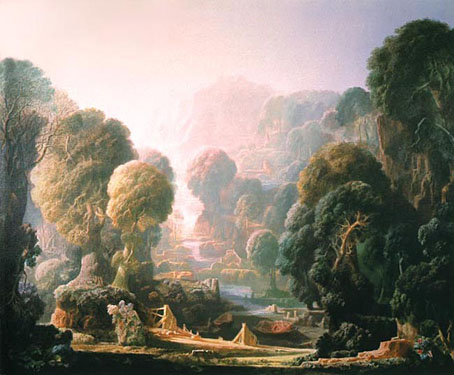
Sunrise in a Valley (1974).

It’s difficult to say whether the work of Harold Hitchcock (born 1914) is rarely seen in his native country because of those British art critics who’ve often regarded fantastic or sacred themes with suspicion—or whether it’s merely because people find his work to be bad. Sometimes the latter accusation appears to be a disguise for the former belief, especially among those who follow the pack rather than drawing their own conclusions. At times the English Channel has acted as an aesthetic as well as a physical barrier. British art never quite got to grips with Surrealism, despite the best efforts of Roland Penrose and others, while Symbolism was almost exclusively a Continental movement whose existence was largely expunged from later art histories; the 1959 Penguin Dictionary of Art and Artists, for instance, has entries for minor groupings such as the Hudson River School and the Nazarenes, but no entry at all for Symbolism. Fantasy was allowable in illustration but not elsewhere; no wonder Mervyn Peake took up writing.

So much for polemic. Hitchcock’s work comprises very detailed landscapes that present a Claude Lorraine-like approach to light with more Modernist forays reminiscent of Expressionist painters such as Franz Marc. His fanciful works remind me of his Surrealist contemporary Leonora Carrington, with their creation of a self-contained, often naive, private world. Hitchcock lives in South Devon and was still active three years ago when the BBC reported his 90th birthday. The American exhibition mentioned in that news story took place at the Phillips Gallery, Carmel, CA and their site has three pages of (rather blurred) examples of his luminous work.

Update: The official Harold Hitchcock site

Harold Hitchcock by Leonard Hitchcock
Catching the Light by Emmanuel Williams

Elsewhere on { feuilleton }
The fantastic art archive